
by Iain McIlwee | 17 Mar, 2023 | Main News Feed
The Competition and Markets Authority announced that they have launched a market study focused on housebuilding in England, Scotland and Wales. Alongside this, they have also launched a separate project on consumer rights in rented homes. The CMA’s market study into housebuilding will focus on four areas: Housing qualities, land management, local authority oversight, and innovation.
The CMA’s consumer enforcement work in housing will focus on: the end-to-end experience from a tenant’s perspective and identifying the consumer protection issues that may arise. The full announcement with further details can be found here.
FIS Members will note that all meetings start with a clear statement:
Members are reminded they agree to conform to FIS policy to comply with the Competition Act 1998. The meeting is convened and held in accordance with the Memorandum and Articles of Association of FIS and the regulations made by the Association. The Association has in place procedures to ensure compliance with all relevant competition laws and the meeting is subject to those procedures.
New guidance was published for all members through BuildUK in 2022 to help support compliance through your business.
You can download the latest guidance on complying with UK Competition Law here

by Clair Mooney | 17 Mar, 2023 | Skills
This week Awarding body NOCN has confirmed that the Installation of Fire Resistant Walls and Linings Qualification will now be available as a Vocational Qualification within the Interior Systems Installers family of qualifications.
This qualification was previously included in the Passive Fire Protection vocational qualification and following a review involving discussions with FIS members and the FIS Skills Board, the organisation has worked with the Association of Specialist Fire Protection and CITB (who are responsible for Occupational Standards in the Construction Industry) to instigate this restructure. The qualification is now an option within the interior system family of qualifications and can be endorsed on the CSCS card, thus helping those working in Dry Lining prove competence in the Installation of fire resistant walls and linings.
The Awarding organisation NOCN has committed to administering the qualification which will be available via NOCN accredited centres: https://trainingcentre-search.nocn.org/ later this year. When the qualification is fully available FIS Approved Training Providers will be advised and members should be able to acquire this qualification with an FIS member discount. In addition CITB will pay the vocational qualification achievement grant of £600 to organisations in scope for the construction industry levy.
Speaking about the these changes, FIS Skills and Training Lead, George Swann stated:
“We appreciate that the qualification landscape can be quite confusing and it is vital that we apply the logic of the way people work to the way that the qualifications are structured. As new competency requirements come in to force aligned to the Building Safety Act, this qualification option will support FIS Members in demonstrating competence in a more onerous compliance environment.”
For information on new competency requirements in the Building Regulations and implementing a Competency Management Plan, click here
by Iain McIlwee | 16 Mar, 2023 | Labour
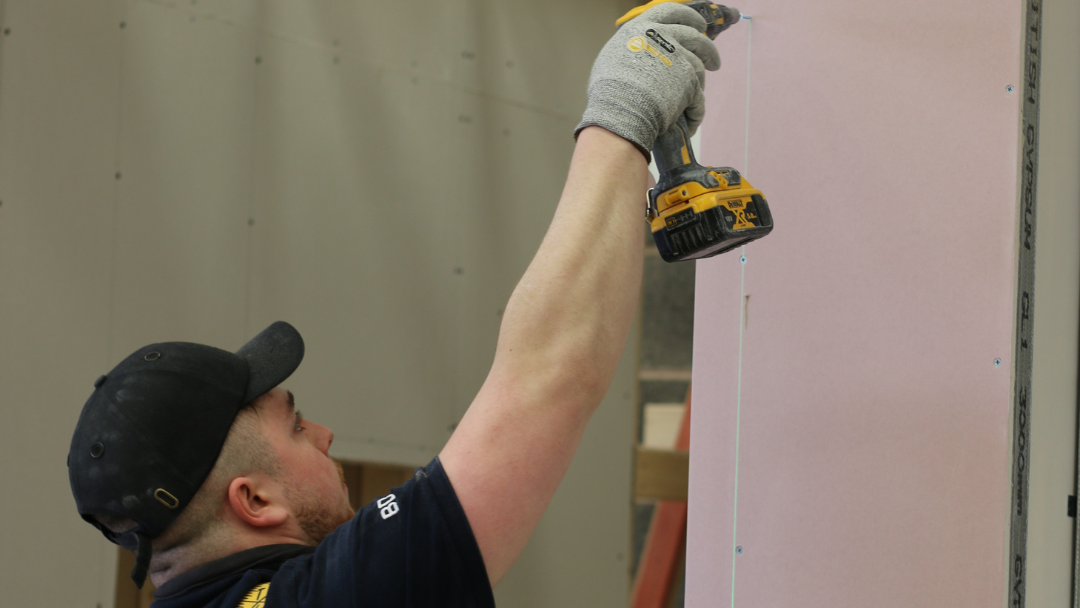
FIS welcomes the announcement in the Budget that the MAC has added a number of new construction trades to the Shortage Occupation List and opted to add Dry Lining to the list of occupations in the Skilled Worker List. This is significant as it potentially provides access to a controlled immigration process that will support the sector in managing any existing or upcoming shortages in our workforce. Other trades most relevant to the finishes and interiors sector now included on the Shortage Occupation List are plastering and carpentry and joinery (both of which were already on the Skilled Worker List).
In advance of starting the full SOL review, MAC were, in advance of the Budget expedited review of occupations in the construction and hospitality sectors, recommending the addition of eligible occupations to the SOL and RQF 1-2 occupations to the Skilled Worker (SW) route where appropriate.
To be eligible for the SOL, an occupation must fulfil the eligibility requirements of the SW route. A job must be classified into a Regulated Qualifications Framework (RQF) level 3-5 skill group or above and meet a minimum annual salary threshold. The Government has uprated these thresholds as part of the routine Spring package of Immigration Rules that were laid on 9 March 2023, following which (subject to Parliamentary approval) this minimum threshold will be £26,200. For this review, the Government have asked that we also consider currently ineligible RQF 1-2 occupations for possible inclusion on the SOL. However, the Government have made clear that such inclusion should be rare, and so the bar is high for such occupations to be added.
Table 5.3: Recommendations for occupations in construction
|
SOC |
Description |
Decision |
|
5311 |
Steel erectors |
Do not recommend for addition to the SOL |
|
5312 |
Bricklayers and masons |
Recommend for addition to the SOL |
|
5313 |
Roofers, roof tilers and slaters |
Recommend for addition to the SOL |
|
5315 |
Carpenters and joiners |
Recommend for addition to the SOL |
|
5319 |
Construction and building trades n.e.c. |
Recommend for addition to the SOL |
|
5321 |
Plasterers |
Recommend for addition to the SOL and recommend that ‘Dryliners’ but not ‘Ceiling fixers’ are moved to this SOC code |
|
8141 |
Scaffolders, stagers and riggers |
Do not recommend for addition to the SOL |
|
8142 |
Road construction operatives |
Do not recommend for addition to the SOL |
|
8149 |
Construction operatives n.e.c. |
Do not recommend for addition to the SOL Recommend that ‘Dryliners’ but not ‘Ceiling fixers’ are moved from this SOC code to SOC code 5321 (Plasterers) |
|
8229 |
Mobile machine drivers and operatives n.e.c. |
Do not recommend for addition to the SOL |
|
9120 |
Elementary construction occupations |
Do not recommend for addition to the SOL |
By moving Dry Lining into the Standard Occupation Classification area 5321 (as per FIS recommendation and lobbying work on the SOC), Dry Lining is now also shares skilled worker status with Plastering for the purposes of being a Skilled Worker.
Commenting on the changes, FIS CEO Iain McIlwee stated:
“It is a relief to finally see Dry Lining recognised as both a skilled occupation and also the shortages that we face as a sector. This is something FIS have been campaigning on for a number of years and I am grateful to colleagues from across the Construction Leadership Council for their efforts in helping to effect this exceptional change and thankful that we now have some movement. We now need to respond to the detailed review taking place to identify other areas of concern and revisit the sponsor and visa process to better understand any further blockers and issues”.

by Clair Mooney | 16 Mar, 2023 | Main News Feed
With his 4 E’s and a Growth Agenda, there was some welcome news in the Budget, not least that the UK is unlikely to enter recession this year. It is also great to finally see key trades in our sector, such as Plastering, Drylining and Carpentry and Joinery finally getting recognised as Shortage Occupations (we have been round the houses on this for the best part of three years now!). The support for investment, ongoing energy support and fuel duty announcements are also welcome, but the hard landing of Help to Buy is, perhaps, a little short sighted as it will almost certainly keep the brakes on for much needed building of homes. It will be interesting to see how much activity the investment zones generate and support investment in property across the UK.
As ever, Prof Noble Francis of the CPA has done an amazing job in summarising the key points for FIS Members. Members can access this here.
by Clair Mooney | 16 Mar, 2023 | Main News Feed
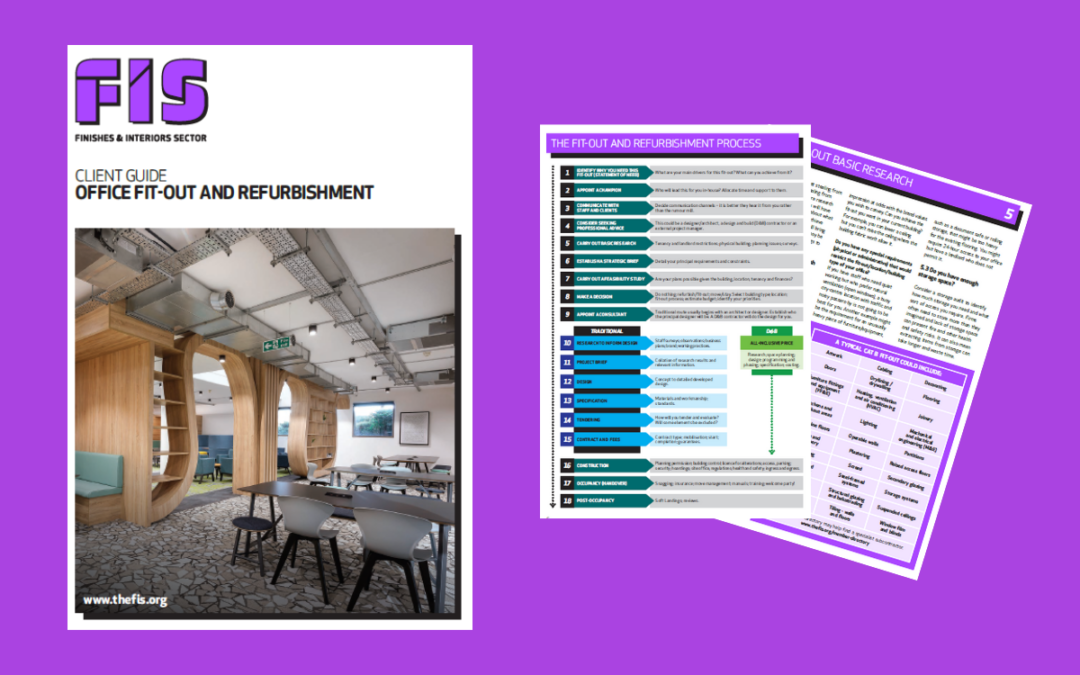
FIS has launched a revised Client Guide to Office Fit-Out and Refurbishment to promote best practice in the fit-out process and to take account of new working practices post-pandemic, the Building Safety Act and advances in sustainability.
First published in 2017, this updated guide is aimed at clients, contractors and architects involved in fit-out projects in a changing world. For clients, creating or adapting an office fit-out that can suit businesses in an environment where hybrid working has become the norm can prove daunting. The publication will guide them through the process from the initial decision as to whether to refurbiush an existing office or relocate and fit-out new premises, through to post-occupancy evaluation. It explains step-by-step the process, along with outlining the professional help available to help ensure a successful outcome.
The revised guide reflects the driving forces behind changes to office space design. In the first instance, it considers the responsibilities of a client and other implications of the Building Safety Act such as the interaction with ‘higher risk buildings’ (as defined in the legislation), and how to consider the impact in the early stages of planning a fit-out. It also reflects the evolution and rapid maturation of best practices and methods of measurement relating to sustainability.
Furthermore, the guide will take account of the digitisation of construction information combined with the increasing adoption of video conferencing technology and other post pandemic implications to ways of working that can mean significant changes to the way offices are designed.
Commenting on the launch of the this updated guide, FIS CEO Iain McIlwee said:
“The guide to office fit-out and refurbishment was developed in 2017 by FIS but since then we have seen many changes in the market including the passing of the Building Safety Act which places new emphasis on safety and digitisation of construction data to fulfil the golden thread of information.
“The updated and revised guide will consider these significant changes whilst at the same time assist clients with the task of fitting out or refurbishing their offices and to promote best practice in the fit-out process.”
The guide is freely available from the FIS website at https://www.thefis.org/membership-hub/publications/client-guide-to-fit-out/

by Iain McIlwee | 14 Mar, 2023 | Labour, Main News Feed
The Construction Leadership Council has published its report of shortage occupations in construction and its updated guidance to help construction businesses access the Points Based Immigration System.
In February 2023, the CLC submitted stakeholder evidence to the Migration Advisory Committee (MAC), detailing shortage occupations that could be considered for inclusion on the Shortage Occupation List of the UK’s Points Based Immigration System, as well as potential roles to be added to the Skilled Worker route.
The CLC’s Movement of People Working Group compiled a comprehensive report, detailing its recommendations, an evidence base, the actions industry is taking to increase the domestic workforce as well as other ideas to help tackle skills shortages.
The CLC recommended the following occupations for inclusion on the Shortage Occupation List:
- Plasterers, Dry Liners and Ceiling Fixers
- Carpenters and Joiners
- General Labourers
- Bricklayers and Masons
- Ground Workers
- Piling Rig Operatives
- Plant Operatives
- Retrofit Co-ordinators
- Road Construction Operatives
- Roofers, Roof Tilers and Slaters
- Scaffolders, Stagers and Riggers
- Steel Erectors
- Thermal Insulators
The MAC is expected to report on construction shortages in due course.
Commenting, Co-Chair of the CLC and Group Chairman and CEO of MACE, Mark Reynolds said:
“The CLC is committed to building our domestic construction workforce and championing construction as one of the best career choices for new entrants but the fact is we are still currently facing chronic shortages. A dynamic immigration system allows us to bridge gaps in workforce need and meet the people requirement for the sector’s pipeline of work. That’s why we are calling for the inclusion of these occupations in the shortage occupation list, to help make it a little easier to access the right people, at the right time’.
FIS CEO, Iain McIlwee added:
“Data from our recent Skills Pulse Survey underpins that 40% of businesses are still experiencing shortages in skilled labour and this is likely to worsen as volumes pick up constraining potential growth. The training sector is rapidly scaling up, but doesn’t provide a quick fix. We are grateful to colleagues from across the construction sector for pulling together and pooling our resources to help make this detailed submission to Government and the MAC and focussing on how we can add a bit of flexibility to the system”.
Access the full report here.
Access the CLC’s revised 2023 Immigration Guidance ‘Movement of People – What you should know’ here.

by Clair Mooney | 10 Mar, 2023 | Main News Feed

by Clair Mooney | 9 Mar, 2023 | Drylining, Technical
FIS has today launched two new expert guides; a Pre-construction Guide for Drylining and a Construction Site Guide for Drylining. They are an invaluable resource for the industry and aim to reduce risk, ensure compliance and guarantee that projects are delivered on time, and to budget.
The guides have been produced off the back of concerning results gathered from an FIS Survey into Challenges in the Drylining sector. The survey found that amongst its member base, 97% of organisations had been asked to commence construction without having sufficient information to accurately detail the installation of the work. Wider discussions had resulted in a number of concerns being raised linked to a lack of standardisation in design detailing required. To start to address this, the FIS Drylining Working Group, which is comprised of manufacturers, designers and contractors working in the drylining sector, produced the guides to continue the provision of information and guidance to the point of installation.
The Pre-construction Guide for Drylining has been pulled together from decades of experience and focuses on the lead-up to commencing installation works. It highlights how to check bids and tenders for compliance, understand time requirements and site conditions, and ensure the design information is sufficient and fit for purpose.
The Site Guide for Drylining provides expert knowledge on preparatory work, sequencing, the checking of design information, how to recognise common issues and address them, and also how to perform quality checks to ensure building compliance.
Commenting on the guides, Iain McIlwee, FIS Chief Executive said:
“Drylining systems form firewalls, fire escape routes and provide passive internal fire protection so it is incredibly important to get it right at all stages of installation and this has to start far earlier and long before boots hit the ground. Our new guides allow professionals to reduce risks, support compliance and most importantly of all encourage responsible planning.”
The guide sits alongside other FIS best practice guides that relate to drylining:
The guides utilise the information, knowledge and good practice employed by its members and deliver a valuable resource for improving works package delivery, enhancing quality and aiding projects to be finished on time, safely and within budget.
FIS members can download both the Pre-construction Guide for Drylining and the Site Guide for Drylining at https://www.thefis.org/membership-hub/publications/site-guides/

by Clair Mooney | 9 Mar, 2023 | Main News Feed
The Construction Industry Joint Council (CIJC) has issued a a revised Promulgation Notice to reflect the increases in the National Living Wage and National Minimum Wage which will come into effect on 1 April. The General Operative rate is the only one directly impacted by the changes and has increased to £10.42 per hour.