Vital work to improve payment in construction – we need your help

Vital work to improve payment in construction – we need your help

In March FIS attended a round table with CLC and Government officials to look into payment practices, retention and support available through regulation via the Duty to Report.  I think there is a desire from Government to beef things up a bit to support SMEs, but we need to ensure that they see votes in change and that small businesses feel strongly about it – so to get change over the line we need your help.  We will, but we also need you to respond to the consultation.

What is the  aim in all this?

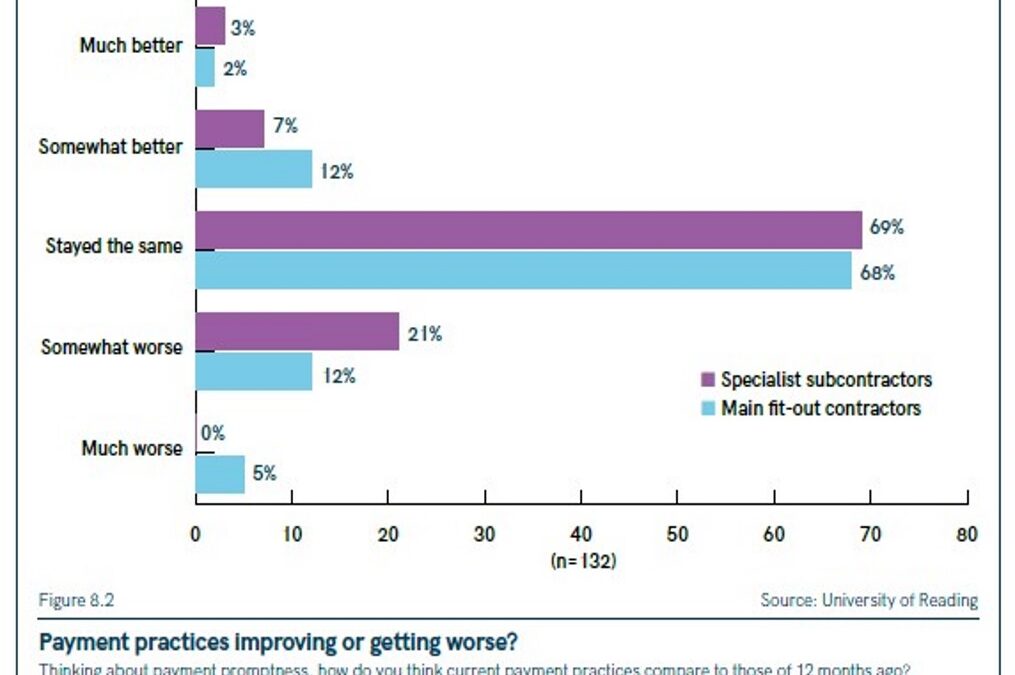
Recent headlines that payment practices in construction are improving are, at best, misleading.  Our own research with the University of Reading (shown in the chart at the top of this page) tells us that, for most in our sector, it is no better and, for nearly a quarter of specialists, it is worsening.  The improvement headlines ring particularly hollow when we see the human impact of poor practice and you know and care for the people that our QS helpine has been working with – it is not just cashflow and the cost of money that concerns us, the stress and human toil of poor payment is literally sickening.

Where the market fails to correct we need regulation to drive better behaviour.  Effective Regulation needs three things, a clear and proportionate set of rules and scope, an mechanism to measure and impactful enforcement.

Why does official data suggest it is getting better, but I am not seeing any (positive) change?

The old addage… lies, damned lies and statistics comes to play here.  The headlines are based on information extracted from the Duty to Report.  The concept of the Duty to Report is it exposes payment practices – it compells larger businesses (those that satisfy two of the following £36 million in turnover, £18 million on its balance sheet and 250 employees) to formally report on payment times against an agrreed criteria.  This means Government can make procurement decisions based on it, have a formal measure to support initiative like the Prompt Payment Code and equally SMEs can check theoretically check a company’s payment history (here) to help decide if you want to work with them. It is a good concept in that it highlights a problem, but the issue is that it is poorly delivered.

The underlying problem is that companies only report on volume of invoices, not value.  Ten tiny invoices (for e.g. stationary) can drown out one huge invoice for construction.  She system can be gamed by selecting what invoices to pay early to mask that you are paying the big ones late.  Thus you can still continue to use the supply chain as a free line of credit and still look good on paper!

The other big issue for construction is that it measures invoice payment, but in the complex world of applications, valuations, pay less notices and certification the invoice is not .  The guidance is actually fairly cut and dry:

  1. For construction contracts in scope of the Housing Grants, Construction and Regeneration Act 1996 or the Construction Contracts (Northern Ireland) Order 1996, businesses must use the earliest point at which they have notice of an amount for payment.
  2. This would generally be the date they receive an application for payment or, in cases where there is no application for payment, the date on which they receive a payment notice (or default payment notice) or on which they issue a payment notice – whichever is earliest. Day 1 of the time taken to pay will be the day after the day on which the business has this notice.

but, guidance is not regulation and frankly there are no meaningful checks and balances on how people are reporting.  In fact in our digging, it was identified that there have been only 18 investigations and no prosecutions.  Without proper checks and balances and strong enforcement, regulation is about as useful as a chocolate teapot!

Aren’t we supposed to be getting rid of retention by 2025?

The CLC roadmap to zero retentions does say that they should be phased out no later than 2025, but like so many ‘Roadmaps’ we seem to have lost the road!! I remain concerned that retention debate often gets derailed by trying to solve two problems at once.  For me there are two distinct parts to this debate:

1.  the underlying concept of retention – how we work, as a sector, manage trust and quality with clients to evolve away from retention and ultimately how our Standard form Contracts support this evolution.

2.  how they are fairly and consistently deployed within the supply chain – a key conclusion from our research is that they aren’t and the further down the supply chain, the less likely you are to actually get your retention.
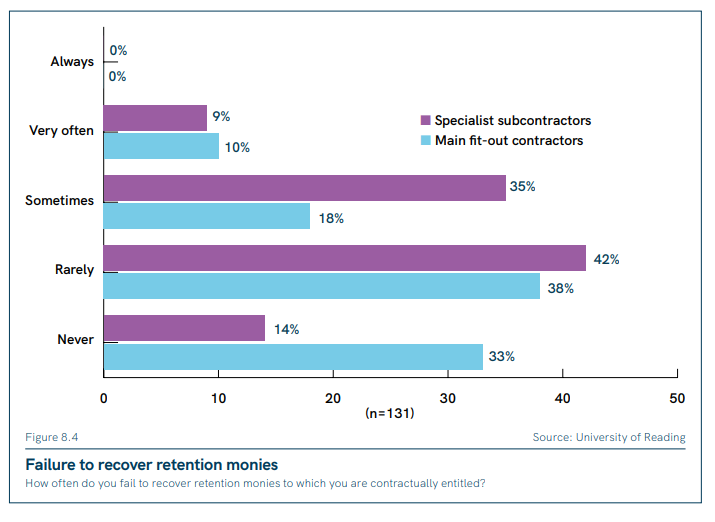
I know it is more nuanced than that in terms of why and whether people have claimed, but for whatever reason the retention isn’t cascading smoothly (certainly not automatically).  If you think of certain parts of our market, the low margin means that the tier one is making around 3% profit on average – the value of retention effectively sit at their approximate profit.  Whilst there is a cash concern that more might be held against than they hold, the motivation for the less scrupulous in the supply chain, the difference between the 33% of main contractors and 14% of specialists always securing retention is about 19% of profit.  For this reason FIS can continue to advocate for the ultimate abolition of retention, but in the interim, to ensure that retentions are protected and AUTOMATICALLY RELEASED based on a defined date (rather than abstract event).

So what do we need you to do?

The purpose of this post is not to rant about things we all know, but to emphasise that FIS reserach is helping to inform a debate which is happening and there does now seem geniune interest from Government in addressing  some of these issues and  appreciation that continued nefarious practices in construction undermine the cultural changes that they want to see.  This is where you come in…

Full details of the Payment Practices and Performance Regulations 2017 consultation here

You can respond via the webiste or by copying and adapting (where you feel necessary) below in an email to the consultation questions to responsiblepaymentculture@beis.gov.uk (by 11.45pm 28th April 2023).

We have with colleagues representing specialists set down a template response that you can be downloaded below, but remember this is your response so do feel free to edit/ammend and add any personal comments or experience to help support understanding and change.

You can download the FIS template response here

Please do send us your response so we can factor in any additional points to the core FIS input on this.  Thanks for your support – together we are stronger.

Iain McIlwee
CEO, Finishes and Interiors Sector

PS  Through this process we are always looking for feedback on our Procurement Research recently completed with the University of Reading that may help you with your response.

PPS For support in managing your contractual responsibility, including the new Best Practice Guide that FIS has helped develop with the CICV in Scotland  and standard Terms and Conditions launched in 2023.
 

Key takeaways from the first Building Safety Conference

Key takeaways from the first Building Safety Conference

With colleagues from across the sector, FIS Chief Executive Iain McIlwee attended the first Building Safety Conference  hosted last week by the Building Safety Regulator (and shared his reflections here).

This week we hear from colleagues at Build UK (of whom FIS is an active member) who have provided a summary of 10 lessons learnt which answers a number of the queries raised during Build UK member meetings. 

Building Safety Conference – 10 Things We Learnt

  1. The Building Safety Regulator becomes operational on 1 April 2023.
  2. The new Building Safety Regime will apply to all buildings – “from Shed to Shard” in the words of the Building Safety Regulator.
  3. The terms ‘High-Rise Building’ and ‘High-Rise Residential Building’ are being used interchangeably with ‘Higher-Risk Building’, and the Building Safety Regulator has committed to work with Build UK to ensure consistent terminology is used across the industry.
  4. Existing Higher-Risk Buildings (with the exception of hospitals and care homes unless they have at least two permanent residential units) must be registered with the Building Safety Regulator by 1 October 2023. This includes those that will be occupied for the first time during the transition period between 6 April and 1 October 2023. From 1 October 2023, new Higher-Risk Buildings must be registered before they can be occupied.
  5. The building registration process will be a multiple-choice tick box format and require a completion certification for each building. The fee for registering each building will be £251.
  6. It is anticipated that those who fulfil the roles of Principal Designer and Principal Contractor under CDM will also fulfil these dutyholder roles under the Building Safety Act.
  7. The Building Safety Regulator will become the Building Control Authority for all Higher-Risk Buildings from 1 October 2023. Work can continue under an existing Building Control Body where a building/initial notice has been submitted or plans deposited by 1 October 2023 and work has commenced by 1 April 2024.
  8. Gateway Two, which requires Building Control Approval by the Building Safety Regulator before construction work can begin, and Gateway Three, which is when a completion certificate is issued by the Building Safety Regulator, are expected to come into force on 1 October 2023.
  9. The Building Safety Regulator will not be specifying the format for the Golden Thread of information, which is the digital record of what has been built to enable those responsible for Higher-Risk Buildings to manage and maintain them safely.
  10. The Industry Safety Steering Group (ISSG), chaired by Dame Judith Hackitt, will shortly be issuing its fourth report with an update on progress made by the industry.

BuildUK have developed an excellent simple introduction to the Building Safety Act which FIS Members can download for free here.

People, numbers, possibilities and the future

People, numbers, possibilities and the future

Having interrogated the CITB Construction Skills Network data it’s estimated 266,000 people are employed in the construction occupations of the finishes and interiors sector.  To sustain this there’s an Annual Recruitment Requirement of approximately 6052 people per year to 2027.  As there are approximately 10,000 organisations working in the sector that’s 1.65 people per organisation, or if every FIS member took on one new entrant per year that would meet one tenth of the estimated requirement.  The recent FIS Skills Pulse Survey shows 45.5% of respondents are currently experiencing labour shortages and do not feel there will be any improvement in recruitment for the next 12 months.

It’s certainly no longer feasible to think other bigger organisations with more resource will train enough people to go round.  People poaching, the act of tempting or accepting newly qualified individuals away from the organisation that supported the training for a pound or so more, is rife within the finishes and interiors sector.  Evidence shows people poaching contributes to a decline in the quality of workmanship as these individuals although qualified often do have the full range of experience needed by the sector and without the ‘safety net’ of the people who trained, coached and mentored them mistakes are inevitable.

Apprenticeships are the employers preferred training and qualification option for new entrants.  As an indication here are the figures for two occupations in the sector 2022 to 2023, due to the duration of the training programmes successful achievements are not shown:

Nation Route Registration Numbers
England Interior Systems Installer 220
Plasterer 900
Scotland Interior Systems 81
Plastering 65
Wales Interior Systems 28
Plastering 121
  Total 1415

This is approximately 80% of the estimated Annual Recruitment Rate for these two occupations reinforcing the drive needed by employers to ensure there will be enough competent people to complete work coming up through to 2027.  If you have never taken on a apprentice there is a raft of free support available from recruitment to funding and the rewards for an organisation can be unlimited.  To help decision making have a read of the FIS Apprentice – Guidance for Employers available to download here You will likely be surprised at the options and what is there, free of charge, to help employers.

The current business environment is making it more challenging to invest in the training and qualifications needed to ensure a future workforce for the sector, but if organisations don’t step up now what is it going to be like in the years ahead.  Everyone knows investing in training can bring competitive advantages, helping businesses to retain and attract more workers and to ensure they have an upskilled workforce to win new work is a focus for FIS.  With increased legislative demands for proof of competence at every occupational level the FIS Sector Guide to Competency Management Plans: https://www.thefis.org/skills-hub/competency/ can help organisations avoid falling foul of the law.

If you are still undecided and would like to talk through taking on a new entrant, general recruitment or upskilling your workforce give FIS a call on 0121 707 0077.

Fire safety awareness in construction and the built environment

Fire safety awareness in construction and the built environment

To help improve standards, CITB in consultation with the industry, has been developing two new online fire safety courses to help improve awareness of fire safety in the workplace.  Specifically developed for people working in the construction industry the course aim to provide detailed information on how to keep safe at work.

Fire Safety Awareness in Construction and the Built Environment – is available now as a FREE eCourse:

  • Suitable for workers of all levels and occupations
  • Basic fire safety awareness in construction and the built environment

You can find out more here.

Fire Safety in Buildings – available in the summer:

  • Course created in collaboration with Working Group 2 and Build UK and FIS
  • Higher level than first course, providing industry a greater level of knowledge of fire safety in buildings, following the construction stage
  • Focuses on key topics such as how legislation and regulations have changed since the Grenfell tragedy
Building Products Performance Part 2 is now available

Building Products Performance Part 2 is now available

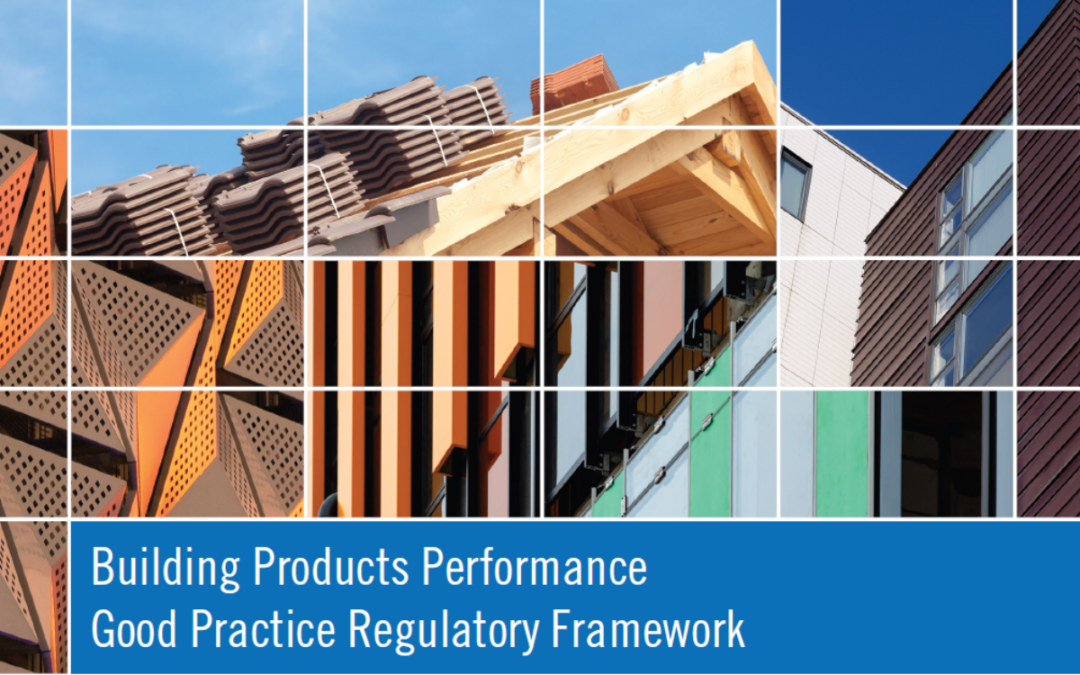
The Building Product Performance Part 2 – Good Practice Regulatory Framework paper is now available.  Developed by an International Building Quality Centre (IBQC) working group, this report incorporates elements from the Building Product Performance Part 1 – Discussion Paper as well as the Feedback Paper that summarised the comments and feedback on the Discussion Paper.

Building Products Performance Good Practice Regulatory Framework

Applications for the Code for Construction Products Information

Applications for the Code for Construction Products Information

At the heart of our industry’s efforts to demonstrate a change in culture and practices is the Code for Construction Product Information.  The Code was developed by the CPA and its members to help make product information clear, accurate, up-to-date, accessible and unambiguous. It will mark a step change for the industry by driving higher standards in construction product information management systems and assessing ethical leadership and culture standards.  It also makes strong business sense as well, providing third-party verification and increased assurance to clients, customers, and insurers.  Information about the Code – including FAQs, Practical Tips to Prepare, and the business case for your organisation – can be found on the CPA website here. Webinars are planned on the following dates:

If you have any questions prior to the webinar, please see the FAQs on the Code website: FAQ – Code for Construction Product Information or contact Rachel Philpott on enquiries@cpicode.org.uk


Building Safety Regulator Conference: What did we learn

Building Safety Regulator Conference: What did we learn

FIS CEO Iain McIlwee reports on the Building Safety Regulators Conference held on Wednesday 22 March.

This Wednesday I attended a full day conference organised by the Building Safety Regulator, along with around a thousand people from across construction and property management.  There was a lot to digest, but the key point is that, whilst there is still much to be done, they are sticking to the original implementation timeline.  The Regulator becomes fully active next month with the Registration of occupied High-Risk Buildings becoming mandatory.  This is significant as it brings greater and clearer responsibility on individuals to ensue that a building is safe and there is a plan in place to keep it that way and it reminds us all that people are at the heart of building safety.

The next key point and they finished with this to emphasise, is that The Building Safety Act is not just about high-risk buildings.  For these there is an enhanced oversight system being put in place by way of Gateways.  For all other buildings, the key recommendations set down in the consultation will be carried through in secondary regulation – still a bit of parliamentary scrutiny required, so not set in stone, but basically the alignment of Building Safety with the existing CDM requirements is critical.  These changes are focussed on cultural change in and tighter controls for construction.  The phrase used was from Shed to Shard

What does it mean if you are working on High Risk Buildings?

Get your head around Gateways.  If working on High Risk Buildings, familiarise yourself with the additional information requirements at Gateway 2 (i.e. how are you going to convince the Regulator that you have a workable design and effective delivery/information management plan) and Gateway 3 (prove that you stuck to and built it as per the plan).  Photographic evidence will be key – the regulator will want reassurance that the stuff they can’t see was done right – controls and procedures are in place to manage the process, competence and communication.  Any changes on the fly will need to be documented, and in many cases, approved by the regulator before progressing.  The Regulator will want to see buildability considered to limit the need for change on site.

Buildings will be required to go through these Gateways from October.  A cautionary tale was that 50% of Buildings did not meet Gateway 1 (Planning and Fire Plan) requirements.  The Regulator is primarily interested in fire and structure, but we were repeatedly reminded that meeting all of the Building Regulations is a requirement.  They expect the process to be dynamic between the Gateways to minimise any hold ups, but these are hold points, hard stops.

The key to making it through the Gateways is evidence, evidence, evidence.  A number of the discussions centred on what Stage (according to the Plan of Works) the design is expected to be at before you can proceed through Gateway 2.  In one of the presentations it was confirmed that design should be completed to Stage 4 (Technical Design) before you can go through the Gateway and Stage 5 (Construction) can begin.  There was mention of the series of gateways, but my impression was that whilst the regulations do make allowances for exceptions, exceptions should be that.   To emphasise this the impact of design changes on weight was used as an example.  If you don’t know how you are building it, how can you fully understand and detail the loadings?

Will it really have much impact on the wider building sector?

Emphatically Yes – in fact this was a big part of the summing up.  Effectively this is not a change to the Building Regulations, but a massive change to the regime and processes expected to evidence compliance.  Building Control is being subjected to wholesale change, a much more robust competency regime with greater emphasis on process.  Greater granularity is to be expected – their focus will be on competence, control and evidence.  We can expect more testing questions as Approved Inspectors become Registered Building Control Inspectors and are subjected to more independent scrutiny and tighter controls.  The process will be very much aligned to the existing CDM Regulations and “as built”.  Within this, the statutory duty holder roles will apply to all projects.  The Principal Designer (PD) role got a fair bit of attention and it was clearly news to some that this statutory role relates to all projects – significantly the PD will be accountable and need to provide confirmation that the requirements of the building regulations have been met.

There are still a few things to iron out, one issue discussed was whether CDM and Building Safety could be separated and administered by two PD’s (in theory yes, but the intent seems to be that one PD should be the norm).  Another question asked was whether this would mark the end of D&B.  It doesn’t, the regulation are being written to allow, but it should be the death knoll for design and dump – with the PD and Designer Roles so closely regulated I simply can’t see how scope of design can be limited in the way we often see it now.

The key for Contractors is to ensure they can demonstrate competence – that is confidence that individuals have the skills, knowledge, experience and behaviours necessary and organisational capability (management policies, procedures, systems and resources) to meet the requirements of the building regulations.

Other key takeaways

It was encouraging to hear the FIS work in helping to establish the Passive Fire Knowledge Group recognised in one of the panel discussions as a good example of taking responsibility and trying to align the supply chain to confront issues before we get to them.  It was also good to hear the work we have done on developing competency frameworks acknowledged and the whole super system concept that we have been focussed on getting a mention with the finishes and interiors talked about in this context.

From the perspective of the new building control procedures, all of this will come at a cost – the term “cost recoverable” was used to describe the work of the regulator.  If you are planning jobs for the future, do have a think about the additional costs in terms of compliance and potential fees.  Significantly if you are working on High Risk Buildings, double check contracts for causes of delay too.

The final and heavily reinforced message was don’t wait, start making changes.  The words “ongoing”, “transition”, “looking into that” and “in progress” were all used and there is a realisation that there is still much to be done.  All the detail isn’t yet in hand, but this will come in the secondary regulation over the coming months (it will be subject to Parlimentary scrutiny which may change and possibly delay aspects), but Regulator is scaling up and the direction of travel set down in the consultation in October doesn’t seem to have been diverted far so it is time to get cracking!

Useful Links to help you start preparing:

  1. FIS Summary of response to the October consultation of reforms to the Building Regulations
  2. FIS Guide to Developing a Competency Management Plan
  3. BuildUK Guide to the Building Safety Act (Available to FIS Members Only)
  4. Start looking at your quality management procedures – FIS PPP Quality Risk Management Toolkit
CITB announces changes to the Grant Scheme from 1 April 2023

CITB announces changes to the Grant Scheme from 1 April 2023

CITB’s latest Construction Skills Network report highlights that 224,900 workers will be required over the next five years to meet the demands of the construction industry. To help employers tackle the skills shortage of workers across the industry, and to address rising costs, CITB has made changes to its grants from April 2023.

The CITB Grants Scheme is available to all CITB-registered employers and provides financial support for employers who offer construction-specific training to their workforce. Below is an overview of the changes:

  • Grant rates doubled for short courses. Employers can now receive up to £240 grant when an individual successfully completes a short course from 1st April 2023.
  • Grant rates have been increased to support individuals impacted by the withdrawal of the Industry Accreditation card. Grant rates for specific supervision and management qualifications have increased to £1,250 and £1,500 for achievements from 1st April 2023.
  • The grant application deadline has been extended to 52 weeks for all grant types.

You can find out more information on the CITB website at www.citb.co.uk/levy-grants-and-funding/grants-and-funding/what-s-new-in-the-grants-scheme


FIS Responds to Consultation on Omitting National Standards from ADB

FIS Responds to Consultation on Omitting National Standards from ADB

FIS has today responded to the the Department for Levelling Up Housing and Communities (DLUHC) consultation on changes to the guidance in England using Approved Document B (ADB).  This consultation includes the recommendation to remove national classes using the BS476 series as a method of demonstrating compliance.

The reason behind the change is that potential flaws in Approved Document B and the use of the national classification standards for Reaction to Fire and Fire Resistance were identified in both the Building A Safer Future work and during the Grenfell Inquiry.  As part of this, it was highlighted that the BS476 series standards have not been reviewed by the British Standards Institution (BSI) in detail for some time (typically over 20 years) whereas the European equivalents continue to be updated on a regular basis.

Through an extensive consultation with members concerns have been raised that this approach would be more problematic when looking at Fire Resistance.  Here manufacturers have been more heavily reliant on testing to British Standards.  This test evidence would all be rendered defunct by the proposed change and a substantial programme of retesting will be required to support the determination of products and systems commonly used today.

Click here for a fully copy of the FIS Position Paper and Response to Consultation on Omitting National standards from ADB March 2023

You can see a full copy of the consultation which closes on the 17th March here.  Please do consider adding your own response.