
by Iain McIlwee | 14 Aug, 2020 | Main News Feed
In recognition that Apprenticeships will be more important than ever in helping businesses to recruit the right people and develop the skills they need to recover and grow – both now and in the long-term. Due to the economic impact of the coronavirus (COVID-19) outbreak the government has introduced incentive payments for hiring a new apprentice to help organisations offer new apprenticeships.
Employers who hire a new apprentice between 1 August 2020 and 31 January 2021 can apply for:
£2,000 for each new apprentice aged 16 to 24
£1,500 for each new apprentice 25 and over
You can apply for the payment from 1 September 2020, after you add new apprentices to your apprenticeship service account. The first payments will be made from January 2021 and will be paid directly into employer’s bank accounts.
How the incentive payments for hiring a new apprentice works
You’ll get the payment in 2 equal instalments. You will be eligible for 50% of the payment 90 days after the apprentice’s start date, and the remaining 50% after the apprentice completes 365 days of their apprenticeship.
The apprentice will need to be in employment and undertaking their apprenticeship at these times as evidenced in the Individualised Learner Record.
Apprentices who’ve been made redundant are eligible as long as they’re a new employee to your organisation. To get the second instalment the apprentice must have at least one year (356 days) of training left to complete.
Find Apprenticeship Training

by Iain McIlwee | 14 Aug, 2020 | Main News Feed
The Northern Ireland Protocol will take effect from 1 January 2021. New guidance provides support for businesses engaging in new processes under the Northern Ireland Protocol. The guidance outlines that, under the Northern Ireland Protocol, the UK Government will ensure that:
- Moving goods from Northern Ireland to Great Britain should take place as it does now – there will be no additional process, paperwork, or restrictions on Northern Ireland goods moving to Great Britain, delivering unfettered access.
- Changes for goods moving from Great Britain to Northern Ireland will be kept to an absolute minimum – with a new Trader Support Service, available to all traders at no cost, to be established to provide wraparound support, alongside guidance on the processes for food and agricultural products designed to uphold the longstanding status of the island of Ireland as a single epidemiological unit.
- Trade in goods between Northern Ireland and Ireland, and between Northern Ireland and EU Member States, will continue unaffected, with no change at the border, no new paperwork, and no tariffs or regulatory checks.
- For trade with the rest of the world, Northern Ireland will benefit from UK FTAs – ensuring the benefits of those agreements are felt right across the United Kingdom.
If businesses are impacted by these changes, they may want to consider the Trader Support Service. It can help businesses if they:
- move goods between Great Britain and Northern Ireland, or bring goods into Northern Ireland from outside the UK;
- act on behalf of someone to move goods between Great Britain and Northern Ireland, or bring goods into Northern Ireland from outside the UK;
- are based in Northern Ireland and receive goods from outside of Northern Ireland;
- send parcels between Great Britain and Northern Ireland, or bring parcels into Northern Ireland from outside the UK, using Royal Mail or an express operator.
The Trader Support Service will be free to use and will guide businesses through any changes to the way goods move between Great Britain and Northern Ireland, and into Northern Ireland from outside the UK. Businesses can also use it to get declarations completed on their behalf. Businesses can register an interest in the Trader Support Service here.
Apply for grants if your business completes customs declarations
Businesses can apply for 3 grants to help their business complete customs declarations. They can apply to get funding for:
- training that helps a business to complete customs declarations and processes;
- hiring new staff to help their business complete customs declarations;
- IT improvements to help their business complete customs declarations more efficiently.
More information on the scheme and how to apply is available here.

by Iain McIlwee | 14 Aug, 2020 | Main News Feed
The FIS Training Group has secured funding to supplement the cost of training courses completed by FIS employer members. This FIS Supplement is in addition to the CITB GET code grant you claim from CITB for short duration courses. Organisations are eligible for this FIS Supplement if the training undertaken is not on their CITB Skills and Training Fund Plan.
FIS Skills and Training Lead, George Swann, states “This is good news for the training group and our community as it enables members to access additional funding of up to £1,000 to cover a wide array of training, from generic health and safety through to specialist courses such as spray plastering, deflection heads or fire door inspection. If you wish to make use of this supplementary funding we advise you to get in touch with FIS asap as it is a limited pot.”
Application for this supplementary funding is straightforward and will be based on quarterly caps. It will be administered on a first come first served basis. To claim an applicant will simply need to send your invoice to info@thefis.org or telephone 0121 707 0077, FIS will review in line with availability and the set CITB criteria. If the claim meets the requirements of the supplement and the cap has not been reached we will arrange a refund of 50% of the course costs up to a maximum value of £250 per delegate, £1,000 per company per year, less the Tier GET code grant claimed from CITB.
See the full terms and conditions below.
For a full list of the CITB Training Standards please see: CITB training standards
CITB GET Fund FIS Supplement Terms and Conditions:
- An FIS supplement can only be paid to organisations ‘in scope’ to CITB and up to date with levy payments.
- The supplement is primarily for micro and small organisations no more than 25% of the total fund can be paid to large organisations (100 or more employees).
- Non Grant Eligible training is not covered by this supplement.
- The supplement cannot be used for Grant Eligible training that is already included on an individual employer contracted CITB Skills and Training allocation.
- Training must have taken place between 01 August 2020 and 31 March 2021 and have been completed before applying.
- Training must have been completed by delegates who are currently employed by or are NET (taxed) Construction Industry Scheme (CIS) sub-contractors of CITB registered employers.
- Invoices supplied must show the full costs of the training which have been carried out including CITB registration number, Training Provider, course name, CITB GET code, Tier value, date of completion, number of delegates, course cost and VAT.
- Successful applications will be notified within 25 working days.
- Payments will be made in the first week of October 2020, first week of December 2020 and first week of March 2021.
Funding is limited so cannot be guaranteed.
FIS are currently surveying members to identify the GET Code training courses in most demand. If your organisation uses CITB short duration courses, please complete this survey
FIS is happy to review and support all of your funding claims through our one to one Skills and Funding Clinics (remember at this time you can still claim CITB Grants for courses undertaken completed in 2019 up until end November 2020 – our Skills clinics will help you to identify and process these claims). This is a service freely available to members through the booking form here. Members are also strongly advised to apply for the CITB Skills and Training Fund 2020 which can allow organisations to claim up to £25,000 to support their training needs.

by Iain McIlwee | 14 Aug, 2020 | Main News Feed
In response to coronavirus, the use of face coverings has become mandatory in more public places, and construction employers have asked the CLC for guidance to help provide a consistent approach across the industry. In The Use of Face Coverings in Construction during Coronavirus (COVID-19), it is proposed that employers make available face coverings as a minimum where workers are not required to wear RPE for their specific task and their workplace meets all of the following criteria:
- an enclosed space
- where social distancing isn’t always possible
- where they come into contact with others they do not normally meet.
The full guidance reads:
The Use of Face Coverings in Construction during Coronavirus (COVID-19)
Construction employers have asked the CLC for guidance on the use of face coverings in response to coronavirus to help provide a consistent approach across the industry.
Definitions
Face coverings are made from fabric or cloth and cover the mouth and nose to protect others, not the user, from infection. They are not PPE as they do not protect people from work-related hazards and are not made to a recognised standard.
Surgical face masks are designed and manufactured to be used in medical settings to limit the spread of infection and they are resistant to droplets of fluids and splashes. Whilst they are made to a recognised standard, they are not considered to be PPE.
Visors are classed as PPE and are usually worn to protect the face and eyes. They protect users, not others, against droplets carrying infection.
Respirators which are used extensively in construction activities, are classed as PPE and protect people from work-related hazards that cannot be eliminated or reduced in any other way. They should be specific to the hazard identified and provided free of charge by employers.
Current Position
The use of face coverings in response to coronavirus is mandatory for members of the public in an increasing number of specified places, most of which meet all of the following criteria:
- enclosed public spaces
- where social distancing isn’t always possible
- where people come into contact with others they do not normally meet
The use of face coverings or PPE is not required in response to coronavirus in offices or whilst carrying out construction activities and the Government guidance on Working safely during coronavirus (COVID-19) – Construction and other outdoor work states that: Workplaces should not encourage the precautionary use of extra PPE to protect against COVID-19 outside clinical settings or when responding to a suspected or confirmed case of COVID-19.
CLC Position
Where construction workers are not required to wear PPE for their specific task and their workplace meets all of the criteria below, their employer should make available, as a minimum, face coverings:
- an enclosed space
- where social distancing isn’t always possible
- where they come into contact with others they do not normally meet
Current Social Distancing Requirements
Workers should maintain a distance of two metres, or one metre with risk mitigation where two metres is not viable.
You can download this advice on the use of face coverings in construction as a pdf for circulation here.
Specific additional guidance on Personal Protective Equipment (PPE)/Respiritory Protective Equipment (RPE) from the FIS
This new announcement from the CLC has not required any change to FIS Guidance already issued. This will continue to be reviewed against official advice and new information available.
FIS COVID-19 Guide to the Selection of Personal and Respiratory Protective Equipment
With PPE / RPE in short supply and a variety of often conflicting information and advice, FIS has produced this guide to help companies to select the right PPE and manage common construction hazardous substances e.g. dust in an environment with the added complexities of protection against COVID-19.
PPE Certificate Checklist
Are you sure that your personal protective equipment (PPE) is legal and its CE compliance certificate is genuine and relates directly to the performance of the equipment?
Guidance on managing applying PPE
As well as issuing PPE it is vital that we ensure people know how to put it on, remove it, clean it or dispose of it to ensure that we eliminate all risks.
You can access the FIS COVID H&S Toolkit here.

by Iain McIlwee | 31 Jul, 2020 | Main News Feed
FIS has updated its BIM Toolbox to embrace the principles of BS EN ISO 1950 (which supersedes BS 1192: Collaborative production of architectural, engineering and construction information. This new standard aligns the UK with International Standards and extends information management principles and requirements within a broader context of digital transformation (including construction and asset management industries), driving the consistent management of all information (whether it’s a report, a drawing or a model, etc).
This FIS BIM toolbox was originally produced back in 2015 to support specialist contractors to develop and deliver a Building Information Modelling (BIM) implementation plan, through an understanding of the key process documents that relate directly to the activities of the sector, focusing on what is required and how to deliver it.
Section A provides an introduction to BIM and considers the business case for its adoption.
Section B looks at the development of BIM capability, implementation of a BIM deployment plan and delivering on a BIM project.
The FIS BIM Toolkit also includes access to new resources to support members in completing Pre Qualification Tender information.
The ISO 19650 series combined with the launch of the UK BIM Framework extends the scope of BIM to consider all information whether it’s a construction programme, a record of a meeting, a geometrical model or a contract administration certificate, providing a more holistic framework where information is considered from the outset of a project. It relies on the following principles:
• Information requirements are defined before information is created, to aid selection of delivery teams.
• The delivery of information to meet the requirements is planned and tested.
• The delivery of information is carefully managed within a common data environment.
• The delivered information is checked against the original requirements, and either accepted or rejected accordingly.
The Toolkit also updates on key terminology to align to the UK BIM Framework as opposed to referring to concepts such as BIM Level 2, which doesn’t specify precisely what information is required, when it is required or which party should generate it.
Mark Norton, Head of BIM | UK Fit Out, Construction London & Engineering Services UK, ISG and Chair of the FIS Digital Construction Working Group stated “Whilst much attention has been on how digital solutions have transformed the way we communicate and collaborate during the COVID crisis, the truth is that the digital revolution has already been driving profound change in the construction sector in the past couple of years. BIM is a central pillar of this, effectively allowing that digital flow of essential information, the Golden Thread as Dame Judith Hackitt refers to it, to move through the supply chain. It also provides a better framework for collaboration, ensuring that essential details are not lost and that we do design and then build, pre-empting and designing out problems, not design a bit, then build a bit and waste time fighting a rear guard action, trying to make the best of it.”
FIS CEO Iain McIlwee added, “I think at times we are in danger of a bit of BIM fatigue, when I think back to 2011 and the first discussions about BIM it was the answer to everything, but nearly 10 years on we are still not seeing the full realisation of these aspirations. But we are getting closer. The recent NBS BIM Report tells us that over half of those construction professionals surveyed now use BIM on most of their projects and a resounding 85% see improvements in collaboration. Reading through this guide refreshed my hope that we are still on the right path, when you strip out all the jargon we are talking about collaboration, early engagement, clearer standards to exchange information and all of the principles intrinsic to the FIS Product Process People Quality Framework.”
You can access the FIS BIM Toolkit here
by Iain McIlwee | 31 Jul, 2020 | Main News Feed
The CLC has issued a Contracts and Disputes Survey to understand the nature and extent of commercial issues within the industry. The findings will inform a review and any updates to the CLC’s guidance and the deadline for responses is Friday 21 August.
As part of the Construction Leadership Council’s Industry Recovery Roadmap Phase 1: Reset target of minimising disruption, the CLC Disputes & Collaboration workstream have published guidance and templates (7th May and 14th July respectively) in order to support industry to mitigate the impact of COVID-19 on project delivery and business resilience.
However, to set the direction of future work in this area, the CLC Disputes & Collaboration Workstream have compiled a short survey to ascertain the nature and extent of the challenges industry is currently facing.
Please help us help you, by taking the time to fill in this short set of questions about the commercial challenges you are or will be facing.
You can complete the survey here
At the same time Build UK has updated its payment performance table in line with the latest results published under the Duty to Report on Payment Practices and Performance, which show that standards of payment performance have been upheld during extremely challenging circumstances. Build UK Contractor members have maintained an average of 36 days to pay invoices in the first half of the year. On average, they now pay 92% of their invoices within 60 days and 75% within terms.
In response to feedback, Build UK’s table has been expanded with more than 40 of the industry’s largest companies, including clients, housebuilders and contractors, to provide a more coherent picture of payment practices within construction than ever before.
You can view payment performance table here.

by Iain McIlwee | 30 Jul, 2020 | Main News Feed
Thousands of smaller businesses in England are set to benefit from £20 million of new government funding to help them recover from the effects of the coronavirus pandemic, the Minister for Regional Growth and Local Government has today (30 July 2020) announced.
Small and medium sized businesses will have access to grants of between £1,000 – £5,000 to help them access new technology and other equipment as well as professional, legal, financial or other advice to help them get back on track.
It comes on top of an unprecedented package of Government support to help businesses to recover, including the £2 billion Kickstart Scheme which will create hundreds of thousands of new, fully subsidised jobs for young people across the country, as well as £1.6 billion invested in scaling up employment support schemes, training and apprenticeships to help people looking for a job.
Minister for Regional Growth and Local Government, Simon Clarke MP said:
We have always said that we would stand behind our businesses and communities as we rebuild following the coronavirus pandemic. This new funding does exactly that.
Businesses will be able to use these new grants to pay for the expertise, equipment and technology they need to adapt, recover and rebuild.
Small and medium sized businesses are the beating heart of communities; they provide employment and contribute significantly to local economies and we are determined to give them the support they need to continue to thrive.
Today’s announcement builds on a £10 million package announced by the Minister earlier this month to help to kickstart the tourism industry and support the visitor economy.
The support will be fully funded by the government from the England European Regional Development Fund and distributed through Growth Hubs, embedded in local areas across England.
- The support will be fully funded by the Government with no obligation for businesses to contribute financially.
- The funding being provided to businesses is supported by the England European Regional Development Fund as part of the European Structural and Investment Funds Growth Programme 2014-2020. The Ministry of Housing, Communities and Local Government is the Managing Authority for the European Regional Development Fund in England. For more information visit (https://www.gov.uk/guidance/england-2014-to-2020-european-structural-and-investment-funds)
- The funding has been allocated to Growth Hubs within each LEP area in line with the current ERDF Programme.
View Growth Hub funding: allocations for each LEP area (PDF, 202KB, 4 pages)
- To establish a viable grant programme, Government have set a minimum of £250,000 for all LEP areas. The allocation of resources will be reviewed as the grant fund is delivered.
- Growth Hubs work across the country with local and national, public and private sector partners – such as Chambers of Commerce, FSB, universities, Enterprise Zones and banks, co-ordinating local business support and connecting businesses to the right help for their needs. They are locally driven, locally owned and at the heart of the government’s plan to ensure business support is simpler, more joined up and easier to access.
- Activities supported through the £20 million can include:
- One-to-many events providing guidance to respond to coronavirus,
- Grants (£1,000 – £5,000) to help businesses access specialist professional advice such as HR, accountants, legal, financial, IT and digital, and to purchase minor equipment to adapt or adopt new technology in order to continue to deliver business activity or diversify.

by Iain McIlwee | 30 Jul, 2020 | Main News Feed
The Ministry of Housing, Communities and Local Government (MHCLG) has announced a number of new policies, which should help to support construction activity, and further detail has been published including:
- Changes to Use Classes Order ‐ From 1 September 2020, a number of existing uses will be condensed into a single commercial, business and service use, which means that planning permission will not be required for changing use going forward. There are a list of exemptions, including pubs, bars, nightclubs and take‐away food establishments, which will continue to require planning permission.
- A new permitted development right ‐ From 31 August 2020, commercial buildings will be able to be replaced with residential buildings using a streamlined prior approval process, rather than a full planning application. There will be a number of qualifications, including a vacancy test of six months, a size limitation of 1,000 square metres, and a height limit of 18 metres.
- Affordable Homes Guarantee Scheme ‐ A new £3 billion scheme will increase investment in providers of affordable housing and support the delivery of a significant number of new affordable homes. The contract for a delivery partner to operate the scheme should be awarded over the coming weeks and the scheme will be open for business by the end of the year.
The Government has also published guidance on extending construction working hours introduced in the Business and Planning Act. Companies are now able to request extended and flexible site working hours through a fast‐track application process, with Local Authorities having 14 calendar days to make a decision otherwise the revised working hours will be deemed to have been consented to.
The Chancellor has launched this week the 2020 Comprehensive Spending Review, which will set out the Government’s spending plans for the current parliament when it is published in the autumn. Due to the current uncertainty, the Chancellor has not fixed a set spending amount but confirmed that departmental spending will grow in real terms across the period.
Responding to the changes, FIS CEO, Iain McIlwee stated “these are all logical steps that should help to unlock a bit more work and right now it is all about marginal gain. I hope that this philosophy is taken into the Spending Review, it is easy to look for headlines in “big ticket items” and landmark announcements, but the devil is always in the detail. The Construction Leadership Council recognises this and is looking at the key markets and what can be done, we are glad to be supporting this work. Accelerating Government Spending, clearing the bottle-necks and removing red tape, looking at tax incentives (such as the Structural Building Allowance and Annual Investment Allowance) and availability of credit are all critical, but to protect jobs, drive productivity and encourage innovation it is not just about volume and investment, it is about sensible investment and supporting the supply chain. Earlier engagement is key to this, for years we have banged on about pipeline, but the benefit of this never cascades into the supply chain enabling the myriad of SME’s, that actually do the work to plan workforces, raise credit and invest in innovation against a predictable order book. The market is always driven by confidence and to protect jobs, encourage innovation and improve the skills and productivity of our workforce, we need any certainty to cascade rapidly through the supply chain.”

by Iain McIlwee | 30 Jul, 2020 | Main News Feed
As Scotland’s building sector continues its recovery, the CICV Forum (supported by FIS) has issued a raft of new health and safety guidance to help steer workers through the phased return.
Seven new pieces of open source collateral have been released, offering in-depth industry advice on topics including face coverings, hand washing, domestic working and what to do if there is a case of COVID-19.
In addition, the Forum has updated the comprehensive 42-page document, COVID-19 Construction Operating Guidance, which underpins the Safe Operating Guidance produced by Construction Scotland, Scottish Government and the wider industry.
Rebecca Crosland, Health and Safety Adviser at the Building Engineering Services Association (BESA), a leading member of the Forum, said: “This new collateral is another important step in protecting both our workforce and the Scottish public as we all work together to minimise the spread of infection.
“The Forum’s Health and Safety sub-group has worked collaboratively to produce clear and practical guidance that is easy to follow and which can be used immediately by businesses of all sizes to help in their ongoing return.”
The seven new guidance documents are available to download below and cover:
- Advice for businesses carrying out non-essential domestic work
- Health and safety checklist before work is carried out
- Effective use of face coverings
- Good hygiene and hand washing
- A questionnaire for clients before site visits
- What to do if someone displays symptoms of COVID-19
- Template letter for confirmed cases of COVID-19
In addition, the COVID-19 Construction Operating Guidance has been updated to reflect the latest developments on face coverings, physical distancing, travel and prevention of cross-contamination, with all new content clearly signposted.
The latest documents were compiled by members of the Forum’s Health & Safety sub-group – Pete Walker, Director of Health, Safety and Training at the British Constructional Steelwork Association, Craig Hartley, Head of Health, Safety and Improvement at Hugh LS McConnell, Jim Cornwall, Technical and Safety Adviser at SELECT and Martyn Raine, Technical and Skills Manager at SNIPEF.
Martyn said: “As the construction industry move to the next stage of the phased return, it’s vital that everyone works together to continue the excellent work done so far.
“Health and safety will be vital in the weeks and months ahead, and it’s paramount that we don’t compromise ourselves or our customers at this crucial time.
“The sector is relieved to be returning at last, but workers everywhere must be aware that there can be no let-up in health and safety awareness.”
Pete added: “This is yet another important demonstration of how the CICV Forum has the best interests of the construction at its heart.
“It’s up to everyone to use this clear and concise guidance to make sure that we operate in accordance with the highest possible standards. I know it will be welcomed by those constructors who continue to help rebuild Scotland responsibly and safely.”
The latest campaign follows two recent animations in which the Forum outlined key health and safety steps and reminded workers to observe physical distancing when not at work.
It also reinforces the Forum’s reputation for proactive innovation, which has seen it at the forefront of clear and concise information distribution throughout the COVID-19 crisis.
CICV_Back at work_Client Confirmed Case
CICV_Back at work_Client Control Measure Checklist
CICV_Back at work_Domestic
CICV_Back at work_Face Coverings
CICV_Back at work_Hand Hygiene
CICV_Back at work_Pre Site Visit
CICV_Back at work_Staying Home
by Iain McIlwee | 23 Jul, 2020 | Main News Feed
As new mandatory requirements come in, Government has provided a summary of Face Covering requirements. FIS has been advised that Site Operating Procedures do not need to change, but we urge members to review their requirements against our guidance and to consider how you will be informing and equipping your workforce.
Face coverings and the Law in England
In England, you must wear a face covering by law in the following settings:
- Public transport
- Indoor transport hubs (airports, rail and tram stations and terminals, maritime ports and terminals, bus and coach stations and terminals)
- Shops and supermarkets (places which are open to the public and that wholly or mainly offer goods or services for retail sale or hire)
- Indoor shopping centres
- Banks, building societies, and post offices (including credit unions, short-term loan providers, savings clubs and money service businesses)
You are expected to wear a face covering immediately before entering any of these settings and must keep it on until you leave. It has been confirmed that this means face coverings are required for customers in showrooms and builders merchants.
You are also strongly encouraged to wear a face covering in other enclosed public spaces where social distancing may be difficult and where you come into contact with people you do not normally meet.
Individuals have been asked to assume that wearing a face covering is standard when visiting a hospital, GP, care home or other primary or community healthcare setting, but be prepared to accept that individual settings may have their own policies and require you to take other measures.
Where this law does not apply?
Indoor premises that sell goods or services but are not typically defined as a shop. Examples of this are restaurants with table service, bars, pubs, entertainment venues (such as cinemas or casinos), visitor attractions (such as heritage sites or museums), exercise and sports venues (such as gyms), and places that provide medical treatment (such as a dentist or optician).
Where a shop is within another premises which does not require a face covering (such as a museum or other visitor attraction) masks are required in the shop only. Check for signage upon entry and exit to know when this is the case.
So is it mandatory to wear face masks in offices and on construction sites?
No, The logic presented here is that masks are less important in places where you regularly see the same people and that contact tracing is well placed to deal with outbreaks in workplaces and schools where interactions can be traced.
When can you remove a face covering?
You can remove your face covering in order to eat and drink if reasonably necessary (see Section 3). This should be in an area that is specifically for the purposes of eating and drinking, such as a food court, unless no such area is available.
If a shop or supermarket has a café or seating area for you to eat and drink, then you can remove your face covering in this area only. You must put a face covering back on once you leave your seating area. If you are in a cafe or takeaway restaurant that does not provide table service, you must wear a face covering unless you are in a designated seated area.
Enforcement measures for failing to comply with this law?
Measures can be taken if people do not comply with this law without a valid exemption.
Shops, supermarkets and other premises where face coverings are required are encouraged to take reasonable steps to promote compliance with the law and could refuse entry to anyone who does not have a valid exemption.
Transport operators can deny access to their public transport services if a passenger is not wearing a face covering, or direct them to wear one or leave a service if they are not wearing a face covering.
If necessary, the police and Transport for London (TfL) officers have enforcement powers including issuing fines of £100 (halving to £50 if paid within 14 days).
Further guidance is provided below
- What is a face covering?
- The reason for using face coverings
- How to wear a face covering
- Face coverings at work
- Buying and selling face coverings
- Making your own face covering
- Maintaining and disposing of face coverings
Face coverings and the Law in Northern Ireland
The use of face coverings on public transport is mandatory.
It is strongly advised that you should think about using face coverings in particular circumstances – short periods in enclosed spaces where social distancing is not possible.
Crucially, do not get a false sense of security about the level of protection provided by wearing a face covering. It is essential that everyone continues to:
- Practise social distancing as much as humanly possible
- Wash their hands thoroughly throughout the day
- ‘Catch it, kill it, bin it’ when they sneeze or cough
That’s still the best way to protect yourself and others from COVID-19.
Further information on the use of face coverings and the exemptions that will apply is available here
Face coverings and the Law in Scotland
In enclosed spaces, where physical distancing is more difficult and where there is a risk of close contact with multiple people who are not members of your household, you should wear a face covering.
People must by law wear a face covering in shops and on public transport and public transport premises such as railway and bus stations and airports. This applies to open-air railway platforms, but not to bus stops.
There is no evidence to suggest there might be a benefit outdoors from wearing a face covering unless in a crowded situation.
Physical distancing, hand hygiene and respiratory hygiene are the most important and effective things we can all do to prevent the spread of coronavirus. The wearing of face coverings must not be used as an alternative to any of these other precautions.
Further information on the use of face coverings and the exemptions that will apply in Scotland is available here
Face coverings and the Law in Wales
The most effective way to protect yourself and others from infection is to follow social distancing rules, avoid touching surfaces and your face, and wash your hands regularly.
Face coverings are not a substitute for these measures, but in some circumstances where it might be difficult to stay 2m away from others, we are advising the use of three-layer, non-medical face coverings.
Face coverings should be made up of three layers as set out by the World Health Organisation but do not need to be medical-grade face masks.
World Health Organisation’s latest technical advice.
by Iain McIlwee | 23 Jul, 2020 | Main News Feed
Construction overview
According to Barbour ABI data, the total value of construction contract awards in June was £2.2 billion based on a three month rolling average.
Compared to May 2020, this is a decrease of 9.2% and is also 57.3% lower than June 2019 (see fig. 2.1). Data for Q2 2020 shows that total construction contract awards are valued at £9.2 billion. This is 51.3% lower than Q1 and also 40.5% lower than for Q2 2019. However, the raw monthly data for June is positive with value increasing by 98% compared with May.
In terms of contract award numbers, June 2020 was positive with 81.4% increase to 477 compared with just 263 in May. Whilst the three month average data is still influenced by the significant decrease in April, the raw monthly data and the increase in contract numbers in June are beginning to signal improving conditions.
Project by region
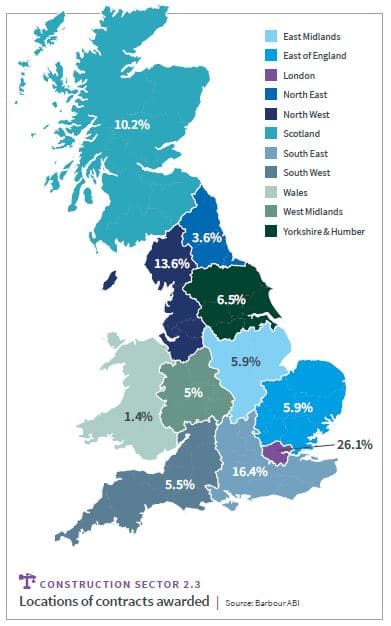
Regional analysis shows that London had the largest share of contract awards in June at 26.1%. The South East was in second place with attributable share of 16.4% of awards and was followed by the North West in third place with 13.6% of contract awards. Wales was again the smallest region with just 1.4% of awards (see fig. 2.3).
Three contract awards were vying for top award status in June and were all valued at £150 million. In Crawley, the Gatwick Airport Station refurbishment project will see Costain Group extend the existing concourse as well as provide extra platforms. This 36 month project is due to be completed in April 2023. In Manchester, the City View Development – Regent Plaza involves the building of 525 residential units in a 26 storey building. This 40 month project is due for completion in Q3 2023 and was awarded to Helix Contracting. Located in Milton Keynes the Santander New Tech Hub Campus is the new eight storey UK headquarters building for the bank. Awarded to John Sisk & Son the project is due for completion in Q1 2023.
Types of project
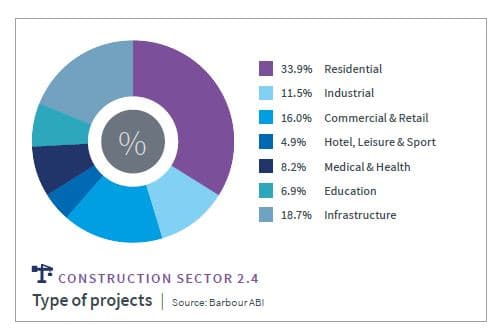
Attracting 33.9% of all construction contract awards the residential sector retained lead status in June. The second largest sector this month was infrastructure which accounted for an 18.7% share of awards.
Commercial & retail was the third largest sector in June accounting for 16.0% of awards. Apart from City View Development Regent Plaza, other notable residential awards this month included the former Lea Castle Hospital Development in the West Midlands valued at £60 million which will provide 600 units. Renewable energy generation featured heavily in infrastructure awards this month including the £75 million 75.5MW Aikengall 11a Wind Farm in the Scottish borders. Within the commercial & retail sector a notable mixed use project was the Tri Sail Towers development in Bishop Stortford valued at £19 million.
The report identifies that, in the commercial and retail sector, MACE and ISG were the leading way in terms of value of contract awarded, McAleer & Rushe Ltd and Willmott Dixon top the table for, Hotel, Leisure and Sport; Balfour Beatty and Integrated Health Projects were the most successful in the Medical and Health sector and Morgan Sindall and Kier for Education.
To see the full report and detailed analysis of the Residential, Commercial and Retail, Hotel, Leisure and Sport, Industrial, Medical and Health and Education Markets including details of key clients, architects and contractors click here.
by Iain McIlwee | 22 Jul, 2020 | Main News Feed
The Professional Practice Task Group for the Construction Leadership Council (CLC) Covid-19 Task Force has today published a methodology for assessing and reporting the cost implications of disruption due to the pandemic. Construction clients and contractors rely on accurate cost prediction as the basis of business plans, financial contracts, and commercial control.
The unprecedented nature of the pandemic is affecting the progress and productivity of existing and future contracts, meaning that the information
upon which estimates are usually prepared no longer applies.
The Toolkit acts as a guide to enable better cost forecasting to assist the industry in making informed investment decisions on viability, improving robustness of pipeline and driving long term economic growth.
Commenting on today’s launch, Simon Rawlinson, Chair of the Professional Practice Task Group said:
“The Cost Assessment Toolkit will help the construction industry manage the impact of Covid-19 on existing and future contracts. It establishes a standard methodology to incorporate the cost impacts of the virus into estimates, provides clarity on exclusions and through the collection of industry wide data allows clients and supply chains to compare their project costs against an aggregated data set. By providing the tools to measure and therefore improve productivity, the toolkit acts as a guide to ascertain and assess project risks and establish viability for the long term.”
FIS CEO Iain McIlwee responded:
“This Toolkit could be one of the most valuable resources the CLC has produced through the COVID crisis. Our sector has been particularly hit by productivity concerns with work often being high, heavy or inside and sometimes all three! It is vital that we work together to understand this so that we can sensibly price and manage work and that we work together as a supply chain to find practical solutions to some of the potential contractual landmines out there. We are looking carefully at this Toolkit and what we can do as a sector to add further context and detail to ensure that it supports the cultural improvement much talked about, but desperately needed in construction”.
Download all the Toolkit documents:
COVID-19 Cost ssessment Toolkit
Covid Cost Assessment Tool – Appendix A
CLC Press Release

by Iain McIlwee | 22 Jul, 2020 | Main News Feed
As part of the easing of lock down restrictions, people may now use public transport in England for any journey, although they are still being encouraged to consider alternative means of transport where possible. Face coverings are mandatory on public transport in England and travellers should maintain social distancing where possible.
Transport for London (TfL) continues to encourage people to avoid using the network during peak times (05:45 ‐ 08:15 and 16:00 ‐ 17:30) and has published a construction toolkit with guidance for businesses in our sector.
Advice supports employers and is designed to “support your workers to help get them and the rest of London moving and working again, as safely and sustainably as possible”.
You can download the Transport for London briefing for the construction sector here
by Iain McIlwee | 21 Jul, 2020 | Main News Feed
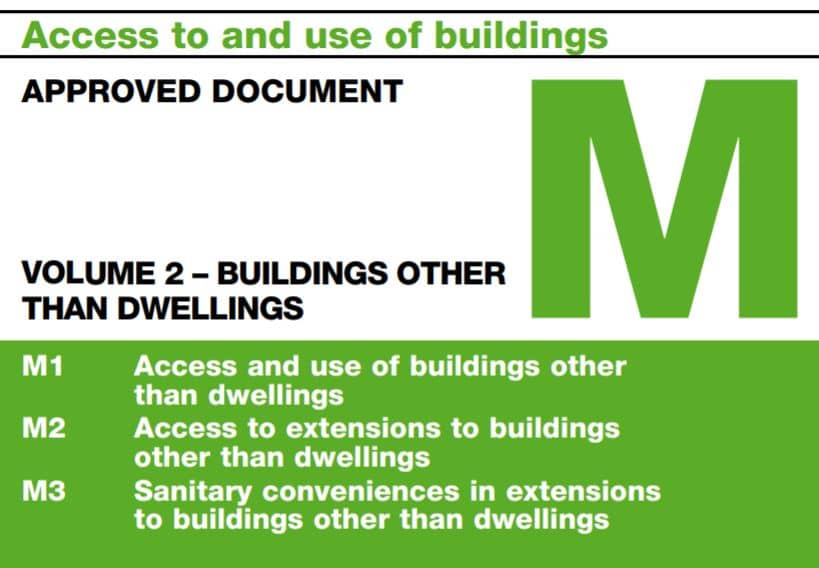
The guidance Approved Document M (access to and use of buildings), volume two, 2015 has been amended following a consultation the provision of Changing Places toilets on the 12 May 2019 which ran for a period of 10 weeks, ending on 22 July 2019, but was then reopened for targeted consultation of sectors most likely to be affected in February 2020 using the same questions.
The guidance in paragraphs 5.6 and 5.7 has been amended to mandate for the provision of changing places toilets within appropriately sized, publicly accessible buildings. The provision states that changing places toilets should be provided in the following buildings types:
- Assembly, recreation and entertainment buildings (see note) with a capacity for 350 or more people. Or a collection of smaller buildings associated with a site used for assembly, recreation or entertainment such as: zoos, theme parks and venues for sport and exhibitions with a capacity of 2000 people or more
- Shopping centres/malls or retail parks with a gross floor area of 30,000 m2 or more
- Retail premises with a gross floor area of 2500m2 or more
- Sport and leisure buildings with a gross floor area over 5000m2
- Hospitals and primary care centres
- Crematoria and cemetery buildings.
Note: Places of assembly, recreation and entertainment can be defined as buildings such as amusement arcades; art galleries; cinemas; concert halls; conference centres; further education colleges; hotels that provide function, sport or leisure facilities; libraries open to the public; motorway service areas; museums; places of worship; theatres; university buildings open to the public.
Clarification is also provided on how the capacities should be derived in these buildings. The amendments also state that further guidance on layout and equipment is available from the changing places consortium campaign website and by reference to guidance in section 18.6, diagram 48 as well as Annexes F and G of BS 8300-2:2018.
Transitional arrangement
The changes in the amendment booklet take effect on 1st January 2021. The amendments do not apply in any case where a building notice or an initial notice has been given to, or full plans deposited with, a local authority and either the building work to which it relates has
(a) Started before that day; or
(b) by 1 March 2021
Full copy of the amendments document is available here.
This needs to be read in context with the current Approved Document M.

by Iain McIlwee | 21 Jul, 2020 | Main News Feed
The HSE has published new guide guidance on Disinfecting premises using fog, mist, vapour or ultraviolet (UV) systems during the coronavirus outbreak.
If you choose to use fog, mist, vapour or UV treatments as a way of cleaning and disinfecting surfaces, discuss your requirements with your manufacturers/suppliers (this may include fumigators), to help you decide if a product/system meets your needs. The treatment you use will depend on:
- the size of the area to be treated, its shape and how easily it can be sealed off if delivering an airborne product
- whether there are hard or soft surfaces – soft furnishings may act as a ‘sink’ for the airborne chemicals and emit them for some time after treatment (it may be possible to remove items such as sofas before treatment)
- the type of business you have – some areas may be better suited to UV surface treatments than airborne chemicals or vice-versa
Any use of these treatments for these purposes should form part of your COVID-19 risk assessment. Users must be competent and properly trained.
Full details of the guidance and advantages and limitations of the various methods are available here.

by Iain McIlwee | 21 Jul, 2020 | Main News Feed
The subject of design liability, drawing control and normal working practices in construction was under the spotlight in the Grenfell Inquiry this week. Simon Lawrence, Rydon’s contract manager on the project between 2014 and 2015, was questioned. A key line of questioning was around how Rydon (Main Contractor) worked with Harley Facades Ltd (the specialist cladding contractor), Studio E (Architect) and Building Control who signed off details as approved for construction and how Rydon could have fulfilled their responsibilities as a Design and Build Contractor.
Around 45 minutes into the recording it was clarified that the role of Rydon was to “manage and co-ordinate the work of third parties” and “to co-ordinate and manage the process of design”. The specific question asked of Mr Lawrence was “At what stage did you believe the design had reached when Studio E started working directly for Rydon?”.
The answer paints from Mr Lawrence is one that many sub contractors will be familiar with:
“Yes I would to get to the completion of technical design, but you often find, particularly with the RIBA stages that there seems to be a bit of float, it is not quite a hard and fast rule. So I think there was enough detail to say it was Stage E when it come across. Whether there was absolutely everything that ticked every single box to say it was the right sections etc etc. I would say possibly not”.
“With the cladding specifically they would obviously be relying on the specialists to add further detail to that information”.
It was suggested in the discussion that Harley Facades Ltd had contractually committed to the design and installation of the cladding system.
“You would look at the design overall and designs particularly around areas where we had third parties specialist looking at, if there was any detail they didn’t have I would expect them to flag it up. Design and Build typically, some form of construction starts before the full design of the full building is finished and complete. So I would take that as a work in progress that would be taken by Studio E and Harley through the early stages project”.
“Would you not require 1 in 5 scale drawings available to you at Stage E?”
“It would be very rare that we would pick up a tender and it would be fully 100% everything ticked off at a RIBA stage. There would normally be a merge between possibly D & E… The further the client progresses the design the better and less risk they have financially obviously when they go out to tender. But we would often pick up you know we may have 1 in 5 drawings on every other part of the building, but not on the cladding because we knew there was a specialist sub contractor coming in to complete that final part of the technical fabrication design work.”
Interesting points were made about how drawings may have proceeded to construction phase without approval through the design chain with Mr Rawlings conceding that “It would have been good to have a design responsibility matrix” an that he was not aware of any process in place to ensure that there were no gaps in scope or deliverables and that each contractor or sub contractor clearly understood their design responsibility and liabilities.
The full video of the hearing session can be picked up here
The inquiry schedule is available here
An example of a Design Liability Matrix is available in the RIBA Plan of Work Toolbox

by Iain McIlwee | 21 Jul, 2020 | Main News Feed
The government is determined to continue to learn the lessons from the Grenfell Tower fire, and reform building and fire safety to ensure that such a tragedy can never happen again. To this end, the Home office is seeking views on proposals to strengthen the Fire Safety Order, implement Grenfell Tower Inquiry recommendations and strengthen the regulatory framework for how building control bodies consult with Fire and Rescue Authorities.
The fire safety consultation contains proposals to:
- strengthen the Regulatory Reform (Fire Safety) Order 2005 and improve compliance
- implement the Grenfell Tower Inquiry Phase 1 Report recommendations that require a change in law to place new requirements on building owners or managers of multi-occupied residential buildings, mostly high rise buildings
- strengthen the regulatory framework for how building control bodies consult with Fire and Rescue Authorities and the handover of fire safety information
The fire safety consultation, published alongside the draft Building Safety Bill, is key part of government’s package of reform to improve building and fire safety in all regulated premises where people live, stay or work and to deliver key Grenfell Tower Inquiry recommendations.
Below is a full package of documents to support the consultation. Alongside the fire safety consultation documents we have published for reference the impact assessment.
Consultation Documents
Fire Safety Consultation Document
Fire Safety Consultation Impact Assessment
How to respond
FIS Members are encouraged to respond directly, but please if you do copy your response to joecilia@thefis.org by 1st October so that we can ensure all views are included in the FIS response which will be submitted on the 12th October.
Supporting documents:
The Regulatory Reform (Fire Safety) Order 2005 call for evidence
The Regulatory Reform (Fire Safety) Order 2005 call for evidence: summary of responses
Grenfell Tower Inquiry Phase 1 report
Grenfell Tower Inquiry Phase 1 report: government response
Draft Building Safety Bill

by Iain McIlwee | 20 Jul, 2020 | Main News Feed
The government has today published in draft its landmark Bill to deliver the biggest changes to building safety for nearly 40 years and make residents safer in their homes.
The Building Safety Bill aims to improve regulations as the government seeks to bring forward a clearer system with residents’ safety at the heart of it.
What this means for the Finishes and Interiors Sector
- The Bill ensures that those responsible for the safety of residents are to be accountable for and must correct any mistakes
- The references to high rise buildings refers to those 18m or higher
- The appointment of a new National Regulator for building safety within the Health & Safety Executive who will have three main functions to:
- Oversee the safety and standard of all buildings
- Directly assure the safety of higher-risk buildings
- Improve the competence of those responsible for managing and overseeing building work
- A more stringent set of rules or high-rise residential buildings will operate covering design, construction and occupation
- A responsible person will be appointed for managing potential risk
- A building will need to be registered with the Building Safety Regulator and before residents move in will need to apply for a Building Assurance Certificate
- Building inspectors responsible for signing off a building as being safe for people to live in will also have to follow these new rules and must register with the Regulator
- Government will have new powers to better regulate construction materials and products and ensure they are safe to use.
- Clients must set up a system where onsite workers can report potential structural and fire safety issues
What to expect from the new Building Safety Regulator
A Building Safety Regulator, already being set up within the Health and Safety Executive (HSE), will be fully established and equipped with the power to hold building owners to account or face the consequences. The regulator will have 3 main functions: to oversee the safety and standard of all buildings, directly assure the safety of higher-risk buildings; and improve the competence of people responsible for managing and overseeing building work.
It will enforce a new, more stringent set of rules that will apply for buildings of 18 metres or more or taller than six storeys from the design phase to occupation. Tough new enforcement powers will see the time limit for both prosecution for non-compliance with building regulations and correction of defects extended from 2 to 10 years. Both individuals and companies will be liable to prosecution.
Failure to adhere to compliance or stop notices or the provision of misleading information to the regulator will be a criminal offence, with a maximum penalty of up to two years in prison and an unlimited fine.
What are the next steps
The draft Bull has been released for scrutiny before it is passed into law by Government, but Government have been clear that they view the Draft Bill as legislation that will evolve as further evidence and risks are identified to ensure that residents’ safety is always prioritised and will also provide new powers to better regulate construction materials and products to ensure they are safe to use.
Government expert Michael Wade has been asked to work with leaseholders, and the finance and insurance industries. He will test and recommend funding solutions to protect leaseholders from unaffordable costs of fixing historic defects, ensuring that the burden does not fall on tax payers. He will also develop proposals to address insurance issues around building safety.
The draft Bill includes a new ‘building safety charge’ to give leaseholders greater transparency around costs incurred in maintaining a safe building – with numerous powers deliberately included to limit the costs that can be re-charged to leaseholders.
It comes as the government also publish a consultation which sets out proposals to implement the recommendations from Phase One of the Grenfell Tower Inquiry that require a change in law. The consultation will also look at strengthening fire safety in all regulated buildings in England to ensure that people are safe from fire regardless of where they live, stay or work. Taken with the draft Bill, these measures will improve the safety of residents in buildings of all heights.
Housing Secretary Rt Hon Robert Jenrick MP said:
This is a significant milestone on our journey to fundamentally improving building safety and delivering real change that will keep people safer in their homes.
I remain committed to making sure we get this right, which is why I will be publishing the draft Bill for scrutiny and improvement before it is introduced in Parliament.
I am also calling on the industry to actively prepare for these changes now. It is vital that the sector moves in step with us, to provide confidence and reassurance to residents that their safety is firmly at the heart of everything we do.
Building Safety and Fire Minister Lord Greenhalgh said:
As a government we are determined to learn the lessons from that fateful night at Grenfell Tower and ensure that a tragedy like this does not happen again.
These are the biggest changes to building safety legislation for nearly 40 years, and they will raise standards across the industry and ensure building owners have nowhere to hide if they break the rules.
Consulting on key recommendations from the Inquiry and wider changes to fire safety regulation will give those affected the opportunity to make their voices heard and help us implement lasting, significant change.
Independent advisor and author of the Independent Review of Building Regulations and Fire Safety, Dame Judith Hackitt said:
I welcome this draft Bill as an important milestone in delivering the fundamental reform this industry needs to make residents and buildings safer.
It meets the ambitions and recommendations set out in my review.
And industry must be in no doubt that it is not enough to wait for the Bill to become law before they implement changes; we expect them to start taking action now.
Iain McIlwee, CEO Finishes and Interiors Sector said:
This much anticipated Bill marks the next step for the Construction Sector we cannot delay further, whilst the industry has time and time again been told not to wait for regulation and major strides have been made, the truth is, without the safety net of regulation, the unscrupulous will still cut corners and undermine those striving to be better.
The government is also announcing that full applications for the £1 billion Building Safety Fund, to remove unsafe non-ACM cladding from buildings, can be submitted from 31 July – with 747 registration forms processed since 1 June.
To also ensure that building owners are clear on which steps they need to take to ensure the building is safe, we will also publish a new Manual to the Building Regulations which contains all Approved Documents in one place.
The draft Building Safety Bill can be downloaded here
A document has also been published on GOV.UK that seeks to explain the document in further detail.

by Iain McIlwee | 17 Jul, 2020 | Main News Feed, Transformation
Hosted by journalist Dan Walker, the Construction Products Association Live Debate – The Future of the Construction Industry pulled together experts, including our own CEO Iain McIlwee to interrogate the impact of COVID-19 on the future of the construction sector. Topics covered included:
- The Covid-19 pandemic has seen one of the greatest hits to both the UK economy and the UK construction industry on record. In its most recent Construction Industry Scenarios, the CPA estimates total construction output in Great Britain is expected to fall by 25% during 2020. Its most optimistic scenario doesn’t expect the industry returning to 2019 levels until early 2022, its more pessimistic ones won’t see it return to 2019 levels until Q1 2023.
With this in mind what could recovery look like?
- The CPA highlights that productivity on site has fallen by 30-40% recently (depending on site size) give social distancing measures. The construction industry has always adapted and evolved and with this in mind can you give some examples of where the industry has already adapted and started to improve on this by new ways of working. Are there others ways the supply chain can help the industry and the Country recover?
How will the construction industry really use this crisis as an opportunity to change itself and work more collaboratively?
- The Government has sent out sometimes contradictory messages about its expectations around things like standards, building regulations and planning, which might be confusing for much of our audience. Government talks, for example, of full support for net-zero and safer, better quality homes and buildings, but then it also suggests it would be willing to walk away from standards and regulatory alignment established with the EU, and to loosen planning regulations.
Is there a ‘disconnect’ here? And how is the construction industry supposed to plan, invest, train, innovate, and really put your shoulder to the wheel if the signals from your biggest client are unclear?
- Looking ahead, Prime Minister Boris Johnson promised a ‘Rooseveltian’ programme of investment in Britain and has pledged to “build, build build” to bring the country out of recession after the coronavirus pandemic. The PM has announced a ‘New Deal’ with £5bn investment to accelerate infrastructure projects, create jobs and revitalise the economy. The CPA’s Economics team has pointed out however that this investment in “not new, additional money despite the spin behind it.”
What more do you think the government can do to stimulate construction activity and where should attention be focused? We heard the Chancellor’s announcement on energy-efficient retrofit last week, but what else could be done, for example, to boost house building, or on infrastructure delivery?
- We have seen so many fantastic examples of our industry stepping up during this crisis, from charity events and fundraising to donations of materials and PPE to various organisations and, of course, maintaining building and maintenance work on essential projects and infrastructure such as the Nightingale Hospitals.
What advice would you give to colleagues across the industry to ensure they all stay safe whilst helping the country recover?
The panel of experts included Peter Caplehorn, CPA; Philip Johns, SIG plc; Graham Edgell, Morgan Sindall; Angela Mansell, Mansell Finishing; Stacey Temprell, British Gypsum; Iain McIlwee, FIS; James Talman, NFRC and Jon Sinfield, BMI UK & Ireland.
The event was sponsored by FIS Members British Gypsum and SIG plc
You can access the recording of the event here

by Iain McIlwee | 16 Jul, 2020 | Main News Feed, Transformation
Build UK issued a statement this week, reiterating that after everything the industry has been through over the last few months, and with more uncertainty ahead, the overriding message from the Construction Leadership Council (CLC) has been that our sector’s long‐term resilience depends on working collaboratively. It is therefore extremely disappointing to receive evidence that some companies are reverting to bad habits and squeezing their supply chains, rather than taking the opportunity to revolutionise the way in which construction projects are delivered.
In terms of practical support, the Disputes and Collaboration group for the Construction Leadership Council (CLC) COVID-19 Task Force has today published guidance on future-proofing contract amendments in the light of COVID-19. Building upon the Contractual Best Practice Guidance published by the group earlier in the year, it includes options for amending many of the JCT and NEC contracts to cater for impacts of the pandemic on delivery of the works/services.
The output cannot tell parties what to do, but can help them identify the issues and distil their negotiated position into the drafting of the contract. It is intended that this advice will provide a starting point for all parties involved as to how they will deal with the COVID-19 pandemic going forward.
The Construction Leadership Council’s guidance on future-proofing contracts can be downloaded here.
The Construction Leadership Council’s guidance on record-keeping can be downloaded here.
The Construction Leadership Council’s publication Covid-19: Managing Contractual Disputes & Collaboration – Summary Guide can be downloaded here.
The CLC statement on Payment and Contracts, supported by Build UK and FIS, reminds everyone that actions at this time will be remembered and that all firms should think hard about how their reputation could be damaged by not doing the right thing. Every business, large and small, has a critical role to play in making sure that cash continues to flow throughout the industry. FIS is encouraging all of our members to sign the RICS Conflict Avoidance Pledge (also supported by the CLC) – you can sign the pledge here.
FIS Members are reminded of the Contractual/Legal Toolkit and the Contract Health Check Tool available here. If you feel you are being treated unfairly, need contractual advice or wish to report negative behaviours, do not hesitate to contact the FIS team on 0121 707 0077 or email: info@thefis.org.
Page 13 of 15« First«...1112131415>