Employer’s guide to the three upcoming employment bills

Employer’s guide to the three upcoming employment bills

Autumn sees significant Employment Law changes with three legislative changes. To support members, FIS Associate Member Citation has produced an essential guide packed with an expert analysis of the Employment Rights Bill, Equality (Race and Disability) Bill, and Skills England Bill set out in the King’s speech with actionable tips so members can ensure compliance.

Members can download their copy at https://tinyurl.com/22558pwz

Helping the supply chain navigate the collapse of ISG

Helping the supply chain navigate the collapse of ISG

On 20 September 2024, the companies that made up the ISG Group were placed in administration. ISG administrators have advised customers that no further work will be undertaken on existing UK contracts and that the UK operations of the ISG Group have ceased to trade with immediate effect.  They have advised companies and customers should take all necessary steps to arrange security and insurance at relevant premises.  Early estimates suggest monies owed to the supply chain could be as high as £700m with only around 10% of this insured.  It is not yet clear what the level of protection afforded by Project Bank Accounts (PBAs) is, but we know a small proportion of ISG supply chain will be protected by PBAs.

If the client intends to continue works then it will have to either step in as main contractor or appoint a new main contractor who will be tasked to re-appoint or re-tender the completion works.

 Understanding Administration

Administration is when a company is given legal protection from creditors while an appointed administrator attempts to rescue the business or achieve a better outcome for creditors than liquidation would provide. During this time, creditors generally cannot pursue claims against the company without court permission.

It’s important to note that in cases like this, immediate payments to creditors are rare, except in exceptional circumstances. Most creditors will need to wait for the administration process to be completed, which can take time. Therefore, it’s crucial to manage expectations regarding cash flow.

Details of the appointment and a Q&A from the administrator is available here.

 How to proceed if you have been impacted:

 If you believe you have exposure to ISG companies, we would advise the following immediate actions:

  • Review your contracts. A key thing to look for is whether the contract is a Collateral Warranties, these are used to bridge the contractual gap and create a direct contractual link for the benefit of those parties that may otherwise have no recourse. Some collateral warranties can also contain ‘step-in’ rights which effectively allow the beneficiary to step in to the underlying contract and issue instructions.  Under a simple contract should the main contractor of a project fall into insolvency the subcontractor will be under no contractual obligation to accept instructions from the employer to complete the works given there exists no contractual relationship. The use of a collateral warranty in this instance creates a direct contractual link allowing the employer to give instructions to the subcontractor, ensuring completion of the latter’s obligations is achieved.
  • Assess any ongoing work: determine the stage of each project and identify any outstanding deliverables.  Submit any outstanding applications.
  • Document all work completed to date. Take detailed photographs, videos and notes as this documentation will be crucial for any future claims or negotiations.
  • Recovering Tools, Plant and Materials. The administrators have advised that retrieval of equipment and / or materials will not be a matter for the Administrators and should be arranged directly between customers and any applicable contractor.  Contact should be made with the client to arrange a time to visit your project sites to retrieve any tools, equipment or materials that belong to you. Ensure you have documented proof of ownership for any assets you remove to prevent any disputes – this is particularly the case with materials where ownership may be less clear.
  • Do not pursue unauthorised actions such as attempting to remove materials or equipment that are not legally yours. Also, ensure you do not cause any damage to the sites or completed works.
  • Prepare your financial records by compiling a comprehensive list of all outstanding invoices, including amounts due, due dates and any retention sums. Keep records of all communications and transactions related to your ISG projects for reference.
  • Get a grip on Cash flow: Do a detailed cashflow forecast, given the likely delays and possibility of defaulted payments, consider all your options and GET PROFESSIONAL HELP if required.  Through your membership of FIS you have access to specialist financial advice and BABR have offered additional interim advice here.
  • Renegotiations: Speak to other clients and suppliers to potentially renegotiate payment terms or request upfront payments to help cover any cash flow gaps.

It is important to note that ISG Administrators have stated “at present, it is not anticipated that there will be any funds available for a distribution to unsecured creditors.”

BuildUK has now published additional guidance which covers what to do with materials stored on site.

 Project Bank Accounts

We have had a number of questions with respect to Project Bank Accounts, these should ringfence any monies due and certified payments should progress.  Any applications submitted, but not certified could be subject to a delay.

Completing ISG Projects.

Clients will hopefully be looking to appoint a contractor to replace ISG.  How they are able to progress the project and the impact on existing sub contractors will depend on the contract and funding.  We will be working with CLC and pressing clients to manage transition with sensitivity to the impact on the incumbent suppliers.

Below is a list of considerations with respect to projects that are restarting:

  • Get a clear picture on completed works, the status of payments to ISG and what the intention is to honour any payments for work completed by the client.
  • How will step-in rights be managed.  Step in rights are usually drafted to give the beneficiary (often the employer or a funder) the right to step in at its option into the contractor’s shoes in the building contract.  The employer doesn’t have to and may seek alternative options as it exposes the party stepping in to take responsibility for outstanding payments to the party providing the warranty and also the responsibility of being the contractor.
  • As an alternative, it is common for arrangements to be made (with agreement of all the parties including the contractor and its insolvency providers) to make direct payment to the subcontractors.  In this case new direct contracts between the employer and the subcontractors or between the replacement contractor and the subcontractors may be presented.  These are likely to be similar terms, but not necessarily identical terms, to the original subcontracts.  Any agreement for outstanding payment and arrangement with respect to warranties would be covered in this appointment.  If you have had design input, be clear on any Intellectual Property (IP) that will be taken forward in the project.  Ensure that you have not ceded rights in your contract with ISG.
  • Re-tendering work:  If you are asked to re-tender ensure this takes into account any IP related input that you may have had on the project and assumptions are emphasised in your tender documents.
  • Ensure that you are clear on the contractual terms for any reappointment – don’t assume they will be the same or even that the contracts won’t be terminated and work re-tendered.  Check the wording of any contracts for onerous high-risk clauses.  Be particularly watchful of any change in design responsibilities or compliance clauses, and that you are not taking any responsibility for any design work carried out by another contractors.  FIS contract reviewers are offering additional pro bono support to members impacted by the failure of ISG. BuildUK have also published guidance that covers the novation process.
  • Collateral Warranties, caution advised: If you are asked to sign a Collateral Warranty ensure that you get legal advice (you can access free legal advice via the FIS Helpline).  Sometimes contractors ask for these at a later date (if obligation is not in the contract) and there may be commercial reasons why a subcontractor would still be prepared to provide a collateral warranty (or may ask for extra payment for doing so) but you are not obliged to do so.  Remember this gives a third party a contractual right to bring  a claim against  you for breach of your contractual obligations.  Without a collateral warranty there is no direct contractual link.
  • Timings:  Ensure that you have a clear understanding of when the expected recommencement date is and factor this into your pricing accordingly.
  • Status of woks: Make sure that any previous works are inspected and any defects identified.  Even if it is your work, things may have changed since you left the site.
  • Managing Risk:  Remember it is appropriate to seek reassurance that the funding is in place to complete the project and if any bonds or project bank accounts are being deployed to protect the supply chain.  FIS members can access free credit checks email FIS team for a one-off or access to the portal. info@thefos.org
  • If you are unsure – check.    FIS offers access to expert legal advisors, consultants, contract reviewers and financial advisors – many of whom have offered pro bono support to members impacted by the failure of ISG.

Vital information FIS is collating.

We have a list of impacted ISG projects, but are trying to gather more detailed information on the direct impact on members. Data we are looking for is size of the contract and monies owed (certified, a valuation of any completed works currently uncertified and retention).  This will be used to support a collective approach to influencing clients to behave responsibly and to support representation and lessons learned as we engage with Government and the wider industry.   For ease of capture, we have set up a short survey for impacted members to complete.

FIS would like to thank colleagues from SNIPEF, ECA, Hill Dickinson, BABR, Len Bunton and DAC Beachcroft for their support in pulling this advice together and their support for our community in this challenging time.    

Further advice is available through the FIS legal toolkit here and you can call the FIS helplines on 0121 707 0077 (07792959 481 out of hours) or can email iainmcilwee@thefis.org who is leading on our response directly for assistance.

FIS launch Best Practice ‘Walls as a System’ guide

FIS launch Best Practice ‘Walls as a System’ guide

FIS has launched a new Best Practice Guide – Walls as a System – to help specifiers, designers, installers and building owners ensure compatibility of compliant test evidence across building components assembled into larger supersystems.

The guide addresses a critical issue in modern construction: the tendency to design and specify building components in isolation, without considering how they interact as part of larger systems. By introducing the concept of ‘Walls as a System’, FIS is promoting a more holistic approach to building design and construction, ensuring interfaces, penetrations, glazing and doors have compatible and compliant test evidence.

Developed with input from technical experts and wider group of peer reviewers across the sector, including ASDMA, DHF, GIRI, GAI, GPDA and PFKG, this guide represents a collaborative effort to provide clear, relevant, and concise design guidance. It aligns with the RIBA Plan of Work and the Building Safety Act Gateways for Higher Risk Buildings, emphasising early engagement with manufacturers and contractors.

This new guide highlights the importance of early planning and clear communication in the design process. It introduces the term ‘fire wall’ to emphasise the critical protective function of certain walls, aligning with existing terms like fire doors and fire glass. The guide includes up to date guidance on maintaining the compartment lines below raised access floors and above glazed fire walls with drop bulkheads, as well as addressing how the imposed load from the walls, glazing and doors will be supported. The appendix includes a list of all relevant standards and a list of further reading.

Commenting on the guide, Iain McIlwee, Chief Executive of  FIS said: “This new walls as a system guide represents a significant step forward in how we approach wall design and construction. By considering walls as integrated systems, we can enhance building safety, performance and compliance across the industry.

“It shows the sector coming together to provide clear, relevant and concise guidance. The core message being early engagement with manufacturers and contractors to ensure that what is designed can be compliantly delivered.”

The Guide was launched during Fire Door Safety Week 2024 and covers the incorporation of Doors in Dry lining partitioning and fire resistant walls.  

You can download the Best Practice Guide – Walls as a System at https://www.thefis.org/membership-hub/publications/best-practice-guides/walls-as-a-system

For further information or for any questions please contact the FIS at info@thefis.org or call 0121 707 0077.

Celebrating excellence at the 2024 FIS Scottish Awards

Celebrating excellence at the 2024 FIS Scottish Awards

The FIS Scottish Awards are a celebration of the exceptional work and diverse range of projects carried out in Scotland. On 20 September, the awards ceremony was held at the impressive voco Grand Central Glasgow. The event was hosted by ex-professional footballer Chris Sutton and was well-attended, with guests eagerly anticipating the announcement of this year’s winners.

The ceremony began with a short speech from FIS Chief Executive Iain McIlwee followed by a welcome address from FIS President Philip Brown, who highlighted the organisation’s activities in 2024 and plans for the future.

After a fantastic three-course lunch, the presentation of the awards began. The winners were as follows:

Gold Award in the Specialist Installation – under £1m category: Carter Ceilings for its installation at the Wallyford Leaning Campus in Mussellburgh.

Silver Award in the Specialist Installation – under £1m category:  Glasgow Ceilings for its installation at the Newmains and St Brigid’s Community Hub in Wishaw.

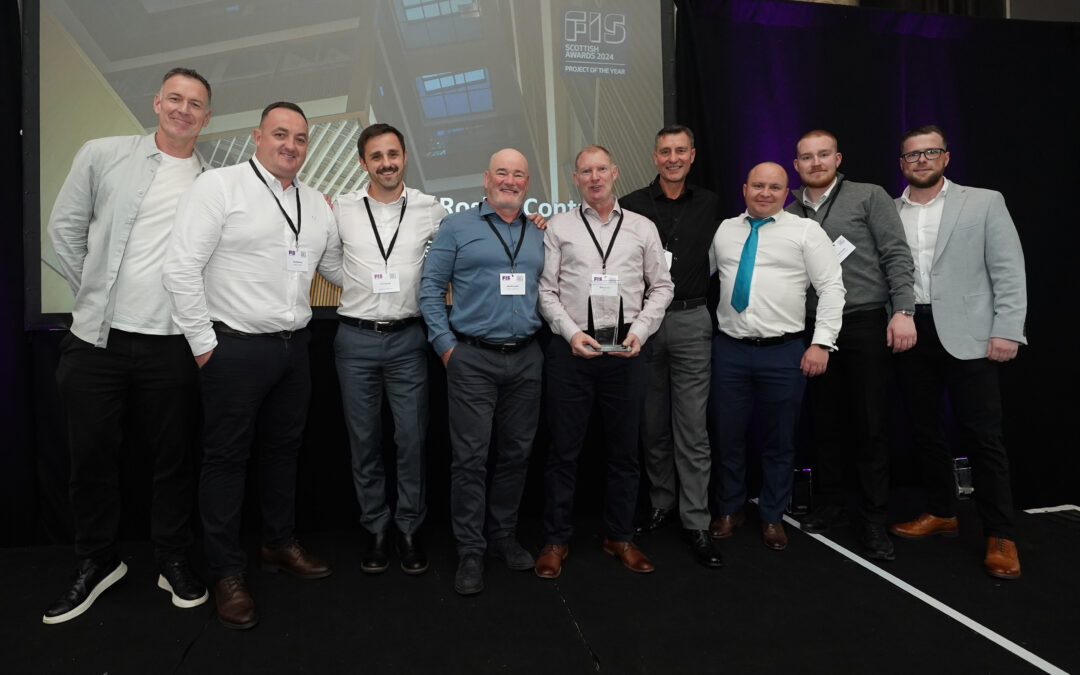
Gold Award in the Specialist Installation – over £1m category: Roskel Contracts for its installation at the Clarice Pears Building, University of Glasgow, School of Health and Wellbeing.

Silver Award in the Specialist Installation – over £1m category: C.C.L Interiors for its installation at the Platform at Central Quay in Glasgow.

Gold Award in the Interior Fit-Out category: Scotwood Interiors for its installation at Rabbies in Edinburgh.

Silver Award in the Interior Fit-Out category: W.M.R Contractors for its Foyer Refurbishment in Glasgow.

Project of the Year: Roskel Contracts for its installation at the Clarice Pears Building, University of Glasgow, School of Health and Wellbeing.

Apprentice of the Year: Ethan Gandy, Ceiling Installation Apprentice at Brian Hendry Interiors.  With his commitment to personal development and consistent high standards, Ethan did not follow the traditional route into construction, but created opportunities to allow this pathway to open up.

Lifetime Achievement Award: Ian Young of Zentia. Described as an inspirational professional who has worked in the ceilings sector for over 40 years spanning many roles from sales manager right through to training delivery. Having retired in 2020, Ian returned to the sector to maintain continuity of training at the Zentia installation school. He now delivers training to a varied audience from office-based internal staff to ceiling supervisors and has trained thousands over the years.

Congratulations to all our winners, and to everyone who entered.

FIS Awards Brochure

You can read all about the winning projects and individuals here.

See photos from the lunch

Experience the moments from the 2024 FIS Scottish Awards through our photo collection as the event unfolded.

See more news likes this

Building Safety Regulator publishes latest gateway data

Building Safety Regulator publishes latest gateway data

The Building Safety Regular (BSR) has published its latest data for the period 8 June to 31 August 2026. The data shows that a total of 333 decisions were made across all valid Gateway Two applications with an approval rate of 84%. However, 174 applications (34% of...

HSE seeks industry views on Control of Asbestos Regulations 2012

HSE seeks industry views on Control of Asbestos Regulations 2012

The Health and Safety Executive (HSE) is conducting a statutory review of the Control of Asbestos Regulations 2012 (CAR 2012) and is seeking views and information through two surveys.  This review is separate from HSE’s recent consultation on proposed updates to CAR...

A tentative return to growth in Q2

A tentative return to growth in Q2

The health of the construction industry improved further in the second quarter of 2024, building from the stabilisation seen in Q1 to signs of modest growth emerging in the three months April to June.

Product manufacturers’ sales increased in the quarter, marking the first rise in two years for heavy side producers, whose products and materials typically feed into the early, structural build phases. SME contractors’ workloads were also reported to have increased, which follows two quarters of decline, albeit driven by a sole sector – repair, maintenance and improvement (RM&I).

Workloads were reported to have still contracted in new build housing and commercial/industrial. Meanwhile, workloads for civil engineering contractors expanded a run of growth to 15 straight quarters, driven by the activity underway on major infrastructure projects, in the energy sector and on frameworks in regulated sectors such as water and sewerage. This sectoral split was echoed in chartered surveyors’ workloads in Q2: infrastructure continued to provide activity, whereas workloads were reported lower in housing, commercial and industrial. Underscoring that a pickup in activity is coming off the back of a period of subdued economic growth and strong inflation, with households and businesses also adjusting to an environment of higher interest rates, forward-looking indicators were largely positive, but tentative. Civil engineering contractors’ order books rose in Q2, along with chartered surveyors and product manufacturers anticipating growth in workloads or sales over the next 12 months.

SME contractors reported that enquiries still decreased in Q2, and in all three main sectors of operation, although the overall net balance was the best in a year. One key longer-term theme for the construction supply chain was pervasive in all the Q2 surveys: the labour force – whether it be cost pressures from wages and salaries, difficulties in recruiting or employment cuts.

FIS members can read the full Construction Trade Survey results from the Construction Products Association, here

Market Data

FIS has access to a wide range of market data from sources including the CPA and Barbour ABI.  In addition, FIS produces a state of trade survey specifically for the finishes and interiors sector.

End Point Assessment for Interior Systems – Ceilings and Partitions is now available

End Point Assessment for Interior Systems – Ceilings and Partitions is now available

We are pleased to announce that NOCN is now providing end point assessment services for Option 2: Ceiling and Partitions of the following apprenticeship standard:

  • ST0388, Interior Systems Installer, Level 2

In response to industry needs, a temporary dispensation has been applied to Option 2, effective until 6 Janaury 2025. This dispensation for an extension of up to 8 additional hours for practical observation and questioning assessment method, bringing the total duration to a maximum of 20 hours. Please note that this dispensation may be withdrawn if it is no longer necessary.

We extend our thanks to FIS members, employer representatives and the trailblazer group for their support and significant contributions to the development of this option.

Fire test data for sound reduction products

Fire test data for sound reduction products

A recent safety report from Collaborative Reporting for Safer Structures UK (CROSS) has highlighted the importance of considering reaction to fire performance in discontinuous ceiling and baffle products. Often these products may offer excellent sound absorption properties using PET or similar materials which can contribute to the development of a fire and therefore may require a classification in accordance with BS EN 13501-1 that aligns with the guidance in Approved Document B or other specified fire strategy.

Reaction to fire classification is derived from tests against a number of standards that vary in applicability between materials and applications so make sure to check with the manufacturer before specifying that the evidence provided is representative of the product in its installed application.

The full report can be read here.

Making use of Sector Based Work Academies

Making use of Sector Based Work Academies

Sector-based work academies (SWAP) are another DWP Funded programme that can support individuals transitioning into a new field of work.  They provide training and education for those currently receiving unemployment benefits. The goal is to equip them with the skills needed to apply for jobs in a different sector.  Academies are tailored to meet the immediate and future recruitment needs of employers, ensuring the workforce is prepared to support business growth.

 FIS is working with West London College and DWP to deliver SWAPs in the area.

A key component of the SWAP model is the provision of a guaranteed job interview, work experience, or employment, enabling members to efficiently recruit candidates

Recruiting through a SWAP has many benefits, such as:

  • Employers get access to candidates who have undergone relevant pre-employment training tailored to the specific needs of the job role.
  • Trial period for candidates
  • The work experience component of SWAP allows employers to assess candidates’ suitability and fit for the role in a real-world setting before making permanent hiring decisions.
  • By providing tailored training and work experience, SWAPs help ensure candidates are well-prepared for the job, which can lead to higher retention rates.
  • SWAPs often focus on helping unemployed individuals, including those from underrepresented groups, re-enter the workforce, enhancing workforce diversity.
  • Participation in SWAPs demonstrates a company’s commitment to supporting local employment initiatives, which can enhance its reputation within the community.

West London College have put together a short video detailing what the SWAP includes.

Please get in touch if you can support and are able to offer work experience or employment and keen to get involved in the SWAP.

FIS has a dynamic Skills Board that helps to drive our work in this space.  If you would like to join the Skills Board or have a colleague who could help target our collective effort, please do consider getting involved.  Find out more here.

World Suicide Prevention Day – the importance of starting the conversation

World Suicide Prevention Day – the importance of starting the conversation

Tuesday 10 September marks World Suicide Prevention Day, part of National Suicide Prevention Month. This campaign aims to raise awareness about suicide preventionand how we can work together to create a world where fewer people die by suicide.

Currently, more than 700,000 people a year take their life around the world and by raising awareness, reducing the stigma and encouraging action, we can help to reduce the instances of suicide around the world.

This year’s theme is ‘Changing the Narrative on Suicide’, which serves as a chance to #StartTheConversation around suicide and shift the culture to one of openness, empathy and support. Every chat, no matter how small, will build a supportive and understanding society and help provide support to anyone who is struggling.

There are lots of available services that can be accessed for anyone who is struggling:

https://www.samaritans.org/support-us/campaign/world-suicide-prevention-day/

FIS has a Mental Health Hub where you can find information and resources to help you with your mental health and wellbeing.

Grenfell Inquiry: Key conclusions and recommendations for the finishes and interiors sector

Grenfell Inquiry: Key conclusions and recommendations for the finishes and interiors sector

The publication of the Grenfell Inquiry Report Part 2 is another landmark for our sector.  The video below is worth watching, it is the introduction to the findings and thoughts of the Inquiry Committee.  As well as a good high-level summary, the committee conveyed well the emotion that surrounds this work and the devastation that the failings identified have had on people, families and communities.  Thouria Istephan, particularly reminded us as she introduced the recommendations:

“Put simply, if you work in the construction industry and you do not feel the weight of responsibility you have for keeping people safe, you are in the wrong job”.

The Main Conclusion

The Inquiry was divided into two phases; Phase 1 which addressed the events on the night of the fire; and Phase 2 which investigated the wider situation understanding the underlying causes and mistakes and bringing forward information and recommendations that can be used to ensure a similar disaster does not happen again.

The main conclusion from the Inquiry is that deaths were avoidable and those in the tower were failed by a number of people, systems and organisations, these include:

  • The Government
  • The Tenant Management Organisation
  • The Council
  • Manufacturers
  • Certifiers
  • Architects
  • Principal and Specialist Sub Contractors
  • Consultants and
  • The London Fire Brigade

Key Points of Focus for the Finishes and Interiors Sector

On Regulation, the Inquiry concluded that:

“The system of regulating the construction and refurbishment of high-rise residential buildings that existed at the time of the Grenfell Tower fire was seriously defective in a number of respects. The statutory guidance in Approved Document B was poorly worded and liable to mislead designers into thinking that complying with its terms would inevitably ensure that the building would comply with the legal requirements of the Building Regulations.”

On Products and Product Testing the Inquiry concluded that there was “systematic dishonesty”, “deliberate manipulation” and “calculated attempts to mislead that products met the requirements”.  It also concluded that certification bodies had not effectively separated commercial pressures from their responsibilities to assurance.

It was highlighted that in the tender process parties were appointed that were clearly not competent to fulfil the functions that they were allocated.  The design process (or lack thereof) was heavily criticised.  Two key statements in the report that shine a light on the impact of cost engineering (I refuse to call it value engineering) and that reinforce why the design and procurement processes need to be better integrated and managed were:

“Although Rydon’s (the appointed Main Contractor) tender was judged to be the most competitive, it still exceeded the TMO’s budget. As a result, although the TMO had received advice from its lawyers that it would be improper to do so, it entered into discussions with Rydon before the procurement process had been completed leading to an agreement that, if Rydon were awarded the contract, it would reduce its price to an acceptable level.”

and how poor contracts and processes lead to confusion and responsibility not effectively allocated, understood or managed

 “Studio E (Architect), Rydon (Main Contractor) and Harley (Cladding Specialist) all took a casual approach to contractual relations. They did not properly understand the nature and scope of the obligations they had undertaken, or, if they did, paid scant attention to them. They failed to identify their own responsibilities for important aspects of the design and in each case assumed that someone else was responsible for matters affecting fire safety. Everyone involved in the choice of the materials to be used in the external wall thought that responsibility for their suitability and safety lay with someone else.”

There are reminders throughout that, not being told and ignorance is not an effective excuse – there were repeated failures to ask and clarify.  The report is also highly critical of the Building Control sign-off process, Building Management and the response of the fire and rescue service.

Next Steps and Recommendations

The report is a hard read, not because it is not well written – it is an excellent, accessible and clear summary of the environment and events that led to the tragedy that was Grenfell.  It is a hard read because, as was expressed by the panel, the elements that caused this tragedy have become endemic in the working practices and are part of the sector’s culture – this has to change.

The Report presents 58 recommendations.  The key ones that could impact our community are:

Revisiting the Scope of the Building Safety Regulator:  Recommend that the government draw together under a single regulator all the functions relating to the construction industry to which we have referred:

  • the regulation of construction products;
  • the development of suitable methods for testing the reaction to fire of materials and products intended for use in construction;
  • the testing and certification of such products;
  • the issue of certificates of compliance of construction products with the requirements of legislation, statutory guidance and industry standards;
  • the regulation and oversight of building control;
  • the licensing of contractors to work on higher-risk buildings;
  • monitoring the operation of the Building Regulations and the statutory guidance and advising the Secretary of State on the need for change;
  • carrying out research on matters affecting fire safety in the built environment;
  • collecting information, both in this country and abroad, on matters affecting fire safety;
  • exchanging information with the fire and rescue services on matters affecting fire safety;
  • accrediting fire risk assessors;
  • maintaining a publicly available library of test data and publications.

Revising the Definition of Higher Risk Building: To define a building as “higher risk” by reference only to its height is unsatisfactory, being essentially arbitrary in nature.  More relevant is the nature of its use and, in particular, the likely presence of vulnerable people, for whom evacuation in the event of a fire or other emergency would be likely to present difficulty. Recommendation that the definition of a higher-risk building for the purposes of the Building Safety Act be reviewed urgently.

Appoint a Chief Construction Adviser:  The minister will need to be able to turn for advice to someone who has good working knowledge and practical experience in the construction industry.  The Inquiry recommends that the Secretary of State appoint a Chief Construction Adviser with a sufficient budget and staff to provide advice on all matters affecting the construction industry, including:

  • monitoring all aspects of the department’s work relating to the Building Regulations and statutory guidance;
  • Provide advice to the Secretary of State on request;
  • bringing to the attention of the Secretary of State any matters affecting the Building Regulations and statutory guidance or matters affecting the construction industry more generally of which the government should be aware
  • Legislation and guidance

Clarify the Statutory Guidance: Recommend that the statutory guidance generally, and Approved Document B in particular, be reviewed accordingly and a revised version published as soon as possible.  Documents should be drafted conservatively and reviewed annually or promptly whenever developments make them advisable.

Fire safety strategy:  Recommend that it be made a statutory requirement that a fire safety strategy produced by a registered fire engineer (see below) be submitted with building control applications (at Gateway 2) for the construction or refurbishment of any higher-risk building and for it to be reviewed and re-submitted at the stage of completion (Gateway 3).

“A compassionate society protects the most vulnerable”:  When Approved Document B is revised, to ensure the safety of occupants, including any with physical or mental impairments, those who design high-rise buildings need to be aware of the relationship between the rate at which fire is likely to spread through the external walls and the time required to evacuate the building or the relevant parts of it.

A stay-put strategy in response to a compartment fire will be acceptable only if there is negligible risk of fire escaping into and spreading through the external wall. Calculating the likely rate of fire spread and the time required for evacuation, including the evacuation of those with physical or mental impairments, are matters for a qualified fire engineer.

Competence of Fire engineers is critical:   Recommendation that the profession of fire engineer be recognised and protected by law and that an independent body be established to regulate the profession, define the standards required for membership, maintain a register of members and regulate their conduct.  This was linked to recommendations to tighten up competency statements and a process to improve training and qualifications to support.

Certification of products and publication of test data:  Recommend that the construction regulator should be responsible for assessing the conformity of construction products with the requirements of legislation, statutory guidance and industry standards and issuing certificates as appropriate. It is expected such certificates should become pre-eminent in the market.

Copies of all test results supporting any certificate issued by the construction regulator be included in the certificate; manufacturers be required to provide the construction regulator with the full testing history of the product or material to which the certificate relates and inform the regulator of any material circumstances that may affect its performance; and manufacturers be required by law to provide on request copies of all test results that support claims about fire performance made for their products.

Architects:  Recognition that both the Architects Registration Board and the Royal Institute of British Architects have taken steps since the Grenfell Tower fire to improve the education and training of architects. Recommendation that they should review the changes already made to ensure they are sufficient in the light of findings.

Recommendation that it be made a statutory requirement that an application for building control approval in relation to the construction or refurbishment of a higher-risk building (Gateway 2) be supported by a statement from a senior manager of the principal designer under the Building Safety Act 2022 that all reasonable steps have been taken to ensure that on completion the building as designed will be as safe as is required by the Building Regulations.

Contractors:  A licensing scheme operated by the construction regulator be introduced for principal contractors wishing to undertake the construction or refurbishment of higher-risk buildings and that it be a legal requirement that any application for building control approval for the construction or refurbishment of a higher-risk building (Gateway 2) be supported by a personal undertaking from a director or senior manager of the principal contractor to take all reasonable care to ensure that on completion and handover the building is as safe as is required by the Building Regulations

Clients:  Broadly here recommendations focussed on assessing the impact of the new responsibility regime set down in the Building Safety Act

Building control:  Recommendation that the government appoint an independent panel to consider whether it is in the public interest for building control functions to be performed by those who have a commercial interest in the process.

The shortcomings we have identified in local authority building control suggest that in the interests of professionalism and consistency of service all building control functions, including those currently performed by local authorities, should be exercised nationally. Accordingly, it is recommended that the same panel consider whether all building control functions should be performed by a national authority.

A construction library:  Recommend that the construction regulator sponsor the development of a  library (i.e. a body of information, such as data from tests on products and materials, reports on serious fires and academic papers), perhaps as part of a joint project with the University of Queensland (who have a Cladding Material Library), to provide a continuing resource for designers.

Other recommendations have been made targeted at Social Housing Providers, the Fire and Rescue Service and Fire Risk Assessors as well as specific recommendations have been made to cover fire control switches, pipeline isolation valves and ageing pipework

Next Steps

The Inquiry report has opened the door to a wave of civil cases and criminal prosecutions –  the Metropolitan Police and Crown Prosecution Service still have under investigation some 19 companies and organisations, along with 58 individuals.   The likelihood is that before charges are made (the Police have said in their statement they need 12-18 months to review the findings of the Inquiry alongside their investigation) and the backlog in the Courts in navigated, we are still a few years away from people standing in the dock, but it will come.  The Inquiry has pulled no punches and individuals and organisations have been named and subjected to heavy criticism and serious allegations have been made.  

In the meantime, the Prime Minister has apologised on behalf of the Government for their identified failings and promised to speed up the re-cladding (the recent fire in Dagenham adds to the pressure here).

In terms of the recommendations, these don’t automatically become law.  The Inquiry has tried to put a foot on the throat of the Government by making a subsequent recommendation “that it be made a legal requirement for the government to maintain a publicly accessible record of recommendations made by select committees, coroners and public inquiries together with a description of the steps taken in response. If the government decides not to accept a recommendation, it should record its reasons for doing so. Scrutiny of its actions should be a matter for Parliament, to which it should be required to report annually“

Some of these recommendations are a bit left field and will require significant consultation, not least bringing “everything” under one Regulator. With the Building Safety Regulator so new this will be a challenge.  Particularly here I would draw attention to Nationalising Certification, this would not be a change that could be rapidly implemented.  The arguments are well reasoned, but there is also recognition of the failures in existing oversight by Government and the UKAS organisation.

The concept of Licensed Contractors has been raised before, there is precedence internationally.  Again the devil will be in the details of the consultation, but it could also support more consistency and a tighter control over how supply chains are engaged and supported.

If I have a disappointment it is that the Inquiry hasn’t pushed hard enough onto why and how the design process failed.  It has not really gone into the “how” a lack of control around the manipulation of risk through contract has fuelled the blame game and the lack of clarity over who should have been doing what and who should have been checking what.  For me the contracts define the relationships and understanding of responsibility and are very much at the epicentre of the cultural issues that we face.  We need to be far stricter on how these are controlled and how design, procurement and contract align to help clarify responsibility and encourage collaboration.

As a final comment the report does a good job in reminding is why this process and our reaction to it is so important, it does not shirk away from the detail of how the failings referenced above caused the death of individuals – the detail is harrowing in places and rightly so.

You can read the full Grenfell Inquiry Phase 2 Report here:

GTI – Phase 2 report Executive Summary

GTI – Phase 2 full report – volume 1 (Part 1 – Introduction; Part 2 – The path to disaster)

GTI – Phase 2 full report – volume 2 (Part 3 – The testing and marketing of key products)

GTI – Phase 2 full report – volume 3 (Part 4 – The Tenant Management Organisation; Part 5 – The management of fire safety at Grenfell Tower)

GTI – Phase 2 full report – volume 4 (Part 6 – The refurbishment of Grenfell Tower)

GTI – Phase 2 full report – volume 5 (Part 7 – Replacement of the gas riser, Part 8 – The London Fire Brigade)

GTI – Phase 2 full report – volume 6 (Part 9 – The deceased)

GTI – Phase 2 full report – volume 7 (Part 10 – Response and recovery; Part 11 – Matters outstanding from Phase 1; Part 12 – The fire testing regime; Part 13 – International responses; Part 14 – Recommendations; Appendices)

Article Written by Iain McIlwee, CEO Finishes and Interiors Sector, 6th September 2024

 

Lens Blog – Don’t sign your life / company away

Lens Blog – Don’t sign your life / company away

Len’s consultancy has never been busier dealing with so many commercial and contractual issues for clients – a sign of the times as financial pressures continue to mount within the UK construction industry.

A consistent problem is the price that so many contractors are now paying for entering into contractual terms some time ago, with the problems coming home to roost now because sadly they’ve entered into contracts that have significant amendments and onerous and unfair provisions, and they are now having to fight their way out of a difficult situation, because of this.

In this article, Len provides some advice to help members to avoid getting into a contractual mess, as they chase work opportunities.

Members can access the full blog

Apprenticeships simplified

Apprenticeships simplified

CITB’s New Entrant Support Team (NEST) recently hosted a webinar discussing Support for Apprenticeship.

Members can access a recording of this webinar here.

This webinar explains the support and resources available from the NEST team and how they can support, covering:

  • Understand apprenticeship funding and requirements
  • Recruit apprentices in a way which is simplified and accessible
  • Retain apprentices by supporting them with on-programme interventions and mentoring training
  • Understand the CITB grants and how employers can benefit
Nominations now open for the Inspiring Change Awards

Nominations now open for the Inspiring Change Awards

The Inspiring Change Awards celebrates organisations and individuals within the built environment sector that have created inclusive cultures through activities to support workplaces, education of the current and future workforce, and the community. Nominations are invited from organisations and projects that have introduced innovative and creative initiatives within the last two years.

Entry is now open for the following catgeories, and will close on 13 September 2024.

Find out full details on the nomination process here.  Please email completed nomination forms to InspiringChange@supplychainschool.co.uk

FIS Head of Skills, Beena Nana is a judge for the 2024 Awards and said:

FIS is delighted to be supporting the awards and working with colleagues from across the industry to challenge all of us to be better and spotlight positive stories that can inspire us all.

The winner of the Awards will be announced at the 2024 Conference which will bring together a range of inspirational speakers from diverse backgrounds and workplaces to share their expertise. For more information on the conference and to book your place click here.


Are you looking to employ an apprentice or new entrant?

Are you looking to employ an apprentice or new entrant?

How CITB’s New Entrant Support Team (NEST) can support you and your business

Are you looking to employ an Apprentice or New Entrant? If you are CITB registered and up to date with your levy the CITB New Entrant Support Team can support you throughout your journey, including:

  • Recruitment
  • CITB Funding
  • Admin (including setting up your Government Digital Account to access additional Grants)
  • Retention

If you wish to find out more, please contact marieflinter@thefis.org for a link to the following Webinars:

26 November 2024 – 09:30/10:30

27 February 2025 – 09:30/10:30

25 March 2025 – 16:00/17:00

Conflict Avoidance Conference – Promoting Co-operation in Construction

Conflict Avoidance Conference – Promoting Co-operation in Construction

FIS Chief Executive Iain McIlwee will be speaking at the Conflict Avoidance Conference on 2 October in London. Iain will be discussing the Conflict Avoidance Pledge including the tools required to avoid and manage emerging disputes.

Speakers include Sir John Armitt, Chair of the National Infrastructure Commission, Tim Tapper, Director of Contract Services at Turner and Townsend, Sue Barrett Head of Contracts & Procurement at Houses of Parliament Restoration & Renewal and FIS CEO Iain McIlwee. 

Commenting on his contribution on one of the panels, FIS CEO Iain McIlwee said:

“I will be using data from the Reading Report and the ongoing research and dialogue Finishes and Interiors Sector has with our community to make the case that better buildings need better contracting. Better Safety and Sustainability are for many locked away by irresponsible contractual appointments and punitive combative behaviours. If you want to unlock better mental health in construction, better occupational health, genuine net zero deliverables, a collaborative approach to building safety and the strategic planning that underpins investment in the skills and technology needed to improve productivity, then we do need to start here. If you disagree, come along and tell us why, if you agree support the Pledge, come along and share ideas and if you aren’t sure get yourself along and listen to the debate”.

Places at the conference are limited, so please book early to avoid disappointment – you can secure your place here.

Should you sign the Conflict Avoidance Pledge?  Find out why FIS is supporting it here.

See more news likes this

Building Safety Regulator publishes latest gateway data

Building Safety Regulator publishes latest gateway data

The Building Safety Regular (BSR) has published its latest data for the period 8 June to 31 August 2026. The data shows that a total of 333 decisions were made across all valid Gateway Two applications with an approval rate of 84%. However, 174 applications (34% of...

HSE seeks industry views on Control of Asbestos Regulations 2012

HSE seeks industry views on Control of Asbestos Regulations 2012

The Health and Safety Executive (HSE) is conducting a statutory review of the Control of Asbestos Regulations 2012 (CAR 2012) and is seeking views and information through two surveys.  This review is separate from HSE’s recent consultation on proposed updates to CAR...

FIS announces new partnership with UK Asbestos Training Association (UKATA)

FIS announces new partnership with UK Asbestos Training Association (UKATA)

FIS is thrilled to announce a new partnership with UKATA, a leading authority in asbestos training. This partnership solidifies the collaboration between the two organisations and aims to further enhance the education and training opportunities related to asbestos across the construction and interiors sectors.

This new relationship reflects the commitment of both organisations to work closely together in advancing asbestos awareness and safety measures across the industry. By combining their expertise, resources, and industry knowledge, UKATA and FIS intend to strengthen efforts to prevent asbestos-related diseases and ensure the highest standards of safety in asbestos management.

Debbie Nixon, UKATA Senior Operations Manager expressed her excitement about the partnership saying,

“We are delighted to formalise our collaboration with the Finishes and Interiors Sector, and I look forward to contributing to our collective efforts to raise awareness about the dangers of asbestos.”

Iain McIlwee, Chief Executive of FIS commented,

‘Asbestos has slipped out of the headlines a bit in recent times, but we cannot get complacent. It is true that usage has been banned since the turn of the century, but it was so widely used historically that we will continue to encounter it in refurbishment works for many, many years to come. If disturbed and inappropriately managed, it is a killer and one of the worst we have known in construction – there is no safe level of exposure. It is critical that construction workers know how to identify and react when they encounter asbestos, not just for their own safety, but for all those around them. This new partnership is about ensuring that the next generation of construction workers have access to the training they need and are not at risk from decisions made in the past and eminently avoidable mistakes that ignorance and complacency may allow today’.

Both UKATA and FIS share a common commitment to asbestos awareness, training, and safety.

Early positive signs for construction product manufacturing amidst long-term challenges

Early positive signs for construction product manufacturing amidst long-term challenges

The Construction Products Association’s latest State of Trade Survey showed early signs of recovery for the construction product manufacturing sector in the second quarter of 2024. Both heavy side and light side firms reported a quarterly increase in product sales volumes, although concerns remain over the near-term strength of demand and labour availability.

In 2024 Q2, a balance of 30% of heavy side manufacturers reported that sales of construction products increased, marking the first quarterly growth since 2022 Q2. Alongside this, 13% of light side manufacturers reported a rise in product sales.

Despite growth over the quarter, comparisons with a year earlier remained weak, reflecting two years of flatlining GDP growth and an extended period of interest rates being held at peak resulting in a significant reduction in demand from private housing new build and repairs, maintenance and improvement (rm&i). Manufacturers’ expectations for the next 12 months were positive in Q2, with growth expected by both the heavy side and the light side. Nevertheless, the strength of demand continued to register as a concern, whilst a record-high proportion of manufacturers flagged up concern over the availability of labour.

Rebecca Larkin, CPA Head of Construction Research said:

“After an extended period of declining sales, particularly on the heavy side, encouragingly we are now seeing the green shoots of recovery. For the heavy side this was the first quarterly growth recorded in two years and given this context, it is perhaps not surprising that sales volumes were still reported lower when comparing to a year earlier given the longer-running weakness experienced by product manufacturers feeding into a slower residential construction sector.

“Whilst cuts in interest rates are expected to be the catalyst for a recovery in the two largest sectors of construction, private housing and private housing rm&i, manufacturers continue to highlight both demand-side and supply-side challenges. In common with construction, one of the industry’s biggest longer-term issues will be attracting and retaining workers.”

Key survey findings include:

  • A balance of 30% of heavy side firms and 13% of light side firms reported that construction products sales rose in 2024 Q2 compared with 2024 Q1, the first heavy side growth in two years
  • Comparing 2024 Q2 with 2023 Q2, 30% of heavy side manufacturers reported a decrease in sales, on balance
  • 56% of heavy side manufacturers and 23% of light side manufacturers anticipated a rise in sales over the next 12 months
  • 57% heavy side manufacturers and 49% of light side manufacturers cited ‘demand’ as the key concern for sales over the next 12 months
  • 29% of heavy side manufacturers also cited ‘labour availability’ as a concern, the highest proportion on record; this proportion was 27% for light side manufacturers
  • All manufacturers reported an increase in wages and salaries compared to a year earlier

FIS members can access the full report here.


Market Data

FIS has access to a wide range of market data from sources including the CPA and Barbour ABI.  In addition, FIS produces a state of trade survey specifically for the finishes and interiors sector.

Interested in becoming a STEM Ambassadors?

Interested in becoming a STEM Ambassadors?

As construction output is expected to grow the finishes and Interiors sector needs to recruit new entrants so that it can keep working. The STEM Ambassador Programme is partnered with the Construction Industry Training Board (CITB) to facilitate the Go Construct Construction STEM Ambassador scheme. Through this collaboration, they aim to showcase the amazing career opportunities in construction and inspire young people to work in the industry.

Go Construct STEM Ambassadors act as the face of the industry for young people, inspiring them to consider a career in construction and the built environment through sharing their experiences and promoting opportunities. The commitment is to be involved in at least two activities per year. Ambassadors lead a wide range of activities, including:

  • Running a trade stand at a careers fair, answering questions and handing out leaflets.
  • Delivering a talk, sharing your experiences of getting into and working in the industry.
  • Leading practical sessions or workshops, giving young people a taste of life in construction.
  • Providing one-to-one mentorship to someone who is just starting out.
  • Network with like-minded professionals, developing your own career as an ambassador.

Not only is becoming a Go Construct STEM Ambassador a great way to develop your employability skills and become a part of a community, through activities you will be helping to inspire the next generation of construction workers and change perceptions about the industry and the Finishes and Interiors Sector.

Please contact Marie Flinter a call on 0121 707 0077 or 07799 903103 or email marieflinter@thefis.org for more information and to join the upcoming webinars.

  • Tuesday 20 August – 12:00/13:00
  • Tuesday 17 September – 10:00/11:00

If you are already a registered STEM Ambassador working in the finishes and interiors sector, please let Marie know.

CLC advises next Government to deliver certainty on pipeline, unlock small site housebuilding and reform planning system

CLC advises next Government to deliver certainty on pipeline, unlock small site housebuilding and reform planning system

The Construction Leadership Council has today published a letter of advice for the next Government, detailing a series of policies that would help the construction industry create economic growth, build much-needed new housing and deliver the UK’s infrastructure pipeline.

The letter, signed by 16 members of the Construction Leadership Council, has been sent to the leadership of both the Conservative and Labour parties, and is intended to offer non-partisan guidance on closing the industry’s productivity gap and maximising its contribution to the UK economy. Specific measures include a presumption in favour of development on small sites, to support smaller housebuilders and improve housing supply, committing to publish an updated five-year National Infrastructure and Construction Pipeline shortly after any budget or fiscal event, and setting out a 10-year policy and regulatory roadmap for the retrofit sector.

The CLC argues that the policies would each help to unlock productivity in the construction industry, encouraging investment in new capabilities, skills and technology; closing the gap between the sector and the wider economy – in turn helping to create £45bn of additional added value annually for the UK; the equivalent to 2% of GDP.

The policies are grouped under five ‘Ps’ – pipeline, procurement, places to live, performance and people – and represent the collective priorities of the CLC members across all parts of the construction industry, from SME housebuilders and materials suppliers to the largest contractors and clients, as well as the CLC’s 2023 report into construction productivity.

The CLC is a non-political body and works in partnership between industry and Government. As such, the letter is addressed to any future government, and has been written to be agnostic to the outcome of the 2024 General Election.

Mark Reynolds, Co-Chair of the CLC and Chairman and Chief Executive of Mace, said:
“Whatever the result of the election in July, the fact remains that the construction industry offers any incoming government the biggest opportunity to create sustainable economic growth and unlock the potential of peoples, places and projects all over the country.

“The CLC is asking politicians of all parties to take this opportunity seriously, review our recommendations and ensure that businesses all over the UK are given the certainty and confidence they need to invest in a brighter future for the sector.”

Best Practice Guide to Heritage Plastering launched by FIS

Best Practice Guide to Heritage Plastering launched by FIS

FIS has today launched its Best Practice Guide – Repair of Historic Ceilings to help promote best practice in the repair and restoration of historic plaster ceilings.

Produced by the FIS Heritage Plaster Group which includes representatives from the plastering trade and building conversation, and written by Sarah Mayfield, a building conservator, sculptor and ornamental plasterer, the guide is an invaluable aid to building owners, managers, architects or surveyors, plaster contractors or conservation officers. This publication will guide them through the specification of traditional ceilings, the multiple varying scenarios and the advantages and disadvantages of each repair technique in accordance with its historic value.

Split into sections, the guide covers everything from the principles of building conversation to understanding the history of the ceiling and its materials, along with the assessment process. It offers a series of points to consider when carrying out repairs in terms of the appropriate materials and techniques, and suspension methods, and includes:

  • Guidance for inspection procedures, scope and site considerations
  • Assessing the historic value and significant features
  • Understanding past interventions, historic maintenance work to the ceiling and its value
  • Future inspection regimes
  • Competence of plaster inspectors and craftspeople

‘It’s a document written for the trade by the trade, and I think that gives it some strength and relevance,” said Roger Curtis MRICS, Head of Technical Resources, Operations Directorate at Historic Environment Scotland.

Commenting on the Guide, FIS Technical Director Joe Cilia said this guide is the culmination o almost three years work to ensure that the content was relevant, informative and importantly peer reviewed by the sectors conservators, craft experts and other associate bodies who work to ensure our heritage is maintained and recorded for others to see, enjoy, and study for years to come.

By increasing a level of understanding of the technical issues among key stakeholders, the guide will play a part in raising the standard of repairs so that the significance and authenticity of the ceiling can be assured.

FIS can trace its roots back in the plastering trade through the Worshipful Company of Plaisterers.  FIS represents suppliers and contractors in the finishes and interior sector. Its members are vetted when they join and then every three years. They abide by a code of conduct and agree to carry out work in accordance with the FIS best practice guides.

A valuable resource for improving works package delivery, these guides work well when they are included in proposals and project plans to demonstrate how to best approach a project.

A searchable list of members can be found here

FIS Best Practice Guide - Repair of Historic Ceilings