CICV unveils Best Practice Guide and webinar  to help lead Scotland’s construction companies through maze of contract negotiations

CICV unveils Best Practice Guide and webinar to help lead Scotland’s construction companies through maze of contract negotiations

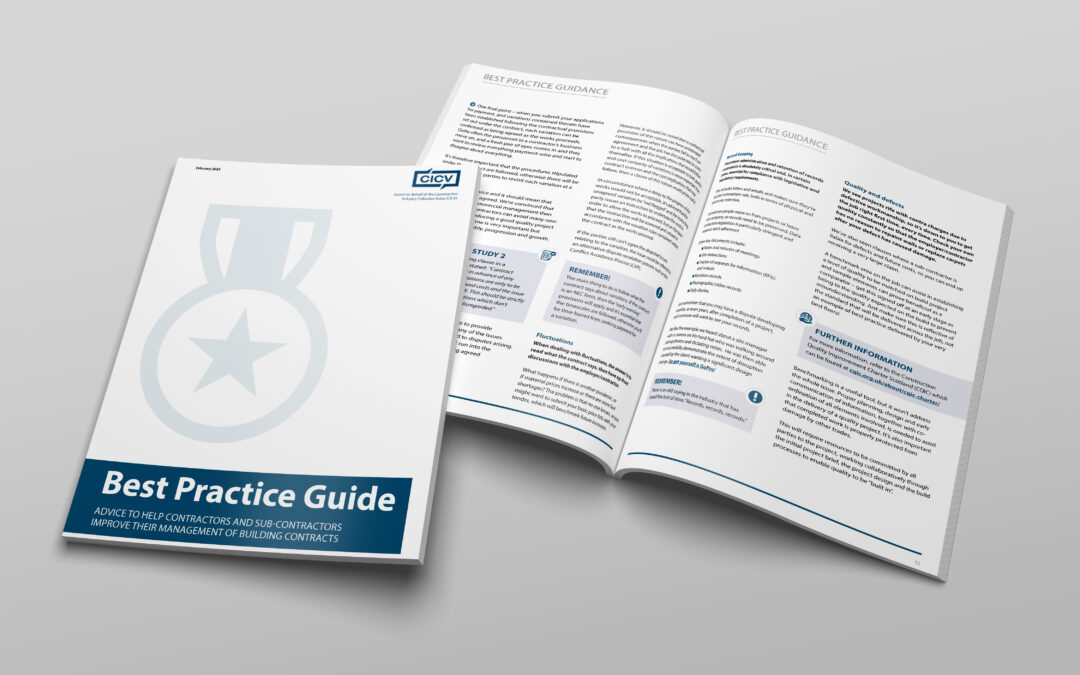
The Construction Industry Collective Voice (CICV) has followed up the results of its recent payments survey by issuing a new Best Practice Guide to help contractors and subcontractors improve cashflow and prevent costly and damaging disputes

Compiled by more than a dozen industry experts, the in-depth guide offers a wealth of practical information, demonstrating how to take control and proactively deal with a range of issues to enhance the entire contractual chain.

As part of its mission to improve the sector, the open source publication is being supported by an upcoming webinar on Friday 3 March that will see experts from the CICV talk through the guide and offer further insights into preventing financial disagreements.

Both resources have been produced in response to last week’s CICV survey on payment and cashflow issues in the industry in Scotland, which revealed that businesses are still suffering the scourge of late payments, outstanding retentions and unexpected charges.

Iain McIlwee, FIS Chief Executive said:

“It has been great to work colleagues from across the CICV to develop this guidance.  It is vital that the supply chain becomes more contractually aware and fully understands the risks they are being asked to carry.  This document is something every contractor should use to ensure that they and their teams are contractually aware and making good decisions.  It is a great training tool too for those joining the sector. The CICV is an amazing force for good and we are very proud to be part of it.”

Industry consultant Len Bunton, who is Chair of the CICV Pipeline and Commercial sub-group, said:

“Following the recent CICV survey, we concluded that the contracting supply chain needed some guidance on improving the commercial management of projects.

“Our highly-experienced contributors have walked through the construction process, giving their best recommendations on how to do things better day-to-day. A lot of the problems we deal with are self-inflicted, so we have gone back to the basics of improving the way in which commercial activities are carried out.

“This is not rocket science, but it’s clear the whole process needs a massive shake-up. Following publication of the guide and our webinar to take the supply chain through it, I am confident we can get change into the UK industry.”

As the latest initiative from the respected industry body, the Best Practice Guide is free to download from the CICV website and looks at a number of areas of interest, including:

  • Tender qualifications
  • Contract amendments
  • Payment schedules
  • Payment applications
  • Payments received and value
  • Variations
  • Retentions
  • Fluctuations
  • Notices
  • Record keeping
  • Quality/defects
  • Conflict Avoidance Process (CAP).

The guide has been drawn up by experts from a range of industry bodies, including Mr Bunton, Finishes and Interiors Sector CEO Iain McIlwee, Scottish Building Federation Commercial Director Ian Honeyman and the National Hub Programme Director of Scottish Futures Trust, David MacDonald.

Mr Honeyman said:

“Agreeing a mutually beneficial and collaboratively agreed contract is the first, vital stage in any construction project, and an area in which can lead to costly and damaging disputes.

“The CICV has therefore looked at the most common reasons for payments being delayed and changed, and has prepared this guide to help companies and individuals understand how to avoid them.”

CICV Chair Alan Wilson, who is also Managing Director of electrical trade association SELECT, said:

“Being paid on time and receiving what you’re due in full is essential for the survival and growth of every business, so this guide and accompanying webinar will help contractors and sub-contractors improve the commercial management of building contracts.”

The Best Practice Guide and webinar are the latest in a string of practical and constructive initiatives launched by the CICV since its creation as the Construction Industry Coronavirus (CICV) Forum in March 2020.

Made up of 28 trade associations, professional services bodies and companies, it has maintained a steady supply of information and practical advice to the sector as well as carrying out surveys, producing animations and posters, hosting webinars and maintaining close dialogue with Scottish Government ministers.

 The CICV Best Practice Guide can be downloaded here and you can register for the upcoming webinar here.


FIS position on omitting National Standards from ADB

FIS position on omitting National Standards from ADB

Government in the UK* through the Department for Levelling Up Housing and Communities (DLUHC), is consulting on changes to the guidance in England using Approved Document B (ADB).  This consultation includes the recommendation to remove national classes using the BS476 series as a method of demonstrating compliance.

The reason behind the change is that potential flaws in Approved Document B and the use of the national classification standards for Reaction to Fire and Fire Resistance were identified in both the Building A Safer Future work and during the Grenfell Inquiry.  As part of this, it was highlighted that the BS476 series standards have not been reviewed by the British Standards Institution (BSI) in detail for some time (typically over 20 years) whereas the European equivalents continue to be updated on a regular basis.

What this means for the Finishes and Interiors Sector
Currently, in England, the Building Regulations allow performance for Reaction to Fire and Fire Resistance to be declared through Classification using European standards.  In these standards, Reaction to Fire is classified as class A, B etc and Fire Resistance e.g. for non-load bearing walls as Integrity (E) and Insulation (I).  This is currently the preferred methodology for performance declaration in the current edition of the ADB.

The Classification process enables the use of a set of clearly defined rules (called “extended applications”) to determine scope of performance.  A classified system supports compatibility of products and is particularly helpful when considering interfaces and products being used to build a system.  Classification allows test evidence to be readily compared (e.g. standard wall constructions that contain dampers to protect penetrations around ducts which have not necessarily been tested in that configuration or the configuration of doorsets within walls).

The Regulations currently also allow performance to be declared for Reaction to Fire and Fire Resistance using test evidence by using BS476 series test standards.  The results of the tests are expressed using National Classes; in the case of Reaction to Fire they are described as Class 0 etc and FR minutes for Fire Resistance.  It is this element that Government are now proposing is removed.

Are there any concerns with this approach?
In Scotland they have already moved to the European classification system for Reaction to Fire.  The Scottish Regulators are awaiting the outcome of the English consultation before deciding on what to do regarding Fire Resistance.

So far, consultation with members (and experts from the wider sector), indicates that there is broad support for England to follow suit and omit the national classes for Reaction to Fire and adopt the European Classification system wholesale.

There is, however, some concern that this approach would be more problematic when looking at Fire Resistance.  Here manufacturers have been more heavily reliant on testing to British Standards.  This test evidence would all be rendered defunct by the proposed change and a substantial programme of retesting will be required to support the determination of products and systems commonly used today.

There are also gaps in the European test standards such as for partial penetrations (where they are currently not covered by a test standard) and external walls (BS 8414 is a national standard and as such is not listed in EN13501 series).  Currently this is addressed using BS tests, Ad hoc tests or assessments using test evidence in accordance with the PFPF Guidance – it is not possible to provide a European Classification by these means.

Designers currently rely heavily on these Ad hoc tests or Assessments using test evidence and rules set down by the Passive Fire Protection Forum (PFPF) Guidance to determine scope and meet the alternative provisions when tested to the relevant parts of BS476 set down in ADB.  This approach does not support Classification in accordance with BS EN 13501-2, furthermore current references in ADB require the exclusive use of classification and do not permit test standards in isolation to determine performance.

Wall systems and fire doors have been identified as key areas which will be greatly impacted by this change and a 12 month transition period has been proposed to allow changes to the new regime to be implemented.

The concern remains the impending lack of evidence (in the right format) may impact the ability of schemes to get through Gateway 2.

Where the difference between National classes for fire resistance and classified systems using EN standards can currently catch you out
Estimators and buyers should be aware that the permissible method to determine fire performance may differ depending on the descriptions used in the tender documents.  Getting this wrong could mean installation may be deemed non-compliant against the specification.

Although the BS EN 1364-1:2015 test and the BS 476: Part 22: 1987 tests have some similarities, and Approved Document B gives a parity between the two test methods this doesn’t mean a parity of specification i.e. a 60mins specification tested to BS 476 would not necessarily pass a 60mins test to BS EN 1364-1, there are differences in the standards and the major ones are:

a) Insulated thermocouples specified in EN 1364 series tests result in a longer build-up of the temperature before the test commences.
b) The furnace pressure is slightly more onerous in the BS EN 1364 series tests.
c) BS 476-22 makes no allowance for the partition height above its tested evidence.

To allow for these, system manufacturers have had to develop different detailing so that the specimen will pass the BS EN 1364-1 test which will impact both material and build costs.

You should always check what test evidence or performance class, or classification is required at the costing, scheduling and material ordering stage and that this information is clearly communicated with the site to ensure a complaint build and avoid costly disputes and remediation.

FIS opinion on the proposed changes
We agree with the general direction of travel which has been evident over the last two revisions of ADB and a consistent rules based approach will address any of the ambiguity that may have existed.

However, we are concerned that the unintended consequences of restricting evidence from ad hoc testing and structured assessments, where neither can define a classification, will lead to delays at Gateway 2 and 3 and potentially issues in demonstrating compliance on jobs across the wider sector. Until an approach on the matter can be agreed then interim arrangements will be necessary.

In addition, the current capacity and facility to test is unlikely to meet the demand to meet the Governments 12 month transition period.

Both of these substantial issues should be considered before making a decision to make these changes.

Next steps

The relevant passages from the consultation are copied below and a copy of the full consultation can be read here

To ensure that FIS can provide a considered response to the consultation please let have you views on the following questions.

Consultation questions for the removal of national classifications

Question 13 – Do you agree that the national classifications for reaction to fire should be removed from Approved Document B? [Agree/Disagree]

Question 14 – Do you agree that the national classifications for fire resistance should be removed from Approved Document B? [Agree/Disagree]

Question 15 – If you disagree, what evidence can you provide that outlines why the national classifications are still required. [Free text]

Question 16 – Do you agree that there should be a transitional period of twelve months? [Agree/Disagree]

Question 17 – If you disagree, how long should the transition period be and what is your evidence to support a longer or shorter transition period? [Free text]

Question 18 – Please outline any concerns you have about the withdrawal of the national classification with regards to fire resistance including potential impacts, such as on the fire door industry. [Free text]

In addition, can you please let us know how many tests would you need to carry out in order to offer classified fire resistant systems.

You can respond directly, but please do keep us informed of your views so we can include in the FIS response and surrounding discussions with stakeholder groups and Civil Servants by completing this poll here (no later than Monday 20 February).

We will hold an online meeting at 11:30 on Friday 10 March to hear your views before submitting our formal response.

To attend please email or if you have any questions, please email me joecilia@thefis.org or calling 07795 958780.

* The equivalent republic of Ireland consultation can be found HERE, interestingly this seperates new build and refurbishment.

Young workers’ safety highlighted during National Apprentice Week

Young workers’ safety highlighted during National Apprentice Week

National Apprenticeship Week is a timely reminder to enusre young workers are receiving the training and supervision they need. Workers are as likely to have an accident in the first 6 months at a workplace as they are during the whole of the rest of their working life.

Apprentices could be facing unfamiliar risks and are more likely to be new to the workplace. The HSE website has information on health and safety for apprentices. There is also a wide range of guidance on its young people at work website, including:

Industry still blighted by serious payment issues, CICV survey reveals

Industry still blighted by serious payment issues, CICV survey reveals

Construction businesses in Scotland are still suffering the scourge of late payments, outstanding retentions and unexpected charges, a new survey by the CICV has revealed.

Some 68% of respondents said their payment terms were altered negatively, with 60% claiming adjustments to payments were made with little or no explanation. And 69% of those surveyed said the time and cost of chasing outstanding moneys was their most significant problem when it came to payment.

The in-depth survey on cashflow and payments was undertaken to help an accurate picture of the current financial landscape in the Scottish construction industry.

Answered by those businesses which operate both as main and subcontractors in the public and private sectors, its key findings included:

  • 52% reporting that they still have problems getting retentions paid
  • 44% revealing that they had been hit with unexpected charges
  • 40% disclosing that they “always or often” had payments reduced
  • 30% saying payment delays have a “major impact” on their company.

Some 50% of respondents said they required external assistance to deal with payment disputes, with 54% saying they had referred a dispute to adjudication.

And 62% of those surveyed also said they were aware of project bank accounts, but only 17% had actually used them.

Len Bunton, Chair of the CICV’s Pipeline & Commercial sub-group, said:

“From these findings, it is clear – and also rather depressing – that cashflow and payment issues are still major problems in the construction industry in Scotland.

“It is especially frustrating to see so many financial disputed still going to costly adjudication and so little take-up of solutions like project bank accounts and the Conflict Avoidance Process – despite evidence that they do work and help to improve all-important cashflow.”

The survey also invited respondents to provide anecdotal evidence of cashflow and payment issues, along with suggestions of how to improve the current situation.

One said: “I’d like to see less subcontracting and more directly employed trades so there’s a joined-up process and effectively one large purse with collective ownership. The minute we sub-contract we divide, and priorities, focus and responsibility aren’t truly shared.”

Another told the poll: “We have problems with the public sector with too many authorisations that prolong and delay payment. A simplified process would help.”

A third added: “Many years ago, main contractors had to show proof of payment to sub-contractors before they received their next payment. Implementing such a practice for all sub-contractors would hugely improve the payment process.”

While a fourth respondent said simply: “Employers need to be held accountable and measured against the agreed payment terms within the building contract.”

The CICV is now devising a series of measures to help combat issues highlighted in the survey, including the imminent publication of a best practice guide. The collective is also planning an online webinar, offering contractors practical advice to help them avoid payment pitfalls.

David MacDonald, who is also a member of the CICV’s Pipeline & Commercial sub-group, added: “The many troubling issues highlighted by this survey simply reinforce the need for the industry to resolve matters before they escalate into disputes.

“The best practice guide, to be published by the CICV shortly, is designed to be used to eliminate poor commercial management and assist contractors to be much more alert to potential problems and risks.

“The planned webinar will also help contractors navigate the perilous waters of payment, which are clearly still littered with many difficulties.”

The survey is the latest in a string of practical and constructive initiatives launched by the CICV since its creation as the Construction Industry Coronavirus (CICV) Forum in March 2020.

Made up of 28 trade associations, professional services bodies and companies, it has maintained a steady supply of information and practical advice to the sector as well as carrying out surveys, producing animations and posters, hosting webinars and maintaining close dialogue with Scottish Government ministers.

  • A full copy of the survey can be download here.
FIS publish latest State of Trade Survey

FIS publish latest State of Trade Survey

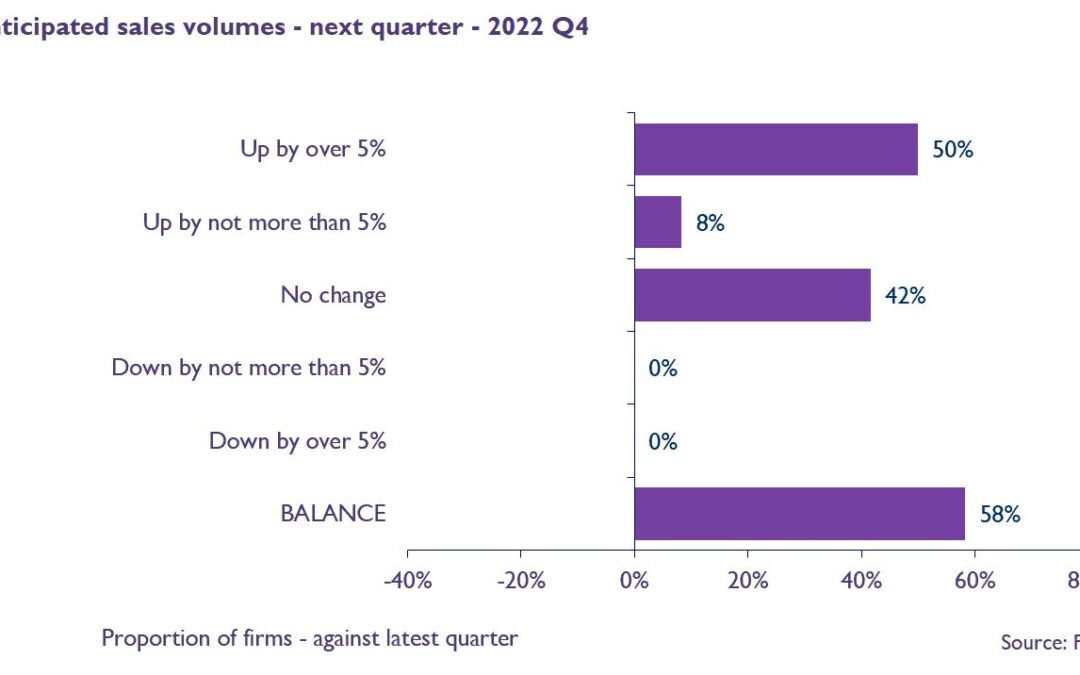
According the the latest FIS State of Trade Survey, the finishes and interiors finished 2022 relatively strongly with a net balance of 42% experienced growth in sales (against 17% in Q3) and 50% of those responding to the FIS State of Trade Survey reporting sales volumes increasing by over 5% (up from 33% reporting the same in Q3).

Looking ahead to 2023, again the picture for sales is more positive than in Q3 with those predicting growth swinging from just 20% to 75%.  There is, however, an acceptance that some projects will slip and not all will turn into boots on the ground and the overall impact on anticipated workload is that there is a slight downward trend with just 33% predicting growth (versus 45% in Q3).

The majority anticipate static market conditions for the year ahead, with a small swing in terms of those predicting a decline (up to 26% from 25% last quarter) resulting  in a net balance predicting growth of 9%.   This is slightly less optimistic than in Q4 2021 when a net balance of 18% were predicting an increase in workloads.

You can read the full findings, including an update on inflation and investment in the FIS State of Trade Survey Q4 2022 here.

FIS data is absorbed into the wider CPA State of Trade Survey – you can see the full results and findings here.

Consultations launched to support Building Safety

Consultations launched to support Building Safety

The Health and Safety (HSE) and Building Safety Regulator (BSR) have recently launched several consultations and research in connection with building safety.

Professional Conduct Rules for Registered Building Control Approvers (RBCAs)
The BSR will be operating as part of the HSE from April 2023. Building control professionals will have to register with the BSR to perform building control work in England. The professional conduct rules sets out standards of professional conduct and practice that registered building control approvers are expected to meet.

The professional conduct rules are mandatory principles of conduct and standards applying to all who wish to register with the BSR as Registered Building Control Approvers (RBCA) in the private sector.

The HSE are seeking views on the proposals and the consultation closes on 17 February 2023.

Draft Code of Conduct for Registered Building Inspectors
Building control professionals will have to register with the BSR to perform building control work in England. The code of conduct sets out standards of professional conduct and practice that registered building inspectors (RBIs) are expected to meet.

The code of conduct are mandatory principles of conduct and standards of behaviour for RBIs, whether they work in the private or public sector.

HSE are seeking views on the proposed code of conduct and the consultation closes on 17 February 2023.

Managing Building Safety
The BSR is inviting views on their information document that highlights the necessary competency for those managing high risk buildings (HRBs), including a summary of the recent British Standard, publicly available specification (PAS):

  • PAS 8673:2022 Built environment – Competence requirements for the management of safety in residential buildings – Specification

 The consultation will close on 24 April 2023 and can be found here.

Building Safety Competence Information for Principal Contractors and Principal Designers
The BSR is inviting views on their information document that highlights the necessary competency for the new principal designer and principal contractor roles, including a summary of the recent British Standards, publicly available specifications (PAS):

  • PAS 8671:2022 Built environment – Framework for competence of individual Principal Designers – Specification
  • PAS 8672 Built environment – Framework for competence of individual Principal Contractors – Specification

 The consultation will close on 24 April 2023 and can be found here.

HSE Research Project – Accountable Person and Principal Accountable Person
The HSE has commissioned an independent research agency, Kantar Public, to interview people working in private and public sector housing organisations who will be an Accountable Person or Principal Accountable Person; will make decisions about the role; are knowledgeable about the role; and/or who will work on important aspects of the role (such as building registration, resident engagement and complaints handling).

All interviews will be conducted by independent, experienced researchers at Kantar Public. For further information or to register your interest to participate in this research, please email marios.zampetis@kantar.com

FIS announces Innovation Awards Shortlist

FIS announces Innovation Awards Shortlist

FIS has announced the shortlist for its inaugural Innovation Awards. The awards aim to shine a light on innovation, debunking the myth that our sector is not innovative.

The Awards comprise four categories, Digital, Sustainability, Product-Fit Out and Product – FF&E. A judging panel was set up for each category, who indpenedetly assesed all entries.

Digital

  • FireDNA – Monitoring Passive Fire Products
  • Chalkstring
  • Performance Based Pay

Sustainability

  • Breathaboard
  • Awallsz Prefabricated Solutions
  • DESSO Origin

Product – Fit Out

  • eekowall
  • Siderise MC Mullion Overclad
  • Drywall Pro-Cut

Product – FF&E

  • Rockfon
  • Wiesner-Hager
  • Yo-Yo DESK Ltd

Congratulations to those who made the shortlist, and thank you to everyone who entered. We will be announcing the winners at the FIS Awards Ceremony on 27 February in London. Reserve your place here.

CPA forecasts recession in construction for 2023

CPA forecasts recession in construction for 2023

The construction industry is expected to endure a recession this year after two strong years for the industry. According to the Construction Products Association’s Winter Forecasts, construction output is expected to fall by 4.7% in 2023 before recovering slowly in 2024 with growth of just 0.6%.

The construction industry is not immune to the impacts of a wider UK economic recession, rising interest rates and inflation. Private housing new build, the largest construction sector, and private housing repair, maintenance, and improvement (rm&i), the third largest sector, are forecast to be the worst affected sectors this year. Falls in activity in these areas are expected to be partially offset by continued growth in infrastructure, the second largest sector, which is already at historic high levels of activity. Even here, however, there are growing concerns over the impacts of double-digit construction cost inflation. Given financial constraints for government, this means that we are likely to see the value of activity expected previously but not the volume.

Private housing is forecast to be the sector most affected by the downturn and fortunes for the sector over the next 12-18 months are likely to go one of two ways. The main forecast anticipates a soft landing for the housing market, which involves a sharp decline in demand during 2022 Q4 and 2023 Q1 before a recovery in demand this Spring. Even still, private housing output in 2023 is forecast to experience an 11.0% fall as housebuilders focus on completing existing developments rather than starting new sites. This fall is primarily due to rising mortgage rates, falling real wages and poor consumer confidence. Plus, there is now a less friendly government policy environment for housebuilders, given the end of Help to Buy, the Residential Property Developer Tax and the Building Safety Levy. The largest impact of the decline in demand is likely to be on property transactions, which are anticipated to fall in 2023 by around 20% whilst house prices are anticipated to decline by 8% -10%. After two consecutive years of double-digit growth, house prices will return to levels seen around a year ago. However, if demand doesn’t recover from Spring as mortgage rates continue to fall, private housing could fall even further, as is outlined in the CPA’s Lower Scenario.

Private housing rm&i output was driven to historic high levels in 2021 due to increased working from home and a ‘race for space’. With falling real wages, poor consumer confidence and double-digit construction cost inflation, many homeowners were quick to start delaying smaller, discretionary improvements work and output has been falling since March 2022. Larger improvements work, however, continued last year as households had pencilled in the finance for it at the start of 2022. Given further expected falls in real wages and increases in mortgage payments for many households this year, a further decline in private housing rm&i output of 9.0% is forecast in 2023. This will focus on a fall in larger improvements activity, before slow growth of 1.0% in 2024 as activity recovers in line with the wider UK economy. Unsurprisingly, however, one area of private housing rm&i that continues to remain strong is energy-efficiency retrofit; given homeowner concerns over energy prices, insulation and solar panel installations activity is currently buoyant.

Infrastructure continues to go from strength to strength, reaching historic high levels in 2022 as it benefitted from multi-billion pound projects such as HS2, the Thames Tideway Tunnel and Hinkley Point C as well as long-term frameworks activity in sub-sectors such as rail, roads and energy. Going forward, further growth in infrastructure output is expected but it is likely to be slower than in previous years due to cost inflation and financial constraints. The Chancellor stated clearly in the Autumn Statement that capital expenditure would be maintained in cash terms. In the near-term, this is likely to mean that current central government projects go overbudget given double-digit construction cost inflation. Also, there will be hesitancy from the public sector signing up to new projects due to uncertainty over costs spiralling further. In addition, financially constrained councils are likely to cut spending on new projects to cover the rising costs of essential repairs and maintenance. In the medium-term, projects towards the end of the government’s Spending Review are expected to be pushed back into the next review period due to budgetary constraints. After 4.9% growth in 2022, infrastructure output is forecast to rise by 2.4% in 2023 and 2.5% in 2024.

CPA Economics Director Noble Francis: “The construction industry has enjoyed a buoyant two years since the first national lockdown largely shuttered the industry back in Spring 2020 and activity still remains high for the moment. Overall, however, construction output is forecast to fall by 4.7% this year. It is worth keeping in mind the broader context that this is not 2008 and the decline is nowhere near the fall in output that occurred in the last recession. Looking back 15 years ago, construction output fell by 15.3% over two years during the global financial crisis.”

“Private housing and private housing rm&i, two of the three largest construction sectors, are highly dependent on the wider UK economy, interest rates, real wages and consumer confidence. So, as the UK economy falls into recession, interest rates rise, real wages fall and consumer confidence remains poor, construction output will fall sharply in these sectors. These falls will be partially offset by continued growth in infrastructure but that means that it is more important than ever that government maintains its commitments to meeting its own targets by investing in levelling up, its infrastructure pipeline and transitioning to Net Zero.”

Amendments to the Payment Practices and Performance Regulations 2017

Amendments to the Payment Practices and Performance Regulations 2017

This week Kevin Hollinrake MP, Minister for Enterprise, Markets and Small Business Government opened a consultation into Payment Practices and Performance Regulations 2017.  The consultation is looking primarily at whether the Regulations should be extended beyond their current expiry date of 6 April 2024. It also provides an opportunity to consult on other potential amendments and improvements to the Regulations resulting from the views expressed by those who responded to the recent statutory review.

The consultation sets out proposals on:

  • amending the expiry date to extend the Regulations beyond 6 April 2024
  • including an additional value reporting metric
  • referencing payment reporting in a company’s director’s report
  • a clarification of how supply chain finance is reported
  • including a new metric on disputed invoices
  • retention payments in the construction sector

FIS fed into the initial review via the Small Business Commissioner and will be responding to the consultation on behalf of our membership.

FIS continues to speak out on poor practice witnessed in construction (see recent article in Construction News – FIS CEO calls out Payment Practices).  We will be also be drawing on research recently conducted with the University of Reading that has highlighted “46% of subcontractors reported waiting for 40-59 days in comparison to only 24% of main contractors. Perhaps most strikingly, only 6% of specialist subcontractors reported being paid within 30 days.”

Specifically on retentions the consultation is exploring:

Question 6: Do you agree that the Regulations should be amended so that payment practice and performance reports should include information on the standard retention payment terms in qualifying construction contracts?

Question 7: Do you agree that the Regulations should be amended so that payment practice and performance reports should include statistical information on retention payments?

But, it should open up an opportunity to raise more broadly concerns over retentions and our response will draw on questions raised in the research conducted with the University of Reading.

If you are interested in feeding directly into the consultation, you can access all the information here.  Please do send a copy of any response or thoughts that you would like embraced in the FIS response to iainmcilwee@thefis.org.  Equally if you want to talk through your views, don’t hesitate to call Iain on 0121 707 0077.

You can see the current FIS position on retentions here along with our wider approach to concerns over procurement and payment fairness in the sector.