
Material Supply Chain Group Statement

Material Supply Chain Group Statement

Statement from John Newcomb, CEO of the Builders Merchants Federation and Peter Caplehorn, CEO of the Construction Products Association, co-chairs of the Construction Leadership Council’s Material Supply Chain Group.

The latest statement below from the Construction Leadership Council’s Material Supply Chain Group (formerly Product Availability Group) continues to show good levels of product availability as we move into the final quarter of the year.

Most regions reported stronger sales prompted by a slight increase in house building activity. This has raised demand for bricks and roof tiles, but their supply has not been unduly impacted, and there are generally good levels of availability across the board. Previously reported issues regarding aerated blocks are being managed by allocated supply. This is likely to continue until the end of the year as manufacturers rebuild stocks.

In the week before the new Chancellor’s first Budget, the main concerns flagged by the Group centred on the potential impact of the government’s ambitions for new housing and infrastructure when, over the past 18 months, manufacturers have adjusted capacity to match far lower levels of demand. This includes construction products manufactured in the UK but also materials, such as structural timber, which are predominantly sourced from European suppliers, and are subject to demand from many countries, not just the UK. Demand world-wide has declined in the last two years leading to the closure of older facilities, the loss of skilled labour, and very low stock levels. This may be problematic if there is a rapid surge in demand for construction products as we progress through 2025.

Understanding the complexity of the construction materials supply chain and the limitations this presents, will be essential to the successful planning and implementation of the government’s plans for growth.

The Group is undertaking research to establish capacity amongst UK producers and assess how quickly this could be increased to accommodate the level of demand required to achieve 300,000 new homes a year. The Group also recognises the global nature of the full construction supply chain, which is more difficult to assess.

Despite these concerns, the latest industry forecasts expect any notable growth prospects, particularly for housing activity, to occur in the second half of 2025. Having noted the complexity and length of the material supply chain, members of the group strongly advocate that industry uses this time to plan in advance, work closely with your supply chain, and forecast and communicate your requirements early with suppliers, distributors and builders’ merchants. Collaborative, ongoing communication throughout the whole supply chain is mutually beneficial and essential to a healthy, productive UK construction industry.

FIS announces new elected Board members, as Ian Strangward takes the helm as President

FIS announces new elected Board members, as Ian Strangward takes the helm as President

At its AGM on 7 November, FIS announced its newly elected Board Directors, along with its new President.

Ian Strangward, Managing Director of contractor member Architectural Wallsz, has been on the FIS Board of Directors for three years and will now start his two-year Presidency, following his appointment by his fellow directors.

Ian has more than 30 years’ experience in the construction industry and at his first address to members, Ian said:

“With the committed team and strong community we have built, I look forward to continuing to work with my fellow Board members in ensuring FIS continues to be member led and is making a difference for individual members and the sector as a whole.”

Ian also thanked outgoing President, Philip Brown for his phenomenal leadership and dedication to the industry. Philip will remain on the Board as Immediate Past President.

Also joining the Board from 7 November as executive directors are, Andrew Measom of Measom Dryline and Helen Tapper of Tapper Interiors, both contractor members of FIS, and Alan Brown of Fire DNA, Lucia Di Stazio of Nevill Long, Richard Mason of British Gypsum and Nigel Watkins of Rockfon, all supplier members of FIS.

Iain McIlwee, FIS Chief Executive welcomed new Board members and said:

“We’re delighted to announce these appointments to continue the strong leadership at FIS and take FIS on to its next chapter of growth and success.”

Full details on the FIS Board is available at https://www.thefis.org/about-us/board/

FIS members can read the minutes of the AGM here.

CITB Skills and Training Conference heading to Wales

CITB Skills and Training Conference heading to Wales

CITB is hosting its next Skills and Training Conference in Wales on 23 January.

Following the success of CITB’s Skills and Training Conferences in Manchester and Scotland in 2024, this one-day event in Cardiff is the latest step in a revitalised engagement programme for employers and training providers from CITB’s Customer Engagement team. CITB’s executive team will be there to meet employers, training providers and other industry stakeholders.

The conference will share key information and updates, discuss challenges, and outline how the construction industry can work towards narrowing the skills gap.

Construction companies and employers can find out more about hot topics like the Building Safety Act and Social Value, while receiving one-to-one support on accessing CITB funding and services, including the new Employer Network initiative.

Training providers, meanwhile, will have the opportunity to hear about the industry’s major opportunities and meet construction companies and industry trade federations.

Julia Stevens, Engagement Director Wales, CITB, said:

“We’re extremely excited to announce that the CITB Skills and Training Conference is heading to Cardiff in January. It’s an excellent opportunity for construction companies to find out more about the training and funding available, and to discuss how we can collectively address the skills gap.

“We’re also looking to engage more training providers in this important conversation, strengthening our network and creating a more robust future for everyone involved.”

The Skills and Training Conference Wales will be held at voco St. David’s Hotel, Cardiff on Thursday, 23 January 2025.

To book your place, visit https://skillswales.citbevents.co.uk/home

Skills Hub

The Skills Hub brings together details of courses specific to the finishes and interiors sector, making accessing and booking training quick and easy. In addition, it provides information on sector careers, apprenticeships and funding, as well as access to e-learning, CPD and other training.

Changes to CSCS Green Labourer Card

Changes to CSCS Green Labourer Card

The Green Labourer card is evolving from February 2025.
The card’s duration will initially be two years instead of five. However, businesses that can verify their commitment to a labouring role will have the opportunity to extend the card’s lifespan to a full five years.
Starting from the 1st of February, 2025, the Labourer card, upon first application, will be valid for two years. Those continuing in labouring roles can renew the card for five years, provided they present proof of employment in a labouring role.
In addition, the CITB Health, safety, and environment test, required only for the initial two-year card application, will now be valid for three years, making it applicable for renewal.
Existing Labourer card holders seeking renewal from February onwards will qualify for another five-year card upon presenting the necessary evidence.
For further discussion, feel free to reach out to Marie Flinter at marieflinter@thefis.org.

Lens Blog – Navigating the Turbulent Waters of the UK Construction Industry

Lens Blog – Navigating the Turbulent Waters of the UK Construction Industry

What an absolute rollercoaster the construction industry in the United Kingdom has experienced in the last 4 to 6 weeks, and I want to talk about some of the issues that I see that have emerged, and to consider what may happen in the future.

The background of course has been the demise of ISG Construction Ltd in administration in the latter part of September 2025 and the Administrators have published a Statement of Affairs which makes absolutely grim reading with the supply chain being owed significant sums of money and they are not likely to receive anything. In my next Blog I may be able to update readers on what has emerged but as at 26 October 2024 it is not clear how some of these major projects will be recommenced and completed and what the impact will be on the supply chain.

In the past few days, we have seen the fallout of two subcontractors also going into administration as a result of the amounts of money that they were owed. As to whether or not there were other issues affecting these organisations, remains to be seen.

Want to see the full article?

FIS members can access the full article

CLC call Halt on Contract Amendments

CLC call Halt on Contract Amendments

The Construction Leadership Council (CLC) has published a hard hitting statement calling a halt on the ongoing practice within the construction sector, of industry-approved forms of contract being amended by clients and their solicitors to introduce terms that are onerous and/or difficult to insure.  This statement has been issued and is the conclusion to ongoing work through CLC Professional Indemnity Insurance Working Group.

The Construction Leadership Council (CLC), as part of the Building Safety Workstream, established a Working Group to focus on Professional Indemnity Insurance.  The key objective of the group was to understand and look to address concerns over the cost, availability and limitations in insurance cover for all parts of the supply chain, from principal designer and contractor through to consultants and specialist contractors. As part this work the PII Taskforce supported an International Underwriting Association event on 31st January 2024 entitled “Competence in the Construction Sector”.  The event reviewed new regulatory requirements in the Building Safety Act.  Speakers were drawn from the construction, governmental, regulatory, legal and insurance sectors with particular focus on competence requirements and how they may help to reduce risk in the construction process.  Wider inference of the Building Safety Act and what can be learned from recent court cases was also covered.

An open panel debate followed looking at the implications on the insurance process.  It was recognised within these discussions that, whilst the work on competence is encouraging and should help to reduce risks moving forwards and hence availability of cover.  Concerns were raised over design liability being pushed deeper into the supply chain leading to confusion around accountability for design elements.  It was noted in discussion that heavily amended contracts add to confusion around risk and contingent risk, impact insurability and potentially create gaps in insurance cover for specific elements (for example, interface details and fixings).

Following exchange between the Insurance Sector and representatives of the CLC confirmed that there is a need to highlight this risk.  The key assertion in the statement is that “standard form building and engineering contracts and professional services contracts issued by contract-producing bodies, should be used by clients with no amendments, except where necessary in the context of project-specific risks and relationships.  The CLC believes that onerous amendments make contracts unviable, reduce competition, increase risk and lead to unnecessary legal costs required to review legal liabilities created by the amendments”.

Introducing the statement Samantha Peat, Chair of the CLC PII Working Group said:

“A sensible approach will simplify risk allocation, give clarity to the project team and their PII providers, and address the concerns for which the CLC PII Working Group was originally formed, namely, to address concerns about cost and efficacy of Professional Indemnity Insurance in Construction. It will also support the focus on accountability, competence and the need for better information management called for by Dame Judith Hackitt and enshrined within the Building Safety Act and the wider reform of the Building Regulations.” 

FIS CEO Iain McIlwee responded:

“This is a massive statement from the Construction Leadership Council – we have to stop this routine amendment of the standard contracts.

This statement echoes the long held concerns of the FIS Community and I would like to personally thank Samantha Peat and colleagues in this Working Group for the amount of time that has gone in to establishing the forum and drawing the right people together to have the open and pragmatic discussion with the insurance industry that has resulted in this clear an unambiguous statement.

We have a legislative process that focusses on duty and a contractual process that focusses on passing the buck – this is bound to create tension. Boundaries need to be reset or we are left with impossible problems, uninsured elements and ultimately the potential for stranded assets and uninsured buildings. T

his is Leadership and we applaud the CLC and supporting representatives from the Insurance Sector for taking a strong line.  The statement in itself will not change the world, but what we do with it can. For me the clear message here empowers the Responsible No by starting to spotlight the Irresponsible Ask. Contract amends are at the heart of the cultural concerns in construction – change is inevitable and has I believe been catalysed today”

The full statement can be read here.

Through the FIS Responsible No Campaign, the organisation is offering subsidised contract reviews and asking members to report (particularly public sector) contracts that are subject to heavy amends and also provide details of Irresponsible Contractual Clauses so that FIS can address behaviours directly with the client.  You can find out more  about the FIS Responsible No Campaign here.

FIS Extends the Responsible No to include PQQ Systems

FIS Extends the Responsible No to include PQQ Systems

FIS has, since it’s outset supported the introduction of the Common Assessment Standard.  This new approach was launched in 2019 by Build UK and the Civil Engineering Contractors Association following concerns that the proliferation of suppliers and duplication of effort and support associated with pre-qualification schemes.  Through it’s introduction, the claim was that this approach will help the industry to £1bn by eradicating duplicate fees and inefficiencies.

The overall impact, whilst positive (over 22,000 companies now have the accreditation and a growing number of companies have formally adopted use)  has not met the ambition and for this reason FIS is adding a Common Assessment call to action to the Responsible No campaign.  Underpinning why this is important FIS CEO, Iain McIlwee stated:

“The Responsible No isn’t about digging our heels in, but starting to identify and address behaviours and processes that are barriers to better.  This is a clear example of that.  The waste here in fees and time is obvious, we have collectively agreed as an industry a better approach and implemented a new standard to do this.  We all need to do our bit in helping to raise awareness and normalise this new approach.  The reality is we can’t blame people for not doing stuff they may not know about or understand – this is all about helping to identify and explain why something is an Irresponsible Ask.

This is a particularly important time for this intervention with the use of PQQs being linked to new requirements for Organisational Capability enshrined in the Building Regulations and the potential for further proliferation as businesses look for angles to make more money rather than support a collective effort.”

To support this effort, FIS have prepared new guidance on the Common Assessment Standard for members and also a template email to recommend adoption on projects where a particular Pre Qualification scheme is listed as required.  Where there is continued resistance to adoption, FIS has also set up a whistleblowing process to enable members to help FIS identify any resistance so that this can be understood and hopefully addressed moving forward.

Finally FIS is asking members to help take stock of where we are now at in terms of impact of the Common Assessment Standard by completing the FIS Pre Qualification Impact Survey here.  Information will be used to support this collective effort and to help deliver change.

The FIS Common Assessment Standard Toolkit is available here

You can find more information on the FIS Responsible No Campaign here

Confusion over Higher Risk Buildings Definition and Roof Gardens

Confusion over Higher Risk Buildings Definition and Roof Gardens

In a recent residential property tribunal, the roof terrace at Smoke House and Curing House in Hackney Wick, East London was deemed by the tribunal to be a seventh storey bringing it in scope of the definition of a higher-risk building under the Building Safety Act.

The case was brought by a group of leaseholders against the landlord (Monier Road Limited) to ensure remediation work was completed.

The tribunal agreed that Smoke House and Curing House should be classed as higher-risk “for the purposes of Part 4 of the Building Safety Act”:

“In our view, it should be registered with the Building Safety Regulator and have a Principal Accountable person appointed. This is not for the Tribunal to specify under the terms of a Remediation Order, but it is considered essential that this building (both Smoke House and Curing House) are managed under the Higher-risk Building regime. The remedial works should be carried out with an application to the Building Safety Regulator as Local Authorities and Building Control Approvers (previously known as Approved Inspectors) are not permitted to work on Higher-risk buildings.”

The Ministry of Housing, Communities and Local Government and the Building Safety Regulator are currently considering the views expressed by the Tribunal in the recent First Tier Tribunal decision (PDF, 328KB) that roof gardens should be classified as a storey when determining whether a building meets the height and storey criteria under the Higher-Risk Buildings (Descriptions and Supplementary Provisions) Regulations 2023.

It is important to note the Tribunal itself acknowledged it was not within its jurisdiction to formally determine whether the building being considered was a higher-risk building. Until stated otherwise, the sector and regulatory bodies should continue to refer to existing government guidance.

Saving Lives: The Critical Importance of Defibrillator Training and Awareness

Saving Lives: The Critical Importance of Defibrillator Training and Awareness

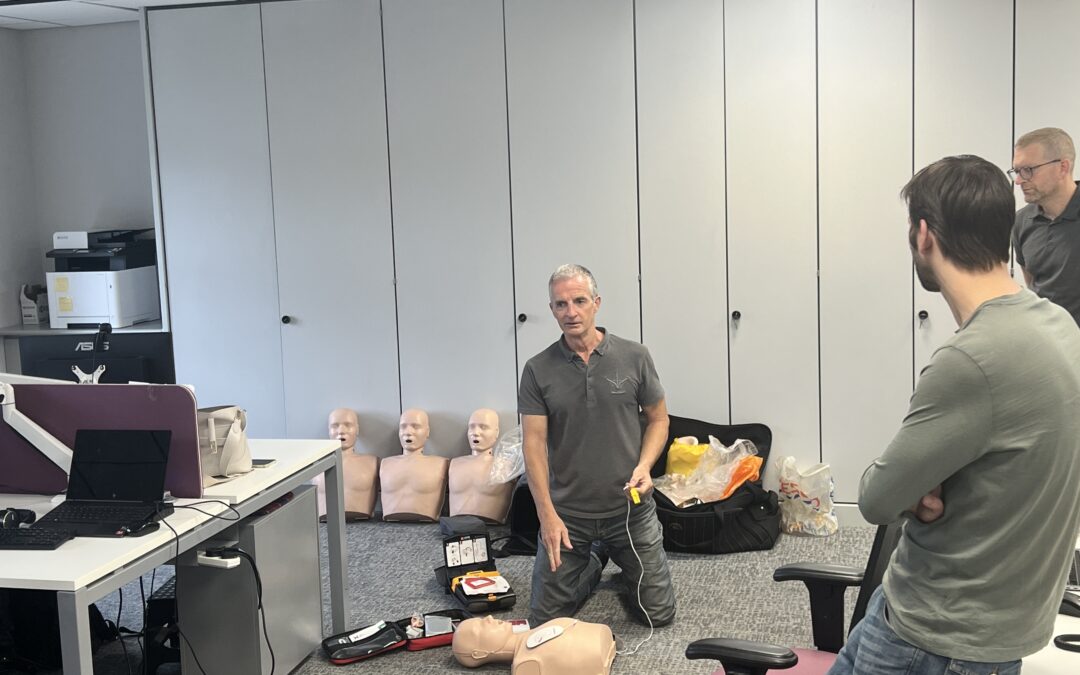
In readiness for Restart a Heart Day, the FIS (Finishes & Interiors Sector) team undertook Basic Life Saving training to understand what to do when faced with an emergency situation. Here, Hermione Neale, FIS Marketing Apprentice, highlights what the team learnt and how early defibrillation can save lives.

In this article, I will cover the effectiveness of defibs, the action to take in an emergency, what CPR (Cardiopulmonary Resuscitation) is, The Circuit and how to access defibrillators, storage of defibrillators, number of first aiders, statistics and Cardiac Awareness week.

Giving people a chance

Statistics show that using a defibrillator within the first minute can have a survival rate as high as 90%, however every minute that passes after this, the survival rate drops by 10%. This proves the effectiveness of defibrillators and how much of a difference they can make in saving lives. With manual compressions the survival rate is between 5-10%, with 1 in 10 people surviving resuscitation.

CPR (Cardiopulmonary Resuscitation) is rescue breaths and compressions in an attempt to bring back the patient’s heartbeat and breathing. CPR (Cardiopulmonary Resuscitation) is different for adults, children over a year and infants under a year. A defibrillator is a device used to restore a regular heartbeat by an electric current.

In the case of an emergency check your surroundings for danger, begin compressions, call 999, call for a defibrillator, turn on the defibrillator, cut off clothing covering chest, place pads as shown, follow defibrillators verbal instructions, if there are signs of responsiveness place them in the recovery position and monitor.

Finding a Defib

The Circuit is the national defibrillator network that is used by the 14 ambulance services across the UK. This allows ambulance services to locate the nearest defibrillator upon arrival of a cardiac arrest. These defibrillators are connected to each of the 14 ambulance services and there are an estimated 90,000 defibrillators currently in the UK. Through calling 999, the operator can tell you where the nearest defibrillator is and then what the code to access it is.

Defibrillators should be stored in a case to protect it from damage and the recommended temperature range is between 0 to 50 degrees. The AED needs to be kept within this temperature range due to the adhesive gel on the pads melting and not sticking to the patient properly, therefore preventing the electrical shock from getting to the heart. In the winter months the defibrillator should be stored in a heated outdoor cabinet. Defibrillators should be checked every day including the batteries to ensure that the defibrillator is ready for use.

It could be you

Every year in Britain, 30,000 people have cardiac arrests outside of a hospital and statistics show that 1 in 10 patients survive due to lack of education and training. 72% of cardiac arrests happen at home and 15% happen at a workplace. Half of out of hospital cardiac arrests are witnessed by a bystander and 7 out of 10 attempt CPR (Cardiopulmonary Resuscitation). However, public defibrillator use is reported at being used less than 1 in 10. The average ambulance response time is 6.9 minutes, which means by the time a call is made and the wait time for the ambulance, the patients survival rate from defibrillation will have dropped by 70%. In 2018, 59% of the public were trained in CPR (Cardiopulmonary Resuscitation) training, however only 19% knew how to use an AED, which means that the chance of cardiac arrest patients has a significantly lower chance of survival.

In a workplace with 25 employees, the minimum legal requirement is one appointed first aider.

This information and statistics show how important informative first aid is to the survival rate of cardiac arrests. It is important for employers to take the time to train their employees and ensure they all have awareness surrounding cardiac arrests, the signs and how to use a defibrillator.

Restart a Heart Day

Restart A Heart Day took place on the 16 October. The Day helps raise awareness of cardiac arrests. This program encourages confidence in CPR (Cardiopulmonary Resuscitation) practice and allowing them to learn lifesaving skills. The focus for this year’s Restart A Heart Day was to aid equal access to defibrillators, which will increase the chance of survival rates. This is now an internationally celebrated day.

Preventing deaths from cardiac arrest

Find out more and see some key questions and answers