0121 707 0077

CSCS Smart Check app is already improving site safety

CSCS Smart Check app is already improving site safety

Launched in April, the CSCS Smart Check app is already improving site safety and card checking procedures on UK construction sites.  Developed by the 38 schemes displaying the CSCS logo, CSCS Smart Check allows those responsible for checking cards to verify all 2.1 million cards using one app on their smartphone or tablet.  You can watch a short video here.

 Having already improved card checking procedures at site gates, CSCS Smart Check now includes a number of additional card schemes that display the CSCS logo and an improved process for reporting cards that may have been obtained fraudulently.

Since its launch, CSCS Smart Check has been downloaded over 15,000 times and is primarily used by construction site managers and gatekeepers to ensure people are qualified and have the right training for the role they do on site.  The app was designed and implemented to meet Construction Leadership Council requirements, which demand the development of a solution that uses smart technology to validate all cards displaying the CSCS logo.

 Currently CSCS Smart Check functions as a standalone application, incompatible with existing site entry systems such as turnstiles and desktop card readers.  There is no immediate impact on existing card checking operations and employers can continue to use these systems if required.  Over the coming months, the app’s project team will reach out to employers and stakeholders to begin the process of enabling existing card checking systems to become compatible with CSCS Smart Check.  The app is free and available to download from the App Store and Google Play. For more information visit www.cscs.uk.com/smartcheck.

Improvements and simplifications to apprenticeships from August 2022

Improvements and simplifications to apprenticeships from August 2022

The Department for Education are introducing a number of changes to apprenticeships through the 2022 to 2023 funding rules:

  • DfE are making it simpler for individuals to accelerate their apprenticeship.  By improving how providers assess prior learning and experience at the start of the programme and funding providers to deliver a robust assessment apprentices will be able to cut out training they do not require and complete their apprenticeship more quickly.
  • DfE are introducing a new minimum number of off-the-job training hours.  From 01 August, the minimum time spent on off-the-job-training will no longer be linked to the apprentice’s working hours.  Instead, DfE will have a consistent figure, irrespective of the hours worked by the apprentice. This will be 6 hours per week.  This change will simplify the reporting for providers and create a level-playing field among apprentices who are on the same standard but working different hours.
  • DfE are changing English and maths requirements for those Level 2 apprentices who start with the lowest level of prior attainment in English and maths.  People who start a L2 apprenticeship without L1 English and maths will no longer need to automatically attempt L2 English and Maths tests to complete their apprenticeship.

The apprenticeship funding rules are published in draft on gov.uk to give providers and employers an opportunity to provide feedback on how we can make them better understood.  Please email any suggestions to fundingrules.comments@education.gov.uk by 24 June 2022.

Skills Hub

The Skills Hub provides information on sector careers, apprenticeships and funding, as well as access to e-learning, CPD and other training.

Consultation opens on Higher-Risk Building Regulations

Consultation opens on Higher-Risk Building Regulations

The Department of Levelling Up, Housing and Communities has published a consultation on the Higher-Risk Building (Descriptions and Supplementary Provisions) Regulations.

This consultation is the first in a series of consultations on regulations which sit under the Building Safety Act 2022. It covers regulations which will complete the definition of higher-risk building for the purpose of the new more stringent regime.

The Building Safety Act 2022 sets the height threshold for buildings included in the new regime as at least 18 metres in height or at least 7 storeys.  .The Act means that buildings meeting this height threshold with at least two residential units will be within the scope of the new regime when they are occupied.   Government have previously consulted on the height-threshold and this is now set in primary legislation, they are not seeking further comments on this through this consultation.

This consultation is seeking views on:

1. The overall definition of a building for the purposes of

a:        the design and construction and
b:        occupation parts

of the new more stringent building safety regime being brought forward by the Building Safety Act;

2. Which buildings are included and excluded in relation to the design and construction part of the new regime and the definitions of these buildings;
3. Which buildings are excluded in relation to the occupation part of the new regime and the definitions of these buildings; and
4. The method for measuring height and number of storeys.

A key point to highlight for members is that the Act covers any construction work in a building at least 18m or at least 7 stories that includes two residential units. 

Currently FIS does not see any major concerns in the proposals, which are consistent with the information published with the Building Safety Act and in keeping with the original proposals set down in Building A Safer Future.  FIS is, however, seeking views of our membership should you wish us to raise any points through the consultation.  You can play these in directly too via the consultation website.

If you have any questions, or want discuss any aspect of the consultation, please contact Iain McIlwee iainmcilwee@thefis.org

Key points from the consultation:

Part one: definition of a building

The proposal is that the regulations will define what is meant by ‘building’ under both the design and construction and in-occupation parts of the new regime.

The consultation proposes that the regulations define ‘building’ as including any structure or erection, and any part of a building, as so defined, but does not include plant or machinery comprised in a building as defined in the Building Act 1984.

This echoes the language found in The Building Act 1984 and is an established definition recognised in the sector and currently used for building work.

Part two: including and excluding buildings from the design and construction part of the new regime

The consultation also sets down which buildings are considered higher-risk during the design and construction phase of the building life-cycle and are therefore subject to the new building control regime, mandatory occurrence reporting, dutyholder and golden thread requirements of the new regime.

The proposal is to define higher-risk buildings under section 120D of the Building Act 1984 as including:

  1. buildings which contains at least two residential units (the Building Safety Act defines residential unit as a dwelling or any other unit of living accommodation, for example a flat or rooms in a university hall of residence where amenities are shared);
  2. care homes; and
  3. hospitals.

The proposal is to exclude from the definition of higher-risk buildings under section 120D of the Building Act 1984:

  1. secure residential institutions (e.g. prisons).
  2. temporary leisure establishments (e.g. hotels); and
  3. military premises (e.g. military barracks).

Part three: excluding buildings from the in-occupation part of the new regime

The Building Safety Act 2022 already defines higher-risk buildings under section 65 as including any building which contains at least two residential units and meets the height threshold of 18 meters or 7 storeys.

The consultation proposes that that the regulations exclude some buildings from the definition of higher-risk buildings under section 65 of the Building Safety Act. The regulations will therefore establish in law which buildings are excluded from the in-occupation phase of the new regime. Without explicitly excluding types of buildings which are likely to have two residential units from the definition of higher-risk building through these regulations, where these buildings meet the height threshold they would otherwise be considered in scope. 

The current focus of the in-occupation regime, set out in part four of the Act, is on domestic buildings. The proposal is therefore to exclude, through these regulations, other types of buildings that are wholly subject to The Regulatory Reform (Fire Safety) Order 2005 (the Fire Safety Order) when they are in use.

The buildings it is proposed to exclude are: 

  1. care homes; 
  2. hospitals;
  3. secure residential institutions (e.g. prisons); 
  4. temporary leisure establishments (e.g. hotels); and
  5. military premises (e.g. military barracks). 

Further definitions of these building types are included in the consultation.

The consultation can be seen in full here. The consultation will be open until 21 July 2022.

For more details of the Building Safety Act click here

New grants that are available to all levy-registered employers

New grants that are available to all levy-registered employers

Grants provide financial support for employers who supply construction-specific training for their workforce. CITB grants help ensure workers are safe, skilled and have opportunities to grow.

From 1 April 2022, the following grants are available through the CITB Grants Scheme:

Drylining – The apprenticeship attendance grant for all new dry lining apprentices has been increased by £2,000:

  •  An additional £1,000 paid with the first attendance grant (after 13 weeks)
  • An additional £1,000 paid with the final attendance grant (towards the end of the apprenticeship).

Enhanced Grant for Rainscreen Cladding VQ Achievements

An additional £400 will be paid on top of the existing £600 Achievement grant for Rainscreen Cladding VQs completed.

Almost 14,000 businesses have been supported with grants, with over £77m paid out in the last year. Members are encouraged to apply for grants to support training within their businesses, including apprenticeships, short courses, and short/long qualifications. More information is available at citb.co.uk/levy-grants-and-funding

FIS Acoustic Verification Scheme recognised on NBS Source

FIS Acoustic Verification Scheme recognised on NBS Source

FIS and NBS, the leading specification platform for the construction industry, announced this week that NBS has now formally recognised the FIS Acoustic Verification Scheme within their product selection tool NBS Source.  This change means that specifiers can search for partition and operable wall systems that have been verified through the FIS Acoustic Verification Scheme (AVS), and make verified acoustic claims part of the chosen product specification. 

This update to the NBS system builds on the partnership NBS and FIS announced in August 2020 that is aimed at driving up standards and compliance through information sharing and best practice amongst construction professionals.

The FIS Acoustic Verification Scheme was established to introduce standard methodology and support honest and consistent declaration of acoustic performance for partitions and operable walls. The FIS partnership with NBS means that specifiers will also clearly be able to see which products on NBS Source have AVS certification and which do not.

The FIS Acoustic Verification Scheme was created to enable manufacturers to verify acoustic airborne sound tests against an agreed criterion and a methodology to present these to market in a consistent and transparent manner. The scheme enables best practice and prevents inaccurate or misleading information from undermining the market and responsible manufacturers and suppliers.

Commenting on the latest update, Iain McIlwee, Chief Executive of FIS said:

“It is vital that we make it easy to get it right.  Specifiers have a difficult role in bringing together a huge amount of information and it is easy to get it wrong.  This is compounded by the use of misleading, or in some cases falsified data, that can mean clients end up paying for acoustic performance that is not achieved.  By being able to bring NBS users as much information as possible at specification point is crucial in making the right building choices.”

Phil Simpson, Technical Content Manager, NBS added:

“It is initiatives like this that drew us to working with FIS, who are a real driving force within the industry and use their technical knowledge and work with their community to help drive up standards and support effective specification.  Simply put the Acoustic Verification Scheme helps bring rigour and supports the specifier.  In working with FIS and organisations like them we are ensuring we are including industry best practice in our content and delivering this efficiently and effectively for our specification customers, who in turn can benefit from having the right information at their fingertips.”

Details of the scheme have also been built into the NBS Chorus cloud-based specification writing platform.

FIS awards industry’s best!

FIS awards industry’s best!

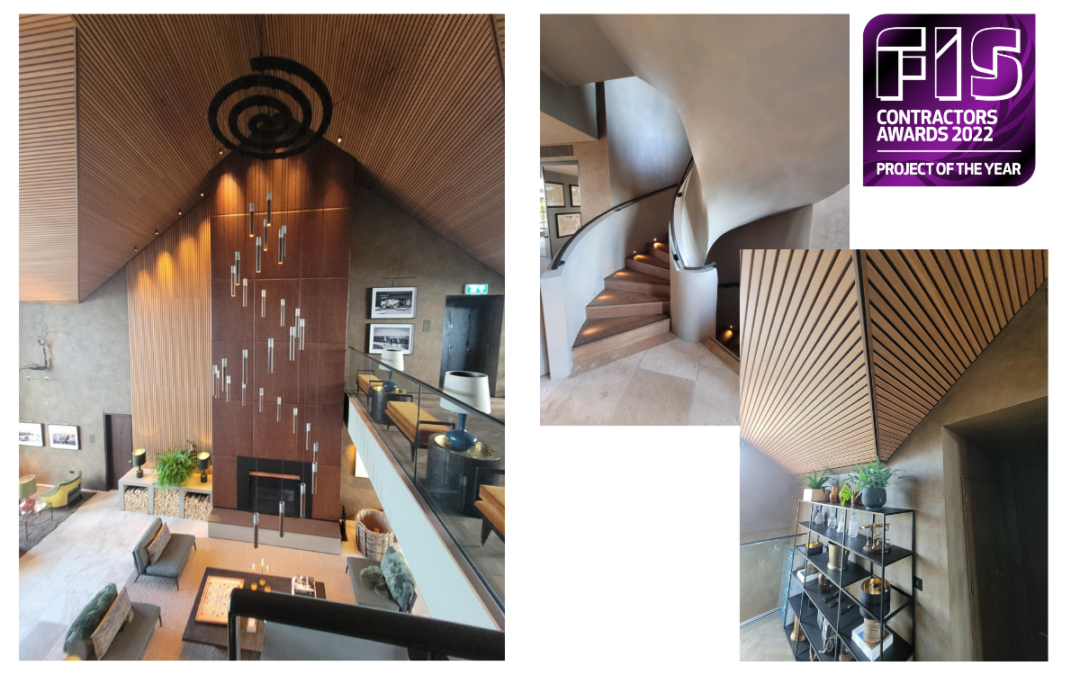
FIS today celebrated the finishes and interiors sector with the announcement of the winners of the FIS 2022 Contractors Awards.

Members and their guests packed out the Nine Kings Suite at the Royal Lancaster Hotel in London to watch the winners in the nine categories receive their prestigious awards.

Indepedent Awards Judges Tony Pieri and Clive Perry, who visited all project entered said:

“We don’t just judge these projects on their overall finished appearance. Other factors – including sustainability, design input, problem solving, logistics, value added initiatives and integration – are all factored into our in-depth assessment of the work involved. Members have excelled themselves in presenting to us a myriad of high quality, stunning projects. They remain a real credit to FIS and to themselves”.

A final award was given for the Project of the Year, which was judged by guest architect Robert Fry, International and
Executive Director of Aukett Swanke Group plc. Robert selected the overall Project of the Year from the winning contracts across all categories.

Robert said:

“The very high quality of the award category winners made the selection of a single project for the ‘Best of the Best’ award a very challenging proposition given the excellence demonstrated by so many varied trades and skillsets brought to bear for clients in such a collaborative endeavour”.

Find out who won here

See the winners across all nine categories.

About the FIS Contractors Awards

The FIS Contractors Awards are held annually to encourage and promote high levels of craftsmanship and design.  Not only does the FIS member who installed the contract win an award, but so does the architect or interior designer of an award-winning project.

Are you one of next year's Award winners?

Only one way to find out!

Entry into the 2023 Awards will open on 1 July!
We’re looking for projects completed between 1 November 2021 – 31 October 2022 – our judges look forward to visiting the spectacular projects that our members complete, and meet the teams that make it happen!

Not a member, but interested in entering? Contact us today to discuss membership on 0121 707 0077 or email info@thefis.org

FIS launches digital platform to provide accurate competency record

FIS launches digital platform to provide accurate competency record

With the requirement to demonstrate competency in your workforce being carried into law with the new Building Safety Act, FIS has teamed with MyProPass (MPP) to provide a platform for businesses to manage the competency of their workforce and for individuals to demonstrate their training history.

The benefit of the MyProPass platform to individuals is that it allows them to store all of their certificates in one place and to share their training history with their employer or anyone else they grant access to their account. They can also browse and sign up to hundreds of training, CPD or industry events in the events directory. Employers can link to individuals accounts, with their permission, to view and download their training history. They can also manage any training activity which requires a certificate through the platform, issuing a digital certificate directly to an individual’s account. At a time when the industry is facing intense scrutiny, this new platform will enable companies and individuals to provide evidence of competency.

FIS Chief Executive Iain McIlwee said:

“This is an exciting next step and builds out from core tools like CSCS. It is clear that better consistency is key to competence management, especially in a fast-moving sector like ours with an uber flexible workforce – only around 30% of our trade workforce are in employment.

“MPP provides the ideal platform for us to start building digital competence passports. This is about more than the core qualifications, as it’s also about encouraging and recognising wider training activities and will offer more of a formal approach to developing and hopefully retaining people in our sector. This platform and the work we are doing around it gives us an opportunity to reset and focus not just on how we recruit, train and develop our workforce, but ultimately how we reward and encourage individuals, investing in the future of the people who are building our future.”

MPP CEO and co-founder Pia Osseforth said:

“We are truly delighted to be partnering with FIS who are leading this space of digitisation and unpicking the challenges of the industry. MyProPass is passionate about digitising competency within the construction industry. The power of data has a big role to play, and this can only be truly realised when skills gained through learning and work experience are detailed and captured digitally. As highlighted within the recent Building Safety Act, this is also becoming paramount for regulators in terms of assessing the competency of individuals working on projects. Talent management that focuses on the needs of individuals and enhances their employability can increase employee motivation and productivity and improve the attractiveness of companies as employers – issues that are particularly significant in the digital age for recruiting and retaining staff. Provision of further training, retraining and skills management are all important aspects of Continuous Professional Development. Employees will have to engage in lifelong learning through further training if they are to be capable of responding as rapidly as possible to changes in skills requirements triggered by automation and digitalisation. Working collaboratively with FIS, we look to provide value to both employers and employees and look forward to creating positive change and impact.”

To support FIS members to meet the need to prove competence, FIS has negotiated a discount for organisations wishing to engage with MyProPass.  Absolutely everything and anything can be stored digitally by individuals and organisations.

For further information about MyProPass visit www.thefis.org/skills-hub/competency-passport/ or call FIS on 0121 707 0077 or email info@thefis.org

Amendments to Approved Document B

Amendments to Approved Document B

Government have now published a new document that sets out amendments to guidance previously published in Approved Document B: Fire safety, Volume 1 – Dwellings and Volume 2 – Buildings other than dwellings.

These amendments will be incorporated in the online available Approved Document B Volume 1 and Volume 2 as from 1 December 2022.  The changes highlighted in this amendment booklet take effect on 1 December 2022 for use in England.

The 2019 edition incorporating the 2020 amendments will continue to apply where a building notice or an initial notice has been given to, or full plans deposited with, a local authority before 1 December 2022 and either the building work to which it relates:

  1. has started before that day; or
  2. is started within the period of six months beginning on that day.

The changes focus on the following fire safety provisions:

  1. Ban of combustible materials in and on the external walls of buildings:
    Consequential amendments following the laying of the Building (Amendment) (England) Regulations 2022.
    Updated provisions in Section 10 and 12 of Volume 1 and 2 respectively for residential buildings (purpose groups 1 and 2) with a storey 11m or more in height.
  2. Secure information boxes: A new recommendation for secure information boxes in blocks of flats with storeys over 11m.
  3. Evacuation alert systems: A new recommendation for evacuation alert systems in blocks of flats with storeys over 18m.
  4. Clarifications and corrections: Clarification of further diagrams, further text clarifications and corrections.

A full copy of the document containing details of the amendments is available here.

The current Approved Document B: Fire safety, Volume 1 – Dwellings and Volume 2 – Buildings other than dwellings (2019 edition incorporating the 2020 amendments) is available for reference here

This announcement coincides with additional information published related to updated requirements for Non-Combustible Cladding.

Price inflation and a diminishing labour supply are now of greater concern than product availability

Price inflation and a diminishing labour supply are now of greater concern than product availability

Statement from John Newcomb, CEO of the Builders Merchants Federation and Peter Caplehorn, CEO of the Construction Products Association, co-chairs of the Construction Leadership Council’s Product Availability working group

Price inflation and a diminishing labour supply are now of greater concern than product availability in most construction sectors.

In terms of availability, little has changed since our last report, with a good supply of most products and materials. Ongoing challenges continue to affect bricks, aircrete blocks, roof tiles, chipboard flooring, gas boilers and other products requiring semi-conductors within sub-components, all of which will be subject to longer lead times throughout the year.

The market is becoming more adept at managing supply of these critical products, and the long-term nature of some of the underlying issues. Although there are reports of delays in supply of boilers leading to extended completion times in new housing, new semi-conductor capacity is coming on stream in late 2023/2024, and expansion in existing capacity will feed into the market over the same timescale.

Demand remains strong in all areas, and this is set to continue into the autumn, although some product forecasts now anticipate a slight slowdown in housing starts towards the end of the year, stemming from rising prices and concerns about affordability. Home improvement work will depend on levels of consumer confidence as costs of living rise.

Members of the group raised concerns regarding the threatened rail strike. This will affect aggregate and concrete deliveries to major infrastructure products, highlighting the need for government to prioritise transport of construction materials should the strike go ahead.

There is, however, some good news from parts of China. With Shanghai gradually removing covid restrictions, production should normalise in that major industrial region by mid-June. Shipping analysts warn, however, that this may exacerbate the current bottlenecks in deliveries to the West.

Across the board, managing price volatility and labour are now the biggest issues.

Although labour shortages are affecting manufacturers, the greatest concern is expressed by housebuilders and SME builders, as it takes at least three years to train a skilled tradesperson.

The cost of energy and fuel are major drivers for price volatility. Initial results of the Group’s horizon scanning exercise suggest energy hedges are short term and very significant increases are expected to come through quite quickly. This will particularly affect energy-intensive products including steel, glass, plasterboard, cement, ceramics and porcelain.

Although steel prices have come down slightly, since initial disruption following the outbreak of war in Ukraine, energy prices remain a major issue and price volatility will continue. Market prices will also be affected by the Indian Government’s unexpected increase to export duties on iron ore and steel, effective from 22 May.

The CLC group will continue to actively engage with energy intensive manufacturers over the coming months, and closely monitor market conditions and the impact of any further price increases and volatility.