by Clair Mooney | 5 Jul, 2022 | Main News Feed
The Construction Industry Joint Council (CIJC) has completed negotiations with trade unions GMB and Unite the Union and reached agreement on a 5.0% increase in all pay rates, which will take effect from Monday 25 July 2022. Non‐taxable elements of pay, such as travel and subsistence allowances, will also increase,
The Construction Industry Joint Council (CIJC) Working Rule Agreement – sometimes referred to as ‘The Pink Book’ – is an agreement between employers and Trade Unions setting out terms and conditions, including national pay rates, that are applied in principle by ‘adherent bodies’ and others across the industry. The aim of CIJC is to help avoid industrial disputes, and simplify the process of negotiating terms between employers and workers. In addition to standard rates of pay, not taxable expenses such as travel and accommodation costs, are incorporated into the agreement.
FIS is represented and the Board were consulted and fed vies in via our membership of Build UK. Other organisations involved in the negotiations include Civil Engineering Contractors Association (CECA), Home Builders Federation (HBF), National Access & Scaffolding Confederation (NASC), National Federation of Builders (NFB), National Federation of Roofing Contractors (NFRC), Painting & Decorating Association (PDA), Scottish Building Federation (SBF) and Trades Unions Unite the Union and GMB.

by Clair Mooney | 1 Jul, 2022 | Building Safety Act, Skills, Transformation
Build UK is working on behalf of its members to do what they can to address the inflationary pressures currently facing the industry. In addition, Build UK has been taking forward its work on long‐standing issues as part of
Improving Business Performance, Increasing Productivity, and Recruiting, Training and Retaining Talent across the whole supply chain.
The statutory review of the Duty to Report regulations published in April highlighted the ‘positive impact’ that Build UK’s benchmarking of payment performance has had across the sector, with Build UK contractor members now taking an average of just 32 days to pay invoices. Ahead of the Building Safety Act coming into force this week,the Working Group 2 report was delivered, benchmarking the competence requirements for six occupations identified as priorities for ensuring fire safety in buildings. Along with the CSCS Smart Check app launched in April, this represents a major step towards ensuring that individuals deemed competent have the appropriate knowledge, skills and training to undertake their role.
by Clair Mooney | 1 Jul, 2022 | Technical
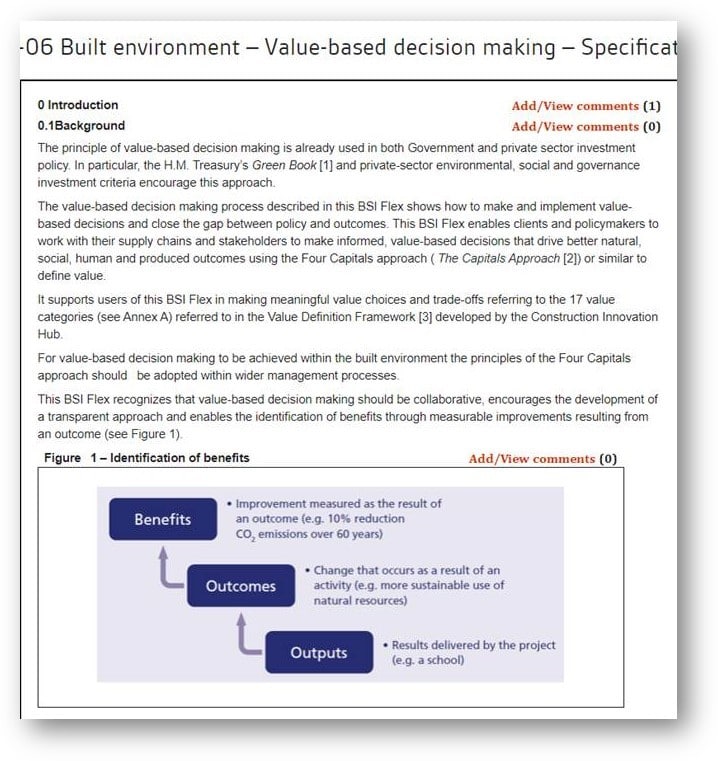
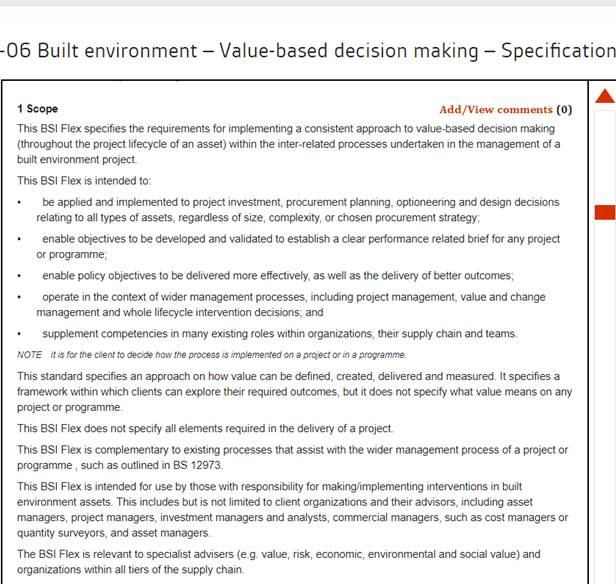
BSI is seeking comments on the proposed new standard: BSI Flex 390 v1.0, Built environment – Value-based decision making – Specification.
The scope of the standard is to lay out the requirements for the implementation and approach to value based decision making taking into account the project lifecycle.
The screen grabs below provide some commentary which will help you understand the background and scope in more detail.
Commenting on Standards before publication provides BSI with instant feedback on the viability and benefits of the standard which we expect to be implemented by the public sector and in turn through procurement routes.
To get involved please follow this link to register on the portal. You can the access the draft and share your comments using this link: https://standardsdevelopment.bsigroup.com/projects/9022-07261#/section
The closing date for comments is 20 July.
NB the draft can not be copied or downloaded.

by Clair Mooney | 29 Jun, 2022 | Material Shortages
Statement from John Newcomb, CEO of the Builders Merchants Federation and Peter Caplehorn, CEO of the Construction Products Association, co-chairs of the Construction Leadership Council’s Product Availability working group
In general, product availability is improving. Some products, including bricks, aircrete blocks, some roof tiles and semi-conductors, which are extensively used in building services products and gas boilers, remain on allocation or subject to longer lead times. Otherwise manufacturers are mostly keeping up with demand and, as stated in our last report, the market has become adept at managing supply with planned delivery times.
Generally, demand is expected to remain positive into the second half of 2022, though some sectors such as private housing RM&I appear to be coming off their highest levels for certain products. Market participants suggest that a slight slowdown in demand may in fact serve to allow stocks to be rebuilt and improve availability.
Average inflation for products and materials so far this year has been around 23%; with more significant price increases in energy intensive products such as insulation, cement, concrete and many steel products. Further price increases for those products are anticipated in the second half of the year owing to rising energy prices and input costs, and some have already been telegraphed to customers.
Concerns have arisen that volatile inflation has led to the failure of relevant indices to reflect market reality. Some contractors are engaging in dialogue to use prime cost, provisional sums and target price-based contract mechanisms to mitigate the risks.
Timber prices, however, have largely stabilised from the highs of last summer. This is largely due to easing demand and strong stocks of structural timber on the ground in the UK making supplies readily available for contractors and merchants. The price of structural timber in Europe and America remains firm to strong and, as a consequence, UK imports of structural timber are reducing. Some panel products have even seen reductions since the first quarter but structural Plywood prices remain firm. Birch Plywood and it potential substitutes have seen little or no availability due to Russian sanctions causing significant upwards price pressure for these products.
Recruitment, retention and related wage inflation continue to present serious concerns across UK construction and may supplant product availability issues in 2023 among the key risks facing the industry. For example, there is clear evidence from the PAG’s participants that skills shortages are making some SME builders reluctant to take on projects, as they don’t have the trades to complete the work.
The UK Government made a major announcement regarding the transition to the UK marking ahead of the ending of recognition of CE marking on 31 December 2022. The change will allow manufacturers with existing type tests from EU notified bodies under AVCP System 3, where the product was tested by 31 December 2022, to affix the UK mark to their products, and to continue to supply them to the GB market without needing to be retested. Further government guidance is here.
The announcement has been welcomed by industry, as it helps alleviate some concerns amongst manufacturers about the ability to place their products on the UK market in 2023. That said, there are many questions and risks still outstanding and industry is awaiting further details from Government. The PAG points out that the Construction Leadership Council is studying the announcement and guidance closely, with the aim of highlighting any outstanding areas of concern and the potential impact on product availability.
Members may also be interested in this Commodities Flash Report of May 2022

by Clair Mooney | 29 Jun, 2022 | Building Safety Act
The Building Safety Act introduces a set of new roles and responsibilities for people who manage occupied, high-rise residential buildings.
Although the Act has become law, the duties it describes for existing occupied high-rise residential buildings have not come into force yet. Registration of existing buildings is expected to begin in April 2023, with the Building Assessment Certificate process expected to begin in April 2024.
A toolbox has been created to help those who will have duties under the Act to get ready for the new regime and manage risks effectively.
If you manage a high-rise residential building, you’ll need to take all reasonable steps to:
- prevent any building safety incidents
- reduce the severity of an incident, should one occur
The Act defines a building safety risk as the spread of fire, or structural failure. The spread of fire includes the spread of all forms of combustion, for example smoke, fumes, and heat.
In the Act, those responsible for occupied, high-rise residential buildings will be required to:
- register their building with the Building Safety Regulator (BSR)
- perform a building safety risk assessment
- introduce measures to manage building safety risks
- prepare a safety case report for their building to give to BSR on request
BSR will be publishing case studies and examples of proportionate responses to common situations as we develop the new regime.
The following series of pages will help you to prepare for the new regime. They contain information and advice on what the Building Safety Regulator is likely to need in any submission.
Safety case information in more detail
- Building Information
- Identifying building safety risks
- Risk prevention and protection information
- Safety Management Systems
- Safety case report
For a full explanation on the Building Safety Act and how it relates to FIS Members click here

by Clair Mooney | 29 Jun, 2022 | Main News Feed
FIS is supporting this year’s Inspiring Change Conference and Awards Ceremony, which is taking place on Wednesday 6 July in London. If you haven’t yet booked your place, this is your last chance. You can register here
The Inspiring Change Conference 2022 is part of the FIR in Construction Programme, sponsored by CITB. It is your opportunity to hear inspirational speakers from diverse backgrounds, including politicians, industry stakeholders, and representatives from other sectors, who have promoted culture change within their organisations to create more inclusive workplaces and communities.
Hear from those who attended our last event
On the day you will:
- Hear about good practice from within the construction industry and beyond
- Learn how to attract and retain a more diverse workforce
- Develop your knowledge and understanding of how an inclusive culture is good for business and can positively influence organisational change
- Be inspired to work together to create a more diverse and inclusive industry
- Network with over 300 like-minded professionals from a range of organisations within the sector
The conference will incorporate the Inspiring Change Awards which highlight and reward organisations within the construction and infrastructure sector that have created more inclusive cultures in their workplaces, education, and the community.
The conference will be followed by Drinks Reception until 6pm.
Who should attend:
Those who can influence culture change within their organisation – Directors and Senior managers such as Chief Executives, leaders in Business Improvement and Business Development, Supply Chain and Procurement, HR and EDI Managers, Community Engagement, FIR Ambassadors and advocate on equality and inclusion.
by Clair Mooney | 27 Jun, 2022 | Market data
The latest weekly update from CPA is available to members here. The updated issues are in Pages 1-5 of the weekly update whilst subsequent pages have existing data and information that remain relevant. This update includes:
- Insolvency Service UK Construction Insolvencies (April 2022)
- DLUHC House Building Starts and Completions in England (2022 Q1)
- HMRC UK Property Transactions (May 2022)
- ONS/Land Registry UK House Price Index (April 2022)
The next CPA forecasts (Summer) will be published on Monday 25 July and there will be a CPA webinar on the forecasts at 11.00 on Wednesday 27 July.

by Iain McIlwee | 23 Jun, 2022 | Market data
To help track movement of wage rates in the UK FIS launched in 2021 The FIS Wage Rate Index. The aim of this work is to support contract negotiations and to help track the impact of shortages on the cost breakdown of projects.
The survey is conducted every six months and FIS is encouraging all contractor members to take part to add to the rigour and value of the survey. Data is published as a price index to allow for regional rate variations and all company specific data is managed in the strictest of confidence. The survey covers core trade roles, labourers, apprentices and construction and site managers.
THE DETAILED RESULTS OF THE SURVEY WILL BE MADE AVAILABLE EXCLUSIVELY TO CONTRIBUTERS.
You can complete the survey via the link here. The survey will close on 8th July 2022.

by Clair Mooney | 23 Jun, 2022 | Main News Feed
One of UK construction’s most recognised executives has been chosen to succeed Andy Mitchell as the new Co-Chair of the Construction Leadership Council.
Following an open recruitment process, an independent panel comprising industry, members of the CLC’s Senior Advisors Group and Government officials, recommended Mark Reynolds (Mace Group Chairman and CEO) to lead the CLC in partnership with Lee Rowley MP (BEIS Minister for Industry). The panel also recommended Richard Robinson (CEO, Atkins UK and Europe) for the newly created Deputy Co-Chair role.
Mr Reynolds has played a key leadership role in the CLC in recent years, including jointly chairing its People & Skills work stream; and co-ordinating its response to the Covid pandemic. As a member of CLC’s Steering Co-Ordination Group, he shaped the CLC’s 2022 Strategy with its focus on Construct Zero, Building Safety, meeting the skills challenge, and implementing the Construction Playbook. He also chairs the Government’s Construction Skills Delivery Group.
Mr Reynolds will be building on the four CLC priorities as he officially takes on the role today – 23 June 2022
Mr Reynolds commented:
“I am delighted to take on this exciting co-chair role following the great work by Andy over the last four years. During that time, I have seen first-hand how the CLC can make a real difference for companies across the whole of the industry”.
“We have faced – and continue to face – challenges that no one organisation can tackle on its own, such as the cost of inflation and impact of rising energy prices; global supply chain pressures and ensuring our collective progression to Net Zero. I am also very pleased to be working with Richard Robinson, CEO for Atkins UK and Europe, on this agenda; who will strengthen our collective leadership and capacity in his role as Deputy Co-Chair.”
“The CLC, working in partnership with Government, provides crucial leadership to the sector. We do this most effectively where we speak to, and for, all parts of industry. Whilst I will continue the CLC’s focus on its four priorities, I would like to engage and listen to the wider industry over the summer to ensure we continue to deliver on the issues that matter most to us as a sector. I want to take this opportunity to encourage organisations across construction to get involved with the CLC’s work.”
Commenting on the appointment, Construction Minister Lee Rowley MP said:
“It’s a pleasure to welcome Mark as the new chair of the CLC. He’s been a key part of the Council in recent years, helping coordinate the industry’s Covid response, as well as supporting job creation in his role with the Construction Skills Delivery Group.
Mark will play a vital role in the months and years ahead as we work to decarbonise the industry through Construct Zero, support it through the Building Safety Act’s introduction, and deliver the first sector-wide skills plan for construction.
I would also like to pay tribute to Andy Mitchell for his outstanding leadership to date, which puts the CLC in a strong position to keep delivering for the sector.”
Outgoing chair Andy Mitchell said:
“The CLC is in a great position to lead industry transformation, working together to overcome any issues that may affect companies nationwide. I am delighted that Mark will be driving forward the Council’s agenda, and look forward to seeing the outputs of its work in the future”.