
by Clair Mooney | 4 Dec, 2020 | Main News Feed
CITB is changing its apprenticeship support to enable all levy-registered construction employers to benefit from an expanded support service. Currently, CITB offers employer and apprentice support for its 7,000 contracted apprenticeships, about a third of the total number across the industry. Under the new plans, throughout 2021, CITB will withdraw from the direct, funded delivery of apprenticeships in England, and instead provide a support service to all employers with construction apprentices. Funded apprenticeship support will continue in Scotland and Wales, and the wider offer will also apply in those nations.
Support for employers will include help accessing grants; choosing the right apprenticeship standard and the right training provider; guidance through the Government’s online apprenticeships system; and building partnerships with colleges and training providers. CITB will continue to offer recruitment support to employers who recruit large numbers of apprentices each year.
FIS is happy to support employer members apprenticeship needs.

by Iain McIlwee | 30 Nov, 2020 | Building Safety Act, Main News Feed, Skills

Joe Cilia Technical Director FIS
Dame Judith Hackett was clear in her interim report of Building Regulations and Fire Safety that there has been a lack of evidence of compliance and competency and even clearer that the industry needed to address this. So, what has happened since February 2018 and do we have a clear roadmap?
A complex problem has been broken up into its constituent parts and addressed by over a hundred organisations, including FIS dedicating cumulative thousands of hours to interrogate information and advice and propose on a better way of working. With work led by the Industry Response Group (IRG) and the Technical Expert Panel (TEP), the work of these groups and the draft Building safety Bill and Fire Safety Bill, are all coalescing to provide a clear direction of travel addressing the linked issues of Competency and Compliance.
To help structure our efforts and uncover how a number of new initiatives will lead to tangible changes to the way we market performance products, the words we use to describe them and the Skill, Attitude Knowledge and Experience needed to specify, purchase, supervise, install and maintain them; we have pulled together this new Map that starts to identify the initiatives are linked and give us an idea of where this will lead in the next year.
It’s about competency…
A Competency Steering Group was established to oversee the issue and twelve working groups were established to address the issue across the supply chain with one overarching group to coordinate the results and a Market Integrity Group (MIG) who would look specifically at how performance products were described and the performance verified.
The twelve working groups are:
- Overarching Competence Body (WG0)
- Engineers (WG1)
- Installers (WG2)
- Fire engineers (WG3)
- Fire risk assessors (WG4)
- Fire safety enforcing officers (WG5)
- Building standards professionals (WG6)
- Building designers, including architects (WG7)
- Building safety managers (WG8)
- Site supervisors (WG9)
- Project managers (WG10)
- Procurement professionals (WG11)
- Products competence (WG12)
The first output from the group is a document called Raising the Bar which was presented at a conference in October 2019 HERE
The report represents twelve months’ work by more than 150 organisations from across the construction, built environment, fire safety and owner/manager sectors, which have come together to improve the competence of those procuring, designing, constructing, inspecting, assessing, managing, and maintaining Higher Risk Residential Buildings (HRRBs). The work is in response to recommendations in the Independent Review of Building Regulations and Fire Safety, conducted by Dame Judith Hackitt.
Setting the Bar is the second and final report of the Competency Steering Group (CSG) and is an update of the Interim Report, Raising the Bar, published in August 2019.
Feeding into this report, for example, is the work I’ve been involved in from WG12 on Products Competence is the development of a Construction products Matrix, which will help manufacturers define the level of expected competence to specify, procure, supervise and install their products. Based on Skill, Knowledge and Experience it will help ensure the correct products are used alongside all products they interact with to create building systems.
The Built Environment competency standard group (BECS) The industry-led programme sponsored by MHCLG will deliver an overarching competence framework standard for everyone working on a building. This is intended to be used by key professions and trades including designers, contractors, fire risk assessors, building managers and others in specialist technical or corporate roles. The framework will provide a set of core principles of competence, including leading and managing safety, communicating safety, delivering safety, risk management, regulations & processes, building systems, ethics, and fire/life safety. The competence framework is being developed using an iterative and dynamic process, in line with our new flexible route to standardization, called BSI Flex.
BSI Flex 8670 v1.0 Built environment – Overarching framework for competence of individuals – Specification is designed to provide a framework for the development of three new PAS documents to describe the competency levels for the three new positions described in the (Draft) Building Safety Bill:
- Building Safety Manager
- Principle Designer
- Principle Contractor
The competency of these people will be overseen by the new Building Safety Regulator (HSE). There will also be an overarching publicly available Specification (PAS) that can be used by industry and trade bodies to develop competency schemes in a consistent way specific to their sector.
Building a safer future Charter In April 2020, the UK Government encouraged industry-wide commitment to sign-up to the Charter, in its response to the ‘Building a Safer Future’ consultation ‘A reformed building safety regulatory system’. In early 2020, the Considerate Constructors Scheme (CCS) was appointed to develop and manage the Charter and FIS is proud to be amongst the first signatories.
It’s about compliance…
Looking beyond competency to other elements of compliance, another new group formed is the Construction Products Standards Committee. This Committee will be comprised of technical experts and academics and it will advise the Secretary of State for Housing on whether voluntary industry standards for construction products should also become UK regulatory standards, a role currently undertaken by the European Commission. The Construction Products Standards Committee will also provide advice and recommendations on the conformity assessment process and product test standards. In particular the Construction Products Standards Committee will advise on:
- the assumptions and weaknesses within the current testing regime, including the effectiveness and accuracy of current tests;
- ways to improve the testing regime and new tests to address the weaknesses; and
- innovation in how construction products are tested.
Organisations, such as FIS will be feeding into this group (via the Construction Products Association), helping to deliver a new rigorous and proportionate process for proving compliance.
Alongside this work the Market Integrity Group (MIG) published their initial findings ahead of developing a Code for Construction Product Information (CCIP). The CCIP will provide a code for all construction product manufacturers (including distributors) to ensure that consistent terminology is used and performance claims are evidence based and have been signed off by the competent technical person in the organisation.
A new body (also formed under the auspices of the CCS) will provide a verification scheme for suppliers wishing to sign up to the code. Its clear that we are reaching a stage where the wind of change is coming and the framework for measuring competence and compliance is being constructed using new overarching legislation that will be built on rapidly over the next months and years.
It’s about collaboration…
In this Map I have attempted to show how these committees, working groups, legislative changes standards, documents, reports and bodies come together and how they will start to lead to a more compliant built environment in the months and years ahead. An encouraging start has been the spirit of collaboration across the sector, bringing us into contact with new individuals, organisation and perspectives on some age-old problems.
I am sure this map will evolve, but as the structures start to settle and the next stage of this huge change begins, if you see anything missing or want to discuss how it all fits together, please don’t hesitate to get in touch.
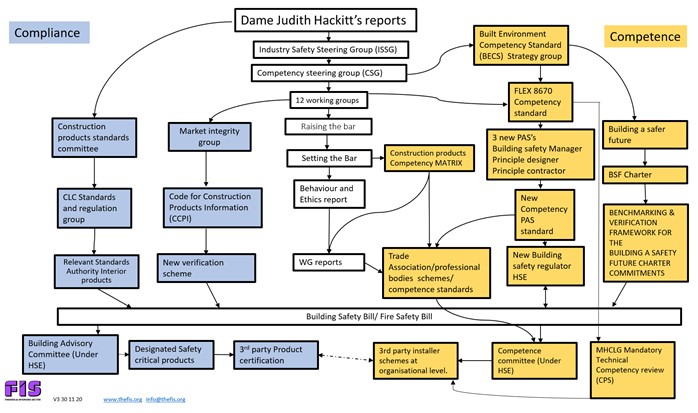
You can download a copy of the Competence and Compliance landscape map here
About Joe
Joe is the Technical Director at FIS which represents the Finishes and Interior Sector, he is responsible for Standards guides and legislation, environmental and sustainability issues. Joe works closely with BSI where he chairs a mirror group and a major review of the drylining standard.
He Co-Chaired the production of Fire-stopping of service penetrations – best practice in design and installation and has been pivotal in developing the FIS Product Process People (PPP) Quality Management Framework.
Joe is the immediate past Chair of the Construction products Association Technical committee and represents the finishes and interior sector on the CPA Technical panel as part of the MHCLG Industry Response Group to the Grenfell inquiry alongside Build UK and CIC.
Contact details
joecilia@thefis.org