0121 707 0077

New Visa Route Available

New Visa Route Available

The Home Office has introduced a new immigration route, Global Business Mobility, to support companies expanding their presence in the UK. It includes a number of new visa options for foreign workers: Senior or Specialist Worker, Graduate Trainee, Secondment Worker, Service Supplier, and UK Expansion Worker. Companies will need a sponsor licence to provide a certificate of sponsorship for these new visas, but eligible foreign workers will not need to prove their knowledge of English when applying.

Most foreign workers in construction are likely to be ‘skilled workers’ and will require a Skilled Worker visa to work in an eligible occupation. The Build UK flowchart providing an overview of the process of employing a foreign worker, along with our detailed guidance on How to Get a Sponsor Licence and How to Apply for a Skilled Worker Visa, have been updated to reflect the latest requirements.

Buckinghamshire Skills Show – FIS Construction Ambassadors, helping industry recruit

Buckinghamshire Skills Show – FIS Construction Ambassadors, helping industry recruit

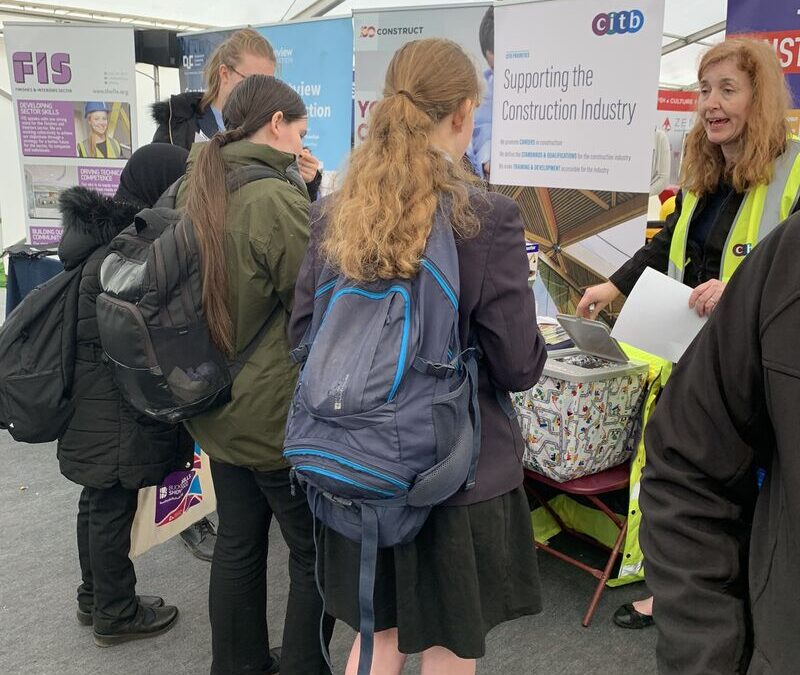
FIS is hugely excited to have signed up to the Go Construct/STEM Ambassador Scheme. Go Construct STEM Ambassadors bring the construction industry to life. Ambassadors engage with young people at educational events across the UK to raise aspirations, showcase career options and support learning.

As a sector, we need to really get ahead of bringing in new talent.  There are lots of opportunities within our industry for new entrants and career changers. Careers in the finishes sector are not however widely publicised; teachers and influencers and therefore young people are not aware of the work and training options available. We need to be more visible as people and as businesses!

One of the ways FIS is helping to promote our sector is through the Go Construct/STEM Ambassador Scheme. Go Construct STEM Ambassadors are construction people who act as the face of the industry. Ambassadors bring the construction industry to life, engaging with potential recruits at educational events across the UK. showcasing career options and supporting learning. Examples of Ambassadors activities include running a trade stand at a careers fair, delivering a talk and sharing experiences of getting into and working in the industry, leading practical sessions or workshops, giving young people a taste of life in construction offering site visits and work experience.

Marie Flinter and Catherine Bullough at FIS are helping to drive this great initiative forward and FIS were delighted to be invited to take part at the Spring 2022 Buckinghamshire Skills Show.

Catherine Bullough said:

With over 5000 young people and job seekers visiting the show over two days, we were certainly kept busy speaking with visitors to our stand who were interested in finding out about careers in the finishes and interiors sector. Over 120 businesses and associations attended, so we also had a great opportunity to network with fellow exhibitors such as CITB, the National Federation of Demolition Contractors and Morgan Sindall. It was a real pleasure to attend such a well organised event; we literally just had to turn up with our stand which gave us loads of time to interact with the students and their teachers

One of the career challenges for our sector is that it can be overshadowed by the more talked about trades such as brick work and plumbing. So, we need to be louder and out there! We need lots more people from industry to become ambassadors for the sector and really shout about what a great job being a dryliner or a plasterer or a ceiling fixer is.  Anyone working in the industry can be a Go Construct STEM Ambassador. Go Construct/STEM have resources available which can support your ambassador activity with access to a national network of likeminded people

Whether you’re a first-year apprentice, a qualified dryliner or a company director, we’d love your support to help more people experience the many varied opportunities in our sector. You just need to be passionate about construction and the built environment and be willing to share your experiences with others.

To find out more about the Scheme, please contact either Catherine or Marie at FIS 0121 707 0077 catherinebullough@thefis.org marieflinter@thefis.org. For more information on the Go Construct STEM Ambassador Scheme click here

Are you struggling with labour shortages and recruitment?

Are you struggling with labour shortages and recruitment?

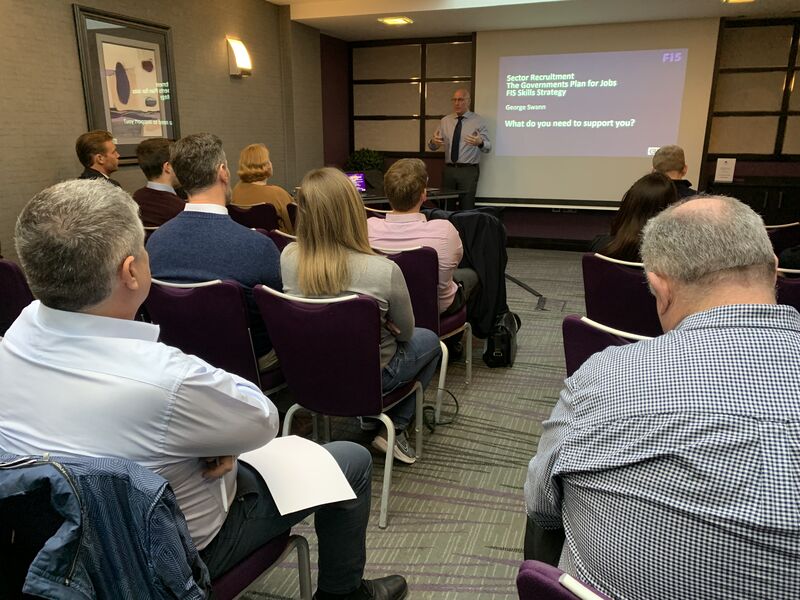
The first of our Regional Training and Recruitment Intervention Events took place in London on Tuesday 22 March 2022.  With labour shortages and recruitment, a key challenge within the sector, presentations and discussion focused on the scale of the problem, local opportunities and provided ideas to support recruitment and retention.

The events are moving round the country and we will also be visiting Leicester, Bristol, Dartford, Manchester and Glasgow. We hope you can  join us at one of these meetings to start the conversation on how we can work together to tackle the skills crisis our sector is facing. To register visit https://www.thefis.org/events/

FIS presented the estimated size of the challenge and suggested systems and methods that employers could use as support.  An outline of the nine government funded schemes was given.  Anthony Frayne from CITB publicised an increase to the grants available specifically for Dry Lining Traineeships and Apprenticeships.  Speakers Rachel Roberts from Greater London Authority presented what is available for employers locally and Jacqui Wordsworth explained the work of, and the support, provided by Women in Construction.  All speakers suggested sources of recruitment that may not have been considered by some and discussions bore out an ambition to promote and attract more people into the sector.  The responses reflected a desire to encourage people from schools, colleges, universities and the rich mix of gender and ethnic diversity available in this country into the finishes and interiors workforce.

John Llamas, Community and Skills Manager, Mace said:

“Really useful meeting this morning and great to see the network working afterwards. Well worth attending if you want to get some insight into support available, how to refine and improve what you are doing to find new people and start the conversation about how we can work better as a supply chain.”

George Swann FIS Skills and Training Lead said

“The loudest message from the London event is FIS know there are employers who are finding it hard out there but as a member of FIS you are never alone, please contact us, if we have not got an answer for you we will know someone who has.  To support recruitment from Schools and Colleges FIS have started to build a network of Construction STEM Ambassadors, as an Ambassador the commitment is two visits per year, if you feel this scheme may help your recruitment needs give us a call”.

Join us at our Regional Training and Recruitment Intervention Events

See more news likes this

Mayor of London launches £2.5m Construction Skills Pilot

Mayor of London launches £2.5m Construction Skills Pilot

The Mayor of London has launched the Construction Skills Pilot, an employer-led initiative that puts £2.5 million behind training designed and delivered in partnership with employers themselves. It supports development of existing models where employers help shape...

Get involved with the SkillBuild Showcase at the National Final

Get involved with the SkillBuild Showcase at the National Final

FIS is inviting members to take part in the Construction Showcase at this year’s SkillBuild National Final, taking place at the Marshall Arena, Milton Keynes, on 18–19 November 2026. The Construction Showcase is an interactive experience hub featuring hands-on...

Changes to Right to Work checks

Changes to Right to Work checks

Temporary changes to right to work checks introduced in response to the coronavirus pandemic have been extended again and will now end on 30 September 2022. Employers can continue to undertake checks via video calls and use scanned copies rather than original documents until this date.

FIS Writes to Mayor of London on calls for temporary visa scheme

FIS has written to London mayor Sadiq Khan to follow up on his calls to create a temporary visa scheme for construction workers to tackle the double impact of Brexit and the pandemic on the building industry.

London Mayor Sadiq Khan is proposing that ministers create a Coronavirus Recovery Visa of at least a year, to help sectors struggling with shortages of workers, including construction.

Mayor Khan said: “Tackling London’s housing crisis has always been one of my top priorities since becoming Mayor. We’ve worked tirelessly over the last five years to get London building again, and the construction sector forms a key part of London’s Covid recovery plan. However, both our recovery and efforts to deliver the genuinely affordable homes Londoners desperately need could now be put at risk if there isn’t the skilled workforce available to build them.

“The Government must look beyond their current blinkered approach to immigration and recognise the impending crisis that is already enveloping one of our most vital industries.

“Training our own people to take on jobs in the construction sector is an admirable aim and one we’re working hard to meet but in the meantime, we need skilled tradespeople on site now to manage the short-term crisis and build a strong recovery.”

FIS has written a letter of support the the Mayor.  The organisation has repeatedly raised concerns with the Home Office over recent years that the points based immigration system fails to recognise core trades as “skilled workers”, lacks flexibility to manage “shortages” and has not factored in the impact of COVID on preparing for and now addressing labour concerns in the sector.   Often working on short notice or late in the programme, the sector is typified by rapid turnaround of projects and high levels of contingent workers, which I believe makes us more seriously impacted even than other parts of construction.

Pressure is most acute and well exemplified in the Dry Lining sector.  It is estimated there were approximately 60,000 people employed across the UK as Dry Liners at the start of 2020. To meet demand and address inevitable churn, the occupation has an annual recruitment rate (ARR) of approximately 1,200 individuals per year.  Going in to 2020 the level of EU workers was 40% across the UK, but could be as high as 80 or 90% in London.  A proportion of this workforce came to UK to work and have not put down strong roots and potentially split their time between here and home (working a few months of the year).

In the letter FIS CEO, Iain McIlwee, comments “Before we worry about who has left, you will see the gap in our figures, across the UK (higher in London) we were hitting close to half of our annual recruitment with immigration.  Plainly put we need to double what we did in terms of recruiting domestic workers, particularly difficult in the current climate.  Beyond this, for every 5% of EU workers that have decided not remain in the UK, we need to find an additional 1,200 workers (effectively doubling our annual recruitment rate again).”

Iain goes on to inform the mayor that “The sector has been identified by CITB as a top 4 priority in terms of shortages and is actively engaged in training reform with a new Apprenticeship Standards and a number structured specialist induction and recruitment programmes run in partnership with the Department of Work and Pensions, but the education and training infrastructure needs time to develop.  We need to evolve the culture in the sector and have to remember that a new recruit tomorrow is not fully productive (in fact initially drains time) – apprenticeship and VQ durations are typically 18 months for Dry Liners and ceiling fixers and 36 months for Plasterer.  COVID has impacted our ability to prepare for and now availability of workers and wage inflation is adding to the challenge and making it more difficult to address.”

If you are having issues recruiting or want to talk to FIS about taking  on an Apprentice, visit the FIS Skills Hub  or call 0121 707 0077 and ask to speak to one of our skills and training  experts.

Inflation continues to squeeze supply chain

Inflation continues to squeeze supply chain

Inflation has hit the headlines this week with figures not seen since the early 1990s reported by the Bank of England. Against this backdrop Iain McIlwee, CEO at the Finishes and Interiors Sector (FIS) reveals new data from the FIS that raises concerns over the squeeze on the supply chain, particularly subcontractors and asks the question: are our contracts and procurement processes and the reliance on fixed price equipped to handle inflation at this pace and scale?

The latest UK Market View report published by Mace Consulting in January is anticipating tender-prices to be 4.5 per cent higher this year.  Whilst a significant jump on previous forecasts, FIS is questioning whether this is enough.

Within the Finishes and Interiors Sector, Material price inflation averaged around 20% in 2021, even higher in some cases such as timber and steel. Whilst there is evidence that prices may have started to stabilise, warnings from Arcadis, CLC and reports from FIS members highlight the next inflationary pressure is the escalating energy costs. Businesses are not protected in the same way as consumers and the pinch is starting to be felt.

But this is only part of the pressure on sub-contractors.  The FIS Wage Rate Survey H2 2021 conducted in December revealed that, across the trades, FIS members have experienced significant wage rate increases particularly in key trade occupations, such as second fix carpenters and dryliners.

Commenting on the survey, FIS CEO Iain McIlwee stated: “It is good to see headline contract values are increasing, but to my mind the maths doesn’t work and they are not moving in line with costs. For most sub-contractors, the core costs of labour and materials will typically represent, according to our latest research, around 80% of business costs. Fuel bills, energy bills are all mounting too; 4.5% doesn’t cut it when the base costs are far exceeding this.

Added to this we are seeing projects subjected to severe delays, programmes out of sync due to the upheavals and in a fixed price environment, this is a real concern and adds further cost and risk.”

Continuing, he said: “I suspect these pressures are felt most acutely in the finishes and interiors sector, as we are late in the programme.  We have to look, as a supply chain, more carefully at how we are pricing work and risk. We must also use contracts better (including fluctuation clauses) and ultimately recognise that sub-contractors are often being asked to hold more than their fair share of price, time and design risk.

Negative behaviours are adding to the cost pressures and we are seeng insurance increasingly difficult to secure and premiums continuing to rise, in some cases by eye-watering amounts – this before we factor in some of the changes to legislaton such as the Defective Premises Act now proposed.  With legacy concerns and adversarial negotiations and disputes still sadly commonplace, we know of a few companies that have decided that it is not worth carrying on or have sadly entered administration this year. More will follow and corners will be cut unless we start to shift the dial, price the risks, generate sufficient time and capital to invest in people and technology and use the conflict avoidance process to work more collaboratively as a supply chain.”

 For further information or for any questions, please contact FIS at info@thefis.org or call 0121 707 0077.