by Clair Mooney | 16 Nov, 2022 | Main News Feed
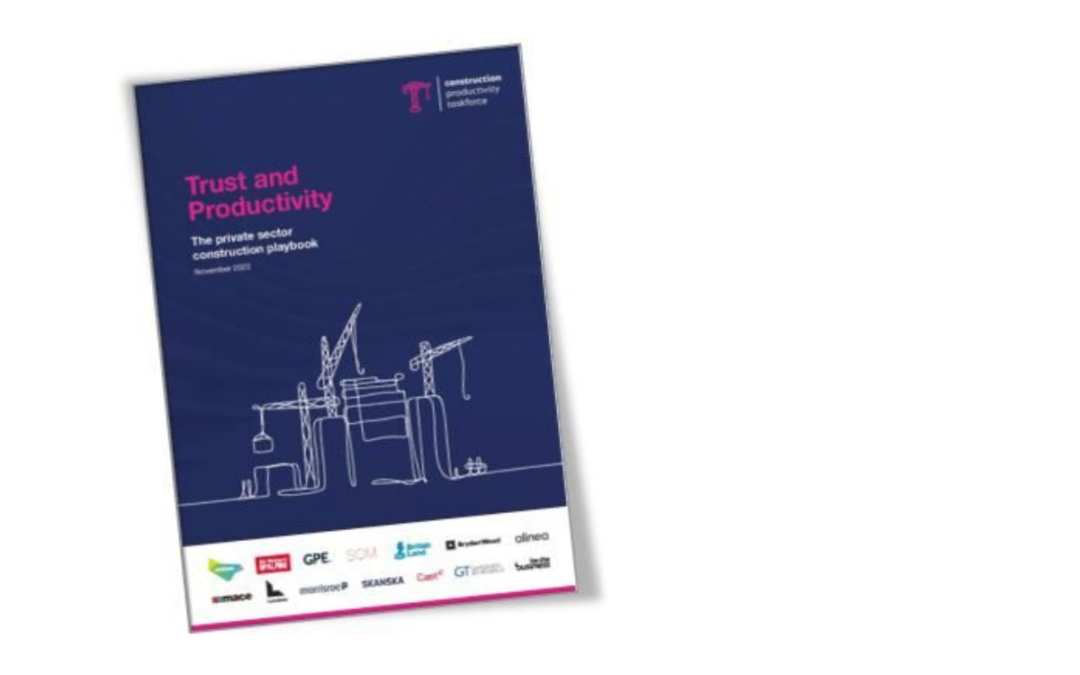
A group of businesses within the construction sector have joined forces to produce a landmark publication aimed at combatting low productivity in the industry.
The goal is to promote trust and collaboration in a highly fragmented industry that can lack transparency. This in turn will help the industry reduce waste, address the skills shortage, and reduce the impact of low margins and investment in UK construction.
The need for action is clear: UK construction productivity growth fell by an average of -0.6% each year between 1997 and 2019 according to Oxford Economics. Over the same period, the productivity of the whole UK economy rose by 2.8%, while the productivity of manufacturing grew by 3.9%.
In real terms, this means that a larger workforce is now required to match historical output, making construction increasingly expensive and leading to a downward spiral of low margins and low investment. Operating under such conditions makes innovation more challenging.
The playbook aims to tackle these problems by encouraging clients, their construction teams and suppliers to work in a more collaborative way to help boost productivity, quality and value. In doing so, they can improve the health, safety and wellbeing of the workforce, reduce carbon and positively impact both the performance and image of the industry.
‘Trust and Productivity: the private sector construction playbook’ has been produced by some of the UK’s leading developers, contractors, architects, engineers, professional services providers and suppliers, under the umbrella of the Construction Productivity Taskforce – a specialised cohort founded by productivity champions Be the Business. Their view is that increasing productivity is essential if we are to cope with increasing skills shortages, use resources more effectively and be able to invest in sustainable infrastructure that meets net zero carbon commitments.
Simon Gorski, Executive Sponsor of the Private Sector Construction Playbook Working Group, and Managing Director, Construction, Europe, Lendlease, said:
“This landmark publication sets out a more productive and sustainable way forward for our industry. Productivity in the UK private construction sector has long been an issue, and while progress has been made in trying to address this, our industry is still blighted by a lack of openness and transparency. I’d like to thank my colleagues across the industry whose leadership has been essential in developing this document. Alongside the Government’s Construction Playbook, I am pleased that the whole industry now has the opportunity to deliver better project and programme outcomes for clients across the private and public sector.”
‘Trust and Productivity’ draws on the experience and expertise of some of the most successful organisations in the UK’s construction sector to set out ten key drivers for success that should underpin any project, while also providing a guide for all points in the project life cycle, from concept through to aftercare. Those ten drivers are:
- Form effective partnerships: Teams not collaborating effectively, team members pulling in different directions, and too much risk unfairly loaded onto one of the parties to a contract creates tension and mistrust from the start. Defined goals need to be agreed at the outset. These should be embedded in a project charter, which sets out clearly the shared objectives, values and measures of success.
- Adopt portfolio and longer-term contracting: Historically, there has been a perception that partnering-based approaches do not deliver value and can stifle innovation. However, when applied in a transparent way, partnering can deliver value and drive innovation, while also providing consistency, improved quality and reduced risk. The business resilience of the supply chain is boosted by a longer-term pipeline of future work. This also encourages investment in innovation and the workforce. In return, clients benefit from improved delivery.
- Take an outcome-based approach: This should resolve gaps between design intent and in-use performance, emphasising the need for improving whole-life value, performance measurement, sustainability, programme and cost certainty, and allow for innovative solutions from the supply chain.
- Embed digital information flows across the whole life of the asset: Increased use of digital information processes and technologies will reduce programme time and whole-life cost, and enable buildings to be delivered more cost effectively, while reducing risk and enabling the smart use of buildings during operation.
- Involve the supply chain early: Early engagement with manufacturers and specialist contractors improves the efficiency of the design and the design process through a better understanding of manufacturing capabilities, logistics constraints and on-site buildability.
- Benchmark objectives: By using key performance indicators across a range of criteria, teams can see where they are succeeding and where they are not. If the project is falling behind its benchmarks, action can be taken swiftly to get back on track. One of the aims of teams should be to measure productivity.
- Allocate risk fairly and appropriately: The allocation of risk needs to be decided by evaluating the project, using experience, expertise and knowledge. The party best placed to manage the risk should take the leadership role and should also encourage collaborative thinking among all parties.
- Pay fairly: Trust and collaborative partnerships can only be established if fair payment is in place. Best practice, as set out in the Construction Act 2011 amendment, should be adhered to at the very least, and embedded in all construction contracts, with any amendments taking into consideration supply chain implications and risk allocation.
- Assess the economic and financial standing of suppliers: Minimising the risk of failure in the supply chain is crucial for the efficient delivery of a project. The financial strength of all supply chain partners should be assessed during the selection process. Assessments should be transparent, objective and non-discriminatory.
- Promote innovation and continuous improvement: Innovation through using digital information processes and digital technology, adopting modern methods of construction and designing for manufacture and assembly can improve productivity, reduce waste and drive significant reductions in lifetime carbon emissions.
‘Trust and Productivity: the private sector construction playbook’ has received endorsements from industry bodies including the Construction Leadership Council and British Property Federation.
Anthony Impey MBE, CEO, Be the Business, said:
“I’m delighted to see the construction industry taking such positive steps to increase their productivity. The private sector construction playbook should act as the cornerstone of a more productive sector and provide inspiration to other industries to do the same.
“Placing collaboration at its core, this document provides clear guidance on how to drive higher productivity outcomes for the sector, key to sustainable growth within the industry and the UK economy as a whole.”
Nigel Webb, Chair of the Construction Productivity Taskforce, and Head of Development, British Land, said:
“By increasing productivity, the construction industry can play a vital role in driving economic growth, supporting the UK’s net zero ambitions and improving the economic health of the sector. This playbook seeks to identify ways to address some of the issues limiting construction productivity. I would encourage clients, contractors, designers and supply chain members to engage with the playbook and start to measure and identify ways to improve productivity.”

by Clair Mooney | 15 Nov, 2022 | Main News Feed
The Construction Leadership Council (CLC) in collaboration with NEC has today published joint guidance to industry on the use of retention clauses under NEC3 and NEC4 Engineering and Construct Contracts (ECC), and sub-contracts.
The publication explains how NEC contract suites deal with defective work and retentions, and to explain that a retention fund may not, in fact, be needed.
The contractual practice of retention payments is intended to provide security against defective work, and the insolvency of businesses in the construction supply chain. The principle is to secure performance and incentivise the elimination of defects in an industry where the quality of work remains inconsistent. However, they can create problems for businesses throughout the supply chain due to the late and non-payment of retentions or through upstream insolvency.
This work forms part of the CLC ambition of moving to zero retentions by 2025, through reducing or eliminating defective construction work and having a procurement and delivery model that recognises, incentivises and rewards consistent high-quality work.
Commenting on today’s publication, Steve Bratt, Chair of the CLC’s Business Models Workstream said:
“The long-term aim is to eliminate the need for retentions altogether. This guidance illustrates that often the need for retentions can be avoided through good contract management and selection of contractors with a good track record of quality work.”
“I would like to thank the NEC Board for their collaborative approach to working with CLC colleagues on this longstanding, contractual issue.”
Speaking on behalf of the finishes and interiors sector, FIS CEO, Iain McIlwee stated:
“This is welcome and definitely a step in the right direction. The retentions debate has raged for decades and progress has been slow at best, but the world is changing rapidly and we cannot let past procrastination dampen our ardour to deliver change. It is widely agreed now that retentions contribute towards many of the negative behaviours in the sector. The Retentions Roadmap outlines a voluntary phased approach to moving towards the objective of zero retentions by 2023, clearly this is unlikely now, but no later than 2025 has to remain as an achievable goal. If we want genuine transformation, we need to be bold. I would urge JCT, which tends to be the more common contract in our sector, to take similar steps in the immediate future.”
Peter Higgins, Chairman of the NEC4 Contract Board said:
“The construction industry has traditionally thought of a retention fund as a necessary and inevitable part of the cost of doing business, but NEC contracts took a different approach, treating retentions as an option to be used only if necessary. NEC is pleased to have worked with the Construction Leadership Council in preparing this guidance on the use of retentions under NEC contracts, and in particular highlighting when holding a retention fund creates an unnecessary expense for contracting parties.“
The guidance is available to download here.
A free webinar to support the new guidance and an opportunity to learn more is scheduled for Monday 16 January 2023 at 2pm.
To register initial interest, please contact info@necontract.com
Both CLC and NEC would like to thank all those that participated in the development of this guidance, in particular, Peter Higgins of PD Consult on behalf of NEC, and Andrew Croft of Beale & Company Solicitors LLP and Claire King of Fenwick Elliott LLP on behalf of CLC.

by Clair Mooney | 14 Nov, 2022 | Main News Feed
Businesses will be given an additional two years to apply new product safety marking, giving thousands of businesses the freedom to focus on growth, Business Secretary Grant Shapps has announced today (Monday 14 November).
The UK Conformity Assessed (UKCA) marking has been introduced as part of the UK’s own robust regulatory framework. It shows that products comply with our product safety regulations which are designed to protect consumers.
However, given the difficult economic conditions created by post-pandemic shifts in demand and supply, alongside Putin’s war in Ukraine and the associated high energy prices, the government does not want to burden business with the requirement to meet the original (31 December 2022) deadline.
The government will continue to recognise the CE marking for two years, therefore allowing businesses until 31 December 2024 to prepare for the UKCA marking. Businesses can also use the UKCA marking, giving them flexibility to choose which marking to apply.
Business Secretary Grant Shapps said:
The government is determined to remove barriers to businesses so they can get on with their top priorities, like providing quality customer service, enabling growth and supporting their staff.
This move will give businesses the breathing space and flexibility they need at this crucial time and ensure that our future system for product safety marking is fit for purpose, providing the highest standard for consumers without harming businesses.
To support manufacturers, the government is also reviewing the wider product safety framework, ensuring we minimise the burdens on business while keeping our system up to date with new innovative methods such as e-labelling.
As part of this, the government will make it easier than ever for businesses to apply product markings.
This package will give thousands of businesses, including electronics and lift manufacturers, additional time to focus on delivering growth and creating jobs, while giving them flexibility in how they meet their legal obligations.
It should be noted that construction products come under specific rules, which have not yet been amended.
The CLC has issued a statement regarding clarification on construction products and the need to ensure that businesses know what products can legally be placed on the market in the UK. You can read the full statement at https://www.constructionleadershipcouncil.co.uk/news/clc-statement-on-ukca-markings/
There will be different rules for medical devices, construction products, cableways, transportable pressure equipment, unmanned aircraft systems, rail products, and marine equipment. Government departments responsible for these sectors are making sector specific arrangements.
Commenting on the announcement FIS CEO, Iain McIlwee stated:
“This is without doubt a positive step. Whilst we await further updates to confirm that the change announced does extend to construction products, it would appear a more pragmatic Policy direction has been set and the desire and time to bring in the required legislation to change status of construction products carrying the CE Mark in time for the new year has dissipated.”

by Clair Mooney | 11 Nov, 2022 | Skills
Build UK has published a guide setting out the most common Routes of Entry in Construction for young people in England leaving school, including apprenticeships, traineeships, T Levels and degrees, and how they might suit different employers. Although the routes of entry into the industry can be complex and confusing, employers that understand them are well placed to offer opportunities and recruit their future workforce.
This helps deliver work under:
- The CLC’s Skills Plan (pg.10), Priority 2: Routes into Industry to ‘Improve the links between education and employers to support the pathways into and through apprenticeships, T Levels and employment’; and
- CITB’s Strategic Plan (pp.8), which states: “supporting and equipping employers and potential entrants with the information they need and making the routes into construction as simple as possible”
The guidance has been endorsed by CITB and the Department of Work & Pensions.
Commenting on the launch, FIS Skills and Training Lead George Swann stated:
This is a straight forward brief on what is primarily available in England, if you need more details or have any specific questions, contact me on 07553 874383 or email georgeswann@thefis.org

by Clair Mooney | 11 Nov, 2022 | Skills
Apprenticeships are the best way to enhance you workforce and the training is free to employers. FIS members are providing this training and have a number of vacancies for Dryliner apprentices and Ceilings and Partitions apprentices. These are primarily at Leeds College of Building, Bedford College and National Construction College East. In Wales FIS member Direct 2U Training are delivering the new Welsh apprenticeship framework for Drylining and Greenlight Safety and Training who are based in Plymouth. For more details please see the FIS Training Directory or call us on 0121 707 0077.

by Clair Mooney | 10 Nov, 2022 | Main News Feed
The HSE has commissioned an independent research agency, Kantar Public, to interview people working in private sector housing, including student accommodation providers, who will be responsible for compiling their organisation’s safety case and associated report.
The requirement to produce a safety case and a safety case report is a new way of working for people and organisations who manage high-rise buildings.
The HSE wants to understand your experience of doing this, the challenges you faced and your views on the information produced so far. This is a chance to shape the future guidance and make sure it works for everyone involved.
Participation is voluntary and will involve a 90-minute interview with Kantar’s researchers, followed by a 30-minute interview to comment directly on the guidance.
Kantar will offer an incentive of £150 as a thank you for your time. Your identity will not be disclosed to HSE, and it will not be possible for HSE to identify individual participants or organisations in the research outputs.
To register your interest, please email marios.zampetis@kantar.com by Friday 11 November.
by Clair Mooney | 10 Nov, 2022 | Main News Feed
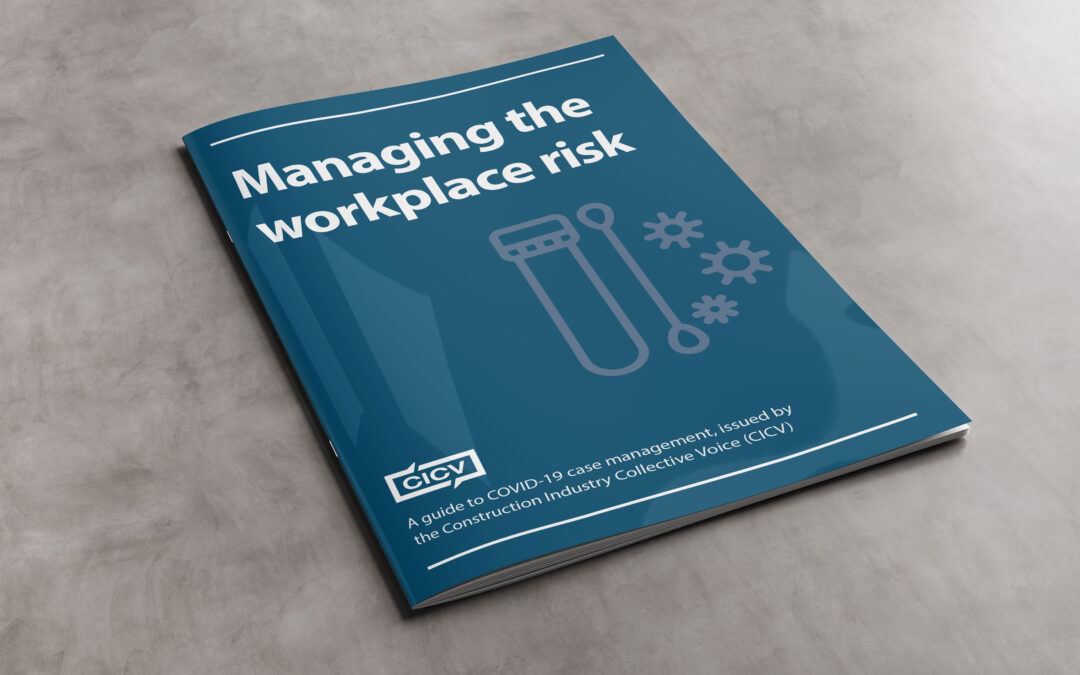
The CICV has produced a new open source guidance document, which is now available to download on the CICV website. Aimed at employers, it gives advice on case management of COVID in the workplace.
FIS Chief Executive Iain McIlwee commented:
FIS is a member of CICV on behalf of our community and this advice is a great example of why. COVID hasn’t gone away, but as employers we still need to manage cases and wider risk – whilst framed for Scotland it is a great reference source for wherever you are in the UK.

by Clair Mooney | 9 Nov, 2022 | Main News Feed
To mark World Quality Week, at the FIS North West Regional Conference in Manchester today, FIS relaunched the FIS PPP Risk Register, a key tool in the FIS Product Process People (PPP) Quality framework.
The FIS PPP Risk Register gives people a structured framework to interrogate project risk based on a assessment of severity and probability of a risk occurring. The standard scoring system helps members to identify any unacceptable high risks and ensure management strategies are put in place to address. The tool also helps a management team to assign risk correctly and contains a range of links to additional tools and information that will help support specific risk management.
FIS CEO Iain McIlwee said: “A large part of our work centres on interrogating and helping members to manage day to day problems they may encounter, risks. This is a moving and evolving space. Our tool helps us to ensure that we are learning lessons and that members are alert to where problems may appear,
Risk is unescapable in any construction project, but at times we can feel so beset by risk that we become indifferent to it. It is vital that as an industry we get better at measuring, managing and mitigating. This simple tool is built on the premise that if you can’t measure it or didn’t think about it, you can’t manage it. It aims to help people to score risks. The underlying principle is that is that we can all learn from our own mistakes, but it is better learn together and avoid learning the hard way wherever possible.”
The FIS PPP Risk Register is available for members to download here
To find out more about World Quality Week, click here

by Clair Mooney | 8 Nov, 2022 | Building Safety Act, Drylining, Technical
FIS and the Tall Building Working Group (TBWG) have published a report which investigates the causes of noise emanating through the fabric of some tall buildings, identifies methods of remediation and provides guidance for affected buildings.
The Tall Building Working Group (TBWG) was formed in 2018 to address a global phenomenon where creaking can be heard in tall residential towers in high wind conditions.
The group was established under the umbrella of trade body Finishes and Interiors Sector (FIS) and set about bringing together the entire supply chain, namely developers, tier 1 contractors, manufacturers, architects, specialist drylining contractors and engineers who are involved in the specification and construction of buildings where noise issues have been reported.
The starting point was to investigate the root cause of this phenomenon and then look at how occurrence can be reduced or better managed in new towers by providing better guidance for architects, engineers, designers and developers.
The group engaged with individuals and organisations from across the globe and absorbed the findings of all available secondary research before embarking on a structured research programme of their own, funded by members of the TBWG.
Further research was carried out by structural engineers WSP to present, in a graphical format, the inter-storey differential movement in vertical and horizontal directions affecting partitions and other elements of fit out. This document explains to the project fit out designer how a high-rise tower reacts to external loads.
- External loads make building move: non-structural elements should be installed in such a way to allow for the movements freely.
- Any locked in movement will cause distress in the non-structural elements.
- Any frictional resistance to movements will cause noise.
The key to reducing the phenomenon occurring in future tall towers is sharing the information contained in the structural engineer’s movement and tolerance reports early with the system owners of the drylining, and providing movement joints to allow the elements of the internal fit out to move independently.
Manufacturers have been exploring different solutions and methods of mitigation. At this stage none have been able to completely eliminate the sound.
Commenting on the work, FIS CEO Iain McIlwee said:
“I think this is a first. I cannot think of a single time when the construction supply chain has attacked a problem in this way. Rather than battening down the risk hatches, reaching for the contract and starting the blame game, this was a genuine attempt to work together to understand and collaborate to solve it. This is a body of work all involved can be proud of, not just because it will help unravel some potentially complex issues or maybe help people sleep more soundly, but because it is an example of how we can collaborate and be better as an industry.”
The TBWG is planning to hold another conference to share the report outcomes with the delivery teams, meanwhile a summary report is available here.

by Clair Mooney | 8 Nov, 2022 | Market data
Construction output is forecast to fall by 3.9% in 2023 following a rise of 2.0% in 2022, as activity currently continues at a high level. The fall for 2023 is a sharp downward revision from -0.4% in the Lower Scenario of the CPA’s Summer Forecasts. This is mainly due to the impact of a wider economic recession, exacerbated by the effect of the ‘Mini Budget’, and the consequent fallout from recent political uncertainty.
There are still many factors which will adversely affect the construction forecast such as falls in real wages and potential further rises in interest rates, which will likely lead to further falls in consumer spending decisions. On top of these issues, the wider uncertainty around the UK economy means that demand for private housing new build and private housing repair, maintenance, and improvement (rm&i) is expected to fall. Other key construction sectors such as commercial and infrastructure are also expected to be affected by increasing concerns over construction cost inflation, which are likely to hinder project viability.
With an annual turnover of £37 billion, private housing is the largest sector in the construction industry. Activity is currently strong with most major house builders sold through to 2023 Q1. However, after the ‘Mini Budget’ announced in October 2022 and the resulting financial market chaos, interest rates are expected to peak at 4%. Activity was already expected to slow due to rising interest rates to 3% but the announcement worsened this forecast. The repercussions of this on mortgage rates will dampen potential demand and house prices for new homeowners. Furthermore, after more than a decade of low mortgage rates, some existing homeowners will be faced with the pressure of increased mortgage repayments and some may be forced sellers, adding further pressure to the housing market. As a result, property transactions and prices are likely to fall over the next year, with house builders likely to reduce house building targets. After growth of 3.0% in 2022, private housing output is now forecast to fall by 9.0% in 2023 before returning to 1.0% growth in 2024.
Following a record level of £24 billion last year, private housing rm&i output, the third largest construction sector, has been decreasing since March 2022. With a drop in real wages and sharp increases in mortgage payments for many households, there is likely to be a further fall in smaller, discretionary improvements and renovation spending. Output in this sector is expected to decline by 4.0% in 2022 and 9.0% in 2023, before marginal growth of 1.0% in 2024.
Commercial output is forecast to remain flat in 2022 before a fall of 5.1% in 2023. This comes as buoyant fit-out and refurbishment activity is offset by a hiatus in major new office and mixed-use tower projects, which dominate the sector. Commercial towers are reliant on large, up-front investment for a long-term rate of return. There are currently major projects in the pipeline over the next 12 months that were signed up to last year. With accelerating costs and worsening economic prospects, however, it raises the question of whether those projects will break ground in the near-term or whether they will be paused and pushed back into 2024 or, potentially even cancelled.
Infrastructure, the second largest construction sector, should be the least affected by issues of household finances and rising interest rates. Nonetheless, it is not immune to the impacts of both sharp cost rises and government making clear that it will not increase departmental budgets to deal with rising costs. Therefore, we are likely to see the value of activity that we expected previously but not the volume. In the medium-term, projects towards the end of the government’s Spending Review will get pushed back into the next review. Councils, which are already financially constrained, are also expected to cut spending on new infrastructure projects and divert finance to cover the rising costs of basic repairs and maintenance. Overall, after 5.2% growth in 2022, infrastructure output is forecast to rise by 1.6% in 2023 and 2.6% in 2024. This will be driven by larger projects already underway such as HS2, Hinkley Point C and Thames Tideway despite the cost overruns and delays.
Overall, given that construction output is expected to fall significantly over the next 12 months, it is critical that new government is focused on delivering its targets including 300,000 net additional homes per year, levelling up, and bringing forward infrastructure activity. Additionally, as part of its movement towards Net Zero, the UK must prioritise the energy-efficiency of its new and existing homes.
Professor Noble Francis: “With the UK economy expected to fall into recession, the construction industry will also fall into a recession. It is worth keeping in mind that activity in the industry currently remains at a historically high level, but it will not be immune to the effects of falling real wages and spending at the same time as the cost of construction continues to rise at double-digit rates.
“The largest effects will unsurprisingly be on private housing and private housing rm&i, given that they are reliant on households’ willingness and ability to spend. Activity in both sectors will fall significantly, albeit from a high point. Major clients’ willingness to invest in new commercial developments will also be tested given concern over the UK economy and rising construction costs. Furthermore, infrastructure will be adversely affected by central government and local authority spending constraints as well as increased pressure for austerity despite continual government announcements and reannouncements of more and more infrastructure.”

by Clair Mooney | 8 Nov, 2022 | Main News Feed
CITB has funded the Innovation Driven Procurement Project to offer 40 SME and micro‐businesses free training, coaching and mentoring to help improve productivity and increase procurement opportunities. Businesses interested in participating must sign up by the end of November.

by Clair Mooney | 8 Nov, 2022 | Contractual and Legal, Lens Blog, Main News Feed
FIS Consultant Len Bunton continues with the theme of getting paid, and what options are open to FIS members. These monthly Blogs are designed to help FIS Members avoid common traps and build on our focus on collective experience.
My Blogs to date have attempted to share some ideas about improving the commercial management of your contracts. In other words, instilling best practice into the way FIS members run and manage their business. What I have endeavored to suggest is ways to ensure you get paid on time, and what you are due.
This time I want to talk about two issues. First the Conflict Avoidance Process, or CAP and Adjudication…

by Clair Mooney | 7 Nov, 2022 | Skills
HS2’s Long Itchington Wood Tunnel site hosted the launch of Open Doors 2023 showing more than 20 students from local colleges what a career in construction might look like! As well as catching a glimpse of ‘Dorothy’, the tunnel boring machine currently excavating a one‐mile twin bore tunnel under an ancient woodland, attendees had the chance to put their questions to the site team about what it’s like to work on such a transformative project. Speaking at the event, Build UK Chief Executive Suzannah Nichol called on the industry to get behind Open Doors and show the next generation that “whatever you enjoy doing and are good at ‐ there is a job for you in construction”.
With bookings for visitors opening on Monday 9 January 2023, members are encouraged to register their sites, factories, offices and other facilities on the Open Doors website as soon as possible, giving schools and colleges plenty of time to plan visits. The initiative is spearheaded by Build UK who have provided a Coordinators’ Toolkit to help you identify suitable sites and maximise your involvement in the event which will run from Monday 13 ‐ Saturday 18 March 2023.
If you are interested or registered to take part in OpenDoors, please advise the FIS via marieflinter@thefis.org and we will help to promote your involvement. Not FIS also has prepared standard letters and guidance to help you in contacting local schools which we can send across.

by Clair Mooney | 3 Nov, 2022 | Membership
FIS has launched its all-new Innovation Awards, which are open to all companies operating in the finishes and interiors sector.
The Awards aim to focus on ideas that help support improvements in efficiency, productivity, performance, quality or perception of the finishes and interiors sector.
The Award categories are:
- Product Innovation – fit-out
- Product Innovation – FF&E
- Digital Innovation
- Sustainable Innovation
There will also be an overall Innovation of the Year. This will be chosen by the conference audience from the winners of the above four categories.
The awards will be judged by a panel of experts and winners will be announced at the FIS Conference, which is taking place during the Workspace Design Show in February 2023.
Entry will close on 9 December. For more information and to enter click here.
FIS Chief Executive Iain McIlwee said:
“There remains a perception that construction is not an innovative sector, our aim with these awards is to debunk this myth and celebrate innovation in our sector across a number of categories. We are looking for innovation that meets a need in the sector and has evidence of adoption or planned use in a commercial environment. So, the successful exploitation of new ideas and bringing creative ideas to life.”
Joe Cilia, FIS Technical Director, added:
“I can think of at least four products which I have seen in the last few years that have been developed by both large and small
organisations based on need to improve quality, address sustainability or save time and I am looking forward to these awards
to be the showcase they need to get to a wider audience.”
The FIS Conference will be a two-day programme on 27-28 February at the Business Design Centre in London. There will be several 1-hour workshops each day, with the winners of the Innovation Awards announced at the Awards Ceremony on 27 February.
More information on the Conference is available here.

by Clair Mooney | 2 Nov, 2022 | Main News Feed
As part of its desire to increase engagement with business leaders across the sector, CLC is to launch an open recruitment competition to select four industry sponsors (one for each of our priority workstreams- below).
1. Building Safety
2. Net Zero and Biodiversity
3. People and Skills
4. Next Generation Delivery
Each sponsor will be asked to undertake the following, working closely with the CLC Co-Chair, Deputy Co-Chair, Workstream groups and BEIS officials:
1. Lead and oversee their respective workstream, working closely with various groups and sub-groups to develop and deliver the strategy to the agreed goals and timetable.
2. To act as industry spokesperson and champion for the relevant workstream to the sector, media and key stakeholders, working closely with the priority and sector industry leads.
3. To utilise their influence, personal and peer networks to support delivery of the priority, and effect change.
4. To offer constructive challenge to workstream leads, ensuring policy development addresses sector business requirements.
Application Process
Prospective applicants are asked to submit their CV and a covering letter (maximum 500 words) setting out their relevant skills and experience together with which role they are applying for to Construction.Enquiries@beis.gov.uk by close Monday 7 November. Your application will be assessed by CLC/BEIS officials.
Timetable
• 19 Oct: Applications open
• 14 Nov: Closing Date for applications
• w/c 21,28 November and 5 December: Interviews with short-listed applicants
• Early Dec: Successful candidates informed
• w/c 12 December: Successful candidates publicly announced
These roles are unpaid with appointments for a fixed-term basis of three years.
The time commitment for each role will include:
• Attending CLC monthly board meetings (1 hour)
• Policy engagement/communications (time to be agreed with the workstream lead)
• Chair workstream meetings and co-ordinate activities (4 hours per month)
If you have any further questions on the roles, please contact Stuart Young on Stuart.Young@beis.gov.uk

by Clair Mooney | 1 Nov, 2022 | Sustainability
FIS has worked with its members to respond to the Government’s call for evidence on net zero. The Government has commissioned a review on the Government’s approach to delivering net zero to ensure it is pro-growth and pro-business. The Government has called all sectors and the public to provide their view on the current approaches. The Review is being led by former Energy Minister Chris Skidmore and will focus on the UK’s fight against climate change maximising economic growth – while ensuring energy security and affordability for consumers and businesses.
Details of the call for evidence can be found here: Net Zero Review: Call for evidence – GOV.UK (www.gov.uk). You can read our response here.

by Clair Mooney | 31 Oct, 2022 | Main News Feed
The Energy Bill Relief Scheme (EBRS) will provide energy bill relief for non-domestic customers in Great Britain.
It applies to all businesses, including those in the construction sector. The Scheme covers energy use for 6 months from 1 October 2022 to 31 March 2023. The EBRS applies to all contracts signed after 1 December 2021, for the supply of energy during the period covered by the Scheme. Contracts signed before 1 December 2021 will not have been affected by the recent rise in wholesale prices, so will not be eligible for support under the Scheme.
The latest guidance can be found on GOV.UK here. This includes information on eligibility, how the Scheme works, how your bill will be reduced and the planned review.
There is a similar scheme for Northern Ireland, providing a comparable level of support. Find out more about how the Northern Ireland scheme here.
The Government has published an Energy Bills Support Factsheet. This provides further details of the support available for businesses and non-domestic consumers with energy bills, as well as details of other policy measures being taken to ensure energy security and affordability.
The Construction Leadership Council CLC has pulled together some useful information to ensure businesses in the construction sector are clear on and able to access any available support.
To access a useful Energy Bill Relief Scheme FAQ produced by the CLC click here
For further energy saving advice from the CLC for construction firms click here
by Clair Mooney | 31 Oct, 2022 | Main News Feed
The New Hospital Programme (NHP) will be holding an Industry Day on Tuesday 13 December to outline how businesses across the supply chain can play a role in the biggest hospital building programme in a generation. With a target to develop 48 hospitals by 2030, the NHP will provide further information on how it is building better, faster and greener, following publication of its first commercial pipeline earlier this year providing visibility of contract opportunities up to 2024.
Places at the Industry Day are limited and members can register their interest to attend either in‐person at the Vox Conference Venue in Birmingham (B40 1PU) or online.

by Clair Mooney | 31 Oct, 2022 | Main News Feed
The Construction Industry Joint Council (CIJC) Working Rule Agreement (WRA) has been updated, following the 5% increase in the national pay rates in July 2022. The WRA ‐ also referred to as ‘The Pink Book’ ‐ sets out the terms and conditions for use across the industry and there are changes to the provisions relating to benefit schemes, pensions and temporary lay‐off.
As set out in the CIJC Holiday Entitlement 2022, this year’s two‐week Winter Break (Christmas shutdown) will run from normal finishing time on Friday 23 December 2022 to normal starting time on Monday 9 January 2023.

by Clair Mooney | 31 Oct, 2022 | Main News Feed
Following publication of the revised version of the Construction Playbook, Build UK has updated its executive summary which is designed to help the whole supply chain understand the Playbook’s key policies and its potential to transform the delivery of public sector projects.
The executive summary, which is endorsed by the Cabinet Office, now incorporates the additional and updated guidance provided in version 1.1 of the Playbook on key topics such as Modern Methods of Construction and Promoting Net Zero Carbon and Sustainability.