
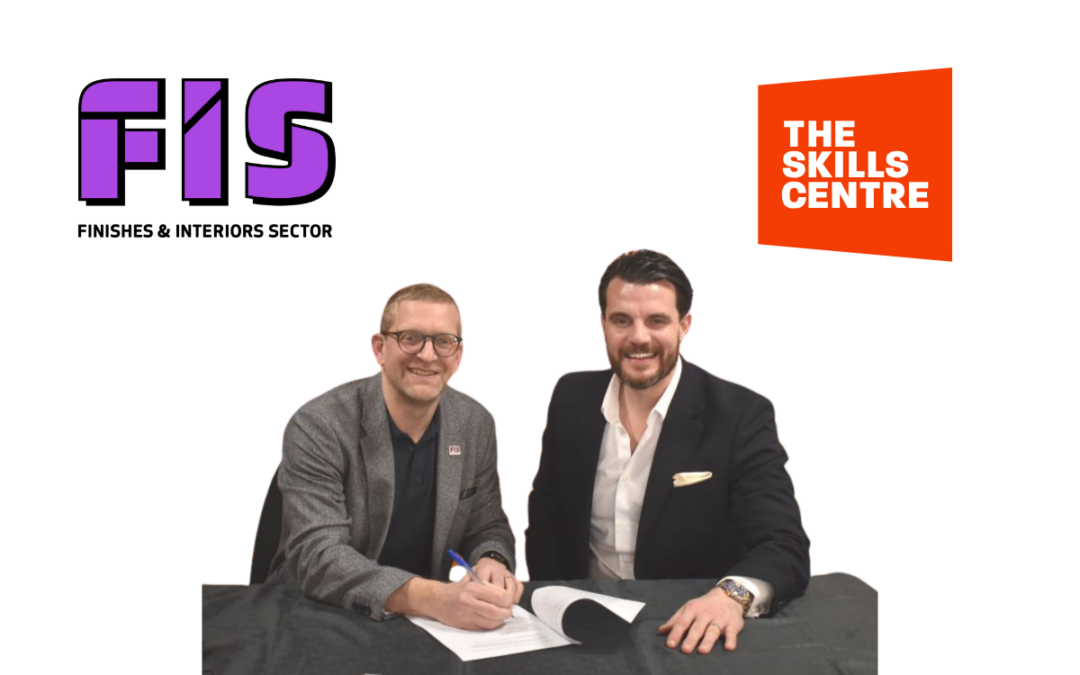
FIS partners with The Skills Centre to tackle skills shortage in the finishes and interiors sector

FIS partners with The Skills Centre to tackle skills shortage in the finishes and interiors sector

FIS is delighted to announce its new partnership with The Skills Centre to deliver essential training and support for individuals pursuing careers in the finishes and interiors sector. This collaboration aims to address the growing skills shortage in construction, specifically in this sector, which faces a critical demand for skilled workers.

According to the Construction Industry Training Board (CITB), the construction sector will require an additional 251,500 workers by 2028. Furthermore, 61% of FIS members report struggling to find skilled workers, highlighting the urgency of this partnership to  address the skills gap. As the UK continues to invest in reaching its Net Zero targets, retrofit projects will increase, driving continued demand for insulation and drylining skills as the 2050 deadline approaches.

Through this collaboration, The Skills Centre will deliver a series of Bootcamps designed to provide individuals with the hands-on training and industry-specific knowledge necessary to kickstart their careers in the finishes and interiors sector. These intensive programmes will bridge the gap between talent supply and employer demand, offering practical experience and career support to participants.

The first offering will be an Introduction to Insulation and Drylining course, which is a free, eight-week programme. Successful participants will earn a Level 2 qualification. The training and qualifications* will include:

In addition, a new Drylining Apprenticeship will be available for pre-screened local candidates who have come through funded Bootcamps. This specialist training will cover Partition Walls, MF Ceilings, Grid Ceilings, Shaft Walls, Metsec Installation, Rainscreen Cladding and Passive Fire Protection.

Employers in the finishes and interiors sector are encouraged to get involved and support the initiative by providing interview opportunities or offering work experience placements with a view to future employment. The initiative aims to support workforce development, create opportunities for career growth, and enhance the talent pipeline within the sector.

Commenting on the initiative, FIS Head of Skills Beena Nana, said:

“We are thrilled to be partnering with The Skills Centre to enhance the support we provide to our members while tackling the growing skills shortages in our industry. This partnership enables us to combine resources and expertise, fostering opportunities for development, training, and growth, which will ultimately benefit our members and the broader community by addressing critical workforce challenges.”

Sam Downton, Director at The Skills Centre added:

“Our new partnership with FIS marks a significant step forward for the interior systems and drylining sector. This part of the industry plays a critical role in shaping the internal environments where we live, work, and learn—but it continues to face skills shortages and often flies under the radar as a long-term, rewarding career option.

“Joining forces with FIS brings together their sector leadership and our expertise in delivering high-quality, hands-on training. Central to this partnership are our specialist Bootcamps, which are imperative for attracting new talent into the industry. They provide a direct route for individuals—many of whom are new to construction—to gain essential skills, site experience, and the confidence to move straight into employment.

“For employers, these Bootcamps open up access to a wider, work-ready talent pool and offer a practical solution to workforce gaps. Together with FIS, we’re not only building stronger pathways into the sector, but also helping to create a more sustainable, inclusive, and skilled future for interior systems and drylining across London and Essex”.

Employers can also attend planned visits to the following training centres to meet candidates and see the training in action:

  • Build East, Stratford – Wednesday, 30 April, 14:00 – 16:00
  • West Horndon, Essex – Wednesday, 14 May, 12:00 – 14:00

If you are an employer interested in attending any of these sessions or would like to support this initiative, please contact Beena Nana at beenanana@thefis.org or call 0121 707 0077.

For employers interested in finding out more about the Bootcamps and how they can get involved, a dedicated webinar will provide all the information needed to get started.

*Actual qualifications delivered may vary based on employer demand at the time of delivery.

Celebrating 10 years of FIS

Celebrating 10 years of FIS

FIS is marking its 10-year anniversary this year, celebrating a decade of unwavering commitment to FIS members and the wider sector.  The FIS community includes contractors, manufacturers and distributors of ceilings, partitions, plastering, drylining, operable walls, steel framing systems, and specialist interior fit-out and refurbishment businesses operating in every type of building.

Formed between a merger of two trade associations in 2015, FIS has grown to represent over 600 members with a combined turnover of over £12.7 billion and a workforce of over 250,000.

Achievements and initiatives
The guiding principle of FIS is to be member-led and it is this support from members through the members Board, working groups, regional events and day-to-day close working that focuses direction and ensures FIS, not only has a clear and informed voice when working to influence change, but that activity is laser focused on delivering practical and tangible benefit to the community and wider sector.

Amongst the notable interventions and achievements over the last 10 years a few stand out, these include:

Steering the industry through Covid

We worked with the wider sector and key stakeholders to ensure members had access to advice in real-time, providing concise daily updates. The work also included mobilising a small working group to develop key H&S support (including the FIS COVID RAMS to support close proximity working). During this time, FIS was a founder member of the Construction Industry Collective Voice in Scotland, working with colleagues from across the nation to collaborate and optimise the support for the wider construction industry in one of the darkest times we have collectively known

Navigated the implementation of the Building Safety Act

FIS fed in to change and developed its Product Process People Quality Framework and Integrated Management Standard to help members manage compliance. FIS guidance on the Golden Thread was recognised as best in class in the industry and the free to member Building Safety Act training course has supported over 450 members to date.

Developed a bank of technical information and guidance

In the last 10 years FIS has developed an impressive bank of information to support the specification and installation of walls, ceilings, floors and SFS Facades. Dedicated Working Groups ensure that this growing wealth of technical information that includes our Best Practice Guides, Specifiers Guides and technical guidance notes help support best practice and training in the sector. Concerns raised in developing guidance for Partitions and Operable Walls led to the formation of the FIS Acoustic Verification Scheme, ensuing members claims about acoustic performance are verified. The scheme was expanded to embrace pods in 2024.

Established the Tall Building Working Group

In 2019 FIS established the Tall Building Working Group to lead research into concerns associated with creaking noises in tall residential towers. In this work FIS collaborated with industry experts from around the globe to study test data and movement of tall buildings and their impact on installations. FIS raised funding and conducted around £100,000 of testing to help identify causes of concern and start to help lead the sector in finding mitigating strategies.

Collaboration with industry bodies

Collaboration has remained at the core of FIS work and we have worked with a number of trade bodies and the wider sector to develop the Firestopping of Service Penetrations Guide – specifically targeting concerns related to the penetration of fire compartments. This work helped inspire the formation of the Passive Fire Knowledge Group, encouraging and leading collaboration outside of traditional industry siloes and latterly the publication of Walls as a System (looking at compatibility concerns).

Commissioned academic research and market data

In addition to an impressive array of benchmarking and market data available to members, FIS has commissioned academic research. The largest study to date was The Reading Report, a collaboration with the University of Reading and AMA Research with nearly 300 business contributing to this seminal study on challenges derived from contracting, procurement and payment practices in the sector.

Enhanced legal support for members

FIS Legal Support has ratcheted up over the past decade and the organisation has produced template contracts, training, a legal helpline and a contract review service delivered through an impressive array of leading industry experts. This work is pivotal in helping members avoid and manage disputes. Over 21 calls have gone through the FIS legal helpline.

FIS launched Project Reuse

In 2021 FIS established a Sustainability Leadership Group. This has become a vibrant forum for action and has specific training pathways to help ensure the workforce is engaged and knowledgeable. Tools to support a standard for pre-refurbishment audits have also led to setting up FIS Project Reuse, a live facility helping overcome practical problems aligned to reuse of products in commercial projects.

Helping to address the sector skills shortage

The skills shortage remains perhaps the biggest strategic challenge for the sector. Constantly changing the angle of attack, the FIS BuildBack programme helped to introduce 160 new entrants into the sector. FIS has developed new apprenticeship standards for Drylining, Ceilings, Demountable and Glazed Partitions and Plastering as well as frameworks to support demonstration of competence against the new industry standard. Work with My Professional Passport to develop the FIS Competency Passport was referenced in a recent Department for Education report written by Mark Farmer into training practices in construction as a tangible example of how innovation can help support change. Most recently FIS introduced a new partnership with The Skills Centre, bringing a modern and agile, employer focussed approach to delivery of apprentices.

Looking ahead
Looking ahead to the next decade, FIS President, Ian Strangward said:

“The success of FIS is that it works closely with us, the members, to interrogate and understand problems, tapping into the collective wisdom.  This means that they are uniquely placed to develop targeted guidance and provide a platform for collective action.  The world today is about more than what you know, it is about how you know.  Much of the success of FIS is built on a structured approach to research and analysis of the problems.  This work has seen us emerge as a real thought leader, not just challenging the behaviours and shortcomings in the sector and regulation, but looking at practical ways we can collaborate to improve.

“Who you know also remains important and all of the great work of FIS means it has never been in a better position to influence change.

“In FIS we are blessed with a modern, driven and effective trade body that stands us, as businesses, in a good place to navigate the uncertainty that is the world today and position ourselves in the best possible position to adapt and meet the changes head on”.

FIS continues to evolve and the next chapter involves the launch of a new collaboration with the University of Reading looking at the low-rise housebuilding sector, a renewed focus on health and safety, using innovation and e-learning to target occupational health issues that are putting workers at risk and shortening careers (adding to the worker shortages).  The organisation has embarked on developing technical guidance into targeted training through the new E-Learning Hub.  This work looks at how information can be better targeted with the scope of FIS support extending to cover with more specificity, in a modular way to support roles like contract management and estimating.  Attention is also starting to turn to how AI and digital solutions can help drive productivity and support both the work of the organisation and the sector as a whole.

The FIS team remains passionate about supporting members in building stronger, more resilient businesses to take the industry forward. As we reflect on the past decade, we want to express our thanks to all our members for being an integral part of the FIS journey. Here’s to many more years of collaboration, innovation, and success. Thank you for your continued support.

Tell your FIS Story

Help us keep to keep telling the story of FIS by sharing your experiences with us.

How has the FIS helped you in the past 10 years?

Build your team and help to address the skills shortage

Build your team and help to address the skills shortage

Come and see us on 30 April at Build East Stratford

FIS has partnered with The Skills Centre to deliver Skills Bootcamps to address the growing skills shortage in the finishes and interiors sector.

To support this, we would like to invite you to your local Bootcamp which is taking place on 30 April at Build East, Stratford to see first-hand the candidates who are currently undertaking training in Internal / External Insulation and Drylining.

As part of the bootcamp, we are looking for employers who can offer interviews, two-week work placements and/or employment opportunities for these candidates.

Funded by the Department for Education, these bootcamps provide a pathway for those looking to enter construction or upskill into a more specialist role.  But without the support of employers these individuals may never enter construction.

By coming along, you can meet the individuals and see the training in action. The Internal / External Insulation and Dry Lining Bootcamps have a duration of 8 weeks, which include 2 weeks work experience, an outline of what is included as part of a bootcamp is listed below:

Training and Qualifications*:

  • Cskills Level 1 Health & Safety
  • CITB CSCS Health & Safety Environment (Green Card)
  • Level 2 Understanding Domestic Retrofit
  • Level 2 Removing Non-Hazardous Waste in the Workplace (Blue Card)
  • Environmental awareness in the construction industry
  • Introduction to Interior Systems
  • Introduction to Passive Fire

*Actual qualifications delivered may vary based on employer demand at the time of delivery.
If you are interested in finding out more about this initiative contact beenanana@thefis.org

We hope to see you there.

Bootcamp dates and venues

  • Build East Stratford, London – visit 30 April 2 – 4pm
  • Birmingham, Aston – date to be confirmed
  • Essex, West Horndon – visit 14 May 12 – 2pm
  • Edgware, London – date to be confirmed


Inspiring the Next Generation: Join FIS at the ‘50 Careers in a Day’ Festival

Inspiring the Next Generation: Join FIS at the ‘50 Careers in a Day’ Festival

FIS is proud to be partnering with Building Our Skills to deliver an exciting Careers Festival – showcasing ‘50 Careers in a Day’ – designed to open young minds to the diverse opportunities available within the finishes and interiors sector and the wider construction industry.

Taking place on Tuesday 20th May at the AluK Design Centre in London, this one-day event will bring together school-aged children, teachers, careers advisors, and parents to explore what a future in construction could look like. The festival will feature real stories from real people, with industry professionals sharing insights into their own career journeys, what inspired them, and the variety of roles available across the sector.

Why Get Involved?

This initiative is about more than just awareness — it’s about making construction a career of choice for the next generation. The event aims to:

  • Position construction as an exciting and rewarding long-term career

  • Provide clear, practical information and guidance

  • Enable direct engagement with passionate people working in the industry

We’re inviting FIS members to get involved — whether it’s by giving a short talk, sharing your story, or bringing along a hands-on activity that helps bring your work to life.

Event Details

Tuesday 20th May
10:00 AM – 4:00 PM
AluK Design Centre, Henry Thomas House, 5-11 Worship St, London EC2A 2BH

Interested in Taking Part?

If you’d like to be part of this inspiring day and help us shape the future of our industry, please get in touch with Beena Nana at
beenanana@thefis.org by Friday 8 May.

Supporting Early Resolution: Why FIS Members Should Sign the Conflict Avoidance Pledge

Supporting Early Resolution: Why FIS Members Should Sign the Conflict Avoidance Pledge

At FIS, we’ve long advocated for better contractual practices and early intervention to help our members avoid the stress, cost, and disruption of disputes. That’s why we’re proud to share that one of our trusted consultants, Len Bunton, has recently been appointed President of the Conflict Avoidance Coalition.

Many of you will know Len through his work delivering contract reviews and offering wise, practical advice to FIS members on a wide range of contractual issues. He continues to be a strong advocate for fairness and collaboration in construction contracts, and his latest message is simple but important:

All FIS members should sign the Conflict Avoidance Pledge. You can do so via the RICS website

What is the Conflict Avoidance Process?

The Conflict Avoidance Process (CAP) is designed to encourage early intervention when issues arise on a project—helping both parties find practical, collaborative resolutions before they escalate into formal disputes. It’s about protecting relationships, maintaining progress, and saving time and money.

We encourage members to go one step further and request that employers and main contractors include the Conflict Avoidance Clause in contracts. A sample clause is available and acts as a declaration of intent from both parties to resolve emerging issues constructively, without affecting their legal rights (including adjudication, if needed).

Why This Matters More Than Ever

With increasing pressure across the sector—particularly around payment terms and cash flow—contractual tensions can escalate quickly. Taking proactive steps now can help prevent those “bumpy rides” later on. By adopting the Conflict Avoidance Pledge and clause, you’re not only protecting your business but also supporting a wider industry shift towards fairer, more sustainable practices.

Need Support?

If you’d like to learn more or need help implementing this approach in your contracts, you can reach out directly to Len Bunton at len@buntonconsulting.co.uk.

FIS remains committed to helping members navigate the increasingly complex contractual landscape—and initiatives like this are a valuable step in the right direction.

Updated Building Control Fees from 1 April 2025

Updated Building Control Fees from 1 April 2025

From 1 April 2025, the Building Safety Regulator (BSR) has introduced increased fees for a range of building control functions, including the processing of applications for Building Control Approval at Gateway Two.

As members navigate the evolving building safety regime, it’s important to be aware of these changes and factor them into project planning and resourcing. To support this, Build UK has updated its Gateway Two Validation Guide, which now includes the revised fee structure and helpful guidance on how to prepare a compliant application.

FIS encourages all members involved in regulated building projects to review the updated guide to ensure smooth progress through Gateway Two.

Recruiting and Retaining the Construction Workforce

Recruiting and Retaining the Construction Workforce

FIS joins concerns in the level of challenges that the workforce are facing as we take part in last week’s Build UK Forum, where we joined industry peers to explore the initial findings of ongoing research by Warwick University into workforce challenges across construction.

The discussion reinforced what many within the finishes and interiors sector are already experiencing which is that the way our industry operates has a direct impact not only on the ability to recruit and retain skilled workers, but also on overall quality, productivity, and performance.

The research is shedding light on some of the key structural and cultural issues affecting our workforce, including:

  • High levels of self-employment
  • Intense project timelines and long working hours
  • Extended periods working away from home
  • A lack of recognition and reward
  • Poor mental health and wellbeing support

As a sector already facing a significant skills gap, these findings underline the urgent need for change. We welcome Warwick University’s continued work, particularly its focus on understanding what draws new entrants into the industry. This insight will be critical to shaping more effective recruitment strategies and building a more sustainable and supportive working environment.

FIS remains committed to supporting members in tackling these challenges and championing improvements that will help attract and retain the skilled workforce our sector needs.


FIS Mental Health Hub

Here you can find information and resources to help you with your mental health and wellbeing.

FIS Wage Rate Survey points to ongoing inflation

FIS Wage Rate Survey points to ongoing inflation

The FIS Wage Rate Survey 2025 (data gathered in the first quarter of the year) revealed that, across the trades, FIS members have continued to experience increases in wage rates averaging around 7% in key trade occupations (the full index is available to contributors only).

Commenting on the data FIS CEO Iain McIlwee stated:

“The data underpins that the supply chain continues to be hit by inflationary pressures with an annual increase of 7% in 2025 piling on top of double digit inflation in 2024.  If we look at what this means in real terms, for some trade areas rates are now (cumulatively) 75% higher than when we started to gather data in 2020.  If we compare this to the wider economy, construction wages continue to outstrip the national average which was below 6% in 2025 and 2025.  This is putting real pressure on specialist contractors.  Comments gathered as part of the research raised concerns linking this inflation to shortages in key trade areas.  If the market does start to improve in 2025 and 2026 there are very real concerns that the skills are simply not going to be there to meet demand.  To address this, it is vital that recent Government announcements about investment in skills don’t just get lost in long term strategy, but are invested in supporting employers now in training and developing their workforce.”

The survey also points to changes in the structure of the workforce, which continues to trend away from direct employment, which has fallen from 26% in 2021 to 23% in 2025.

FIS also gathered data on Payment Trends, with around 20% suggesting that payment payment practices have worsened in the past 12 months and less than 5% reporting improvements.

FIS gathers and collates a range of market data to support the sector,  you can see the full range of data available here.

Important judgment related to design development

Important judgment related to design development

The case of Workman Properties Ltd v Adi Building and Refurbishment Ltd involved the expansion of existing facilities at Cotteswold Dairy in Gloucestershire. The dispute centred on the design responsibilities under an amended JCT Design and Build Contract 2016, specifically regarding the completion of the design to RIBA Stage 4 and/or BSRIA Stage 4.  This case sheds light on several important legal principles and underpins concerns raised by FIS regarding the impact on the levels of design completeness and greater risk being pushed into the finishes and interiors sector in the face of increased building complexity and concerns related to compliance and insurability in the architectural world.  The key points of the case were:

  1. Design Responsibility
  • The court clarified that the contractor, ADI, was responsible for completing the design to RIBA Stage 4/BSRIA Stage 4 (i). This decision rejected ADI’s argument that Workman Properties had warranted the design’s completeness.
  • The judgment emphasized the importance of clear contractual terms in defining design responsibilities. It highlighted that the contractor must ensure compliance with the employer’s requirements, even if the design is incomplete at the time of contract formation.
  1. Contractual Interpretation
  • The court underscored the principle that contracts should be interpreted based on their written terms rather than subjective intentions or pre-contractual negotiations.
  • ADI’s reliance on pre-contractual exchanges and subjective understandings was deemed irrelevant and inadmissible. This reinforces the importance of relying on the contract documents themselves for interpretation.
  1. Suitability of Part 8 Procedure
  • In another concerning aspect of the judgement, the court found that the adjudicators decisions were based on an incorrect interpretation of the contract.  ADI had previously succeeded in adjudications related to design obligations and financial claims.
  • The court emphasized that the Civil Procedure Rules Part was appropriate for resolving the dispute, as the issues were primarily legal and did not involve substantial factual disputes. In this the court rejected ADI’s contention regarding the relevance of pre-contractual negotiations and subjective understandings (the facts of the case).
  • In doing this the court’s decision clarified the contractual position regarding design responsibility, providing a foundation for resolving future disputes efficiently (setting precedence).

This case serves as a reminder of checking the design and pricing risk when confronted with an incomplete design, the importance of precise drafting in construction contracts and the limitations of relying on external factors and secondary communications for adapting the principles set down in the contract.


FIS Contractual and Legal Toolkit

FIS members can access services to navigate construction market complexities, including template contracts, guidance on standard terms, dispute resolution support, and best practice advice, alongside their advocacy against unfair payment practices.

FIS Contract Review Service

The FIS Contract Review Service assists members in identifying problematic clauses early. Key features include:

  • Selection of four expert panelists
  • Initial review costs £450, with £150 for a detailed virtual meeting (prices vary by contract size)
  • Analysis of trends and market updates through advisory articles
  • Supports FIS’s commitment to the RICS Conflict Avoidance Process.