FIS develops e-learning to support specification of ceilings and acoustic absorbers

FIS develops e-learning to support specification of ceilings and acoustic absorbers

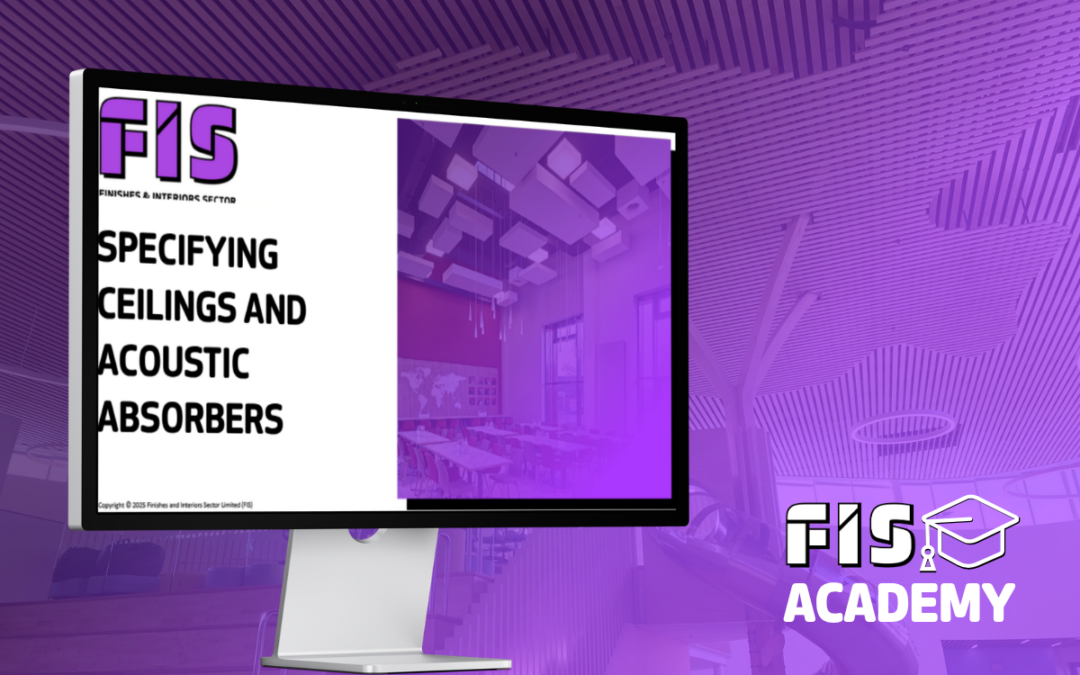
FIS has developed e-learning alongside its recently updated Specifiers’ Guide for Ceilings and Acoustic Absorbers to help project teams fully understand the criteria when writing a specification for a suspended ceiling or acoustic absorber. 

With specification more important than ever in construction, this e-learning module and supporting guidance will support everyone involved in selecting and specifying ceiling systems. 

Developed by the FIS Ceilings and Absorbers Working Group which comprises representation from manufacturers, suppliers and contractors involved in the design, supply and construction of ceiling systems, the guidance and associated e-learning is intended to guide architects, designers and installers through the criteria in selecting and specifying a suspended ceiling and acoustic absorber that will satisfy the performance needs of an internal space while providing the desired visual effect.  

Commenting on the guide, FIS Technical Director James Parlour said:

“Suspended ceilings are complex kits, and it can be difficult for architects and designers to specify a complete solution that is robust and deliverable. Generating advice for specifiers that manages expectations and leverages the combined expertise of our members to give advice that will ultimately improve outcomes for delivery teams is indispensable”.

The structured guidance addresses what a good specification looks like and includes 10 top tips to producing a specification. It then breaks down the key performance issues around fire and acoustics and the other issues of volatile organic compounds, light reflectance, impact resistance, air permeability, wind loading, sustainability and conformity marking. 

“In total, there are 36 parameters to consider to ensure a safe, compliant and complete specification. This is crucial if the specification is not to be misinterpreted and any alternatives assessed and checked as equal before approving them,” added James Parlour. 

The guide sits alongside other FIS Guidance that relates to ceilings as well as supporting e-learning which is available for free to FIS members via the FIS Academy.

  • Site Guide for suspended ceilings 
  • Installation of suspended ceilings 
  • Selection and installation of top fixings for suspended ceilings 
  • Maintenance and access into suspended ceilings 
  • Recommendations for the Safe Ingress of Plasterboard 
  • A guide to BS EN 13964 – suspended ceilings, requirements and test methods
  • Health and safety handbook 

These guides work well when they are included in proposals and project plans to demonstrate how to best approach a project. They are also good differentiators when someone is in competition with non-members, and are an excellent introduction to new members of the team and any trainees and apprentices. 

You can download the Specifiers’ Guide – Ceilings and Acoustic Absorbers here. 

CIJC holiday entitlement to increase from January 2027

CIJC holiday entitlement to increase from January 2027

The Construction Industry Joint Council (CIJC) has agreed a staggered increase in holiday entitlement over the next two years.

From 1 January 2027, an additional half day will be introduced, taking the annual entitlement up to 23.5 days (plus eight bank holidays). Another half day will then be added from 1 January 2028, taking the total to 24 days. An updated Holiday Entitlement for 2027 will be made available to members in December.

New Hospital Programme releases new Supplier Guide

New Hospital Programme releases new Supplier Guide

The New Hospital Programme (NHP) represents the most significant investment in NHS infrastructure in recent decades. It is not only delivering new hospitals, it is transforming how healthcare infrastructure is planned, designed and delivered across the NHS, supporting the ambitions set out in the 10 Year Health Plan for England.

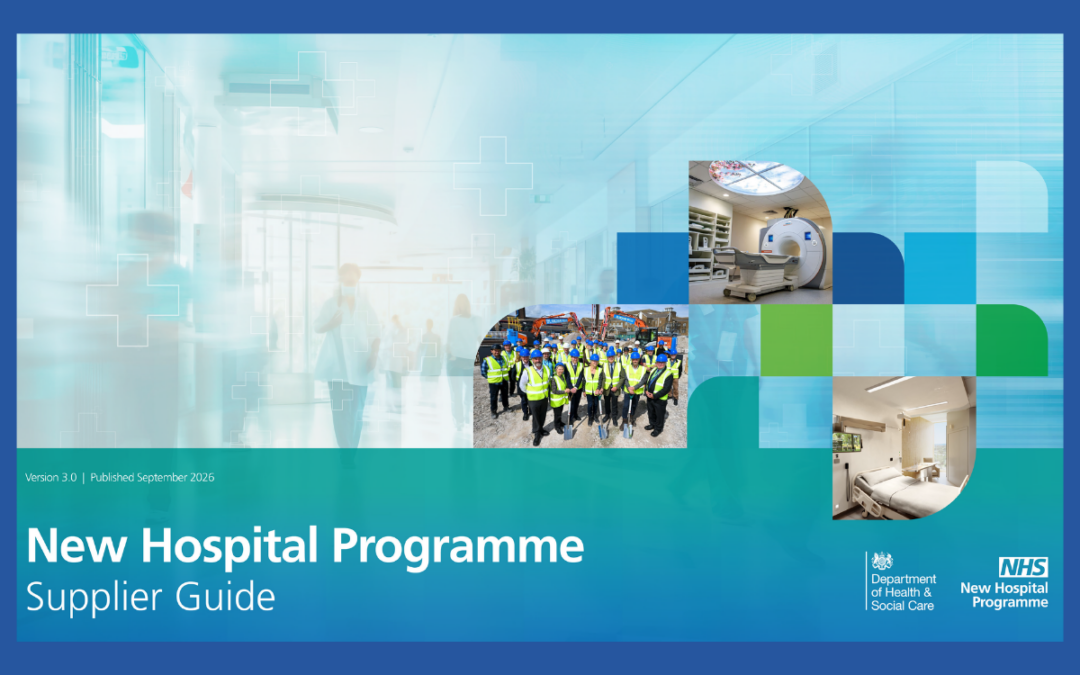
FIS has worked closely with major client groups such as the New Hospital Programme (NHP) to support engagement with the supply chain and the development of their new Supplier Guide, which aims to help prospective suppliers better understand NHP, how it will be delivered, and how businesses can prepare for future supply chain opportunities.

The guide details how you can find opportunities and what products and services the NHP will be looking to procure. You can download the guide here:

Supplier Guide – New Hospital Programme


Can you offer work placements to help tackle the skills shortage?

Can you offer work placements to help tackle the skills shortage?

The Construction Leadership Council is hosting a webinar to support construction employers in offering placement opportunities. During the session you will be among the first to gain access to the new Construction Industry Placements Playbook, an easy-to-use guide to work placements, delving deeper into how placements are vital to showcasing what a career in our sector looks like. There will also be guidance on funding that is available to employers.

FIS Head of Skills Beena Nana said:

“FIS has been supporting this work to help address one of the biggest challenges facing our industry – attracting and developing the people we need for the future. Industry placements, done right gives individuals a chance to see what a career in construction really looks like, while helping employers connect with potential future recruits. If we want to build a stronger talent pipeline, we need to make it easier for businesses to open their doors and provide these opportunities. This webinar and the new Playbook are aimed to help employers take that vital first step.”

Webinar details:

  • Date: 11 November 2026.
  • Time: 12 noon – 1 pm
  • Location: Online via Microsoft Teams.

Register your interest: CSMB Work Placement Webinar


Fire Risk Assessments and Fire Risk Appraisals of External Walls Practitioner Guidance

Fire Risk Assessments and Fire Risk Appraisals of External Walls Practitioner Guidance

The Construction Leadership Council has published practitioner guidance setting out the behavioural principles that should be applied when developing, reviewing and auditing fire risk assessments (FRA) and fire risk appraisals of external walls (FRAEW).

The advisory note provides information for those directly and indirectly impacted by the undertaking these assessments and appraisals. This includes, but is not limited to:

  1. Authors
  2. Reviewers
  3. Auditors
  4. Commissioning parties
  5. Regulatory bodies
  6. Lenders, valuers and other parties relying upon the outputs
  7. Any identified stakeholder of the bodies listed above.

The guidance can be found here.

The British Standards Institution recently published a revised edition of the code of practice for FRAEW. PAS 9980: 2026 can be found here.

The Ministry of Housing, Communities and Local Government has also published FRAEW supporting guidance which aims to help non-technical users understand the appraisals of their external walls, what to consider when commissioning an FRAEW and how to interpret the report findings. The supporting guidance can be found here.

Cladding Bill raises the stakes for product manufacturers – FIS developing guidance on product non-conformity and recall

Cladding Bill raises the stakes for product manufacturers – FIS developing guidance on product non-conformity and recall

The Government has introduced the Building Safety (Remediation of Unsafe Cladding etc) Bill to Parliament. It was introduced on 14 October 2026 and aims to drive forward the remediation of unsafe cladding and ensure that those responsible pay towards the cost of remediation work.

Much of the Bill is aimed at building owners. It creates a new legal duty on those responsible for the safety of their buildings, such as freeholders, to identify, assess and fix issues without delay, and anyone who obstructs this work could face criminal penalties. But manufacturers should take note too. The Government says the Bill will give developers, contractors and others who have paid for remediation a simpler route to recover costs from cladding manufacturers where their products contributed to a building being unsafe, by removing legal barriers that have blocked these claims. It would also amend the construction products cause of action in section 148 of the Building Safety Act 2022, including what counts as a relevant building and the liability of associated companies.

Section 148 already lets anyone with an interest in a building containing dwellings sue a manufacturer or seller directly if a non-compliant, misleadingly marketed or inherently defective product makes a dwelling unfit to live in. Claims can’t be excluded by contract and can be brought for 15 years, or 30 years looking back for cladding. The direction of travel is clear: liability is widening, and how a business responds when something goes wrong will matter more than ever.

FIS guidance on product non-conformity and recall

FIS has been working with the regulator and is developing guidance for construction product suppliers on what to do when a product may not perform as it should. The guidance separates what the law requires today, what good practice looks like, and what is proposed under construction product reform. Its five key messages are:

  • Act on potential risk, not proof. If there is reason to think a product may be unsafe in use, act and report it, whatever standard it is made to. For products under the Construction Products Regulation, a shortfall against declared performance must be corrected, withdrawn or recalled even if it isn’t a safety risk.
  • Report through the right route. In Great Britain that is normally Trading Standards or your Primary Authority, working with the Office for Product Safety and Standards (OPSS). Reporting is not automatically a route to enforcement. Businesses that find a problem, act on it and keep the regulator informed are treated as acting responsibly.
  • Tell your customers early, in writing, with batch detail. For construction products, the installing contractor is usually the first and most important customer to inform.
  • Base decisions on an evidenced risk assessment. “It should be alright” won’t satisfy building dutyholders or regulators. The OPSS PRISM method gives a recognised structure.
  • Engage insurers early and keep records. Late notification and poor records are the most avoidable sources of loss.

The guidance also covers running a response in line with PAS 7100 and the new PAS 2000:2026 code for construction products, practical traceability (tracing a batch to where it was fixed in a building, not just the site it was delivered to), communications, insurance, and a checklist for the first days of an incident.

Get involved

We’d welcome input from members on your views on the Bill and on the guidance before it is finalised. If you’d like to see the draft and comment, or if your business is currently affected by a product non-conformity or recall issue and would like support, please contact James Parlour (jamesparlour@thefis.org). Members can access the FIS legal helpline for free expert legal advice – early advice is essential on such matters.


FIS supports consultation on new As-Built and Handover Information Guidance

FIS supports consultation on new As-Built and Handover Information Guidance

FIS is encouraging members to engage with the public consultation on As Built & Handover Information: Requirements, a new industry guidance document developed through a Construction Leadership Council (CLC) Industry Task and Finish Group and BIM in Asset Management, with contributions from more than 100 representatives from across the built environment. FIS was pleased to contribute to the development of the guidance.

The guidance aims to establish a consistent understanding of the information that should be provided at project completion, helping to ensure that building information remains accurate, trustworthy and useful throughout the life of a building. It reinforces the principle that information should be treated as a project deliverable, rather than something assembled at the end of a project.

FIS’s input focused on the need to align design, construction and information management processes from the outset. Building on the principles of the Golden Thread, FIS advocated for a joined-up approach that connects design intent, product information, installation records, verification activities and operational data into a single information workflow. The Federation also highlighted the importance of ensuring that procurement strategies, contractual conditions and commercial arrangements support these objectives, providing the time, clarity and resources needed to create and maintain reliable building information.  This work links closely to Design Codes currently being developed by FIS.

Commenting on the consultation, Iain McIlwee, Chief Executive of FIS, said:

“The Golden Thread is often described as a digital challenge, but in reality it is a project delivery challenge. Good information does not appear at handover. It is created through design decisions, product choices, installation records, inspections and verification activities throughout the life of a project. If we want trustworthy information, we need procurement, contracts and commercial arrangements that recognise information as a deliverable in its own right. This guidance is an important step towards creating that joined-up approach.”

The consultation is open until 16 October 2026 and FIS encourages members involved in design, specification, installation, commissioning and building operations to review the document and share their views.

Members can download the documents here and respond to the consultation directly here.

FIS launches new board lifter guidance to support safer drylining practices

FIS launches new board lifter guidance to support safer drylining practices

Following growing industry discussion around the use of board lifters in drylining, the FIS Health and Safety Working Group has launched new guidance to help businesses understand the safety procedures involving the handling and positioning of large, heavy boards and lifting aids to manage risk, improve positioning accuracy and reduce injury. 

The guidance provides contractors, clients, principal contractors and duty holders with a practical, risk-based approach to the use of board lifters. It responds to growing client requirements and industry discussion around the mandatory use of lifting aids and clarifies how legal duties under the Manual Handling Operations Regulations 1992 should be applied in practice. 

Members can support safer methods of working by setting out the benefits, limitations and risk assessment considerations when installing heavy drylining boards. Logistical issues such as restricted spaces, stairwells and cluttered sites can create difficulties and render the use of lifters impractical or prevent them from being used to their full potential. Equipment setup, storage, productivity and site logistics should always be considered in the planning stage of a project.

Commenting on the launch of the new guidance, David Cant, Chair of the FIS Health and Safety Working Group said:

“Whilst board lifters can support safer methods of work, their use is not universally practicable. Construction projects vary considerably in layout, access, programme constraints and working environment. In some situations, introducing board lifters may create additional logistical challenges, affect productivity, or even introduce new health and safety risks if not properly assessed and managed. For this reason, the use of board lifters should never be treated as a blanket requirement or a one-size-fits-all solution – the decision must be determined through a suitable and sufficient risk assessment.”

Members can support safer methods of working by setting out the benefits, limitations and risk assessment considerations when installing heavy drylining boards. Logistical issues such as restricted spaces, stairwells and cluttered sites can create difficulties and render the use of lifters impractical or prevent them from being used to their full potential. Equipment setup, storage, productivity and site logistics should always be considered in the planning stage of a project.

This new guidance from FIS reinforces that board lifter use should be determined through task-specific risk assessment. The guide includes: 

  • Legal frameworks 
  • Where board lifters can help 
  • The practical limitations on the use of board lifters 
  • The safe deployment of board lifters 
  • Maintenance and inspection of board lifters 
  • The industry position on mandated use 
  • Toolbox talks for use on site 
  • Example RAMS document 
  • Board lifter checklist 
  • Dynamic risk assessment approach

To download the Board Lifters in Drylining Guidance, click here.

FIS secures CITB funding to support specialist upskilling across the finishes and interiors sector

FIS secures CITB funding to support specialist upskilling across the finishes and interiors sector

FIS has successfully been awarded funding through the Construction Industry Training Board’s (CITB) new Specialist Upskilling Fund, supporting efforts to address skills shortages and improve access to high-quality training across the fit-out, drylining and plastering sector.

FIS is one of 11 organisations selected by CITB following a strong response to its call for applications. The Specialist Upskilling Fund has been established to help remove barriers to training in specialist areas of construction and increase access to sector-specific competence training and NVQ achievement.

For FIS members, this provides an opportunity for us to work with employers and training providers to strengthen the skills pipeline across our sector, helping businesses identify any skills gaps, develop their workforce and ensure that workers have the competence required to meet the changing demands of the industry.

FIS will be offering support to members in accessing cost-effective, high-quality training and guidance, with a particular focus on supporting progression towards recognised sector-specific qualifications.

Beena Nana, Head of Skills and Training at FIS said:

“This is a fantastic opportunity to help FIS members address skills gaps, strengthen their workforce and support progression towards recognised qualifications. By improving access to high quality, sector specific training, we can help build a more skilled and competent workforce for the future of our industry.”

The CITB Specialist Upskilling Fund will support a range of specialist construction sectors, with successful applicants also including organisations representing civils and infrastructure, heritage, plant hire, retrofit, roofing, shopfitting, tunnelling and drilling, wood occupations and contract flooring.

Julia Stevens, Director of Industry Delivery at CITB, said:

“We’re pleased to share the successful applicants that have been awarded funding through our Specialist Upskilling Fund.

“We remain committed to providing sector-specific skills investment to ensure that support is available to construction employers to help develop their businesses and train their teams.”

FIS members are invited to contact Marie Flinter who will be able to provide further information on this programme.