


0121 707 0077

HSE publish new guidance: RIDDOR reporting of COVID-19

HSE publish new guidance: RIDDOR reporting of COVID-19

There is no requirement under RIDDOR (The Reporting of Injuries, Diseases and Dangerous Occurrences Regulations 2013) to report incidents of disease or deaths of members of the public, patients, care home residents or service users from COVID-19.The reporting requirements relating to cases of, or deaths from, COVID-19 under RIDDOR apply only to occupational exposure, that is, as a result of a person’s work.

What to report

You should only make a report under RIDDOR when one of the following circumstances applies:

Dangerous occurrences

Dangerous occurrences are certain unintended, specified events, which may not result in a reportable injury, but which do have the potential to cause significant harm.

For an incident to be reportable as a dangerous occurrence, the incident must have resulted (or could have resulted) in the release or escape of coronavirus, that is, led to a possible or actual exposure to coronavirus.

The assessment does not require any complex analysis, measurement or test, but rather for a reasonable judgement to be made as to whether the circumstances gave rise to a real risk or had the potential to cause significant harm.

Find out more about what the law says including some examples of what is not and what is reportable as a dangerous occurrence.

Cases of disease: exposure to a biological agent

When deciding if a report is required, the responsible person (usually the employer) must make a judgement, based on the information available, as to whether or not a confirmed diagnosis of COVID-19 is likely to have been caused by an occupational exposure, that is, whether or not there is reasonable evidence that a work-related exposure is the likely cause of the disease.

The report should specify a disease due to exposure to a biological agent and use the case of disease report form.

Get more information on what constitutes a diagnosis and more guidance on making a judgement and reasonable evidence.

Work-related deaths due to exposure to a biological agent

For an incident to be reportable as a death due to occupational exposure to coronavirus there must be reasonable evidence that a work-related exposure caused the worker’s death.

The responsible person should notify the enforcing authority by the quickest practicable means, without delay, and send a report within 10 days. The report should specify death due to exposure to a biological agent using the “case of disease” report form.

More on work-related deaths from coronavirus: What the law says and information on making a judgement using reasonable evidence.

Make a RIDDOR report online

You can access the FIS COVID H&S Toolkit here

CLC Schools Initial Scoping Workshop Report Published

CLC Schools Initial Scoping Workshop Report Published

Education represents the second largest element of public service spending in the UK behind Health – equivalent to around 4.3 per cent of national income. However, despite this level of commitment, the UK continues to face significant challenges when it comes to ensuring there are sufficient school places to meet growing demand.

According to ‘The School Places Challenge 2019’ published by Scape Group, despite efforts to increase school building over recent years, local authorities continue to face an uphill battle – with the number of children needing a school place in England expected to rise by 385,031 by 2021/22, and Scotland, Northern Ireland and Wales expecting to require an additional 33,179 pupils between them by 2020/21.

In a post Covid-19 financial landscape the need to deliver high quality buildings with improved levels of efficiency will never be greater – and represents an opportunity to turn this challenge into a positive catalyst for change.

The Construction Leadership Council has identified that innovation and smart construction has the potential to transform the productivity of the construction sector, address its capacity issues and improve the quality and performance of the buildings we produce.

We have already seen positive progress by the Innovation in Buildings workstream to drive the adoption of smart construction within a Residential context and are now pleased to extend this thinking across another sector.

Working with the Department for Education and a number of key industry, academic and government representatives we have commenced the development of a collaborative plan of action to deliver a real increase in smart construction across Educational building delivery.

The findings of our initial launch workshop are published below, and we look forward to sharing our ongoing progress with you throughout 2020 and beyond.

Read the Initial Scoping Workshop Report here.

Local Authority Amendments To The Standard Building Contracts Used In Scotland

Local Authority Amendments To The Standard Building Contracts Used In Scotland

In a letter supported by FIS issued to Kevin Steward MSP, Minister for Local Government Housing and Planning, the Chair of the CICV Forum draws attention to the unwelcome practice of amendments to Building Contracts in both the public and private sector and the devastating impact this can have on the construction sector as risk is forced through the supply chain.  The letter alerts the Minister to one instance where a contract from a Local Authority was presented with a total of 67 pages of amendments.

The letter also spotlights specific instances where entitlement have been removed and contractors are being forced to take all the financial impact of COVID related events.

In support of the letter, FIS CEO Iain McIlwee stated: “Once again we see the industry working together lead by the CICV.  It is so disappointing to see some of these underhand tactics being used to exploit the industry’s need to find work and ramp things back up again – Alan makes some excellent points in his letter and I hope the Scottish Government will step up and take on board the suggestions contained.  With the extended lock down Scottish Businesses have had a particularly difficult time, but these issues are not confined to Scotland and companies across the UK need to be very careful about what they sign up to in these uncertain times.”

The full letter can be read here.

Note that the Construction Leadership Council continue to gather information about the nature and extent of commercial issues within the industry – the deadline for the survey (which can be completed here) is Friday 21st August.  FIS is encouraging all members to complete where they have concerns to raise specific issues as they arise with FIS.

The Self-Employment Income Support Scheme claim service is now open

The Self-Employment Income Support Scheme claim service is now open

If Labour Only Sub Contractors are eligible for the second and final Income Support Scheme grant, and have been adversely affected on or after 14 July 2020, you can make a claim on or before 19 October 2020. You can claim for the second grant even if you did not make a claim for the first grant. If you have different circumstances it can affect your eligibility. If you’re self-employed or member of a partnership, find out how your circumstances can affect your eligibility for the scheme.

Please see here to understand how HMRC works out trading and non-trading income for the Self Employment Income Support Scheme.

New Guidance from BSI on Safe Working During the COVID-19 Pandemic

New Guidance from BSI on Safe Working During the COVID-19 Pandemic

Latest News

HSE statistics release: coronavirus disease reports and new support for reporting

HSE statistics release: coronavirus disease reports and new support for reporting

Where a worker has been diagnosed as having COVID-19 and there is reasonable evidence to suggest that it was caused by occupational exposure, employers are required to report the case to the relevant enforcing authority under the Reporting of Injuries, Diseases and Dangerous Occurrences Regulations 2013 (RIDDOR).

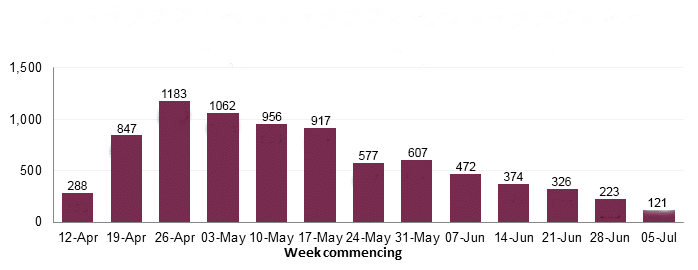
Latest published figures up to week ending 11 July show:

  • 7,971 disease notifications of COVID-19 in workers where occupational exposure is suspected were reported to enforcing authorities (HSE and LAs) over the period 10th April – 11 July, including 119 death notifications
  • around 80% of all worker reported cases (fatal and non-fatal) since 10 April were in HSE enforced workplaces
  • the majority of reports received since 10th April are for workers in the Health and Social Work sector (including for example hospitals, residential homes and day care). Around 75% of reports were recorded by employers against these activities, although the actual percentage may be higher as it is known that many reports for this sector get mis-classified by employers, particularly to the accommodation sector and to other personal services
  • 85% of worker COVID-19 reports received since 10 April were from workplaces in England, 8% in Wales and 7% in Scotland
  • the number of COVID-19 notifications made to enforcing authorities has generally fallen week-on-week since beginning of May, and is now at the lowest weekly level since week commencing 12 April (consistent weekly data is unavailable prior to then)
  • all cases that are reported to HSE and Local Authorities are being assessed and investigations initiated where incidents meet our published Incident Selection Criteria. We are unable to comment on individual investigations at this time.

Total suspected occupational COVID-19 reports made by employers to the Enforcing Authorities, 12 April to 11 July 2020

The statutory disease reporting form was changed on 10 April to enable systematic identification of COVID-19 reports. Guidance was also issued on this date around reporting requirements for COVID-19 deaths under RIDDOR. While some COVID reports may have been made prior to 10th April, they will not be consistent with later time periods. Therefore the data considers reports from 10 April onwards only.

The Government has also published New guidance for businesses and organisations on how to recognise, contain and report incidents of coronavirus has been published. Action cards have been developed to cover a range of businesses and organisations to provide specific advice on the issues each type of organisation may face now lockdown restrictions have been eased. The cards are designed to be printed or downloaded to keep on hand in your business or organisation.

You can access the FIS COVID H&S Toolkit here.

Incentive payments for hiring a new apprentice

Incentive payments for hiring a new apprentice

In recognition that Apprenticeships will be more important than ever in helping businesses to recruit the right people and develop the skills they need to recover and grow – both now and in the long-term. Due to the economic impact of the coronavirus (COVID-19) outbreak the government has introduced incentive payments for hiring a new apprentice to help organisations offer new apprenticeships.

Employers who hire a new apprentice between 1 August 2020 and 31 January 2021 can apply for:

£2,000 for each new apprentice aged 16 to 24

£1,500 for each new apprentice 25 and over

You can apply for the payment from 1 September 2020, after you add new apprentices to your apprenticeship service account.  The first payments will be made from January 2021 and will be paid directly into employer’s bank accounts.

How the incentive payments for hiring a new apprentice works

You’ll get the payment in 2 equal instalments. You will be eligible for 50% of the payment 90 days after the apprentice’s start date, and the remaining 50% after the apprentice completes 365 days of their apprenticeship.

The apprentice will need to be in employment and undertaking their apprenticeship at these times as evidenced in the Individualised Learner Record.

Apprentices who’ve been made redundant are eligible as long as they’re a new employee to your organisation. To get the second instalment the apprentice must have at least one year (356 days) of training left to complete.

Find Apprenticeship Training

Brexit: Goods into, out of, or through Northern Ireland and new Grants to Support Customs Declarations

Brexit: Goods into, out of, or through Northern Ireland and new Grants to Support Customs Declarations

The Northern Ireland Protocol will take effect from 1 January 2021. New guidance provides support for businesses engaging in new processes under the Northern Ireland Protocol. The guidance outlines that, under the Northern Ireland Protocol, the UK Government will ensure that:

  • Moving goods from Northern Ireland to Great Britain should take place as it does now – there will be no additional process, paperwork, or restrictions on Northern Ireland goods moving to Great Britain, delivering unfettered access.
  • Changes for goods moving from Great Britain to Northern Ireland will be kept to an absolute minimum – with a new Trader Support Service, available to all traders at no cost, to be established to provide wraparound support, alongside guidance on the processes for food and agricultural products designed to uphold the longstanding status of the island of Ireland as a single epidemiological unit.
  • Trade in goods between Northern Ireland and Ireland, and between Northern Ireland and EU Member States, will continue unaffected, with no change at the border, no new paperwork, and no tariffs or regulatory checks.
  • For trade with the rest of the world, Northern Ireland will benefit from UK FTAs – ensuring the benefits of those agreements are felt right across the United Kingdom.

If  businesses are impacted by these changes, they may want to consider the Trader Support Service. It can help businesses if they:

  • move goods between Great Britain and Northern Ireland, or bring goods into Northern Ireland from outside the UK;
  • act on behalf of someone to move goods between Great Britain and Northern Ireland, or bring goods into Northern Ireland from outside the UK;
  • are based in Northern Ireland and receive goods from outside of Northern Ireland;
  • send parcels between Great Britain and Northern Ireland, or bring parcels into Northern Ireland from outside the UK, using Royal Mail or an express operator.

The Trader Support Service will be free to use and will guide businesses  through any changes to the way goods move between Great Britain and Northern Ireland, and into Northern Ireland from outside the UK. Businesses  can also use it to get declarations completed on their behalf. Businesses can register an interest in the Trader Support Service here.

Apply for grants if your business completes customs declarations

Businesses can apply for 3 grants to help their business complete customs declarations. They can apply to get funding for:

  • training that helps a business to complete customs declarations and processes;
  • hiring new staff to help their business complete customs declarations;
  • IT improvements to help their business complete customs declarations more efficiently.

More information on the scheme and how to apply is available here.

Supplementary Funding available from CITB for FIS Members

Supplementary Funding available from CITB for FIS Members

The FIS Training Group has secured funding to supplement the cost of training courses completed by FIS employer members.  This FIS Supplement is in addition to the CITB GET code grant you claim from CITB for short duration courses.  Organisations are eligible for this FIS Supplement if the training undertaken is not on their CITB Skills and Training Fund Plan.

FIS Skills and Training Lead, George Swann, states “This is good news for the training group and our community as it enables members to access additional funding of up to £1,000 to cover a wide array of training, from generic health and safety through to specialist courses such as spray plastering, deflection heads or fire door inspection.  If you wish to make use of this supplementary funding we advise you to get in touch with FIS asap as it is a limited pot.”

Application for this supplementary funding is straightforward and will be based on quarterly caps.  It will be administered on a first come first served basis.  To claim an applicant will simply need to send your invoice to info@thefis.org or telephone 0121 707 0077, FIS will review in line with availability and the set CITB criteria.  If the claim meets the requirements of the supplement and the cap has not been reached we will arrange a refund of 50% of the course costs up to a maximum value of £250 per delegate, £1,000 per company per year, less the Tier GET code grant claimed from CITB.

See the full terms and conditions below.

For a full list of the CITB Training Standards please see: CITB training standards

CITB GET Fund FIS Supplement Terms and Conditions:

  1. An FIS supplement can only be paid to organisations ‘in scope’ to CITB and up to date with levy payments.
  2. The supplement is primarily for micro and small organisations no more than 25% of the total fund can be paid to large organisations (100 or more employees).
  3. Non Grant Eligible training is not covered by this supplement.
  4. The supplement cannot be used for Grant Eligible training that is already included on an individual employer contracted CITB Skills and Training allocation.
  5. Training must have taken place between 01 August 2020 and 31 March 2021 and have been completed before applying.
  6. Training must have been completed by delegates who are currently employed by or are NET (taxed) Construction Industry Scheme (CIS) sub-contractors of CITB registered employers.
  7. Invoices supplied must show the full costs of the training which have been carried out including CITB registration number, Training Provider, course name, CITB GET code, Tier value, date of completion, number of delegates, course cost and VAT.
  8. Successful applications will be notified within 25 working days.
  9. Payments will be made in the first week of October 2020, first week of December 2020 and first week of March 2021.

Funding is limited so cannot be guaranteed.

FIS are currently surveying members to identify the GET Code training courses in most demand.  If your organisation uses CITB short duration courses, please complete this survey

FIS is happy to review and support all of your funding claims through our one to one Skills and Funding Clinics (remember at this time you can still claim CITB Grants for courses undertaken completed in 2019 up until end November 2020 – our Skills clinics will help you to identify and process these claims).  This is a service freely available to members through the booking form here.  Members are also strongly advised to apply for the CITB Skills and Training Fund 2020 which can allow organisations to claim up to £25,000 to support their training needs.