
0121 707 0077

Apprentice Wage Rates

Apprentice Wage Rates

Following the increase in the National Minimum Wage (NMW) rates from 1 April 2021, the Construction Industry Joint Council (CIJC) has confirmed that, where the pay rates for apprentices in the Working Rule Agreement do not align with the NMW, the NMW takes precedence and apprentices should paid in line with the latest NMW rates.

In last week’s newsletter we reported that the Minimum Wage Rate changes announced in the Budget came into force on the 1st April.  New rates of the National Living Wage (NLW) and National Minimum Wage (NMW) come into force on 1 April 2021. These follow recommendations made in the autumn by the Low Pay Commission (LPC). To mark the uprating, this report looks ahead at the implications of the incoming rates and the LPC’s remit for the year ahead.

The new NLW and NMW rates are set out below. The NLW now applies to all workers aged 23 and over. The previous age of eligibility was 25. This will come down again to 21 by 2024.

Previous rate Rate from April 2021 Increase
National Living Wage £8.72 £8.91 2.2%
21-22 Year Old Rate £8.20 £8.36 2.0%
18-20 Year Old Rate £6.45 £6.56 1.7%
16-17 Year Old Rate £4.55 £4.62 1.5%
Apprentice Rate £4.15 £4.30 3.6%
Accommodation Offset £8.20 £8.36 2.0%

These increases mark the first step on the path to the Government’s target of an NLW set at two-thirds of median earnings by 2024. This report sets out the latest pathway to that target, based on projections of average pay growth. We are currently consulting on the NLW and NMW rates to be introduced from April 2022.

More information on the NLW and NMW is available here
Visit the FIS Employment Toolkit here
COVID-19: Employer Testing Duty and Self Isolation Rules

COVID-19: Employer Testing Duty and Self Isolation Rules

If you are an employer that requires staff to travel regularly across UK borders, you must take reasonable steps to facilitate your employees to take tests.

To help protect the country from coronavirus (COVID-19), there are testing regimes in place for those who travel regularly across UK borders. If you are an employer that fulfils the following definition, then you must take reasonable steps to facilitate the taking of tests by your employees:

  • you employ more than 50 employees, of which some or all are required to take workforce tests, including agency workers you are responsible for
  • your employees are required to complete testing after international travel

As an employer your ‘reasonable steps’ to facilitate the taking of tests might be:

  • establishing workplace coronavirus (COVID-19) testing or providing your employee with home testing
  • supporting access and signposting employees to testing outside of the workplace

Remember:   A key consideration for any policy is that if you get a positive lateral flow test (LFT) which is confirmed by a positive PCR test, LFT testing will not be effective for 90 days after you have tested positive so you must not use the tests during this period.

For more information on defining “reasonable steps” click here
BuildUK has set up a guide to help set up and run a workplace testing site
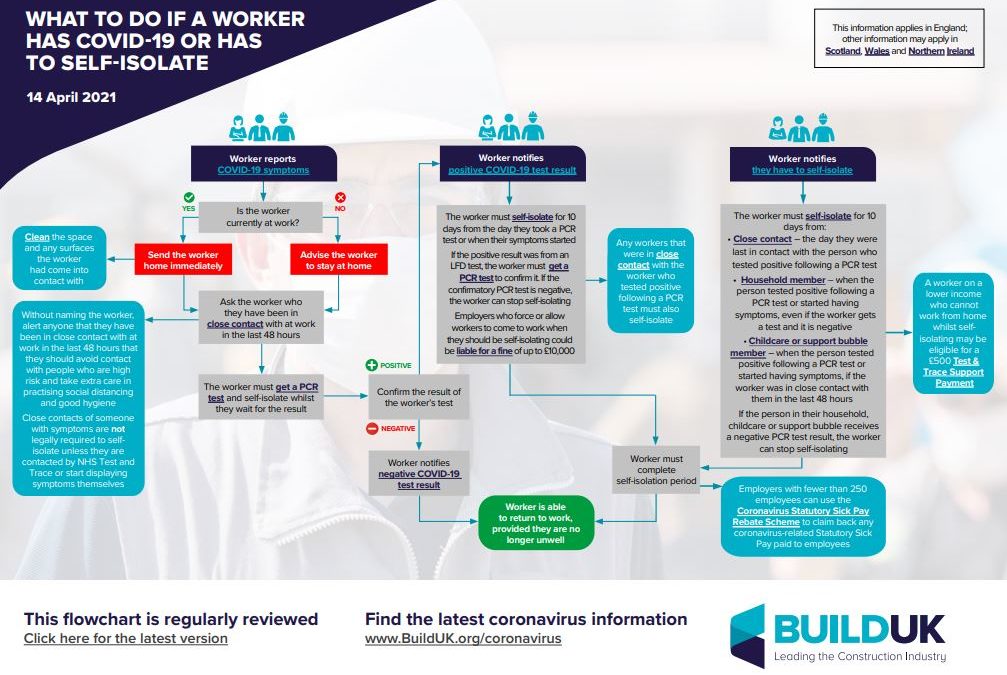
BuildUK has also produced a helpful flow-chart around what to do if a worker needs to self isolate

Visit the FIS COVID-19 Hub here

FIS Responds to Safer Buildings in Wales Consultation

FIS Responds to Safer Buildings in Wales Consultation

FIS has written to the Welsh Government to formally support the CPA response to the Safer Buildings in Wales consultation and highlighted the confusion caused by Regulation 7 and challenges in building classification.  On the whole the consultation sets out an achievable path for Welsh Regulations to embrace the fundamental elements of the Building Safety Bill that is expected to be passed into law before the summer recess.

The consultation focussed on 7 key areas.

  1. Setting out the scope of the Building Safety Regime
  2. The Building Safety Regime (Design and Construction Phase)
  3. The Building Safety Regime (Occupation phase)
  4. Residents: Roles and Responsibilities
  5. Raising Concerns
  6. Regulating the Building Safety Regime
  7. General Requirements in Relation to Fire Safety Equipment

FIS is particularly encouraged by the recognition of the importance of compartmentation and the emphasis outlined and the importance of managing interfaces.  We were also able to highlight recent collaborative work in the production of the Fire Stopping of Service Penetrations Guide that can be referenced in future official guidance to support the avoidance of design and construction issues in this space and support one of the aims identified in the consultation in terms of “verifying that all works that breach compartmentation (eg holes drilled through walls) use appropriate and adequate fire-stopping”.

The full response from the CPA can be downloaded here

VAT Deferral New Payment Scheme

VAT Deferral New Payment Scheme

Companies that deferred VAT payments between 20 March and 30 June 2020 and have monies outstanding need to take action and join the VAT deferral new payment scheme by 21 June 2021.  Those who do not join the scheme or settle the account before 30th June could be charged a 5 per cent penalty or interest on what they owe.

If businesses join by 21 April, they will pay their deferred VAT in 10 instalments, rather than nine or eight instalments if they wait until closer to the deadline. To join the scheme, a company must have:

  • a Government Gateway account
  • submitted any outstanding VAT returns from the last four years and corrected any errors on existing returns
  • calculated how much it owes, including the amount originally deferred and how much has already been paid.

Companies must pay the first instalment upon joining the scheme and make subsequent payments via Direct Debit.

For more information on the VAT Deferral Payment Scheme, click here

You can access the FIS Business and Taxation Toolkit here

Product Shortages ‐ CLC Statement

Product Shortages ‐ CLC Statement

The CLC Product Availability Group has issued a statement on the availability of construction products, which confirms that demand will remain high throughout 2021 and urges ‘all users [to] plan for increased demand and longer delays, keep open lines of communication with their suppliers and order early for future projects’. It highlights timber, steel, polymer supplies and coatings as materials of particular concern, with both timber and steel experiencing very strong global demand.

Build UK is working with the Chartered Institute of Procurement & Supply (CIPS) to monitor the availability of construction materials post‐Brexit. There are no products currently RAG‐rated ‘red’, with most manufacturers reporting that the mitigation strategies they put in place have avoided significant delays or shortages, and they will continue to hold extra stock this quarter to ensure continuity of supply.

Safety Alert: On site storage

Safety Alert: On site storage

If loading out a site and in wake of shortages and potentially taking larger orders of product than would ordinarily be the case, remember to check insurance implications and to survey the area carefully to ensure that any loading limitations on the floor/storage area are adhered to and have factored in risk to protect from environmental (cleanliness, humidity or temperature issues), stacking (adherence to storage instructions) or construction related damage.  Also pay particular attention to safety factors that may arise if product is not stacked in accordance with manufacturers instructions and H&S best practice (e.g. leaning/stacking of boards).  FIS Site Guides are free to download for members and include some helpful reminders on storage issues.

Encourage the Next Generation

Encourage the Next Generation

How to become a Construction Ambassador:  We are all aware of the difficulties of encouraging the next generation into one of the finishes and interiors sectors many careers.  As an employer you no doubt feel concern when it’s time to recruit, by becoming a Construction Ambassador yourself or allowing members of your workforce to become Ambassadors it could remove some of those concerns and it does not need to take up a lot of your time.  Construction Ambassadors play a vital role in promoting careers in the construction industry.  These specially trained individuals:

  • inspire others to consider a career in the industry and share what it’s actually like to work in construction
  • very often provide the first introduction to the construction industry for young people who are considering their future career
  • engage young people with the fantastic opportunities available in the industry, ambassadors can encourage the next generation of construction professionals.

Anyone working in the industry can be a construction ambassador.  You just need to be passionate about construction and the built environment, and willing to share your experiences with others.  Whether you’re a first year apprentice or a company director, STEM learning would love your support to help more people experience the varied opportunities in our sector.  It’s easy to sign up, to become a STEM Construction Ambassador, register via the link below:

  1. Once registered you will need to re-visit your new STEM Ambassador profile to join the construction specific STEM scheme. Go to Profile > Skills & Qualifications > Edit and under the header ‘schemes participation’ search construction and select ‘Construction & Built Environment’ so that STEM Learning can continue to support you with the latest information and resources to enable you to inspire the next generation of potential entrants to the sector.
  2. When you reach the ‘scheme participation section’ select to participate in the ‘Construction and the built environment’ scheme and tick the box indicating you are happy for your details to be shared. Ticking this box is very important as it will allow STEM Learning to send you news about the latest Go Construct resources, opportunities, events and training.
  3. You’ll need to complete a free of charge Enhanced Disclosure Check as part of your registration process. Depending on whether you hold a DBS check (or the Scottish equivalent), it could take up to three weeks for this to be processed.
  4. When you’ve registered, you’ll need to complete some induction training and a safeguarding assessment. Your induction will explain how you can manage your own engagements and request resources via your personal STEM Learning dashboard.
  5. Once STEM Learning are satisfied with your Enhanced Disclosure Check you will be good to go and can start booking in events to attend as a construction ambassador. Register to be an Ambassador here

George Swann, FIS Skills and Training Lead says “this is an opportunity to show school leavers and their teachers that the finishes and interiors sector has many opportunities for long and fulfilling work careers”.

Apprentice Employers can make up to 10 new reservations

Apprentice Employers can make up to 10 new reservations

From 1 April 2021, the Education and Skills Funding Agency (ESFA) will reset reservation levels for employers who do not pay the Apprenticeship Levy.  This will enable employers to make up to 10 new reservations to fund new apprenticeship starts in the financial year 2021-22.  ESFA will continue to monitor the number of reservations used by employers who do not pay the Apprenticeship Levy and will keep this under review.

Funds transferred from employers who pay the levy to other employers through the apprenticeship service are not included when measuring the number of reservations.  Employers who do not pay the Apprenticeship Levy can reserve funds for training and assessment in the ‘finance’ section of their apprenticeship service account.  They can also give training providers permission to do this on their behalf.  Find out more

Employers can reserve funds up to 6 months in advance.

From 1 April 2021, we are extending the reservation period for employers who do not pay the Apprenticeship Levy from 3 to 6 months.  This means that from 1 April, these employers will be able to reserve funds up to 6 months before an apprenticeship is planned to start.  This will give employers greater flexibility when planning their apprenticeship programmes and reassure them that funding for apprenticeships is available for a longer period.  Find out more

FIS Launch Digital Spine to help companies chart their digital journey

FIS Launch Digital Spine to help companies chart their digital journey

Ahead of the next Digital Construction Working Group (28 April 10am), FIS has launched a new tool to help members to follow and understand the technologies that are shaping the present and future of construction.

Expressions like Industry 4.0’, the fourth industrial revolution, the Digital Revolution are bandied around and the Construction Playbook isolates the need to “develop new solutions including improved digital capabilities.” but what does the digitalisation of the finishes and interiors sector actually mean to projects and businesses in the supply chain?

FIS CEO Iain McIlwee commented “The Digital Spine was born at a Round Table we hosted with key experts from our sector. We looked at where digital is having influence and what is holding us back.  A key concern was that behind all of these digital solutions is whole new language that we are struggling to get to grips with. The roundtable also isolated that the environment can be bewildering with solution not always matched to problem and real concerns over interoperability of all of the rapidly expanding range of tools at our disposal.  Taking a step back we decided that the best way to help was to create the Digital Spine, a simple outline of the language behind the technology that is evolving to support the FIS community, but vitally also to contextualise tools against the core areas of business operation where they have the potential to support change. We are grateful to all the members who have supported the development to this point and encourage all users to bombard us with questions and omissions to support development from here”.

Mark Norton Group BIM Director, ISG added “The Digital Spine is great because it is simple and the key to innovation is to keep it simple and align it to genuine problems, not get caught-up in the technology.  We recognise that this is a start and the tool will evolve with questions and as new innovation emerges.  We’ll be reviewing at the Digital Construction Working Group on the 28 April and starting to look at where the biggest impact is and how we can ensure the FIS community is aware of opportunity, alert to the challenges and vitally too has influence in the way that some of these tools are emerging to support standardisation.”

The Digital Spine is available here.
You can reserve your place at the FIS Digital Construction Working Group here.