0121 707 0077

Long Covid safety-critical roles checklist

Long Covid safety-critical roles checklist

The CICV Forum, in which FIS is actively involved, has produced an advice document offering a practical checklist that will help employers identify and help safety-critical workers who may be suffering from the ongoing effects of Long Covid.

Long Covid is a condition that, at the time of writing in October 2021, currently affects approximately 60,000 people in the UK – and numbers will inevitably continue to rise as we move through the pandemic. It is defined as “Signs and symptoms that develop during or following an infection consistent with COVID-19 which continue for more than 12 weeks and are not explained by an alternative diagnosis.”

Sufferers can require practical, medical, and emotional support similar to that already offered by employers for conditions such as cancer, chronic fatigue syndrome (also known as ME) and diabetes..

As some of the symptoms of Long Covid could have an impact on safety-critical roles, it is important to consider any new conditions that may have developed. Health issues or conditions that affect an individual’s performance or present a risk of sudden incapacity could have serious consequences.

The practical checklist is available to download at https://cicvforum.co.uk/downloads/

New Net Zero Strategy for decarbonising the UK economy

New Net Zero Strategy for decarbonising the UK economy

Ahead of the COP 26 summit next week, the Government has published a Net Zero Strategy setting out how the UK will reach net zero emissions by 2050.

The Strategy sets out an economy-wide plan for how British businesses and consumers will be assisted in making the transition to clean energy and will support the creation of thousands of high-skilled jobs in new industries across the UK.

Four government documents were issued and below is a link to each document and a very short comment. 

UK Government Net Zero Strategy https://www.gov.uk/government/publications/net-zero-strategy 
This is the overarching strategy of how to reach the UK’s 2050 Net Zero target and the interim milestones of a 68% cut by 2030 and 78% by 2035.  It is the first such national strategy in the world.

Heat and Buildings Strategy https://www.gov.uk/government/publications/heat-and-buildings-strategy 
Moving Buildings towards Net Zero is a combination and balance of making buildings more energy efficient and providing non-fossil fuel based heating systems (e.g. heat pumps, heat networks or hydrogen).  In this Strategy the withdrawal of gas boilers in favour of heat pumps looms large, with insulation and retrofit taking a low profile.  There seems little acknowledgement that a whole house approach is needed if heat is to be provided by a heat pump, i.e. are the radiators suitable, is there a water cylinder to store heat.  There does seem more optimism than reality that the price of a heat pump will plummet in a very short time period to be equivalent to the price of a gas boiler.  Installing such kit will in any case require that a house is well insulated otherwise the heat pump is likely to fail to deliver the comfort required.

The grants announced to be available from April 2022 will help only 90,000 homes install low carbon heating solutions.  The target is for 600,000 heat pumps to be installed annually from 2028.  Heat pumps currently are much more expensive than gas boilers, are rather large, need an outside wall and require an internal water cylinder for heat storage.

(For an excellent overview of what is required for a home to have an efficient heating system using a heat pump read the HHIC report:  Heating Up to Net Zero).

 Another area of controversy is the validity of using EPC band C as meaning that a home has an efficiency rating suitable to help us reach Net Zero – many experts very much disagree and this has been well documented in a number of reports.

Tucked away in a quiet corner is the announcement of a consultation on a market-based mechanism for low carbon heat which is to introduce an obligation on the manufacturers of gas and oil boilers sold on the UK market to achieve the sale of a certain number of heat pumps, and potentially other low-carbon heating appliances, proportional to their boiler sales in each period.   Lets hope consumers are willing to buy the heat pumps produced !

The potential opportunities of hydrogen will await the outcome of current pilot trials.

Treasury’s Net Zero Review https://www.gov.uk/government/publications/net-zero-review-final-report
Without financing the Net Zero Strategy remains a wish list, and it is widely reported that the Chancellor is not fully on board as to how to pay for the Net Zero transition, especially with the decline of fuel duty as people make the switch to electric cars.  Clearly the tax regime will need a fundamental review.  The Review considers the potential macroeconomic effects of the transition; the potential economic opportunities and risks of the transition; the factors affecting a household’s exposure to the transition; the policy levers that could support the transition; and the likely fiscal implications of the transition”.


Treasury Greening Finance: A Roadmap to Sustainable Investing  https://www.gov.uk/government/publications/greening-finance-a-roadmap-to-sustainable-investing
This is about ways to ensure that information on sustainability is available to financial market decision-makers, that they act upon it, and that “financial flows across the economy shift to align with a net zero and nature-positive economy”.   Existing disclosure requirements will be streamlined – such as the UK’s commitment to make reporting aligned with the Task Force on Climate-Related Financial Disclosures (TCFD) mandatory – with new requirements, including on reporting environmental impact.

Further information is available on the Government’s Net Zero Strategy is available here.

Calculating your orgnaisation's carbon footprint

Join us on 8 November, to see a demonstration a new free tool developed by the Supply Chain Sustainability School that enables organisations to measure their corporate emission footprint. This webinar will also provide an opportunity for you to put any questions forward to the tool developer.

FIS Sustainability Hub

FIS is committed to taking a pro-active lead, not just in supporting the UK ambition to net zero carbon by 2050, but delivering profound transformation within our supply chain on all aspects of ethical and environmental sustainability. We have created this hub to bring together resources and information that will support your journey to net zero.

Changes to draft regulations concerning the Building Safety Bill

Changes to draft regulations concerning the Building Safety Bill

Gov.UK have published the following updates of draft regulation concerning the Building Safety Bill which is currently going through Parliament. These are:

The Construction Products Regulations 2022

  • These regulate the safety of construction products being placed on the UK market.
  • Part 2 sets out a general safety requirement which all construction products must meet
  • Part 3 sets out provisions with respect to safety-critical products, how safety-critical standards may be developed and by whom (BSI) as well as giving the obligations for economic operators
  • Part 4 requires economic operators not to make false or misleading claims about construction products
  • Part 5 covers enforcement
  • Part 6 makes clear that nothing in the regulation will prevent lawfully CE marked construction products from being placed on the NI market
  • Part 7 extends to GB only and makes provision for qualifying NI goods to be placed on the GB market.

The Higher-Risk Buildings (Prescribed Principles for Management of Building Safety Risks) Regulations 2022
These regulations set out the principles an accountable person must follow in taking all reasonable steps to prevent a building safety risk materialising or reducing the severity of any incident resulting from  a risk materialising.

Other updates can be found in the following documents:

  • The Higher-Risk Buildings (Descriptions and Supplementary Provisions) Regulations 2021
  • The Buildings (Appointment of Persons, Industry Competence and Duty holders) (England) Regulations 2021
  • The Building (Higher-Risk Buildings) (England) Regulations 2022
  • The Building (Restricted Activities and Functions)(Engalnd0 Regulations 2022

All these documents are available here.

If you have any feedback, please email iainmcilwee@thefis.org

Government announces free adult training courses to begin

Government announces free adult training courses to begin

Thousands of working adults will be offered free courses to rapidly upskill in STEM sectors including engineering, digital and construction.

65 short and modular courses will start to roll out from later this month at 10 Institutes of Technology (IoTs) across England in sought-after STEM subjects. This will include courses such as Digitisation of Manufacturing and Digital Construction.

The courses will be a blend of classroom and remote online study, and will vary in length from 50 to 138 hours – giving more adults greater flexibility in how and when they learn, so they can fit it around their lives.

The government’s network of Institutes of Technology – collaborations between leading employers, further education colleges and universities – specialise in delivering high-quality Higher Technical Education and training in Science, Technology, Engineering and Mathematics (STEM) subjects, such as digital, advanced manufacturing and engineering, providing employers with the skilled workforce they need.

A total of £6.4 million is being invested to support IoTs to offer the free courses, which will support up to 4,000 working adults to get on the path to a new, rewarding career and will plug local skills shortages.

Boosting the uptake and quality of Higher Technical Qualifications – that sit between A levels and degrees – and supporting adults to study more flexibly throughout their lives is a key part of the government’s landmark reforms to post-16 education and training.

A major review of higher technical education revealed these qualifications can unlock the skills employers need and lead to well paid jobs. However, it also shows that the quality of qualifications on offer at further and higher education providers can be variable and it can be hard for students and employers to find the ones that are right for them.

From September 2022, the government will start rolling out newly approved Higher Technical Qualifications, beginning with Digital, and followed by Construction and Health in 2023. A full suite of qualifications will be available by 2025.

Higher Technical Qualifications will provide a natural progression route for both young people taking T Levels or A levels, and adults looking to upskill or retrain – enabling them to take the next step up and gain higher technical skills in key subjects like STEM.

Your business journey to Net Zero

Your business journey to Net Zero

Ahead of the UN climate change conference (COP26) hosted in Glasgow later this month, two briefing sessions will take place next week for businesses to hear from senior UK officials on plans for COP, as well as how they can follow and support the activities going on in the blue and green zones and regional activity.

  • Wednesday 20 October 09:00-10:00 BST. Link to join is here
  • Thursday 21 October 16:30-17:30 BST. Link to join is here

Small businesses from across the UK are invited to join the green business revolution and commit to becoming more sustainable. By November, the aim is for as many UK small businesses as possible to join the UN’s ‘Race to Zero’, a global effort to reduce the amount of greenhouse gases we all generate to zero by 2050.

Small businesses can sign up to the Race to Zero by visiting the new Business Climate Hub which is an official UK Government site offering practical steps on cutting emissions and inspiring success stories from other businesses. Taking action on climate change will help businesses to grow, seize new opportunities and adapt against the challenges of a changing planet. Reducing emissions can lower running costs, save money, attract new customers and help to start a green business movement.


FIS Sustainability Hub

FIS is committed to taking a pro-active lead, not just in supporting the UK ambition to net zero carbon by 2050, but delivering profound transformation within our supply chain on all aspects of ethical and environmental sustainability. We have created this hub to bring together resources and information that will support your journey to net zero.

Inspiring change in construction

Inspiring change in construction

Has your business or project created a more open and inclusive culture where everyone feels valued?

Has it:
• Attracted new employees from a wider talent pool?
• Helped address gender or racial inequality in the industry?
• Removed barriers to inclusion, enabling all employees and potential employees to have the same opportunities?
• Increased employability rates in the community?
• Helped tackle issues in today’s society?
• Built collaborative relationships with stakeholders and suppliers?N

Now in its fifth year, the Inspiring Change Awards and Conference highlight and reward organisations within the construction and infrastructure sector that have created a more inclusive culture. Creating open and inclusive workplace cultures in which everyone feels valued, and respects colleagues, is recognised as key to business success. Increasingly, employees want to work in companies that recognise the importance of fairness, inclusion and respect and clients are focussing on diversity and inclusion within their procurement policies.

Submissions to the 2021 Awards are asked to provide evidence that the organisation recognises the value of employee and/or community engagement and that they have introduced initiatives that have achieved benefits for both the business and the community. Entries needed to show how initiatives are aligned to company goals, made a sustainable and positive impact on the workforce or community in which it operates and have delivered positive results.

Judges are looking for innovative interventions that are aligned to company strategy and will inspire other employers to follow their lead. The awards recognise businesses that improve the quality of life of the workforce and their families as well as of the local community and society at large.

Categories
The following categories will be awarded:
• Inspiring Change in the Workplace – Company and Project
• Inspiring Change in the Community – Company and Project
• Inspiring Change in Education – Company and Project
• The FIR Inspiration Award
• Inspiring Change SME Award – SMEs entering one of the three main categories will automatically be entered for this Award

Eligibility
The Inspiring Change 2021 Awards are eligible for all those working in the construction industry and build environment in the UK. There are awards for SMEs and project-based initiatives. The deadline for entry is 22 October 2021. For more information visit www.inspiringchangeawards.com or contact brionywickenden@ceca.co.uk.

Help develop future talent for your business

Help develop future talent for your business

Construction T-Levels are now available for the following areras of our sector:

  • Design, surveying and planning
  • Onsite construction with an occupational specialism in plastering which includes drylining

T-Levels are two-year courses with a 45 day industrial placement for 16 to 19 year olds.   Designed with employers, each T-Level is an alternative to three A levels, and can lead to an accelerated apprenticeship. They also help young people develop the knowledge, attitude and practical skills to thrive in the workplace.

At the heart of each course, a 45-day industry placement will give you early access to the brightest talent entering your market. Employers that are interested in offering an industry placement, can get help to find a local college, school or training provider to partner with. They will support you at every stage of the industry placement so you can focus on getting the most out of your placement student.

Over the autumn, the Department for Education and SDN are hosting a series of online sessions to help employers explore, plan for, and host T-Level industry placements.  They’ve started a new series to give employers a more in-depth understanding of placements for particular T-Levels.  They’re also covering specific topics to support employers and their teams. Topics covered include:

  • The role of the line manager and mentor in industry placements (27 October)
  • Introduction to industry placements – supporting your workforce development (9 November)
  • Hosting industry placements in construction roles (18 November)
  • A longer two-hour industry placement workshop, to start planning for industry placements and talk with other like-minded employers (30 November)

You can find out more and register here

Candidates are available for work placement now, if you would like more information please see: https://www.tlevels.gov.uk/ If you need information, advice and/or guidance please call FIS on 0121 707 0077 or email info@thefis.org

Candidates successfully complete BuildBack programme and now ready for work

Candidates successfully complete BuildBack programme and now ready for work

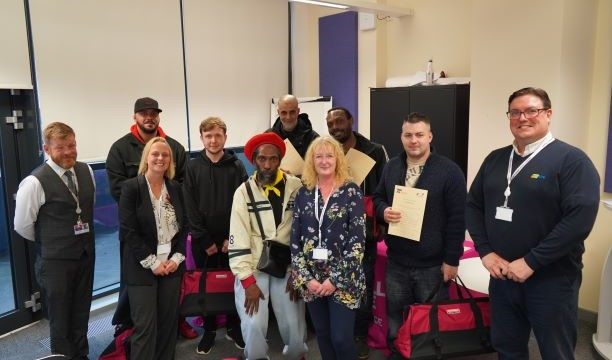
Certificates were presented to Sandwell College adult learners to mark their successful completion of the FIS BuildBack Drylining Programme.  The learners received training in drylining fixer boarder and finisher across a six week programme.

Stuart Smith Project Manager for HSS Tool Hire presented each learner with a set of tools, and in addition to the tools, each candidate is equipped for the workplace with a full set of PPE and a CSCS card.  Four candidates have acquired work placements with local finishes and interiors companies and four are looking for an opportunity to demonstrate their capabilities to potential employers.

If you are interested in taking on a candidate or would like to explore how this project can help your own recruitment please contact Catherine Bullough by calling 07900 083325 or email catherinebullough@thefis.org or call Marie Flinter on 07799 903103 or email marieflinter@thefis.org

Funded through CITB, BuildBack is a collaborative recruitment and induction programme facilitated by FIS. You can find out more information at https://www.thefis.org/skills-hub/recruitment-induction/buildback/


Mixed signs for construction activity

Mixed signs for construction activity

The latest information from Builders’ Conference shows that there were 441 contracts worth £7.5 billion awarded in September. Whilst the value was 60% higher than the previous month (£4.7 billion), it did include a £2.2 billion contract for the Colne Valley Viaduct which is part of HS2, underlining the importance of the Government’s investment in infrastructure. For the first time since December 2020, the public sector outperformed the private sector, recording 51% of the value. There were 165 housing projects worth £2.5 billion (33%) and 55 office projects with a total value of £561 million (8%).

The number of tender opportunities was 24% down on August and remained 53% below the monthly average for the past year.

Market Data

FIS has access to a wide range of market data from sources including the CPA and Barbour ABI.  In addition, FIS produces a state of trade survey specifically for the finishes and interiors sector.