Are you interested in taking on an apprentice, but unsure where to start?

Are you interested in taking on an apprentice, but unsure where to start?

CITB has set up a ‘New Entrant Support Team’ to assist registered members with taking on Apprentices and new entrants from inception to completion and will cover

Recruitment
The team will signpost you to useful employment resources and help advertise your apprenticeship vacancy on Talentview to attract potential candidates and let them find you – all for free, helping you get the right apprentice.

CITB Funding
The team will ensire you’re set up to receive CITB apprenticeship grants:
• Attendance grant: £2,500 (per year, per apprentice)
• Achievement grant: £3,500 (on successful completion of the apprenticeship).

Admin/paperwork (including Government Funding)
You will receive help with the paperwork, liaising with the training provider, setting up your Government Digital Account and more so you can focus on the job.

Retention
The team will keep in touch to make sure you have the support you need to help your apprentice achieve and become a fully-fledged employee on completion.

More information is available here.

FIS sets out a Blueprint for a Better Construction for the next Government

FIS sets out a Blueprint for a Better Construction for the next Government

FIS has today issued the first part of the FIS Manifesto, A Blueprint for Better Construction: Delivering Change in the Finishes and Interiors Sector.

This document, the first in a series of three policy documents sets down FIS views on near- and long-term policy levers that will support transformation in the sector.  The Manifesto draws heavily on recent research with the University of Reading on Procurement and Contracting, It is less focussed on the macro-economic picture than the Chancellor’s Budget, instead zoning in on the pressing business challenges which beset the specialist construction sector set against four key headings.

  • Public Sector Procurement reform led by a more ambitious Construction Playbook.  This needs to be backed by a consistent effort to measure outcomes.
  • Eliminate unreasonable risk transfer by enforcing standard form contracts that are aligned with supply chain insurance.
  • Revisit the Construction Act to simplify payment, reform retention and extend enforcement powers.
  • UK Construction Products Marking rules must be aligned to those for other products to support investment in new testing.

Commenting on the launch of this document, FIS President Philip Brown stated:

“This document draws together a lot of work that the FIS team has been doing through our daily engagement with members.  For an organisation to have a strong voice, it must carry a strong mandate and this is what we are seeking here.  We have a unique opportunity with Building Regulatory Change and an awakening on Sustainability already adding momentum to transformation.  Now is the time to rally the construction voice, to unite our community around a number of key simple statements.  The main focus is Policy levers, but it should complement our “Empowering the Responsible No” campaign highlighting areas where clients, including Government have unreasonable and damaging expectations that are ultimately undermining the sector.”

FIS CEO Iain McIlwee added:

“This Manifesto draws together the key challenges and policy levers that identified through our research and wider engagement with members.  The essence of this document is simple, but we do not underestimate the scale of the challenge.

My hope in setting these points down with explanation and specificity that we are moving beyond the who and why and starting to get into the what, when and how.  We will be encouraging members to engage with their local representatives to carry this points forward and will be sharing with officials and politicians as well as colleagues from across construction to ensure our next Government are clear of the actions they need to take to unlock the full potential of our sector and the broader construction industry.”

The manifesto is available to download here

Building Safety Act the changes and the risks at the Gateways

Building Safety Act the changes and the risks at the Gateways

On the day that we learned that the majority of higher risk building Gateway 2 applications were not valid (Regulator: Majority of higher-risk building applications ‘not valid’ | Construction News) the HSE has asked us to remind you that from 6 April projects may need to transition to the Building Safety Regulator (BSR) as the building control authority.

Some projects are eligible to stay under their current building control arrangements, as long as they meet certain criteria. Eligibility for transitional arrangements in building control – Making Buildings Safer

However, if your project:

  • Had building control arrangements in place, AND
  • Building work (including design work) had started, AND
  • A notice that the work had made sufficient progress was not given to the LA by 6 April

OR

  • Has started building work but existing building control arrangements cease /are cancelled OR
  • Has started building work but there were no formal building control arrangements in place

Then, your project will need to transfer from your existing building control provider to BSR.

You will do this through the portal, which has been adapted to accommodate projects.

New guidance is on its way and we will circulate it as soon as it becomes available.

For more guidance and to register for our new online training visit www.thefis.org/knowledge-hub/technical/fire-protection/building-safety-act/

Amendments to Volumes 1 and 2 of Approved Document B

Amendments to Volumes 1 and 2 of Approved Document B

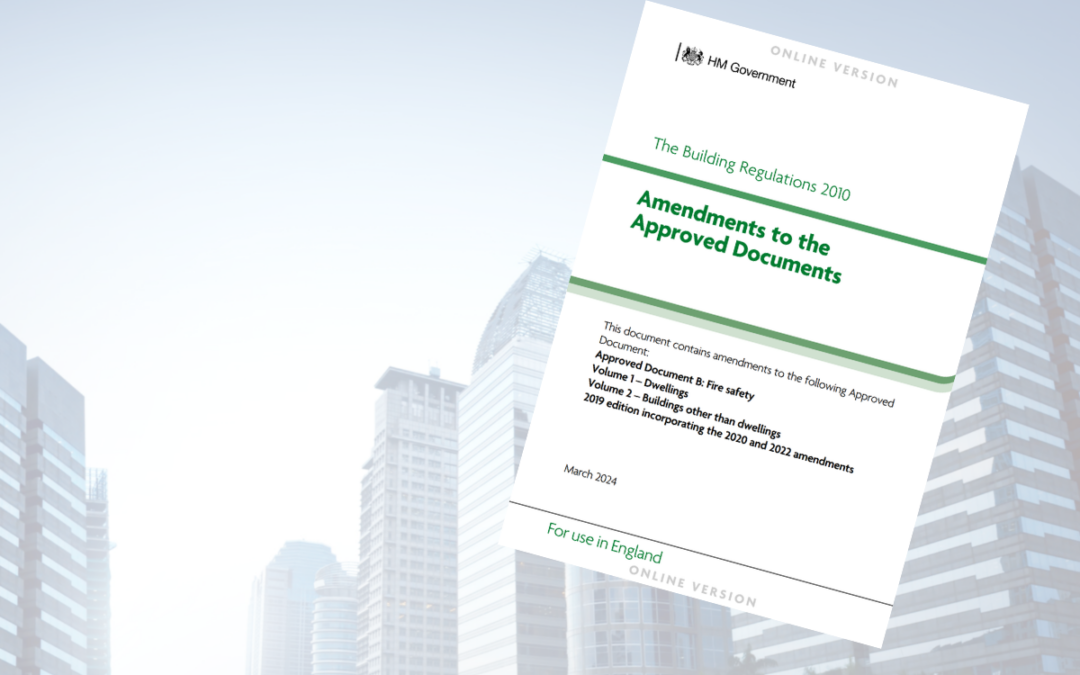
The Government has published a document listing amendments to Volumes 1 and 2 of Approved Document B which will come into effect in September 2026.

These amendments principally concern:

  • Threshold for the provision of a second staircase in blocks of flats with a storey 18m or more in height.
  • Evacuation shafts are introduced to support the provision of evacuation lifts.
  • Changes to provisions for fire doorsets.
  • New terminology including definitions for evacuation shaft, evacuation lift lobby, interlocked stair and storey exit.
  • Provisions for horizontal escape and vertical escape separated as per the structure of Volume 2.

The 2019 edition incorporating the 2020 and 2022 amendments will continue to apply where a building notice or an initial notice has been given to, or a building control approval application with full plans made to, the relevant authority before 30 September 2026 and either the building work to which it relates:

  1. has started and is sufficiently progressed before that day; or
  2. is started and is sufficiently progressed within the period of 18 months beginning on that day

You can view the amendments at the link below:

Fire safety: Approved Document B

FIS will publish further detailed guidance on these changes in the coming months.

See more news likes this

Avoiding risk to compartmentation from raised access floor interfaces 

Avoiding risk to compartmentation from raised access floor interfaces 

Why: To address concerns raised through Collaborative Reporting for Safer Structures UK (CROSS-UK), FIS has developed guidance to highlight compartmentation requirements when specifying raised access floors (RAF). What: Guidance recognises that fire resistance testing...

FIS Responds to Government Consultation on NEET Youth Report

FIS Responds to Government Consultation on NEET Youth Report

FIS has submitted a response to the government’s consultation on the rise in NEET (Not in Education, Employment, or Training) among young people. Drawing on sector evidence, FIS highlighted structural barriers limiting youth participation, including the decline in...

H&S Update: IPAF Position on Secondary Guarding for MEWPs

H&S Update: IPAF Position on Secondary Guarding for MEWPs

FIS continues to work closely with the International Powered Access Federation (IPAF) through a reciprocal agreement aimed at strengthening safety standards across the finishes and interiors sector. As part of this collaboration, both organisations are monitoring key...

Making standards accessible

Making standards accessible

Standards are used in our everyday lives to show that products are safe, suitable for a particular use or provide guidance and process, for example many products carry a CE or a UKCA mark to demonstrate their conformity to certain standards, yet access to Standards can be restricted simply by their cost which can run into £100’s, because the National bodies who draft them are part funded by selling them.

We recently covered The European Court of Justice Judgment on providing the free Harmonised standards which are used to define products where CE marking is mandated.  We see this as an interesting development and may have repercussions on how Standards are managed moving forwards, in the UK and Europe.

At FIS we strive to make the key standards free to our community via the FIS Standards Portal.  It is important moving forwards that we have a robust standard setting body, but the cost to access and use the standards is not prohibitive, particularly for SME’s.

This is just one of the membership benefits. If you are not currently a member and want to know more, please don’t hesitate to contact our Head of Membership Michelle Armstrong  michellearmstrong@thefis.org

Flexible working changes ahead

Flexible working changes ahead

On 6 April flexible working requests become a day one right for UK employees. This means employees don’t have to have any length of service with your business before they submit a formal request for flexible working arrangements.

FIS member Citation is hosting a webinar on Wednesday 10 April to explain what flexible working actually is and what you need to do to implement these legislation changes.

REGISTER HERE

The webinar will cover:
• What a statutory flexible working request is and who can make one
• What these changes mean for your business and how you can prepare
• How to handle requests, make your decision and update contracts of employment
• An overview of all the other Employment Law changes coming into force across 202