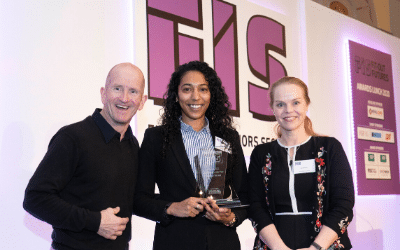
FIS Technical Director Joe Cilia was delighted to be asked to join the Specifi 100 Voices speaker series at the Specifi London Interiors Roadshow event on Wednesday 5 February 2020. The event brings together 100 thought leaders and activists across the construction sector to explore how this climate and biodiversity emergency declaration can be turned into practical action, the obstacles that must be overcome, and the tools available to specifiers to move towards the net-zero future.
Joe presented on how office partitioning has developed over the years to meet the changing requirements and functions of people within offices, how technology has allowed new ways of working and enabled flexibility within the work force and manufacturers have reacted to this demand for flexible layouts by developing relocatable and not just demountable partitions, that can be reused and are designed for deconstruction.
The event was a great opportunity for us to update specifiers present about the best practice advice available from the FIS including the amazing vetted membership.
Following the launch of the CSCS’s new online application service on 9 December, the site has experienced some technical issues resulting in increased card processing times for some applicants.
Alan O’Neile, Head of Communications at CSCS said: “In most cases cardholders can apply online for their own CSCS card without any issues. These cards are generally processed and delivered within 3-5 working days.
“However, employers applying online for cards on behalf of their employees may be experiencing problems. CSCS is working hard to fix these issues and we apologise for any inconvenience caused.”
In the meantime, CSCS has issued some advice to assist with card applications:
Employer applications: There are several issues with the employer application process. These include:
Applications not saving
Missing applications
Cards not processed/delivered
Our team is working to resolve these issues. In the meantime, please apply as normal and your applications will be processed, and cards delivered within 10 days
Non urgent employer applications: If you are an employer and your applications are not urgent, CSCS request that you wait until the issues with the employer application system have been resolved. Your assistance here would be greatly appreciated.
Renewals: Several issues have been reported with the renewal of existing CSCS cards. CSCS recently confirmed the renewals issue is now resolved. Individual applicants wishing to renew an existing card can now proceed with their applications. Please note that there are some cards which cannot be renewed. For further information visit the New Not Renew webpage.
Photographs: All applications currently require a passport style photo to be submitted. This is a temporary measure that will be resolved soon.
When fixed, applicants will not be required to submit a photo. The photo taken during the CITB Health, Safety and Environment test will automatically be uploaded during the application process. CSCS will continue to keep the industry updated via their website and Twitter account.
Following the Scottish Government’s consultation – Practical fire safety for existing specialist housing and other supported domestic accommodation which closed in October 2019, they have now published new guidance – Practical Fire safety Guidance for existing Specialist Housing and other similar premises.
The Government had previously announced its intention to introduce a Fire Safety Bill which will put beyond doubt that the Fire Safety Order requires building owners and managers of multi-occupied residential premises of any height to fully consider and mitigate the risks of any external wall system and front doors to individual flats.
There are a number of risk factors which may impact the level of risk and the consequent priority for inspection and/or remediation. MHCLG is seeking a means to make these assessments and decisions based on them using a risk informed methodology.
To better understand risks in existing buildings MHCLG is starting a wide ranging research project to develop an evidence base on how to characterise and prioritise the risk within buildings and how best to prioritise action based on a broader understanding of risk.
This call for evidence seeks your views and supporting evidence to help define the scope of this research by providing in advance stakeholder evidence to help define the scope of this research by providing in advance stakeholder and industry views on approaches, tools and methodology that should be considered.
The winners of the 2020 FIS Fit-Out Futures Awards were announced on 4 February at Plaisterers Hall in London. The event, which was attended by some 300 FIS members and guests, is held annually to celebrate the outstanding contributions and achievements of individuals, who have demonstrated excellence, dedication and commitment to their personal development, organisation and the finishes and interiors community. There are four categories – Apprentice of the Year, Outstanding Employee, Future Leader and the President’s Lifetime Achievement Award.
The judges said: ‘Kennya is showing great determination to succeed in a male dominated profession. The effort she applies to learning, coupled with her skill level and enthusiasm, is truly exceeding expectations. It was interesting to read how, not only is she inspiring other apprentices and peers, but inspiring her mentors to enjoy delivering training and up their game.’
Runner up: Lewis Round – Plastering Apprentice, Roseville Contracts
The judges said: ‘Lewis’ ability is a credit and he shows real determination to do a good job and further his own successful career – something that cannot be trained. His ‘can do’ attitude shines through and his speed, efficiency and willingness to learn is apparent. He also comes across as an incredibly pleasant young man.’
Outstanding Employee
Winner: Tony Waistell – Site Supervisor, Thomas Interiors Kindly sponsored by: SpecFinish
The judges commented: ‘ Tony’s loyalty, dedication and tenacity in a totally selfless capacity are to be commended. And the support shown to his colleagues is outstanding.
He appears to really care about his team and also appears to show the utmost dedication. We were particularly impressed on how he clearly takes his employees welfare seriously, an issue we know is incredibly important these days.’
Runner up: Lee Jones – Assistant Surveyor, Manorcraft Interiors
The judges said: ‘Lee has shown reliability, adaptability and attention to detail. He shows commitment to personal development and respect for his colleagues.
His commitment to the company, his role and ongoing training shines through, in terms of the quality outcomes achieved in his management of major profile projects.’
The judges commented: ‘Robbie is someone who is clearly very adaptable and shows great initiative in his own professional development. He communicates well and has gained respect within the team he already leads.’
Runner up: Lee Moore – Site Manager, Stortford Interiors (UK)
The judges said: ‘Lee has his eye on his own professional development and at the same time leads by example and has respect from his fellow workers.’
Julie has been heavily involved in the community and raising awareness of the sector to encourage young people to get into construction for many years.
Described as a natural leader and outstanding communicator, she is always on hand to offer advice and support to colleagues.
She is a well-known figure in the Kent Construction Community through their involvement with the Kent Construction Focus Group and the Kent Invicta Chamber of Commerce.
She works tirelessly for many local charities and encourages young people to join our sector through local careers fairs, where she provides mock job interviews to boost confidence and encourage participation.
She has encouraged many to consider a career in construction and is an outstanding role model not just for these young people but for her own team, who recognise that her energy and commitment have contributed to the success of the company.
To see the photographs of the event head over to our Facebook page
All at the FIS were shocked and saddened to read the news yesterday that Astins had entered administration. Details of the events that led up to the news have been reported on SpecFinish here.
This is devastating news for all involved and our hearts go out to all of the families of the 209 employees and wider workforce that have been impacted. The statement issued by Astins describes a perfect storm of all of the issues that are currently impacting the construction sector in the UK, with specialists left carrying an unacceptable level of risk both from a contractual and financial perspective.
We have already sent information to the Department of Business, Energy and Industrial Strategy as Intervention is required. Something has to be done to look at the credit crunch that is undermining investment and deepening our risk exposure – we need a credit guarantee scheme dedicated to construction. We need to review again the inadequate policies that are making no meaningful difference to abhorrent payment and contractual cultures and to revisit the idea of a Construction Credit Guarantee Scheme and Building Safety Fund to address legacy issues that will undermine progress.
First things first though, we are encouraging all employees of Astins to send us their contact details and appealing to any companies interested in recruiting some of the excellent people that were working at Astins to get in touch.
Details of how to exchange details are included on our JobSpot here