by Clair Mooney | 2 Jul, 2021 | Main News Feed, Membership, Technical
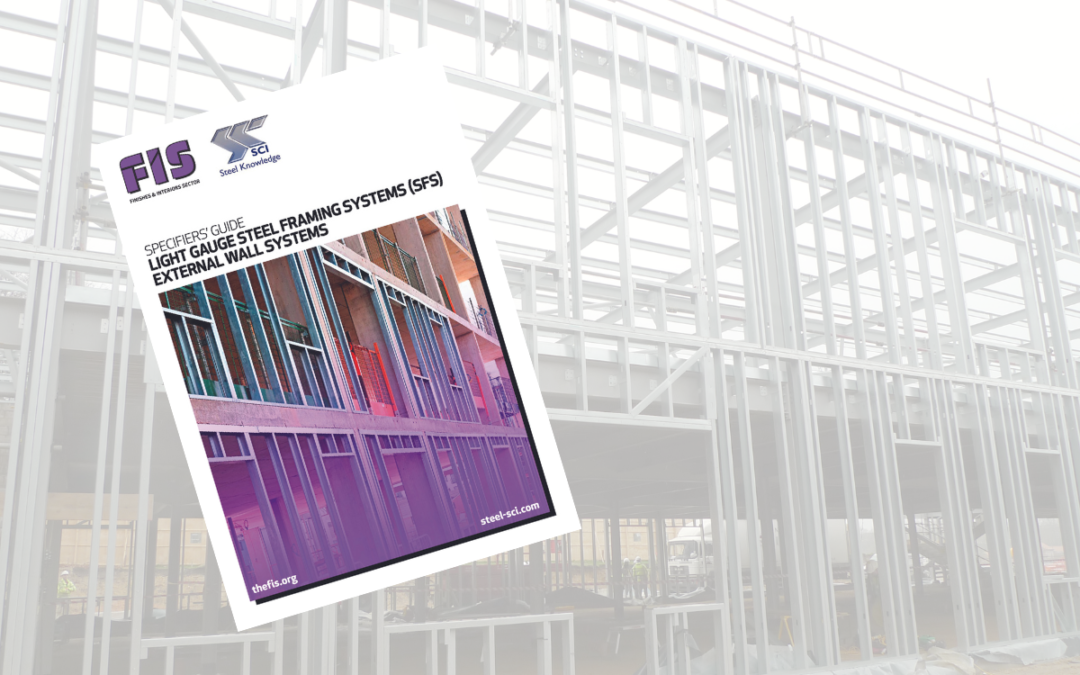
FIS in partnership with the Steel Construction Institute (SCI) has launched a Specifiers’ Guide to Light Gauge Steel Framing Systems (SFS) External Wall Systems to help specifiers understand the granular details involved in the design process and production of a specification.
The Specifiers’ Guide was produced by the FIS SFS working group made up of manufacturers and installers of SFS external wall systems in conjunction with the Steel Construction Institute (SCI), which provide an independent source of information and engineering expertise in steel construction. It is intended to guide architects, engineers, designers and installers through the stages in designing, selecting and specifying steel framed systems to form the external envelope for steel and concrete framed buildings.
FIS Chief Executive Iain McIlwee said: “This is the second specialist guide that FIS has produced in partnership with the Steel Construction Institute and demonstrates the strength in collaboration, producing guidance to ensure that accurate and detailed specifications can be written so that external walling systems can be procured and installed to meet the required specification.
Commenting on the guide, Colin Kennedy, Chair of the FIS SFS working group and Managing Director of FIS member Veitchi Interiors said: “Specifying SFS external wall systems requires considerable thought and design, even before a specification can be written. This is because the specification should be developed alongside the engineering design rather than a simple output from a list of attributes and parameters, to cover the three light steel external wall systems and the six current variants of SFS.”
Andrew Way, Associate Director at the Steel Construction Institute, added: “In order to achieve the correct specification, a considerable amount of information is required about the intended use of the product and the desired performance characteristics. This was the learning curve for me and the key lesson that this new guide addresses, in that the SFS should be fully engineered specifically for the building. Most importantly its location, proximity to other buildings and how that building is designed to accommodate movement is essential before it can be specified.”
Colin Kennedy continued by saying: “The construction industry is rightly under the microscope to ensure that the lessons from the terrible tragedy three years ago at Grenfell Tower are learned and that this starts with ensuring that the specification is clear, compliant and written by those who are competent and subsequently installed by those who can demonstrate they have the Skills, Knowledge, Experience and Behaviour (SKEB) to be considered competent.”
The guide includes 23 questions relating to ‘critical building information’, a further 15 questions to check that they are all addressed, a list of 10 questions on risk and how to avoid them and a further 10 questions on writing a smart specification to ensure a safe, compliant and complete specification can be written. All of which is crucial to ensure that the specification is not open to misinterpretation, and that any alternatives can be assessed and checked as equal, before approving them.
The guide sits alongside other FIS best practice guides that relate to SFS:
Design and Installation of Light Steel External Wall Systems
Recommendations for the Safe Ingress of Plasterboard
FIS Health and safety handbook
These guides work well when they are included in proposals and project plans to demonstrate how to best approach a project and are an excellent introduction to new members of the team and any trainees and apprentices.
You can download the Specifiers’ Guide to SFS External Wall Systems here https://www.thefis.org/membership-hub/publications/specifiers-guides/light-guage-external-wall-systems/
by Clair Mooney | 1 Jul, 2021 | Building Safety Act, Technical
In response to the Department for Education’s consultation on document BB 100 Fire Safety Design for Schools (see below), CPA has produced a strawman for discussion.
A virtual meeting to discuss this will be held on Tuesday 10 August to finalise the CPA response.If you are interested in attending, full details are available here.
===================================================
Building Bulletin 100 (BB100) is non-statutory guidance on fire safety for schools. The guidance covers designing a school building so that pupils and staff will have early warning if a fire breaks out and can evacuate quickly and safely. BB100 advises how to minimise the spread of fire and how to ensure the building structure is adequately resistant to fire. It also includes requirements for access and facilities for the Fire and Rescue Services. BB100 requires updating and simplifying, to see if additional fire safety measures should be included and whether there is content that is no longer needed.
In May 2019 CPA responded to a Department for Education consultation on the Technical Review of Building Bulletin 100 – Design for Fire safety in Schools. On 27 May 2021, the Department for Education published a revised draft of BB 100 together with a new consultation seeking answers to 12 questions.
The revised draft of BB 100 can be viewed here.
As CPA will be responding with a consolidated member’s view, we would encourage FIS members to complete this short questionnaire with their initial thoughts and email this to FIS by 30 June. CPA will then draw up a strawman and circulate for a later meeting to discuss the final text.
Members can also respond directly via the online consultation questionnaire here. This deadline for response via this survey is 18 August 2021.
by Clair Mooney | 18 Jun, 2021 | Technical
On Wednesday we hosted a webinar to review BS 8000-8:2021 Workmanship on construction sites – Part 8: Design and installation of dry lining systems – Code of Practice
The work began to formally review this code of practice in 2013, it has not been an easy journey and there are a number of similarities between this standard and BS8212 Code of practice for dry lining and partitioning using gypsum plasterboard Practice (1995) that needed to be taken into account, before it’s withdrawn.
After 20 years since the standard was introduced, much has changed in the sector and the review was driven by the need to provide better guidance for designers and to consolidate and provide a consistent approach to managing tolerances and a pressure on contractors to go beyond the standards and deliver even more exacting tolerances. This has led to reports of fallout in terms of retentions and delays caused by ongoing snagging. Completion of this work should provide a strong platform to focus a communications campaign from FIS reminding our clients, and those inspecting our work, how tolerance should be measured and managed.
The survey will be open for four weeks and the results will be fed back to the BSI committee who will also review the feedback from the public review.
A recording of today’s webinar is available here.
The revised standard will be available for public review later this summer, but ahead of this we are gathering your thoughts on the changes through an industry survey which you can find here.
by Clair Mooney | 2 Jun, 2021 | Main News Feed, Technical
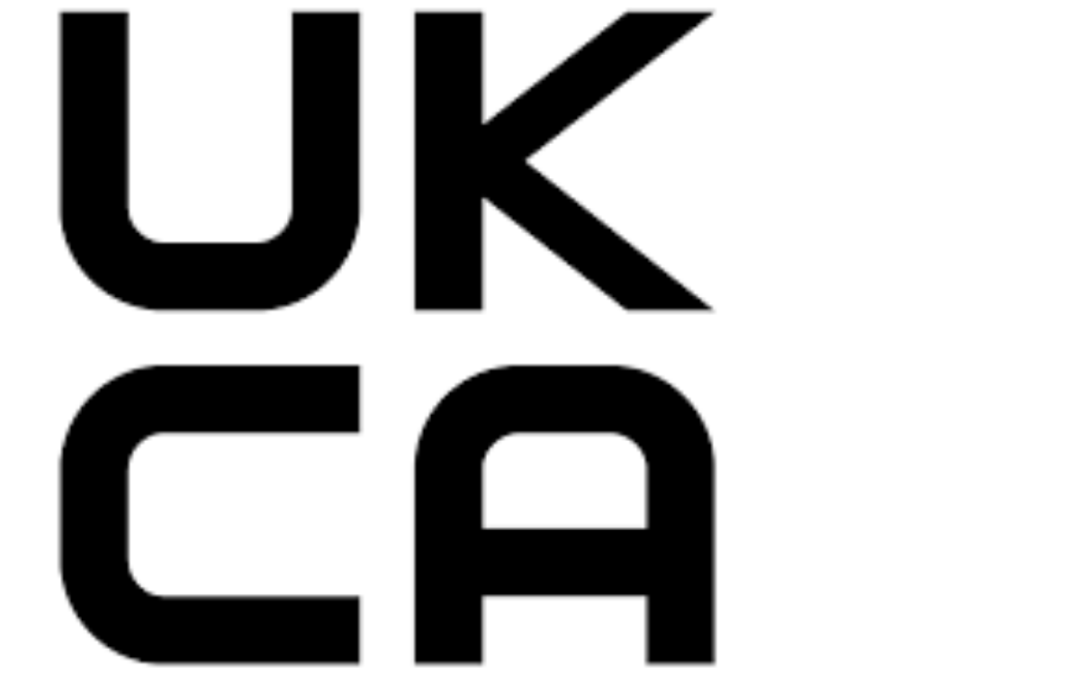
BEIS has issued an update to “Using the UKCA marking” guidance last issued on 31 December 2020. More information has been added on when a you can self-declare along with updates to the ‘Relevant UK and EU legislation” to remove inaccurate legislation.
The updated guidance can be viewed here.
While this is general guidance there are several references to separate guidance being available for construction products which should be read. These link back to guidance issued in September 2020 dealing with the two UK Statutory Instruments – Construction Products (Amendment etc.) (EU Exit) Regulations 2019 and 2020.
Notable differences in the text are as follows:
On page 2, Selling goods in Great Britain
The following has been added:
‘The circumstances in which you can use self-declaration of conformity for UKCA marking are the same as for CE marking. If you were able to self-declare conformity for the CE marking, you will be able to do the same for the UKCA marking.
Check the list of areas where self-declaration is permitted.’
On page 3, When to use the UKCA marking
The following has been added:
‘This does not apply to existing stock, for example if your good was fully manufactured, CE marked and ready to be placed on the market before 1 January 2021. In these cases, your good can still be sold in Great Britain with a CE marking even if covered by a certificate of conformity issued by a UK body before 1st January 2021. These goods will need to be placed on the market before 31 December 2021.
On page 3, How to use UKCA marking, Placing the UKCA marking, General Rules
The following has been added:
A product may have additional markings and marks, as long as they:
-
- Fulfil a different function from that of the UKCA marking
- Are not likely to cause confusion with the UKCA marking
- Do not reduce the legibility and visibility of the UKCA marking.
On page 4, Rules for using the UKCA image:
The following has been added:
‘The UKCA marking can take different forms (for example, the colour does not have to be solid), as long as it remains visible, legible and maintains the required proportions.’
On page 5, UK Declaration of Conformity
Please note that construction products manufacturers have a Declaration of Performance so CPA recommends that this also applies to DoPs
The following sentence has been added:
‘We recommend that manufacturers have a separate UK Declaration of Conformity to their EU Declaration of Conformity.’
On pages 6-7 there is a new table titled ‘Legislative areas where self-declaration of conformity for UKCA marking is permitted’.
This lists the CPR with a product scope of AVCP System 4.
On page 8, there is a new item ‘Transitional measures relating to the UKCA marking.’
The last sentence categorically states that these transitional arrangements do not apply to construction products.
The following guidance issued in the original document “Using the UKCA mark from 1 January 2021” dated 1 September 2020 now excludes the following text:
Future use of markings in the UK
From 1 January 2022, the CE marking will not be recognised in Great Britain for areas covered by this guidance and the UKCA marking. However, a product bearing the CE marking would still be valid for sale in the UK so long as it was also UKCA marked and complied with the relevant UK rules.

by Clair Mooney | 21 May, 2021 | Membership, Sustainability, Technical
This year already seems to be disappearing at pace and whilst COVID-19 is thankfully starting to dominate less, we are now looking at material and labour shortages and cash tightening. But beyond the immediate pressures, a positive is that conversations are intensifying around change – transformation driven by core values of quality and sustainability.
At FIS we are keen to support this change, frankly it is why we exist – we are owned, effectively as a co-operative, by our community to help make the market better for you and get our members specified on jobs. In this work we are constantly asking ourselves and using our network to interrogate:
- How can we help YOU today? By producing toolkits, factsheets, guides, honing advice, helping you secure funding etc
- How can WE be better tomorrow by working together as a community and being more than the sum of our parts? Sharing, consolidating, research, standardising, benchmarking, finding economies of scale etc
- How can THEY help us? How do we need to INFLUENCE the world around us to ensure success? Research, engagement, best practice, respect, lobbying, representation, negotiation and communication (key to this is showing we have the support of our industry, effectively researched and backed up views and being present when the debate happens)
To this end and off the back of a growing and increasingly engaged membership, our Board have decided to invest in two new roles. The first focussed on the vetting and technical support provided by FIS and the second to look at the opportunity that the net zero and wider sustainability work presents in terms of driving early engagement and improving the reputation of the sector as a whole and specifically our membership as value driven businesses and leaders. This second role is on a contingent basis initially, but we hope with continued growth and support we will be able to develop the individual and the role into a permanent role. Initially we would be prepared to consider secondment options to test and support our views about the ongoing requirement.
Both of these roles will help us to develop resource and add to the collective wisdom – helping us not just to do, but to have the time to listen and improve our understanding of our community and ultimately the customers of our sector and will crucially adds weight to our ability to influence.
Please do share an pass on details to help FIS better support you. Together we are stronger.

by Clair Mooney | 21 May, 2021 | Building Safety Act, Health and Safety, Technical
The government has taken the next step to ensure materials used to build the nation’s homes are safe and tested properly, by announcing the appointment of two experts to lead an independent review of the system for testing construction products.
Paul Morrell OBE will be the chair of the independent panel, along with legal expert Anneliese Day QC. The review will examine how to strengthen the current system for testing construction products to provide confidence that these materials are safe and perform as marketed. The panel will engage with a wide range of stakeholders with a report published later this year with recommendations.
More information is available at www.gov.uk/government/news/independent-experts-to-review-safety-of-construction-materials