
by Clair Mooney | 18 Jun, 2021 | Labour, Skills
The Financial Times this week reported on an exodus of EU workers from the UK that has left the British construction industry facing an acute shortage of labourers in some specialist trades. The article, which includes a quote from FIS CEO Iain McIlwee refers to a looming crisis for the government’s “build back better” strategy.
FIS and others have advised that unless urgent steps were taken, work on some projects could slow this summer. The article talks of a sector already under pressure because of an ageing workforce, a shortage of key building materials such as timber and steel as well as Covid-19 restrictions. Commenting on the situation Suzannah Nichol, chief executive of Build UK, called for a “more nuanced approach to immigration”. “There are already lots of pockets of shortages in specific trades and across particular spots in the UK,” she said. Employment in the construction sector fell from 2.3m in 2017 to 2.1m at the end of 2020, representing a 4% fall in UK-born workers and a 42% fall in EU workers, according to the Office for National Statistics. More than 500,000 UK-born construction workers are expected to retire in the next 10 to 15 years.
Iain McIlwee, Chief Executive of the Finishes and Interiors Sector trade body, went on to say that by the end of March, almost half of FIS members were reporting labour shortages. “It’s not so much that we can’t or won’t change and train or retrain UK workers but that the timescale is unrealistic,” he said. “There simply isn’t enough flex in the new immigration system.”
This issue was also discussed on Politics Today on the BBC, with Suzannah Nichol urging Government again to look at how we can manage evolution to a new normal and warning that there are still a number of unknowns surrounding summer travel and long-term settlement issues. Iain McIlwee of the FIS noted that whilst it was good to see the issue getting coverage, the response from the Home Office and ability to flex the immigration system was still disappointing. “My fear is that the debate about labour shortages that is impacting hospitality and other sectors is getting confused with the skills shortage that we are talking about in construction. There may be enough bodies in the domestic workforce, but there is more to delivering a skilled construction workforce than handing a former Debenhams worker a hard hat and calling them a dryliner – it takes time to adjust. In our sector we have an employment footprint of around 250,000 and around 40% (at the start of 2020) were from the EU. To make up for churn we need to recruit somewhere north of 3,000 new trade operatives a year. In terms of domestic workers we need to make up for the shortfall of 1,200 workers that we would historically have attracted from the EU and for every 5% that don’t lock in through the settlement scheme by the end of June, we need to find that number again. We need time to change the culture, build the training capacity and manage change. We lost last year to COVID, what we don’t need now is lectures on what we should have done (whilst adapting to COVID and trying to keep the economy going), but support and time to manage change.
FIS is keeping track of shortage issues and providing guidance to businesses via the FIS website here.
Catch-up on the recent FIS webinar on managing your business in a time of shortage here.

by Clair Mooney | 18 Jun, 2021 | Labour, Skills
FIS has been working with CITB and the devolved nations regulators to make changes to qualifications available for the interiors and finishes sector. The requests included:
- New qualification development Drylining – Fire Resistant Walls, VR355 v3 Erect fire resisting walls and wall linings.
- New National Occupational Standard (NOS) for Operable Partition Walls ‘Service, maintain and repair operable partition wall systems’.
- Additional knowledge requirement, ‘how fire spreads through a building and how to impede it and protect the structure’
All of these changes have now been accepted in principle and should start appearing as amendment to qualification in late September 2021. Further evidence of consultation with employers is need for the new NOS Service, maintain and repair operable partition wall systems. Details of this work are available at Interior systems – CITB under ‘Reviews’. If you would like to contribute, please contact George, georgeswann@thefis.org or telephone 07553 874838.
by Oscar Venus | 16 Jun, 2021 | Labour, Main News Feed, Skills
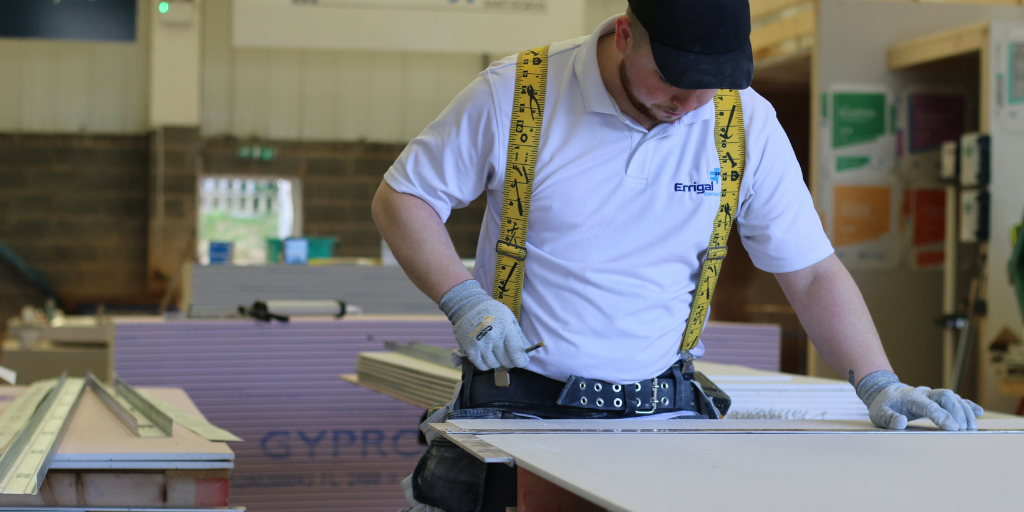
In August 2020 one of our manufacturer members was approached by the Awarding Organisation NOCN for help in preparing test materials for the Interior Systems Installer Apprentice End Point Assessment (EPA) and brought this to the attention of the FIS Skills Board. In November2020 FIS Skills Board members produced Risk Assessments and Method Statements for the end test and in January 2021 FIS brought together an EPA Development Group of Employers, Suppliers, Training Providers and NOCN. The materials developed to assess both options of this apprenticeship, Dry Liners and Ceiling and Partition Installers will soon be ready for use.
This work was facilitated by FIS with the direct support of Joe Cilia FIS Technical Director and George Swann FIS Skills and Training Lead. This would not have been achieved in the time frame allowed without the support, time, materials and expertise freely provide by FIS members. Many thanks go to: British Gypsum, Roseville, Stortford Interiors, Measom Dryline, Time Limit Interiors, Errigal, Komfort, North West Skills Academy, the Construction End Point Assessment Company and the staff at NOCN.
This is an example of collaboration at its very best. If you would like to be involved in the work of FIS, join the Skills Board or one of the Working Groups, please give us a call.

by Clair Mooney | 3 Jun, 2021 | Labour
This week, Select has relaunched its Stay in Scotland campaign, encouraging EU citizens to apply to the UK Government’s EU Settlement Scheme.
EU Citizens living in Scotland, who have not yet applied, are being urged to apply now to avoid missing the deadline of 30 June, so they can carry on living, working and studying in Scotland. Irish citizens and people with indefinite leave to remain do not have to apply.
FIS Chief Executive Iain McIlwee said:
“With the potential for further labour shortages and need to increase our recruitment domestically just to stand still as we can no longer rely on new cohorts of skilled EU workers to plug the gaps, it is vital that we communicate with workers here to ensure that they are aware of and have completed their application through the settlement process. The June deadline is a hard stop. Whilst this campaign is focussed on Scotland, it is relevant to all firms across the UK”
With the deadline fast approaching, you can get support to apply now at mygov.scot/stayinscotland
by Clair Mooney | 22 Apr, 2021 | Labour, Skills
There have been reports of up to 60% labour not being available by some FIS members. With this in mind, FIS has two projects specifically designed to attract people into the sector. In addition, the Governments Plan for Jobs has four initiatives that rely on employers’ willingness to provide work placements and/or for T-Level students industrial placements.
Critical to the success of these two projects is the commitment from employers to give individuals a chance by offering work placements.
FIS Build Back Programme
This programme accepts individuals from a range of backgrounds including HM Forces Career Progression candidates and clients put forward by the Department for Work & Pensions (DWP). To help prepare the candidates for work, each learner receives training in drylining finxing and boarding and are supplied with personal protective equipment, a set of tools and a CSCS Provisional Card. The candidates just need an opportunity to show employers what they can do during a work placement. This may ultimately lead to a full-time work opportunity and will also add new talent to the workforce.
There are currently 43 HM Force Career Progression candidates that have received Fixer Boarder training available for work placement now. Please contact Catherine Bullough by email: catherinebullough@thefis.org for details.
FIS Kickstart Programme
This is part of the Government’s Plan for Jobs; we help employers fill their new vacancies. By working with the DWP, FIS can help to source suitable candidates for a six-month job placement within the business. Once successful candidates are placed with the company, the employer is entitled to claim a support grant of £1500 plus the national minimum wage salary payments based on 25 hours per week.
For more details on these projects and to register your interest in offering work placements please contact Catherine Bullough, Skills and Training Coordinator on 07900 083325 or email catherinebullough@thefis.org

by Oscar Venus | 9 Apr, 2021 | Labour, Skills
In March FIS ran a snap survey to look at workforce trends in the wake of the new points based immigration system. The survey reports that 38% of companies are currently experiencing a labour shortage, with over 60% of contractors predicting shortages as work picks up over the summer. This number increases significantly when we look at the larger companies (those with greater than £5million turnover), here 59% are already experiencing shortages and 74% are predicting worse to come. Dryliners head the list of concerns followed by ceiling fixers, partitions installers, plasterers and carpenters and joiners.
The report shows that the UK finishes an interiors sector remains heavily reliant on EU workers with around half of all companies relying on EU workers for more than 20% of their workforce and 17% of firms reporting that EU workers account for more than 60% of their workforce.
The report also gives insight into employment and use of gangs and agencies in the sector. Across all contractors, 44% of the workforce is employed, 42% work as labour only sub contractors with gangs providing 11% of the contingent workforce and agency workers making up the final 3%. Again this shifts as we look to the larger (>£5m turnover) sector with employment accounting for 26% of the workforce, labour only sub-contractors 39%, gangs 30% and agency workers providing the final 5%.
Commenting on the numbers FIS CEO, Iain McIlwee stated:
“These numbers are cause for concern and we will keep our focus on supporting the rapid scale up in training infrastructure that is required to meet this seismic shift in the way we are going to need to recruit and manage our workforce going forward. We will also continue the dialogue with the Home Office to try and get some common sense applied to the process to ensure we can evolve effectively to the new world order dealing with real world problems rather than political concerns and waiting to see what the official data will tell us when the facts are staring us in the face.”
Read the full FIS Statement on Skills Shortages here