
by Oscar Venus | 8 Aug, 2023 | Drylining, Labour, Skills
Sector Based Work Academy – West London College
Registration – Friday 22nd September, 10am
Starts – Monday 25th September, 10am
Location – Southall Community College , Beaconsfield Road, Southall, UB1 1DP
What we are asking members to do is to support with the work experience and guaranteed job interview
✔Pre-employment training – focusing on requirements for the construction sector
✔Relevant sector ‘tickets’ including Health and Safety
✔Work experience placement – a great opportunity for a business to identify talent and for the individual to cement their knowledge and understanding of the required role
✔A guaranteed job interview or help with an employer’s recruitment process
Sector-based work academies are a valuable resource for those looking to transition into a new field of work. These academies provide training and education to individuals who are currently receiving unemployment benefits, with the goal of preparing them to apply for jobs in a different sector.
The placements offered through sector-based work academies are specifically designed to meet the immediate and future recruitment needs of employers. By providing individuals with the skills and knowledge necessary to succeed in a particular field, these academies help to recruit and sustain a workforce that is equipped to grow and develop a business.
Overall, sector-based work academies are a powerful tool for both job seekers and employers. They provide a pathway for individuals to transition into new fields of work and help businesses to find employees with the right skills to thrive.
The 2 Week program is designed with the aim of preparing individuals for employment in the construction sector. The program is made up of various components including pre-employment training, sector tickets, work experience placement and guaranteed job interviews. These components are put together to ensure that individuals are equipped with the necessary skills and experience to succeed in the construction sector.
Pre-employment training is an important aspect of the program as it focuses on the requirements for the construction sector. During this training, individuals will be taught about the various roles in the sector and the skills required to succeed in these roles. The training will also cover topics such as health and safety, communication and teamwork.
Relevant sector tickets, including health and safety, will also be provided to individuals as part of the program. These tickets are important as they demonstrate that individuals have the necessary skills and knowledge to work in the construction sector. Employers in the sector often require individuals to have these tickets before they can be employed.
The program also includes a work experience placement which provides individuals with the opportunity to gain practical experience in the sector. This is a great opportunity for businesses to identify talent and for individuals to cement their knowledge and understanding of the required role.
Finally, the program includes a guaranteed job interview or help with an employer’s recruitment process. This ensures that individuals have the best possible chance of securing employment in the construction sector.
For more information or to sign up to the course please email Beena Nana

by Clair Mooney | 8 Aug, 2023 | Membership
Entry is now open for the 2024 FIS Innovation Awards.
Now in their second year, the Innovation Awards are open to all companies operating in the finishes and interiors sector and focus on ideas that help support improvements in efficiency, productivity, performance, quality or perception of the finishes and interiors sector.
The Award categories are:
- Product Innovation – Fit-Out
- Product Innovation – FF&E
- Digital Innovation
- Sustainable Innovation
There will also be an overall Innovation of the Year. This will be chosen live by the audience during the awards ceremoney from the winners of the above four categories.
The awards will be judged by a panel of experts and winners will be announced at the FIS Conference, which is taking place during the Workspace Design Show in February 2024.
Entry will close on 31 October 2023. For more information and to enter click here.
FIS Chief Executive Iain McIlwee said:
“There remains a perception that construction is not an innovative sector, our aim with these awards is to debunk this myth and celebrate innovation in our sector across a number of categories. We are looking for innovation that meets a need in the sector and has evidence of adoption or planned use in a commercial environment. So, the successful exploitation of new ideas and bringing creative ideas to life.”
Joe Cilia, FIS Technical Director, added:
“I can think of at least four products which I have seen in the last few years that have been developed by both large and small
organisations based on need to improve quality, address sustainability or save time and I am looking forward to these awards
to be the showcase they need to get to a wider audience.”
The FIS Conference will be a two-day programme on 27-28 February at the Business Design Centre in London. There will be several 1-hour workshops each day, with the winners of the Innovation Awards announced at the Awards Ceremony on 27 February.
More information on the Conference will be available shortly.

by Iain McIlwee | 1 Aug, 2023 | Main News Feed
It has been confirmed that the next edition of JCT (JCT 2024) is anticipated to be issued in the early part of next year. The final decision on the release date will be determined by when the secondary legislation necessary to implement many of the provisions of the Building Safety Act 2022 has been published (expected to be finalised by October 2023).
What are the key changes:
Modernising and streamlining: changes will include the adoption of gender-neutral language, provision for execution by electronic signature and the facility for notices to be sent electronically.
Fluctuation provisions: Price uncertainty is set to continue and the JCT has launched a new fluctuations hub to offer guidance on its Fluctuation Options and also plans to move the fluctuation provisions to an online document to increase prominence and accessibility. Currently, fluctuation Options B & C are available online while Option A features in the JCT contracts.
Extensions of Time: There will be new relevant events to cover epidemics, updates to how ‘statutory powers’ are dealt with and ‘Statutory Undertakers’ will be redefined to ‘Statutory Providers’. In addition, the period of time for the Employer to assess an interim extension of time will be reduced from 12 weeks to 8 weeks from receipt of the Contractor’s particulars. The relevant event dealing with antiquities will be extended to deal with UXB’s, contamination and asbestos.
Loss and expense: The Contract Particulars will provide for parties to include optional additional grounds for the contractor to claim loss and expense. These include epidemics and the exercise of statutory powers by the UK Government which directly affects the works. The relevant matter dealing with antiquities will be extended to deal with UXB’s, contamination and asbestos.
Liquidated damages: The JCT is also making amendments to reflect the Supreme Court’s decision in Triple Point Technology Inc (Respondent) v PTT Public Company Ltd (Appellant) (2021). The decision restores the orthodox position that liquidated damages clauses apply up to termination of a contract, but not thereafter. Clear wording must be used if parties want to agree a different approach. The planned updates to the JCT will provide that where works are not complete at termination, LDs can be levied up to termination and only general damages for delay can be claimed thereafter.
Resolving disputes, arbitration and adjudication: Parties will be able to choose a nominating body or appointer of their choice, as opposed to the original short list. However, it is anticipated that the particulars will still include a list of bodies, as the AICA is being removed (due to it now being defunct). The notification and negotiation of disputes, set out at Supplemental Provision 10, will no longer be an optional provision. Subject to the parties right to refer a dispute to adjudication, this provision deals with the avoidance or early resolution of disputes or differences by requiring each party to promptly notify the other of a matter that is likely to give rise to a dispute or difference. It also requires senior executives to meet “as soon as practicable, for direct, good faith negotiations to resolve the matter”.
Allocation of risk: There will be a new provision added to the contract to deal with unexploded ordnance, contaminated materials and asbestos.
Legislative changes: There will be updates to reflect recent legislation including the Building Safety Act and its secondary legislation (once this has been finalised) and the two new insolvency grounds that were introduced under the Corporate Insolvency and Governance Act 2020 will be added.
Construction Act: There will be revisions to termination accounting provisions to reflect the requirements of the Construction Act, in particular a due date for the final payment after termination will be added.
Future proofing: The contract has been drafted with consideration to the Construction Playbook, sustainable development, collaborative working and environmental considerations.
In addition, a new set of contracts will be added to the suite. The Target Cost Contract, the Target Cost Sub-Contract and the Target Cost guide will be published alongside the updated suite.
While the final amendments are not released yet, the above is understood to be a good guide for the changes that are being implemented.
Commenting on the changes, FIS CEO Iain McIlwee stated:
“Changes to JCT are long overdue, there has been a lot of water under the bridge since 2016! But, whilst the changes are welcome, recent research by Reading University points to the fact that the very concept of a standard form of contract is to all extent and purposes almost dead.
It is vital that these changes are heralded with some real leadership making it clear that the contracts are designed to be used in an unamended format. Where amends are deemed necessary the users should be cautioned against “risk dumping” and the contracts should be deemed invalid unless changes are clearly marked up in the body of the contract instead of included in an unwieldy schedule of amends.
The new Building Safety Regulations emphasise that risk should be dealt with by the person most able to manage it – there is a huge opportunity for JCT to get behind this principle and champion the import of standard and unamended contracts.”
This summary of the changes is based on content in the latest edition of JCT News

by Iain McIlwee | 1 Aug, 2023 | Technical
The Department for Business and Trade announces an indefinite extension to the use of CE marking for UK businesses, but DLUHC (who regulate Construction Products) have indicated that this extension will not apply to construction products.
The Department for Business and Trade (DBT) has announced today a package of smarter regulations designed to “ease business burden” that includes recognition of the CE mark in the UK beyond the 2024 deadline. This means British firms will be able to continue the use of CE marking alongside UKCA in perpetuity. But, FIS have been informed that this easement relates only to the 18 sectors that fall under DBT – it does not apply to construction products.
Announcing the change Business Minister Kevin Hollinrake stated:
“The Government is tackling red tape, cutting burdens for business, and creating certainty for firms – we have listened to industry, and we are taking action to deliver. By extending CE marking use across the UK, firms can focus their time and money on creating jobs and growing the economy.”
DLUHC have indicated to the Construction Products Association (who are leading representation on this matter through the Construction Leadership Council) that recognition for construction products will continue until 30th June 2025 ONLY. The rationale offered is that the Government remains committed to ensuring the testing regime for construction products is effective and inspires public and market confidence. DLIHC have indicated that they will set out their proposals for reform of the construction products regime in due course.
Commenting on this announcement FIS CEO Iain McIlwee stated:
“The logic is hard to follow here. All the arguments about red-tape, business burden, avoiding cliff edges and refocussing on innovation and growth that apply are replicated, even magnified, in the construction sector. The unnecessary re-testing of product that transitioning to UKCA necessitates is a waste of resource and, particularly in the case of fire safety, precious furnace time. The Government talk about pragmatism, but this is not extending to construction and that is disappointing and frustrating in equal measure. I only hope that “due course” considers, but doesn’t conflate the need to focus on product safety, which is a very separate and significantly more important issue to address.”
You can read the full announcement here.

by Iain McIlwee | 27 Jul, 2023 | Building Safety Act
Cladding Safety Scheme opens to give thousands more buildings access to government funding to fix dangerous cladding for the first time.
The government has announced its biggest building safety intervention to date as part of a wider package of measures to help end the building safety crisis across England.
The full opening of the Cladding Safety Scheme (CSS), announced in a speech by Housing Secretary Michael Gove, means that costs associated with removing unsafe cladding in mid-rise buildings will now be covered by government funding, protecting leaseholders from costs where the responsible developer cannot be made to pay. It is estimated that thousands more mid-rise buildings will qualify, giving tens of thousands of residents across England a pathway to a safe home, with no cost whatsoever to leaseholders in the building.
The CSS will be funded by both the £5.1 billion allocated by government to fix the most dangerous buildings and through revenue from the Building Safety Levy on new development.
The scheme will be available to all medium-rise buildings between 11 and 18 metres across England and high-rise buildings over 18 metres outside of London where fire safety professionals have recommended that works must take place. The scheme will also be available to the social housing sector.
All building owners who believe they are eligible for funding need to apply through Homes England Cladding Safety Scheme application portal.
Any leaseholders or residents living in a building they think is eligible for funding will be able to provide further information about their building using Homes England’s ‘Tell Us tool’.
Peter Denton, Chief Executive of Homes England, said:
The Cladding Safety Scheme pilot was an important step in removing the cost burden on leaseholders trapped in unsafe homes and built on the progress made on building safety.
The full rollout of the programme allows us to go even further. Our team is ready to go, and we expect thousands of buildings to benefit over the next decade.
We will continue to work with DLUHC to ensure the pace we’re working at is maintained, so we can bring peace of mind and protection to the millions of people whose lives have been affected by unsafe cladding.
The opening of the CSS means that costs of fixing dangerous cladding for all buildings in England over 11 metres will now be covered either by government funding or by developers who built them.
Earlier this year, the Secretary of State secured the signatures of 49 of the country’s biggest housebuilders on his developer remediation contract – a major step toward ending the building safety crisis.
The developers all put pen to paper on the legally binding document and committed themselves to fix unsafe buildings they developed or refurbished in England over the 30 years to 5 April 2022. The government has now written to eligible developers to invite them to join the Responsible Actors Scheme giving them 60 days to respond. Eligible developers who choose not to join, or who join the Scheme but then renege on their commitments, will be prohibited from carrying out major development or obtaining building control approvals.
While funding is a major part of solving the crisis, it is also important that residents see swift progress once work has been deemed necessary. The government has been clear that there is no excuse for unsafe cladding to be left unmanaged. Building owners must meet their legal obligations to fix fire safety defects in their buildings and make homes safe quickly.
The Department for Levelling Up, Housing and Communities, the Building Safety Regulator, the Local Government Association, and the National Fire Chiefs Council have today published a joint statement committing to work together to enforce the remediation of fire safety defects, underlining their commitment to see buildings made safe faster. Building owners who continue to stall can expect to face robust enforcement action from regulators, with the full support of government behind them.
The Greater London Authority will continue to deliver remediation to London-based 18m+ buildings through the Building Safety Fund.
Buildings in England already progressing through the Building Safety Fund will not be transferred into the new CSS but their progress will remain unaffected.
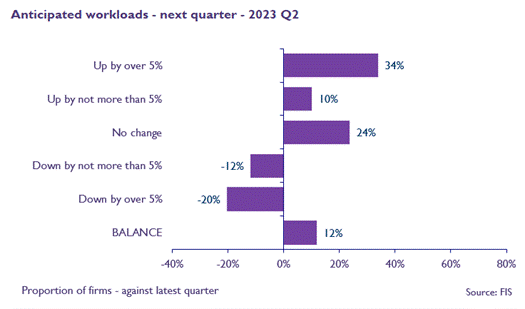
by Iain McIlwee | 27 Jul, 2023 | Market data
Workloads reported by members in the FIS Q2 State of Trade Survey have continued to trend positively with a higher balance (18% up from 5% in Q1) reporting Growth. Within this, 35% of members have experienced growth greater than 5% and just 29% reported a decline for the quarter. The balance (-7%) of respondents did, however, report a decline in sales in Q2 2023 with those reporting a growth in sales dropping from 75% to 43% quarter on quarter. This is the first time the net balance has been negative since Q3 2020.
This trend is consistent with data from Barbour ABI which has highlighted that most sectors have seen falls in terms of contract awards compared to Q1, with notably industrial reducing by 45% and healthcare by 50%. Conversely, awards over Q2 in education continued on a positive trend and the commercial sector remained relatively positive albeit volatile. NHBC has reported that Q2 new house building registrations fell in the UK by 42% compared with a year ago according. It should, however, be noted that was from a base almost double the long-term average. The numbers in 2022 were distorted as house builders worked to get ahead of the new building regulations.
Looking ahead to the next quarter, both sales and workload for the next quarter are trending positively, but the balance is lower than the past couple of quarters. There are still reports of work slipping with rising interest rates and concerns over compliance (particularly linked to staircases) impacting viability of projects. It is also worth noting that, whilst overall trend remains positive, 20% of members are expecting workload to slip by in excess of 5% in Q3.
Members can access the full FIS State of Trade Survey Q2 2023 here

by Oscar Venus | 27 Jul, 2023 | Main News Feed
The Building Safety Regulator (BSR) is set to oversee the building control approval process for all higher-risk buildings from 1st October 2023. In order to ensure the ongoing safety of residents, the BSR will also manage the safety of these buildings while they are occupied. To provide a clear overview of the new building control regime and the BSR’s role as the Building Control Authority, a free one-hour lunchtime webinar will be hosted on Wednesday 9th August from 12pm-1pm. The webinar will be hosted by Colin Blatchford-Brown, Operational Policy lead for Gateways and Building Control, and Jenny Hagan, Senior Policy Advisor for Gateways and Building Control.
The engaging and informative webinar is open to all those interested in the new building control regime, including designers, architects, local planning and building control authorities, building control professionals, private and public sector contractors, clients, principal accountable persons/accountable persons, developers, and industry organisations. Attendees will gain a deeper understanding of the new building control regime, the importance of duty holder roles, and the gateways. The webinar will also provide the opportunity to ask questions to the experts and receive a post-event copy of the presentation and a recording of the webinar.
Register for the webinar here

by Clair Mooney | 24 Jul, 2023 | Main News Feed
Construction output is forecast to fall by 7.0% in 2023, primarily due to sharp falls in activity in the two largest construction sectors, private new housing and private housing repair, maintenance and improvement (rm&i). Output in the third largest construction sector, infrastructure, has also been revised down again due to government delays to roads and rail projects that will only add further cost to the projects when they return. Construction output is forecast to increase in 2024, by 0.7%, as wider economic growth boosts demand for both new build housing and rm&i activity.
FIS Members can download their copy of the CPA’s Summer Forecast here.

by Clair Mooney | 21 Jul, 2023 | Main News Feed
To help keep tabs on wage rate inflation, FIS launched in 2021 The FIS Wage Rate Index. The aim of this work is to support contract negotiations and to help track the impact of labour shortage on the cost breakdown of projects.
The survey is conducted every six months and FIS is asking all contractor members to take part. Data is published as a price index to allow for regional rate variations and all company specific data is managed in the strictest of confidence. The survey covers core trade roles, labourers, apprentices and construction and site managers.
THE DETAILED RESULTS OF THE SURVEY WILL BE MADE AVAILABLE EXCLUSIVELY TO CONTRBUTORS.
You can complete the survey via the link here. The survey will close on 21 August 2023. If you cannot complete, please share the link with the person in your business who can.
Your support is, as ever, appreciated.