Changes to Working Time Regulations: guidance for employers

Changes to Working Time Regulations: guidance for employers

On January 1, 2024, the UK government implemented amendments to the Working Time Regulations, which are outlined in this document. Please note that this guidance cannot provide definitive answers to all individual queries or be used in place of personalised legal advice. Employers must negotiate the changes in terms and conditions with their workers or representatives.

The main focus of this guidance is on the minimum entitlement of 5.6 weeks’ paid holiday. However, workers may have contractual entitlements to additional paid leave beyond this statutory minimum. Therefore, employers should first review individual contracts and consult independent legal advice if necessary.

It is important to note that all illustrative holiday pay calculations in this guidance are based on gross pay data (before any taxes or deductions).

Additionally, this guidance refers to ‘workers’ as individuals whose employment status is either as a ‘worker’ or an ’employee’, entitling them to paid leave.

See the guidance here


Join Citation on Wednesday, January 10th at 11am for an informative webinar on changes in employment law. Our discussion will focus on a range of topics including new regulations around carers’ leave, flexible working, and holiday entitlement and pay for irregular hours/part-year workers.

Be one step ahead this year by attending this webinar.

Workshops and webinars available through the Supply Chain Sustainability School and FIS

Workshops and webinars available through the Supply Chain Sustainability School and FIS

The Supply Chain Sustainability School and FIS have collaborated to bring you a range of workshops and webinars specific to the finishes and interiors sector. We’ve highlighted below all the upcoming sessions and relevant resources.

Introduction to Modern Slavery with Willmott Dixon
Tuesday 16 January 2024, 10 – 11am
This webinar will introduce you to the topic of modern slavery featuring insights from Willmott Dixon.
REGISTER HERE

Using Lean for Continuous Improvement and Problem Solving
Tuesday 23 January, 10am – 12pm
REGISTER HERE

Net Zero, SBTs and Carbon Offsetting
Thursday 1 February, 10 – 11am
REGISTER HERE

Introduction to Circular Economy
Thursday 15 February, 12 – 1pm
REGISTER HERE

Embedding Sustainable Procurement
Wednesday 21 February, 9:30 – 11:30am
REGISTER HERE

Len takes a look back at 2023

Len takes a look back at 2023

As we get to the end of 2023 there is no doubt it has been a tumultuous year for the industry in the United Kingdom. We have experienced some significant business failures which regrettably have left a mountain of debt due to a wide range of subcontractors across the industry. Fortunately, so far at any rate in Scotland, we appear to have avoided the impact of businesses stalling and going into administration and fingers crossed during 2024 that we do not experience any casualties.

The results of the recent CICV Payment and Cash Flow Survey made grim reading, but the responses really were not surprising as many of us who advise contractors and subcontractors, felt that recently reflected what the supply chain was experiencing across Scotland this being a general slowdown in payment periods, and a reduction in the amounts that the supply chain were due. Anecdotally, some clients say that they are currently experiencing a downturn in work opportunities, coupled with a tightening of margins and there are now definite concerns emerging regarding pipeline of work in 2024.

I have set out some positives with the hope that we will see some of these issues been delivered to see a general improvement in the construction industry in Scotland. In 2024 the process of educating the industry on the Best Practice Guide which sets out some of quite simple recommendations to contractors and subcontractors to improve the way in which they manage the commercial aspects of the construction projects. Getting contractors to buy into this is especially important and in embedding these recommendations into their businesses, and already there are several pilot workshops been planned and the feedback will hopefully be positive that lessons are being learned from the solid advice that has been provided. In addition, several contractors are seeking to have internal workshops to bring their commercial and contract management teams up to speed on the SBCC Forms of Contract.

The Quality Initiative is also a great idea and I know that CICV will be supporting this and again this initiative needs to be brought in at site level to ensure that less and less projects have issues concerning non-compliant workmanship which inevitably results in the costs associated with rework and contra charges, from the contractor and the clients. It really is up to everyone reading this article who runs a construction business, to make sure that their focus is on quality, and to end the criticisms experienced by the industry because of non-compliant workmanship and defects.

There is no doubt that there is a surge towards more collaboration in the industry and as to what form that takes remains to be seen, but it strikes me from sitting on the fence that the industry does want to collaborate more closely with the employers, contractors, and the supply chain to improve performance on construction projects. This is going to be a never-ending and a long term process and needs energy and dedication to drive these changes through.

Much work is happening behind-the-scenes on the Construction Accord and in my personal opinion it is essential that the Scottish Government and the construction organisations work very closely together to achieve the objectives of the Accord, and there is no doubt that this is going to take a number of years to come to fruition, but the positive side of this is that discussions are underway and some very positive ideas and objectives are emerging.

Again, on a positive note the Conflict Avoidance Process and the Conflict Avoidance Pledge are gaining traction and we are now seeing a number of major projects having CAP incorporated into the building and engineering projects from the outset. In addition, the level of approaches to the RICS are increasing, to have 1/3 party brought in to try to resolve issues at the initial stages and avoid issues escalating into expensive and time-consuming disputes. The Conflict Avoidance Coalition will come forward in 2024 with a new structure which will focus on promotion and growth, and developing guidelines and processes, and a major conference will be held in 2025 which hopefully will attract major clients users of the construction industry and consultants, contractors, and subcontractors.

I have also been encouraged by the work of the Finishes and Interiors Sector who have appointed experienced individuals to provide Contract Reviews to FIS members. This means that when a tender enquiry comes in a tenderer can have the conditions of contract reviewed to identify any high risk clauses that might require financial recognition but hopefully the parties can negotiate out some of the unacceptable risk transfer amendments and thus start the project with a balanced and fair set of conditions of contract. It is beyond my comprehension why public and private sector clients continue to have pages of amendments to the Standard Forms and the industry needs to stand up to this type of conduct.

One question I was asked recently was – are attitudes changing and so the answer to that is yes. In my own work with a number of clients I have noted that they are walking away from employers who are only interested in lowest price, they are walking away from employers who as I say produce ridiculous amendments to the Standard Forms and there are walking away from both public and private sector clients who are either late payers, or who continually reduce the amounts due to contractors and the supply chain. I find that approach to be refreshing and hopefully it will spread throughout the industry.

So, let us take a positive view moving into 2024 and let us hope that the industry can take on some of the many recommendations coming forward, to make the industry in the United Kingdom a positive and profitable sector to be in.

Read all of Len’s blogs and get more information about all the Business and Legal Support available through the FIS here.

FIS Digital Construction Working Group Report

FIS Digital Construction Working Group Report

The meeting was chaired by Diane Tocco, Director of Diane Butterworth Limited, a longstanding FIS Member that specialises in digital solutions, initial office planning, visualisation and Revit Families.

Diane opened by reminding the attendees of the whole group objectives –

  • Establish best practices and encourage the sharing of knowledge.
  • Help appraise membership and support digital tools as they emerge in the sector.
  • Support the implementation of digitisation within organisations by influencing and educating key decision-makers and providers.
  • Simplify the understanding of emerging tools and interoperability between them.
  • Ensure engagement is active within the sector to the wider conversation of digital construction.

And the specific focussed Objectives of the day:

  • Support compliance with the more onerous Information Management requirements in the revised Building Regulations (the Golden Thread)
  • Integration of digital tools and the impact on the Golden Thread.
  • Evaluate the application of BIM to drive improvements in the delivery of training and safeguarding health.

To set the scene for the meeting Iain McIlwee revisited the progress of the Group from BIM4Fit-out to the Digital Construction Working Group and the tools and support that has been developed including:

  • BIM Toolkit
  • Key Product Data Templates
  • FIS guidance on Pre-Qualification BIM Questions
  • And the Digital Spine

This year the substantive piece of work was the development of the FIS White Paper:  Introduction to the Golden Thread and Digital Information Plans published in October.

Legislation: What is the Golden Thread?
George Stevenson, Chairman www.bim4housing.com  and Managing Director at ActivePlan Consulting Ltd

George Stevenson of ActivePlan Limited and Chair of the BIM4Housing Group update on work that FIS has supported in developing Asset Modelling that is aligned to and supporting the delivery of the Golden Thread.

Overview new FIS Guide:  Introduction to the Golden Thread and Digital Information Plans
Iain McIlwee, CEO, Finishes and Interiors  Sector

Iain then ran through the key sections and learnings from producing  the White Paper and into details of the research that FIS has conducted in 2023 to understand digital readiness within the sector.

Key findings from FIS research are that 28% of Suppliers and 72% of contractors do not currently have a Digital Information Plan in place.  Concerns we raised about information available, particularly time taken to hunt down evidence of performance, missing interface and fixing details and confusion in terms of performance scope.  Again in tender packs the lack of critical details related to product and performance were highlighted.

Open Discussion on Key trends:  Digitalisation and challenges in the finishes and interiors sector.

The discussion moved to real life examples of how the Golden Thread needs to be more clearly established at the start and more work needs to be done to define requirements upstream to ensure FIS Members are not being overloaded, overwhelmed and set up to fail.  Linking this to wider technical work (and considering digital implications of technical work) was emphasised as the biggest priority for the group.

The scale of the challenge was discussed.  Fundamentally Golden Thread is information that we have, simplistically it needs to be structured better to share it.  Concerns remain that clients don’t know what they want so aren’t providing proportionate and structured requests for information.

It was noted that every building will have its own golden thread. The contents of it will depend on and is the responsibility of the dutyholders for that project: principal designer, principal contractor and client.

The question was posed, “What defines the piece of unambiguous information used to define the beginning of the Golden Thread?”.  This is difficult to define and comes back to questions.   Simplistically this was identified as a requirement, that needs to move from performance to a prescriptive requirement, which is then satisfied by a product (and supporting evidence).  Then the Golden Thread is a digital connection between that and what was installed (check the right product was installed correctly).

The importance of System based thinking was discussed, because the next level is the context of a product within a system and ultimately the building.

Looking at the complexity of the current situation is frightening and debilitating, so it is important to remember the fundamentals. Manufacturers must start from where they are. All the data required already exists in their systems. The challenge is to put it into structured form, so that it can be mapped against the information requirements of their clients. They won’t provide it until it is asked for – it requires a client request. That client request needs to be proportionate to their requirements for data. The data requirement should be provided in a structured form too!”

To search for the simple answer it was proposed that The Golden Thread starts with reasonable questions.  Alignment and talking in the same language is a challenge, this is about clarification.  One of the problems is we have all been dumping unstructured information on each other that can’t be used.  Needs to be a client pull.   The client has to structure requests to support structured response – legislation should start to help.  Noted clients need to confirm that they have received adequate information, which encourages better interrogation and ultimately articulation of requirements.

Key questions that need to be answered clearly through the process were clarity around:

  • What was specified?
  • What was installed?
  • What was its performance?
  • Who installed it?
  • Who inspected it?
  • Who maintained it?
  • What replaced it?
  • What risks do we anticipate?

A tender, considered to be a full NBS spec, which pushed all of the design work onto the specialist contractor, all complex performance requirements (judged on pre-installation testing) and no detail.  This makes a mockery of the Golden Thread as sufficient time is not allowed and information is still being dumped.  Upgrading the way tenders are coming out, 300 drawings showing sections, but not the finite detail.  BIM is not forcing out the detail, it is still being avoided.

Noted that it is very unusual for the partition to be modelled because there is too much detail and the problem is that who is going to do it.  Partition walls are typically modelled by the architect using generic models .  If using Revit there are tools to support the make-up, normally get the model and then work with the manufacturer and detail not added til stage 4, which is too late when overlapping  with Stage 5 means contractors are being put in difficult predicaments and seen as the “bad guys” asking questions too late.  M&E Programming was also discussed as adding to the complexity.

Cut and paste specifications with several different elements being badly and inconsistently presented was highlighted as another common problem that means effective output is difficult when the right information is not received in the first place.

Ultimately the conclusion was that the Golden Thread will fail in intent unless vital design and procurement details are managed. The Golden Thread is not a plaster and  in wake of increased complexity, misaligned and badly managed tolerances, we need to emphasise the importance of the “Responsible No” and “Early Supply Chain Involvement” and standardised information requirements.

Levers for change, Golden Thread, Building Safety Act, Insurance all need to be used to accelerate the change and limit the pain in implementation of new regulations.

Swe now that we need to provide information in a more structured and efficient way.  Who is responsible is still a concern and we need to look at better understanding.  Key action to return to Product Data Templates and ensure we are capturing all the information that we need at the start and identifying scenarios where our information requirements are not being met.

As in all aspects of our activity the FIS focus of this group is observation (understanding the challenges and opportunities), standardisation (encouraging consistency), normalisation (collective action) and representation (ensuring external barriers are understood and removed).

Copies of presentations given at the meeting are available below.

FIS Guide to the Golden Thread and State of Play for Digitalisation 2023

FIS ActivePlan – Building Safety Act and Digitalisation 12-12-23

FIS BIM4H Case Study Doorsets Dec 2023

The FIS is hosting a session on Digitalisation of Fit-out:  Transformation through information at the Workspace Design Show in February and also hosting the Digital Innovation Award at the exhibition.  More details here.

To access the FIS Digital Toolkit Click here

FIS is actively seeking case studies of positive Digital Information Management to form the basis of webinars, case studies and articles in 2024.  To nominate a case study, email iainmcilwee@thefis.org.

Expanding England’s tree coverage and encouraging the safe usage of timber in construction

Expanding England’s tree coverage and encouraging the safe usage of timber in construction

The government is committed to increasing England’s tree canopy and woodland cover to 16.5% by 2050, as per the statutory tree and woodland cover target. However, planting trees alone is not enough. To make the most out of the materials they provide, the government has also pledged to enhance the safe use of timber in construction (TiC) as part of the Net Zero Strategy, the England Trees Action Plan, and the 2023 Environmental Improvement Plan. This will help reduce embodied carbon in the built environment, promote tree planting and forest management, create new green jobs and industries, and build domestic supply chains.

It’s important to prioritize safe, high-performing, and best-practice timber construction to achieve the net-zero pathway. Alongside resource efficiency measures and other low-carbon products, the use of timber will provide the most significant benefits.

See the roadmap here

Re-use, net zero, sustainability and FIS efforts

Re-use, net zero, sustainability and FIS efforts

Wednesday marked the last formal FIS Working Group meeting for 2023 with the FIS Sustainability Leadership Group descending on Clerkenwell, kindly hosted by Troldtekt in their showroom.  As host Steve Mansell kindly acted as Guest Chair (this Chair for this group rotates between the members).   

Action:  If you are interested are a contractor and interested in sustainability and haven’t could you please complete our survey here (it is helping to inform our work). 

The meeting was a chance to reflect on key work programmes associated with supporting sustainable transformation and a net zero approach within the finishes and interiors sector.   

As in all aspects of our activity the FIS focus of this group is observation (understanding the challenges and opportunities), standardisation (encouraging consistency), normalisation (collective action) and representation (ensuring external barriers are understood and removed).   

Led ably by FIS Sustainability Champion Flavie Lowres, the Leadership Group reviewed progress against the plan.  This is an important area of focus and it is becoming increasingly so as clients start to interrogate in more detail the impact work.   

The meeting zoned in on the area of re-use with the first live demo of the pre-refurbishment audit tool that FIS has been working to develop with the University of Hertfordshire (built around the standard Audit protocols FIS has developed and is currently working with NBS to turn into a specification standard).   We also discussed the re-use initiative, our plans to set up a pilot collective re-use hub on the outskirts of London.   

At the heart of all FIS does is collaboration and we have and are doubling down on our partnership with the Supply Chain Sustainability School in 2024 with a number of targeted training interventions: 

Upcoming sessions   Dates 
Introduction to Modern Slavery webinar     16th January at 10 – 11am  
Using Lean for Continuous Improvement and Problem Solving workshop     23rd January at 10am – 12pm 
Net Zero , SBTs & Carbon Offsetting webinar    1st February at 10 – 11am  
Introduction to Circular Economy webinar    15th February at 12 – 1pm 
Embedding Sustainable Procurement workshop    21st February at 9:30 – 11:30am 
Business Case for FIR workshop     12th March at 10am – 1pm 
Building Level Assessments webinar   21st March at 12 – 1pm 
EPD webinar  Date TBC 

The plan is also to work with the School to help benchmark activity within the sector based on a framework that has been developed (in consultation with FIS).  More on this in the New Year. 

We had brief updates on the ongoing work around establishing a more consistent approach to information exchange and how we can better embrace social value in the work (the fourth discussion this week about the failure of Section 106 clauses to deliver positive outcomes and something we do intend to take on in 2024 – initially with the work we are doing with the City of London and the Skills for a Sustainable Skyline Taskforce).  

We also had an update from Iain McIlwee, FIS CEO on why FIS is supporting Ska Rating as a mechanism to support the measurement of project impact within the sector.  Iain has recently joined the Ska Board to help encourage uptake of and support investment in the next stage of development for what is already a fantastic process for measuring impact of refurbishment projects in retail, office and higher education.  

We’d like to thank all members who have supported the Sustainability Leadership Group and provided inspiration, imagination, expertise and time to help shift the dial and we look forward to working with you all to deliver on your ambition in 2024. 

The FIS sustainability group has grown since I started at FIS 2 years ago. It is very interesting forum where participants can share and collaborate on the topic of sustainability. The strength of the group is that it includes all the stakeholders from the fitout industry and all different levels of knowledge of sustainability.  

If you are interested in getting involved in the FIS Sustainability Leadership Group in 2024 or just want to find out more about our activities, email flavielowres@thefis.org.   

Action:  If you are interested are a contractor and interested in sustainability and haven’t could you please complete our survey here (it is helping to inform our work). 

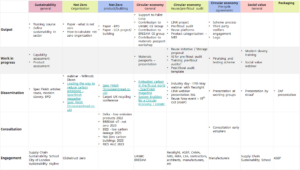
Activity Map and update 2023 – FIS Sustainability Leadership Group. 

Visit the FIS Sustainability Hub here 

Latest FIS Wage Rate Survey

Latest FIS Wage Rate Survey

To help monitor wage rate inflation (and other contractual issues), FIS launched in 2021 The FIS Wage Rate Index. The aim of this work is to support contract negotiations and to help track the impact of labour shortage on the cost breakdown of projects.

The survey is conducted every six months and FIS is asking all contractor members to take part. Data is published as a price index to allow for regional rate variations and all company specific data is managed in the strictest of confidence. The survey covers core trade roles, labourers, apprentices and construction and site managers.

THE DETAILED RESULTS OF THE SURVEY WILL BE MADE AVAILABLE EXCLUSIVELY TO CONTRIBUTORS.

You can complete the survey via the link here. The survey will close early in the New Year. If you cannot complete, please share the link with the person in your business who can.

Your support is, as ever, appreciated.

The 12 pays of Christmas

The 12 pays of Christmas

With cashflow continuing to be a thorny issue across the industry, it’s never been more important to ensure your payment preparations are in good health. Here, our expert elf delivers a dozen festive financial pointers to help prepare your business balance sheet for the New Year and beyond…

Unfortunately we’re still seeing significant contractor and sub-contractor business failures across the UK, resulting in a trail of devastation for the supply chain.

I’ve recently dealt with payment and cashflow issues for a number of SMEs and the level of difficulties currently being experienced is extraordinary.

After 40 years in the industry I don’t think I’ve ever seen so much chaos and it’s desperately sad to see so many businesses going into administration and good people being made redundant.

It’s essential that FIS Members minimise risk in 2024, so with apologies to the classic tune <<The 12 Days of Christmas>>, I’ve wrapped up a dozen of my own top payment tips to ensure you don’t lose sleep over payments and can enjoy a silent night…

1. Use Mr (or Mrs) Clause – use an experienced professional to analyse any contracts you’re bidding for and highlight any high-risk clauses. This will allow you to discuss the issue in advance and request that the clauses are removed or mitigated. There’s no use doing this after your tender has been accepted!

2. Make a list and check it twice – ensure you have a payment schedule in your contract, setting out the dates when you’ll make an application for payment, what you need to provide, the due and final dates for payment and when a pay less notice will be issued. Stick religiously to these dates – your commercial manager should have them in their calendar.

3. Stay another day – beware your payment schedule running out. If a job runs past the last date in the schedule, make sure it’s extended until you reach practical completion.

4. Talk turkey – payment applications are often rejected or reduced because you haven’t provided the relevant information. Too much detail is better than not enough, so ensure your commercial manager follows up each application with a call to the contractor to establish they have everything they need. There’s nothing worse than getting to the end of the month, only to find your application has been shredded!

5. Follow the star – make sure you do what the contract says about submitting notices. So if it says they must be sent by email and registered post, do that. If it says they have to go to individuals and an organisation, do that instead.

6. Wrap it up – a sub-contractor told me recently that if his money isn’t received by the final date for payment, he issues a notice to suspend the performance of his obligations on site the next day. You’re perfectly entitled to do this and I find it’s a good wake-up call to both contractors and employers.

7. Do you hear what I hear? – you’ll often get an early indicator if there are trading difficulties, so keep your eyes and ears open. If the contractor or employer isn’t paying on time or reducing payments, share intelligence and compare notes with other sub-contractors.

8. Avoid a ding-dong – if you’re delayed, tell the contractor or employer why ASAP and give early notification of an extension of time. Some clients say they don’t want to ruffle feathers, but your priority is your <<OWN>> business. A standard contract allows extensions of time and payment of loss and expense, so take advantage.

9. Head for quality street – quality is still a major issue in the industry, with clients being charged for failing to rectify defective workmanship, remove rubbish and comply with health and safety regulations. The Construction Quality Improvement Collaborative is a major step forward – it’s worth signing up at www.cqic.org.uk to demonstrate your credentials and commitment to doing things right.

10. Jingle all the way – I recently issued a notice of adjudication to a defaulting party who quickly paid up. The Low Value Dispute Adjudication offers a fixed fee for an adjudicator to run such a dispute so you should take advantage – find out more at www.rics.org

11. Goodwill to all men – SELECT is among the many bodies to sign up to the Conflict Avoidance Process (CAP), which you can use as an early intervention to prevent issues escalating and allow you to keep working (and earning). Check it out at www.rics.org/capledge

12. Stuff those turkeys – finally, if you’re working with an organisation that’s repeatedly giving you the runaround, have the courage to tell them their goose is cooked and give them the boot.

In addition to these pointers, please read the CICV’s Best Practice Guide – available to download for free from www.cicvforum.co.uk – to improve your commercial management.

There’s no doubt we’re in for another tough 12 months across the industry but those firms that prepare properly will manage to weather the snowstorms to come.

Changes to Skilled Worker Visas

Changes to Skilled Worker Visas

The Government has announced a number of changes to the Points‐Based Immigration System (PBIS) designed to reduce overall net migration. From next spring, the Government will increase the earning threshold for the Skilled Worker visa from £26,200 to £38,700, as well as raise the Immigration Health Surcharge from £624 to £1,035. The Shortage Occupations List will also be replaced with a new ‘Immigration Salary List’, which will retain a general salary discount but include fewer occupations.

Under the PBIS, most workers from outside the UK in construction are ‘skilled workers’ and require a Skilled Worker visa to work in an eligible occupation. Build UK’s flowchart provides an overview of the process of employing a worker from outside the UK, with detailed guidance on How to Get a Sponsor Licence and How to Get a Skilled Worker Visa.