
by Iain McIlwee | 16 Feb, 2021 | Main News Feed
As part of its work to reduce pressure on public transport during lockdown, Transport for London (TfL) has used data provided information to help businesses identify hotspots on the network. Construction sites should continue to stagger shifts and coordinate with neighbouring sites to reduce the number of workers around these hotspots at the busiest times. Workers who change at Stratford, West Ham and/or Canning Town are being asked to travel further into London and change at Mile End (for Bond Street), Bank (for London Bridge), Embankment (for Waterloo) and Whitechapel (for Canada Water).
Workers continue to be encouraged to walk or cycle to work where possible, and Build UK has produced a simple guide for workers on travelling to work, as well as a helpful poster which can be displayed on site.
Visit the FIS COVID-19 hub here, for all the updates

by Iain McIlwee | 15 Feb, 2021 | Building Safety Act, Insurance
The Construction Leadership Council (CLC) welcomes the announcement made recently by the Housing Secretary, Rt Hon Robert Jenrick MP on expansion of the Building Safety Fund. This included full funding for the removal of unsafe cladding for leaseholders in all residential buildings 18 metres and over (6 storeys) in England; and a finance scheme to provide reassurance for leaseholders in buildings between 11 and 18 metres (4 to 6 storeys).
The CLC recently submitted an industry wide response ahead the Chancellor’s Budget Statement on 3 March 2021. This focussed on a small number of key interventions including an increase in the funding for the Building Safety Fund to cover the remediation of all eligible buildings and other matters.
Government and industry must continue to work together to ensure the tragedy of the Grenfell Tower fire does not happen again.
The majority of this work is being led by the Ministry of Housing, Communities and Local Government (MHCLG) through their Building Safety Programme and is structured around four key areas: identification of unsafe buildings, making those buildings safe, identifying system problems, and fixing the system.
The construction industry must play its part too and there is already significant work underway.
The Construction Leadership Council Building Safety workstream aims to support CLC and industry engagement with the Grenfell Inquiry, Building Safety Programme, new regulatory bodies and wider work for the built environment. Key objectives include identifying the intersections between the core work of the CLC and Building Safety Programme, where appropriate enhancement and contribution to key building safety regime objectives and driving industry awareness and understanding – key is leadership and culture change both in the immediate (new and existing High Risk Residential Buildings buildings) and longer term for the entire industry.
Over the past two years the Competence Steering Group (CSG) has assembled a coalition of organisations from across the built environment and fire industries together with organisations representing building owners and managers. Their aim was to come up with a blueprint to improve competence for those working on higher-risk buildings, and drive a culture change right across the industry.
The group has produced 2 reports – Raising the Bar published in August 2019 and Setting the Bar published in October 2020. The work was initiated by the recommendations in Dame Judith Hackitt’s review Building a Safer Future. Since the publication of the ‘Setting the Bar’, the CSG and its 13 Working Groups have consulted widely and taken on board feedback as they have continued to develop sector frameworks. These frameworks will provide the skills, knowledge, experience and behaviours needed to carry out specific roles, and deliver a more rigorous approach to the essential training and assessment that is required.
In addition, MHCLG has commissioned the National Standards Body, BSI, to develop the National Standards for the overarching competence framework and accompanying Publicly Available Specifications (PAS) standards for the three regulated roles of Principal Designer, Principal Contractor and Building Safety Manager.
Improved product safety is also a key part of building safety reforms. Work has been ongoing over the past few years to ensure that the products that go into buildings are safe and therefore buildings are safe. This work has been aligned with the recommendations in Dame Judith Hackitt’s 2018 report Building a Safer Future and the draft building safety bill published by MHCLG in July 2020. This includes the industry development of a code for construction product information, led by the Construction Products Association’s Marketing Integrity Group. The aim of the code is to have a robust and consistent approach to how construction product information is communicated. The draft code proposes the principles of clear, accurate, up to date, accessible and unambiguous information through 11 clauses.
Throughout 2021, the Building Safety workstream will look to share and update the industry via the CLC website on key work and announcements. Most recent activity includes:
- The Government has announced a new national regulator for construction products operating within the Office for Product Safety and Standards (OPSS). An independent review has also commissioned to examine weaknesses in previous testing regimes for construction products, and to recommend how abuse of the testing system can be prevented.
- Launch of the industry consultation on a proposed new code for construction product information.
- Recent article by Graham Watts, Chief Executive of the Construction Industry Council, a Member of the MHCLG Industry Response Group and Chair of its Competence Steering Group.
All in the industry must engage and play their part to improve.
Iain McIlwee FIS CEO added “It is clear that the industry is needs to pull out all of the stops to ensure that profound changes to culture and process happen, but for me the fund still falls short of attacking the problem head on. Cladding is but one issue, it is not addressing the wider aspects that were uncovered in Grenfell and previous disasters. It also concerns me that there is now talk of a levy on development, which could potentially impact funding for future works. For me we are still looking at systemic failure – the Building Safety Fund needs to be more ambitious and better targeted. The Pension Protection Fund offers a good parallel and has been effective in targeting and overcoming A more thinly spread levy, linked to e.g. Insurance Premium Tax that does not leave lease-holders with debilitating loans and further angst”.
FIS Three Steps to Rebuilding Construction

by Iain McIlwee | 12 Feb, 2021 | Main News Feed
The £20 million SME Brexit Support Fund, offers support to help small businesses adjust to new customs procedures, rules of origin, and VAT rules when trading with the EU.
Eligibility: The SME Brexit Support Fund could give you up to £2,000 if your business has up to 500 employees, and no more than £100 million annual turnover.
SMEs who trade only with the EU, and are therefore new to importing and exporting processes, can apply for grants of up to £2,000, to pay for practical support including training and professional advice to ensure they can continue trading effectively with the EU.
For more information on the SME Brexit Support Fund, click here.
Full guidance on how you can use the grant, who can apply and how to apply, click here.
Visit the FIS Brexit Toolkit click here

by Iain McIlwee | 12 Feb, 2021 | Main News Feed
An online portal has been launched to make it even easier for business in the private sector to get involved and find out more about offering rapid testing in the workplace. Business that are open during lockdown can now sign up to rapid testing programmes that identify cases of Covid-19 in employees who are not showing symptoms, to help stop the spread of Covid-19, and ensure vital public and economic services can continue.
Businesses can register to order coronavirus rapid lateral flow tests for employees if:
- Your business is registered in England
- You employ 50 people or more
- Your employees cannot work from home
Testing is key to breaking the chains of transmission. Around one in three people who have coronavirus have no symptoms and may be unknowingly spreading the virus. This expansion of testing will find more positive cases, keeping workers who cannot work from home unknowingly passing on the virus and protecting vital public services. For more information, click here.
Some key points on how this will impact businesses in the Finishes and Interiors Sector:
Key points:
- Main focus is to root out the 1 in 3 that have the virus, but show no symptoms
- Will support community testing, still open to construction workers for smaller sites
- Links with a digital platform and the employee is notified. Employer doesn’t receive “personal medical information”.
- The system is based on the Lateral Flow Test and will detect a positive test in 95% of cases when people at their most infectious. Government guidelines have been updated to reflect that self-isolation is essential if someone receives a LFT (it doesn’t need to get rechecked on a PCR test).
- In terms of false positives, it is apparently close to 100% specificity (>99%)– Government have emphasised “very, very few people will get a false positive”.
- It can’t be mandatory, but will be strongly encouraged.
- Plan is to test on sites twice a week (if people visit multi sites, it isn’t a passport system so may get tested multiple times)
- It will add to standing time on site
FIS has been consulted and has fed in information related to the introduction and has raised questions around multiple site visits and employer/employee rights. If you have any questions or comments, please don’t hesitate to contact iainmcilwee@thefis.org

by Iain McIlwee | 12 Feb, 2021 | Skills
It is National Apprentice Week (8 to 14 February 2021). This week provides an opportunity for organisations to showcase the contribution they are making to the future finishes and interiors workforce and society. The Week can provide a platform to come together and celebrate apprenticeship journeys and successes as well as to say ‘Thank You’ to everyone who makes them possible.
All week, young people in England and Wales have been learning how they can pursue a rewarding career in construction this National Apprenticeship Week (NAW), with events and conversations that took place across the country. With approximately 2200 new workers needed in the finishes and interiors sector each year up to 2025, and the CITB Migration Report showing that 16% of companies across construction will look to provide more apprenticeships in response to the challenges of Covid-19 and Brexit, it’s a great time to be talking about apprentices and engage young people in the process.
What can you do?
Taking on an apprentice or utilising the new Construction Traineeship initiative is a fantastic opportunity for any business, although FIS do appreciate that many of you face challenging times. FIS are asking you to post details of apprenticeship opportunities, on the FIS JobSpot and let us know about work placement opportunities. The FIS website has a range of tips and advice on how you can look at taking on apprentices, take a look at the FIS Apprentice – Guidance for Employers you’ll find it at the bottom of the page at Apprenticeships. Young people looking to learn about becoming an apprentice can get some great information from the CITB Go Construct. Scottish Apprenticeship Week will be taking place from Monday 1 to Friday 5 March 2021.
As the Government looks to construction to be a trailblazer in leading Britain’s economic recovery, there are great opportunities and incentives for employers to start getting new talent into finishes and interiors businesses. Up to £2,000 is on offer for each new apprentice an employer hires by 31 March this year, with 19,000 applications for this fund received already. In addition to this there is also a further £1000 of funding available for apprentices under 25 who have an education, health and care plan or have been in the care of their local authority. There’s also currently a £1,000 boost to help companies taking on new trainees and further support via CITB funding and grants for organisations in scope. FIS are a KickStart Gateway organisation and can help members take advantage of this scheme which may encourage you to take on an apprentice.
- Post your apprenticeship opportunities on the National Apprenticeship Service websites England by clicking here, and on Welsh Government Apprenticeship Vacancy Service by clicking here; and on the FIS JobSpot
- Reposting content from Go Construct and on your own social channels, using the tags, and;
- Sharing your apprentice stories with FIS so we can encourage other members
- Tag your on social media so everyone can see and share your posts.
This is an opportunity for the finishes and interiors organisations to talk openly with young people and those looking for a career change about the opportunities they have to pursue a rewarding career in the sector, while also attracting new talent where people may be looking for a career change. There is a commitment to get more learners from further education into jobs and apprenticeships, while also increasing the number of apprentices completing their training contact your local college to see if they can help.
Still time to get involved
“Build the Future” is the theme for NAW2021 and the core focus is to encourage everyone to consider how apprenticeships help individuals to build the skills and knowledge required for a rewarding career. Key to this is positive stories, if you are thinking about taking on an apprentice in the finishes and interiors sector, have an apprenticeship success story (either yourself or someone you supported with an apprenticeship that has flourished in your business) please contact the FIS Team.
For the very first time, National Apprentice Week is entirely based in a digital world. From virtual career fairs through to factory tours. There will be personal stories from apprentices and employers about their own journeys and experiences and why apprenticeships help to #BuildTheFuture.
Individuals, employers, training providers and communities are being encouraged to get involved, to celebrate apprenticeships and how they:
- TRAIN apprentices, and future proof their workforce and careers though apprenticeships;
- RETAIN apprentices, gaining the skills and knowledge needed by the business, and seeing apprentices thrive, whilst having impact;
- ACHIEVE a real return on investment from apprentices; realising the business benefits of apprenticeships, with apprentices progressing in their chosen careers.
A toolkit is available now to support the apprenticeship community with planning their activity for National Apprenticeship Week 2021.
You can also join in the conversation with the #AskAnApprentice or #AskAnEmployer sessions to help employers, potential apprentices, teachers and parents understand the real benefits of apprenticeships.
For updates on National Apprenticeship Week and the campaign follow National Apprenticeship Service on our social media channels:
Twitter: @Apprenticeships Twitter: @FireItUp_Apps Instagram: @fireitupapps Facebook: FireItUpApps LinkedIn: National Apprenticeship Service
The Week Hashtags: #NAW2021 #BuildTheFuture
Thinking about taking on an Apprentice
FIS has a raft of information on Apprenticeships, including our Guidance for Employers. If you have plans for National Apprentice Week or have a story that you want to share/tell, please get in touch so we can share via SpecFinish and our Social Channels.
Alternatively give us a call on 0121 707 0077 or email info@thefis.org – we will be happy to help.
Positive stories from the Finishes and Interiors Sector

by Clair Mooney | 11 Feb, 2021 | Membership
RThe #StopReverseVAT campaign is off to a great start reaching more than 1.2 million social media users in its first week.
Whilst the Treasury’s position is still to introduce Reverse VAT on 1 March, the campaign is gathering pace and traction with an Early Day Motion being tabled by Kirsten Oswald MP calling for the Government to reconsider the implementation of Reverse VAT. Early Day Motions are a great way of drawing attention to subjects and increasing support for this motion is an excellent way of raising the profile of Reverse VAT within parliament. Kirsten has also contacted Build UK offering her support for the campaign.
Build UK has issued a press release in response to the Chancellor’s Plan for Jobs and Andy Steele, Vice Chairman of Build UK, spoke directly to the Construction Minister, Anne-Marie Trevelyan, urging her to raise the issue of Reverse VAT with her colleagues in the Treasury and make sure that they fully understand its impact on the industry and the supply chain.
Keep up the pressure
With the amount of interest already being shown, we want to keep up the pressure on the Government to withdraw the Reverse VAT legislation. You can really help by:
- Writing to your Member of Parliament:
- highlighting the damaging impact Reverse VAT will have on your business, sector and the construction industry
- including the Reverse VAT Factsheet
- asking them to support Early Day Motion (EDM) 1466
- Sharing more postcards using your Trade Association branding to show the range of sectors supporting the campaign
- Liking, retweeting and commenting on social media postings that have used #StopReverseVAT
- Include @HMTreasury @Jesse_Norman @RishiSunak @Annietrev #PlanforJobs in your postings on social media.
Read more on how the campaign to stop Reverse VAT is gaining momentum.
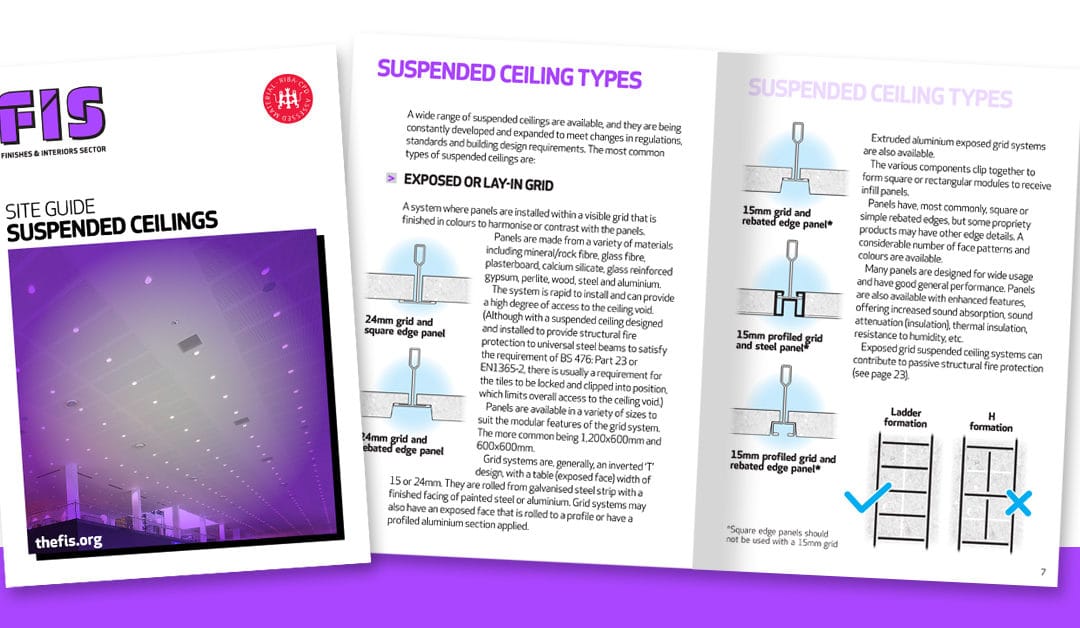
by Clair Mooney | 10 Feb, 2021 | Membership
FIS has launched a revised and updated Site Guide for Suspended Ceilings to help a project team fully understand the requirements of the suspended ceiling contractor.
The Site Guide for Suspended Ceilings was produced by the FIS Ceilings and Absorbers working group which comprises representation from manufacturers, suppliers and contractors involved in the design, supply and construction of ceiling systems. The site guide is intended to help main contractors, designers and project managers to understand the terminology, descriptors and different ceiling systems used, and the process of delivery, handling and planning the installation. It also provides an understanding of the site conditions, the plant and access equipment needed as well as highlighting the key health and safety points and requirements from the Construction (Design and Management) Regulations 2015 (CDM).
“In publishing this guide, FIS’s aim is to help the project team achieve a completed building that looks and functions to its full design potential. It is not intended as a definitive technical manual, but rather a framework that will support main contractors, site managers/supervisors, designers, engineers and others involved through the building process.”
Iain McIlwee, FIS Chief Executive
The early appointment of a specialist suspended ceiling contractor who has the necessary experience and resources to achieve satisfactory completion is of major importance whilst contractor membership of FIS will be a significant indicator of a contractor’s suitability.
The guide sits alongside other FIS best practice guides that relate to ceilings:
Installation of suspended ceilings
Selection and installation of top fixings for suspended ceilings
Maintenance and access into suspended ceilings
Recommendations for the Safe Ingress of Plasterboard
Health and safety handbook
In addition, the new specifiers guide to suspended ceilings will be available in Spring 2021.
These guides work well when they are included in proposals and project plans to demonstrate how to best approach a project. They are also good indicators if a contractor puts the guide forward as part of a submission of a contractor’s ability to deliver the ceiling installation to the required standard and are an excellent introduction to new members of the team and any trainees and apprentices.
You can download the Site Guide for Suspended Ceilings here.

by Clair Mooney | 10 Feb, 2021 | Skills
Qualifications in Wales have announced alternative assessment arrangements for Essential Skills Wales qualifications. Centres will be able to provide a Centre Determined Grade for learners who are unable to access the adapted methods of assessments due to the impact of COVID-19. The arrangements will allow greater flexibility for centres to support as many learners as possible to complete their qualifications by allowing a wider range of evidence to be used to demonstrate the learner has the relevant skills. The alternative assessment arrangements will apply to all Essential Skills Wales qualification: Application of Number, Communication, Digital Literacy and Employability, including Entry Level, and will be available to learners due to complete their qualifications before 31 August 2021.
What this means
- Where learners are able to complete the adapted assessments, they can continue to do so. The adaptations to the assessments remain in place and remote assessment and invigilation options are being made available.
- If learners are unable to complete their assessments, the centre may consider delaying the assessment until later in the course if this is unlikely to cause a negative impact for the learner.
- If learners are likely to be negatively impacted by a delay and there is a risk to their successful completion of the qualification and future progression, then the centre can move to a Centre Determined Grade approach.
- Centres will need to inform their awarding body if they intend to use Centre Determined Grades.
- The Centre Determined Grade must be supported by good evidence that shows that the learner has demonstrated they have the necessary essential skills at the relevant qualification level.
- Awarding bodies will provide further guidance on the types of evidence that can be used and on the quality assurance arrangements in early March.
Qualifications in Wales understand that many learners are waiting to complete their Essential Skills Wales qualifications so that they can progress to employment or further study. This approach allows flexibility in how learners complete their Essential Skills Wales qualifications while disruption to teaching and assessment continues and allows centres to make decisions that are in the best interests of their learners.

by Clair Mooney | 10 Feb, 2021 | Skills
Apprentices can support your plans for the future.
To help support employers who hire an apprentice, additional incentive payments for taking on an apprentice have been extended to 31 March 2021. This includes hiring redundant apprentices.
George Swann, FIS Skills and Training Lead said: “This is great news for all finishes and interiors organisations with the capacity to take on an apprentice, but have been restricted by the current lockdown. If you have not given any thought to employing an apprentice and feel you have capacity it is well worth considering as these incentive payments enhance the benefits of adding an apprentice or two to your workforce”.
Some of the benefits of hiring a redundant apprentice include:
- a quick return on investment as you’ll have a work-ready apprentice who already has relevant skills and experience
- finding the right skills you need to boost your organisation
- supporting an enthusiastic apprentice who has lost their job with a new opportunity
FIS produced guidance explaining the apprentice incentives and how they are accessed. Full details here.
There is also a document ‘Apprentices – Guidance for Employers’ https://www.thefis.org/skills-hub/apprenticeships/ which has information to help you recruit an apprentice and access all the funding your organisation may be eligible for.
Following this announcement the ESFA Apprenticeship Agreement for Employers has been updated.
The latest version of the agreement will be available for employers to accept through their apprenticeship service account from 1 Feb 2021. Employers will need to accept the latest agreement if they wish to apply for incentive payments for apprentices who start their apprenticeship between 1 Feb 2021 and 31 March 2021, where they are eligible to do so.
