
by Clair Mooney | 10 Mar, 2022 | Skills
The largest and longest-running construction skills competition in the UK returns, as registration opens for SkillBuild 2022. SkillBuild is delivered by CITB and forms a part of WorldSkills UK, often dubbed the ‘skills Olympics.’ As preparations for another year get underway, WorldSkills UK are on the look-out for talented construction trainees to go head-to-head in a bid to be crowned the winner of their chosen trade.
The regional qualifiers run UK-wide, from April to June each year. During the one-day event, competitors will be tested not only on their technical abilities, but on their time management, problem solving and skills working under pressure. Across WorldSkills as a whole, there are more than 60 competitions available. Included in this are nine Foundation Skills competitions aimed at learners with special educational needs and disabilities, additional learning needs, or who need additional support for learning. Those who excel in the qualifiers will be invited to take part in the national finals, in November 2022.
Specifically for the finishes and interiors sector are competition categories for Plastering and Plastering and Drywall Systems, Joinery, Carpentry and Furniture and Cabinet Making. For more information and details of how to enter go to: https://www.worldskillsuk.org/competitions-category/construction-infrastructure/

by Clair Mooney | 9 Mar, 2022 | Main News Feed
All timber originating from Russia and Belarus is ‘conflict timber’ and therefore cannot be used in PEFC-certified products, the Board of PEFC International clarified today.
PEFC is extremely concerned about the Russian government’s attack on Ukraine. The military invasion is in direct opposition to our core values. This aggression causes unspeakable and unacceptable pain and death to innocent people, including women and children. It also has an immediate and long-term destructive impact on the environment, on forests, and on the many people that depend on forests for their livelihoods.
The clarification that timber from Russia and Belarus is conflict timber follows an extraordinary meeting by the PEFC International Board to discuss Mr Putin’s military aggression against Ukraine and its implications for PEFC and PEFC-certified forest owners and companies.
The categorisation of timber from Russia and Belarus as conflict timber follows the adoption of the Resolution on Aggression against Ukraine by the United Nations General Assembly, which “deplores in the strongest terms the aggression by the Russian Federation against Ukraine […] [and] the involvement of Belarus”.
The PEFC International Board continues to monitor the situation and will consider additional measures as necessary.
PEFC has created a set of FAQs which is available at https://pefc.org/conflict-timber-faq
The clarification that timber from Russia and Belarus is to be categorised as ‘conflict timber’ is based on the UN General Assembly Resolution A/ES-11/L.1 (2 March 2022) “Aggression against Ukraine” during the 11th Emergency Special Session, to safeguard the integrity of PEFC chain of custody certification. This clarification is initially valid for six months.
by Clair Mooney | 9 Mar, 2022 | Building Safety Act, Technical
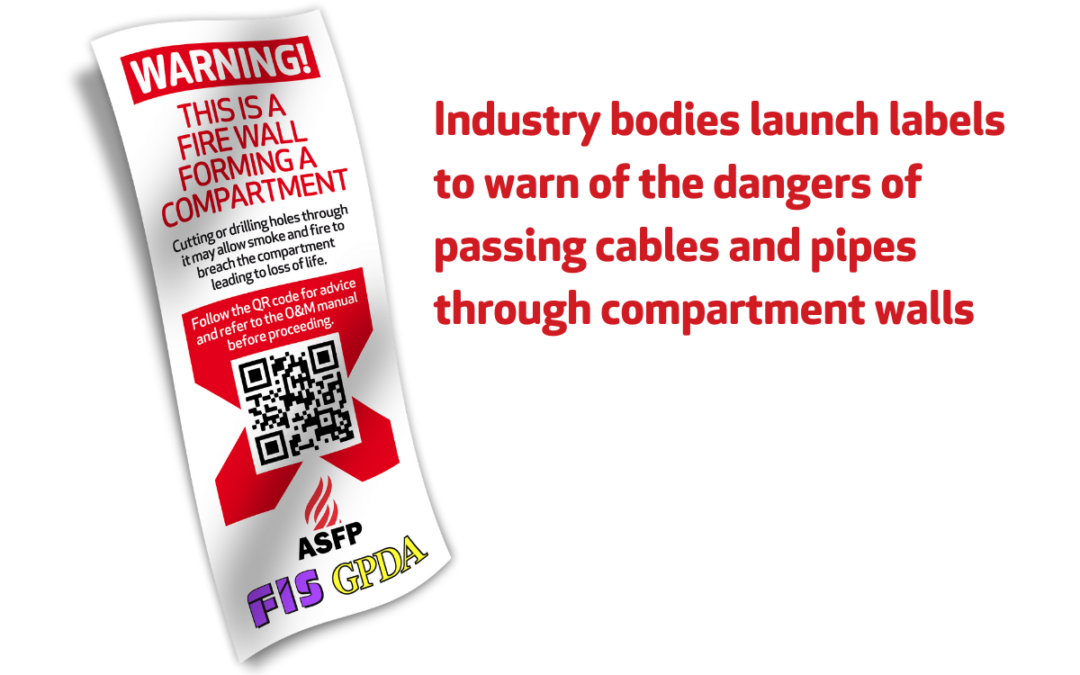
The leading trade bodies representing fire protection, the fit-out and interiors sector and plasterboard manufacturers have come together to warn of the dangers in passing cables and pipes through firewalls used for compartments in buildings.
FIS joined forces with the Association for Specialist Fire Protection (ASFP) and the Gypsum Products Development Association (GPDA) to launch a labelling initiative to provide instant guidance on what to do when considering whether and how to pass cables and pipes through compartment walls.
One of the biggest issues facing M&E contractors who are employed to pass services through a building, is that they may not be aware that the partitions they need to pass through are fire rated, and any holes cut into them will negate the performance of the partition. This may allow smoke fumes and fire to pass through from one compartment to another, which could lead to loss of life, extensive damage to the building and have huge impacts on any business.
Often the route for these services is at high level through the void above ceilings, so the new labels will be placed on the firewall in the ceiling void by the contractors so that any facility manager, M&E or cabling contractor will be instantly aware of the performance of the compartment wall and importantly, where to find guidance in future.
The labels can be printed from a downloable pdf available at www.thefis.org/knowledge-hub/technical/fire-protection/firestopping/fire-labelling/
ASFP, FIS and GPDA all believe that this simple initiative is not only good practice but has the potential to save lives and property.
by Clair Mooney | 7 Mar, 2022 | Health and Safety
Managing sickness absence within a business has always posed a large obstacle for employers. FIS Associate Member Citation has received a surge in sickness absence concerns from employers over the last few weeks, ranging from employees testing positive with COVID-19 and employees being reluctant to return to work due to health concerns surrounding the pandemic, to more typical start-of-the-year sickness absence issues.
With more and more employees experiencing long COVID-19 symptoms, employers are losing increasing amounts due to work long-term sickness and, without the appropriate policies and procedures, this could be a huge loss for employers.
To help FIS members, FIS Associate Member Citation has created two guides on how to manage both long and short-term sickness absences.
Managing long-term sickness absence
From creating a policy and return-to-work processes, to avoiding a discrimination claim, this includes important advice from our experts on how to best manage long-term sickness absence, in a world which is consistently evolving due to COVID-19. Guidance available at https://tinyurl.com/fislongtermsickness2022
Managing short-term sickness absence
The government reports that two-thirds of small businesses (62%) do not have formal sickness absence policies in place. In order to manage this in the best possible way it is important that you, as the employer, consider implementing a fair and clear process to help identify repeat offenders, deter other employees from not turning up to work, and ultimately retain as many employees as possible in the workplace. This guidance covers what processes you should put in place, managing recurring absences and more. Guidance available at https://tinyurl.com/fissickness2022

by Clair Mooney | 3 Mar, 2022 | Main News Feed
The National Cyber Security Centre (NCSC), the UK’s technical authority on cyber security, have issued
guidance for organisations on the steps they need to take to bolster the UK’s resilience against the heightened risk of malicious cyber incidents in and around Ukraine. We know many organisations and businesses in the UK have well laid out plans and good cyber security measures in place. However, due to the nature of online global networks, attacks that occur overseas could have an impact on UK institutions, services and systems. This is why organisations and businesses are being urged to take action now.
While the NCSC is not aware of any current specific threats to UK organisations in relation to events in and around Ukraine, the guidance encourages organisations to follow actionable steps that reduce the risk of being impacted by cyber attacks, including:
- patching systems;
- improving access controls and enabling multi-factor authentication;
- implementing an effective incident response plan;
- checking that backups and restore mechanisms are working;
- ensuring that online defences are working as expected, and;
- keeping up to date with the latest threat and mitigation information.
For further information visit: https://www.ncsc.gov.uk/guidance/actions-to-take-when-the-cyber-threat-is-heightened where you will find the relevant advice, actions and resources.
by Clair Mooney | 3 Mar, 2022 | Main News Feed
Following the lifting of the remaining coronavirus restrictions in England, Build UK has updated its COVID‐19 flowchart to reflect the latest Government guidance. Individuals who test positive are now advised to stay at home, rather than it being a legal requirement, and they are no longer required to tell their employer if they need to self‐isolate.
Following the end of routine contact tracing, the Test and Trace Support Payment scheme has ended. Individuals who were required to self‐isolate before 24 February can still submit an application for payment up to 42 days after their first day of self‐isolation until 6 April.
The Coronavirus Statutory Sick Pay Rebate Scheme will close on 17 March, and employers with fewer than 250 employees can submit claims for up to two weeks of coronavirus‐related SSP until 24 March.
Face coverings are no longer mandatory on the London transport network but customers are still strongly recommended to wear them.

by Clair Mooney | 1 Mar, 2022 | Drylining, Technical
FIS has today launched its Specifiers’ Guide to Drylining to help specification writers fully understand the criteria when writing a specification for drylining, including partitions, wall linings and shaft wall systems.
The Specifiers’ Guide – Drylining was produced by the FIS Drylining Working Group which comprises representation from manufacturers, designers and contractors working in the drylining sector. Pulling together decades of experience, this guide is the third in the series of guides and is designed to help specifiers and designers understand the questions that should be addressed before the specification can be produced and then how the specification should be structured, and which standards referenced.
Commenting on the guide, Iain McIlwee, Chief Executive of FIS said:
“Specifying drylining seems, on the face of it, simple enough: consider the look, performance and cost, and there it is. If only it were that simple there would not be cases where evidence of fire compartmentation could fail or fail to perform because the issue wasn’t apparent during the specification process.”
The guide includes top tips when specifying drylining, as well as reference material to regulations for safety, fire performance and standards.
“A well written specification not only ensures the installation meets the client’s requirements, but it also means the specifier’s requirements are less open to interpretation, which is key for the whole supply chain if they are going to deliver the quality and detail first time, on time,” added Iain McIlwee.
The guide sits alongside other FIS best practice guides that relate to drylining:
Installation of Drylining
Site Guide:Drylining
These guides work well when they are included in proposals and project plans to demonstrate how to best approach a project. They are also good differentiators when someone is in competition with non-members, and are an excellent introduction to new members of the team and any trainees and apprentices.
FIS plans to have CPD material to accompany the guide later in the year.

by Clair Mooney | 25 Feb, 2022 | Skills
FIS is excited to announce the return of Regional Workshops, with the first event since before the pandemic scheduled for Central London on the 22nd March. This will be followed by a series of events in Bristol, Leicester, Dartford, Manchester and Glasgow running through to May.
With labour shortages and recruitment a key challenge within the sector, the core theme for these events is a collective response to labour shortages and attracting the next generation of workers. Time will be allowed for open discussion and networking.
The core aim is to look individually and collectively at how we can better target recruitment through schools, colleges and local networks, develop local training networks and access all available funding to build a sustainable workforce. Focus will be on understanding local need and opportunities, developing a network of ambassadors and looking particularly at apprenticeships, but also the wider vocational qualification landscape and competency in the existing workforce.
The FIS team will be supported by representatives of CITB and local speakers aiming to give members fresh ideas, a clear plan of action and understanding of the support available to attack their skills gap. This will include ideas and resources to support approaches to local schools, how to work more effectively with the Department of Work and Pensions, case studies and a list of initiatives and funding that can support your recruitment efforts and induction and development of workers. Details of the support available from CITB for recruiting and qualifying people will also be given and there will be plenty of time for questions.
Six events have been scheduled to be held across the UK. These are breakfast events 07:30 until 09:45 so employers can attend, get a bit of breakfast discuss recruitment and qualification needs and identify how FIS can help prior to starting the working day.
Locations
London – 22 March
Leicester – 30 March
Bristol – 5 April
Dartford – 26 April
Manchester – 10 May
Glasgow – 11 May
Please look out for your individual email invitation from FIS or reserve your place via the FIS Events page. If you would like more information contact Skills and Training Lead George Swann on 07553 874838 or email georgeswann@thefis.org
by Clair Mooney | 25 Feb, 2022 | Main News Feed
The Prime Minister has announced the Government’s Living with COVID‐19 plan, which will see the remaining coronavirus restrictions in England lifted from 24 February 2022. Emphasising the need to ‘begin to treat COVID‐19 as other infectious diseases such as flu’, the Government has confirmed the restrictions will be withdrawn as follows although the updated guidance has not yet been published:
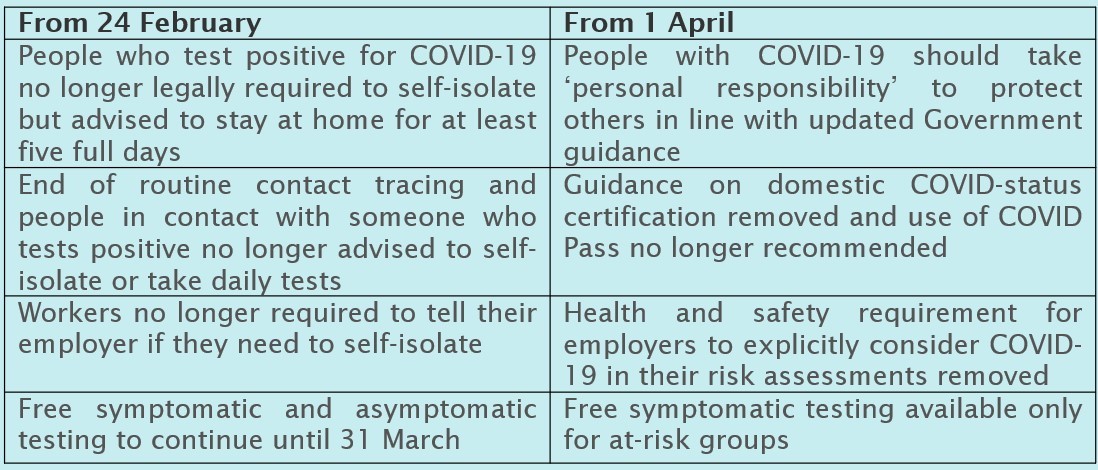
Different restrictions remain in place in Scotland, Wales and Northern Ireland.