0121 707 0077

Construction activity buoyant, but strong headwinds coming, warns Construction Products Association

Construction activity buoyant, but strong headwinds coming, warns Construction Products Association

In its latest quarterly forecast, the Construction Products Association (CPA) sees a dramatic slowing in growth, with uncertainty ahead as global issues start to affect the UK market.

In previous years, the predicted 2.8% growth in construction output anticipated by the CPA team would be cause for celebration. However, while a robust figure, this is a sharp revision down from the 4.3% growth forecast just three months ago.

Demand remains strong across the industry in Q2, and the current project pipeline suggests that this will support activity levels until at least 2022 Q3. The downward revision to the growth forecast stems from concern around a host of price pressures arising from both local and global issues.

Prior to the conflict in Ukraine, UK construction was already facing labour and product availability issues and the impact of reverse charge VAT and IR35. Rising energy costs were driving near-record price increases in construction products and the continued conflict is exacerbating this issue.

The impact of these pressures, and of more general rising costs, on demand will vary considerably by sector. Across the board the picture is one of positive market conditions in the short term with anticipation of tougher times ahead.

In private housing repair, maintenance and improvement, the stellar performer post the initial Covid-19 lockdowns, SMEs report that demand remains high, but this is the sector arguably most exposed to current price inflation, falls in consumer confidence and pressures on household incomes. Overall, output is expected to fall by 3% in 2022 and 4% next year from current all-time highs.

Private housing, the largest construction sector, remains strong, with housebuilders reporting resilient demand. Longer term, there must be questions over consumer confidence but output in this sector is forecast to rise by 1% in both 2022 and 2023. This contrasts with the 3% per year growth forecast three months ago.

The fastest growth is expected in the industrial sector, in which output is forecast to rise by 9.8% in 2022 and 9.3% in 2023, due to a strong pipeline of warehouse projects, resulting from a long-term shift towards online shopping.

Infrastructure, traditionally less affected by immediate economic conditions, remains positive. Large projects such as HS2, Thames Tideway and Hinkley Point C combined with the five-year spending plans in Page 2 of 3 regulated sectors such as rail, road and power generation point to a forecasted growth of 8.8% in 2022 and 4.6% in 2023.

On the supply side, the main immediate impact of the war in Ukraine for construction products will be the knock-on from rising energy prices and commodity shortages. Soaring energy costs will have to be passed on and lead to sharp rises in the cost of energy-intensive products. This will affect both imported products such as aluminium and steel and locally sourced products such as bricks and cement.

Contractors are likely to feel the pressure first, particularly those working to fixed-price contracts. For future projects, contractors will be forced to re-price, add fluctuation costs and introduce risk-sharing arrangements to deal with the uncertainty over potential cost inflation.

Noble Francis, CPA Economics Director, offered this summary of the latest figures:

“The major challenge is creeping uncertainty. The immediate picture is one of resilient demand and healthy pipelines. Longer term, the current inflationary pressures, if sustained, will have an increasingly depressing impact, while the continuation, or potential escalation, of conflict in Europe presents an existential risk.

“Specialist sub-contractors are feeling the effects first, particularly those working to fixed-price contracts. For future projects, contractors will be forced to re-price, add fluctuation clauses and introduce risk[1]sharing arrangement to deal with the uncertainty over potential cost inflation.”

Access the full report

FIS members have free access to the CPA Forecast and can download their copy via the button below.

Not a member? Contact FIS on 0121 707 0077 for details on joining.

See more news likes this

OPSS survey on Bespoke construction products

OPSS survey on Bespoke construction products

The Office for Product Safety & Standards (OPSS) has commissioned the Centre for Strategy & Evaluation Services (CSES) to conduct a study to develop its evidence base on "bespoke" construction products. This research will review current practices regarding the...

National Construction College Interior Systems Installer Provision

National Construction College Interior Systems Installer Provision

FIS is working with the National Construction College (NCC) Bircham Newton to deliver the Interior Systems Installer Apprenticeship – Ceilings pathway. Interior System Installer (Ceilings and Partitions) Apprenticeship The Interior Systems Apprenticeship (Ceilings and...


CICV tells construction clients that rise in project costs reflects ongoing global turmoil

CICV tells construction clients that rise in project costs reflects ongoing global turmoil

The Construction Industry Collective Voice (CICV) has reassured clients that ongoing price rises for projects are caused by global events not “profiteering” – and says any increases only reflect the spiralling costs that are affecting the whole construction industry.

Clients have voiced concerns at the increasing costs of construction work, but the body insists this is due only to ongoing global events sparking a rise in fuel costs and shortages of raw materials and labour.

Iain McIlwee, FIS Chief Executive said:

“The war in Ukraine, energy price hikes, impact of Brexit and fallout from COVID-19 have all created a ‘perfect storm’ just as there is a surge in demand, with price increases being imposed on the industry as a result.

Construction professionals are increasingly being forced to shoulder these ongoing rises, particularly when it comes materials, and are having no option but to pass these increases on to clients. But it is not profiteering – it is a necessity for these businesses to survive.”

The CICV’s Post-Brexit & Trade sub-group this week discussed the higher costs for raw materials, energy, labour and transport being faced by construction businesses of all sizes in Scotland, with particular focus on inflationary pressures for SMEs caused by external factors.

Iain added:

“This is a really challenging time for all in the construction supply chain with costs rising, often at short notice.  The critical thing now is that we work together as a supply chain.

Too often in construction we have contracted down all risks, but we are now in a position where fixed prices could undermine the resilience of contractors or suppliers and we need to adopt a more collaborative approach and consider how fluctuations clauses can be deployed and any risks fairly shared so as not to undermine the quality or viability of a project or businesses.”

The CICV says as well as the negative impact of political, military and health issues, the withdrawal of red diesel in April has also led to higher costs for construction firms.

Chris Cassley, Policy Manager at CICV member the Construction Plant-hire Association (CPA), said:

“The UK Government’s environmental strategy with the removal of red diesel for construction plant has undoubtedly contributed to the current financial impact on industry, and despite representations to government departments, has proceeded regardless.

“The rise in energy and material prices, together with supply chain pressures and higher inflationary figures, has led to a tipping-balance for suppliers and customers alike, and in many instances resulted in necessary price increases. These increases are very likely to be passed back up to the client and for government projects, it will be the taxpayer who will ultimately have to pay.”

Another warning came from Andrew Richards, Strategic Director of Safedem and a member of the Construction Scotland Industry Leadership Group, (representing SMEs and the supply chain) which is working in tandem with CICV to support the industry. Mr Richards said:

“The knock-on effects caused by the global events of the past two years looks like they will continue for the immediate future, so clients should consider fluctuations and rises in construction costs as part of ‘the new normal’ and shouldn’t expect prices to fall any time soon.

“Construction professionals are equally concerned about the uncertainty that surrounds the marketplace and are only passing on cost increases through necessity, not greed.”

The Post-Brexit & Trade panel is one of 12 sub-groups run by the CICV, covering a range of issues ranging from health and safety and skills to the supply chain and project bank accounts.

The collective was rebranded from the Construction Industry Coronavirus (CICV) Forum at the start of 2022 to reflect its widened remit, which now covers all areas of construction.

Since its creation in March 2020, the CICV has drawn on the collective expertise of its members to maintain a steady supply of information and practical advice to the sector as well as carrying out surveys, hosting webinars and making appeals to government ministers.

Skills Bill clears way for the Institute for Apprenticeships and Technical Education to unify system

Skills Bill clears way for the Institute for Apprenticeships and Technical Education to unify system

Somewhat in the shadow of the Building Safety Bill, new laws were also passed on Thursday through the Skills and Post-16 Education Act that will help transform the skills and training landscape and level up opportunities across the country.

The Skills and Post-16 Education Act is to level up and drive economic growth across England, making Green skills and careers advice in schools a priority.  The Institute for Apprenticeships and Technical Education (IfATE) have been tasked to create a unified skills system which is simpler to understand and employers and learners can really trust.

While much attention has been paid to level 3 qualifications and careers advice, the act gives the secretary of state a host of new powers over the FE and skills sector.  For example, the secretary of state now has legal powers to designate and remove designation of employer representative bodies (ERBs) responsible for developing local skills improvement plans (LSIPs).  They also have powers to introduce “statutory guidance” to tell ERBs who they should consult with and what should go in to their LSIPs.

The lifelong loan entitlement now also has some statutory underpinning.  The flagship policy to provide loans with four years of post-18 education for modular and full qualifications at levels 4 to 6 is set to come on stream in 2025 and is currently out for public consultation.

Another of the secretary of state’s new powers is to introduce an official list of approved post-16 training providers along with new conditions for registration and restricting access to funding to providers on that list.

The act introduces new duties on college governing bodies to review and publish how their education and training offer is meeting local skills needs.  The secretary of state gains new powers to use the intervention system where providers are failing in this duty.

The Institute for IfATE gets powers to approve and withdraw approval for technical qualifications under the act.

Skills to support the growing green economy will be prioritised to create a workforce for jobs now and in the future, and schools will be required to make sure all children get to meet people that provide technical education routes such as apprenticeships, T Levels or Traineeships, opening their eyes to a wide range of careers.

The legislation will help economic recovery and growth by making it easier for people to train to get the skills they need to secure well-paid jobs in industries with skills gaps, such as construction, health and social care, engineering, digital, clean energy and manufacturing.  It will also give more people the opportunity to get jobs in their local areas, by requiring employers and colleges to work together to identify the skills needed within communities.

The Act underpins the government’s transformation of post-16 education and skills as set out in the Skills for Jobs White Paper and will help level up and drive growth across the whole country.  Minister for Skills Alex Burghart said, “The Skills and Post-16 Education Act will transform the skills, training and post-16 education landscape and level up opportunities across the country.  This legislation will make sure everyone can gain the skills they need to progress into a rewarding job, and businesses have access to a pipeline of talented, qualified employees for their workforces, boosting productivity.”

Jennifer Coupland, chief executive of IfATE, which leads with implementing the government’s employer-led technical education reforms, said,

“Following passage of this landmark legislation, we can look forward to creating a unified skills system which is simpler to understand and employers and learners can really trust. IfATE has empowered employers to drive up the quality of apprenticeships and roll out exciting new T Levels. The time is now right to extend the employer-led reforms across technical education.”

Key measures introduced by the Act include:

  • supporting the creation of a unified skills system that builds from quality gains achieved with Apprenticeships and T Levels by ensuring all technical qualifications match up to employers’ high standards;
  • embedding employers in the heart of the skills system by placing a legal requirement on colleges and other providers to work with employers to develop skills plans, so that the training on offer meets the needs of local areas, and people no longer have to leave their hometowns to find great jobs;
  • making sure all pupils meet providers of technical education so that they understand the wide range of career routes and training available to them, such as Apprenticeships, T Levels or Traineeships, not just the traditional academic options;
  • prioritising green skills so the training on offer across the country meets the needs of the growing green economy and helps gets more people into jobs;
  • supporting the transformation of the current student loans system so from 2025 learners an access a flexible loan for higher-level education and training at university or college, useable at any point in their lives;
  • introducing new powers to intervene when colleges are failing to deliver good outcomes for the communities they serve; and
  • making it a criminal offence to provide, arrange or advertise essay mill services for financial gain to students taking a post-16 qualification at institutions in England including colleges, universities and sixth forms.

Employers in eight trailblazer areas across the country have already been working with local training providers to create skills plans that align to what local communities need.  These plans are now being rolled out across the country, opening up more opportunities for people to gain the skills they and businesses need to succeed.  The new measures build on the work already under way to boost skills and get more people into better jobs, including working with employers to create more Apprenticeship opportunities, establishing a network of Institutes of Technology and rolling out new T Levels.

George Swann FIS Skills and Training Lead said,

“FIS is listed on the directory od professional and employer lead bodies with IfATE to monitor the quality of apprenticeship End Point Assessment for the sector.  This puts FIS employers front of house for the initiatives published through the Royal Assent of the Skills and Post-16 Education Act.  We will continue to work with IfATE and provide information advice and guidance to FIS members on all things skills”

FIS launch Specifiers Guide to Partitioning

FIS launch Specifiers Guide to Partitioning

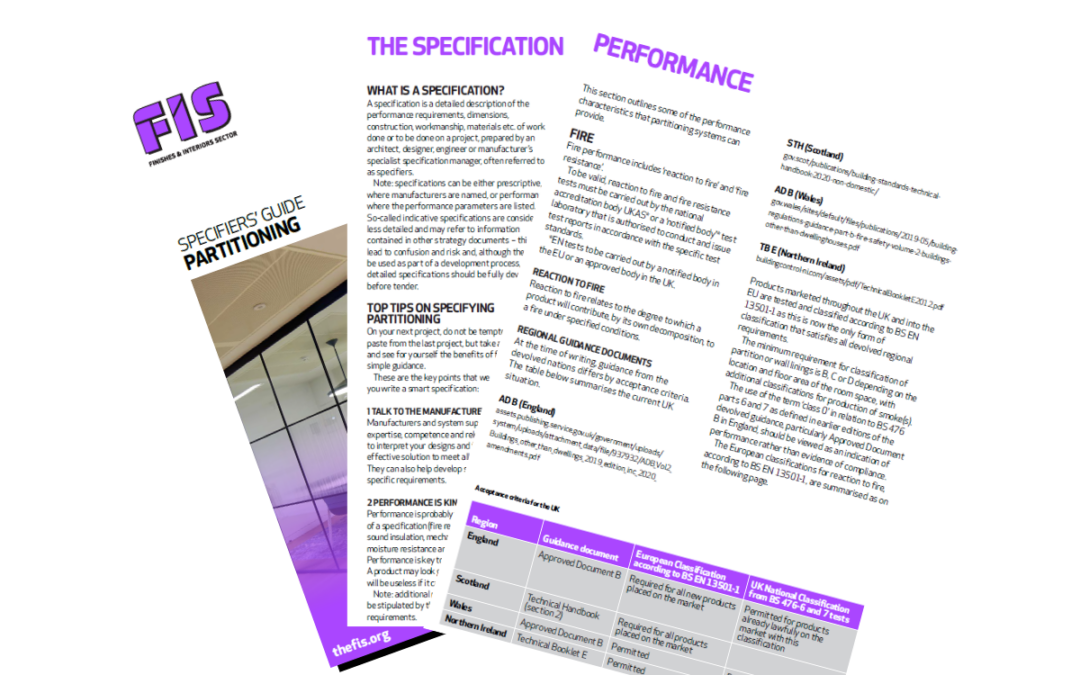
FIS has launched a Specifiers’ Guide to Partitioning to help specification writers fully understand the criteria when writing a specification for partitioning, including moveable walls and pods.

The Specifiers’ Guide to Partitioning was produced by the FIS Partitioning and Pods Working Group which comprises representation from manufacturers, designers and contractors working in the sector. Pulling together decades of experience, this guide is the fourth in the series of guides and is designed to help specifiers and designers understand the questions that should be addressed before the specification can be produced and then how the specification should be structured, and which standards referenced.

Commenting on the guide, Iain McIlwee, Chief Executive of FIS said:

“Specifying partitioning seems, on the face of it, simple enough: consider the look, performance and cost, and there it is. If only it were that simple there would not be cases where inappropriate glass was used in guarding or the partition wasn’t performing acoustically because the flanking paths hadn’t been addressed”.

The guide explains the vast range of product options and how careful specification can help with relocatability in the building as well as enjoying enhanced tax benefits as well as reference material to regulations for safety, fire performance and standards.

“A well written specification not only ensures the installation meets the client’s requirements, but it also means the specifier’s requirements are less open to interpretation, which is key for the whole supply chain if they are going to deliver the quality and detail first time, on time,” added Iain McIlwee.

The guide sits alongside other FIS best practice guides that relate to partitioning:

FIS Acoustic Verification Scheme – FIS (thefis.org)

Best practice guide for installing Partitioning

Servicing operable walls

These guides work well when they are included in proposals and project plans to demonstrate how to best approach a project. They are also good differentiators when someone is in competition with non-members, and are an excellent introduction to new members of the team and any trainees and apprentices.

FIS plans to have CPD material to accompany the guide later in the year.

You can download the Specifiers’ Guide to Partitioning at www.thefis.org/membership-hub/publications/specifiers-guides/partitioning/

For further information or for any questions please contact the FIS at info@thefis.org or call 0121 707 0077.

Building Safety Bill has now become law

Building Safety Bill has now become law

The Bill received Royal Assent on 28 April 2022. FIS will continue looking at how the Bill will impact our community and will keep members up-to-date with developments.

This is without doubt the biggest shake-up of Building Regulations since they were introduced in 1666, placing new demands on competence in the workforce, product selection and documenting process (e.g. digital record keeping) on all in the supply chain.

FIS is committed to supporting our members with compliance and ensuring the Bill supports a better safety and a more collaborative approach to procurement.

This is a landmark day for construction and we have prepared an initial summary of the key implications that you can access below

Outlook remains positive despite inflationary headwinds

Outlook remains positive despite inflationary headwinds

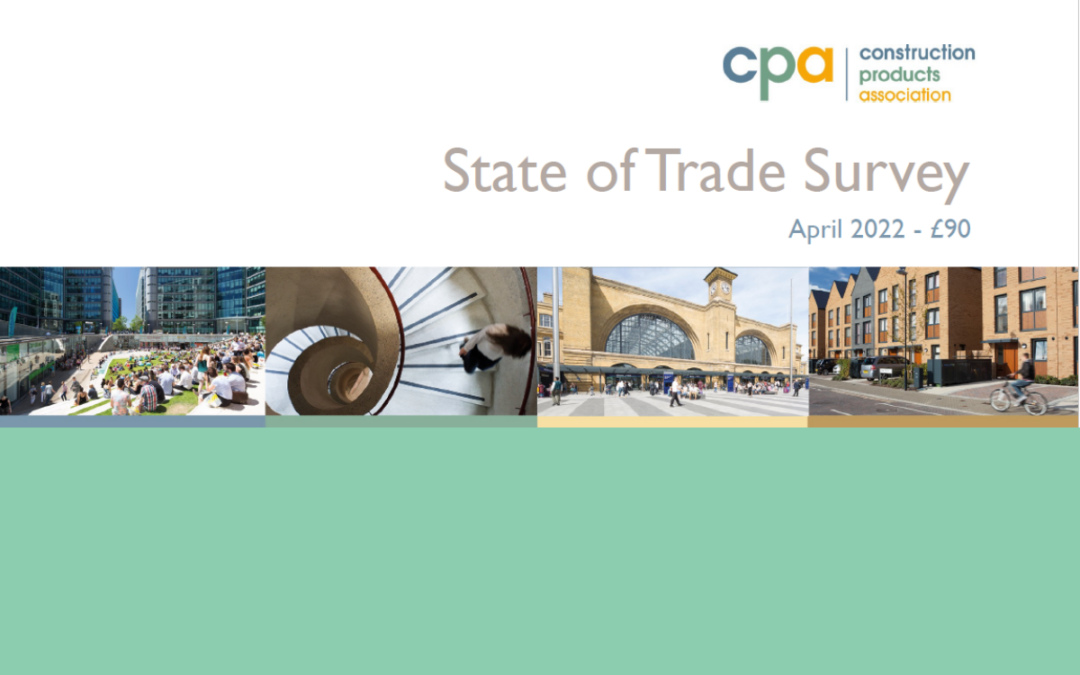
Construction product manufacturers reported a positive start to 2022, recording a seventh straight quarter of growth in sales in Q1, according to the Construction Products Association’s State of Trade Survey. Broad cost pressures remained across the sector but are yet to dent manufacturers’ expectations for growth in the year ahead.

Cost inflation persisted across the supply chain and three storms that brought heavy rainfall across the country between 16 to 21 February affected construction projects on site. 43% of heavy side firms and half of light side firms reported a quarterly rise in sales in Q1, up from balances of 31% and 22% respectively, in Q4. While demand levels in private housing and private housing RM&I have been sustained by the ‘race for space’ and major infrastructure projects continue to make progress, commercial has also gained from fit-out, refurbishments and changes in use activity. Despite economic headwinds, 80% of heavy side and 77% of light side firms anticipated a rise in sales over the next 12 months, the joint-highest balances in nearly eight and seven years respectively.

As global supply chain issues and inflationary pressures were further exacerbated by Russia’s invasion of Ukraine on 24 February, all firms cited annual rises in costs. Upward pressure came from a range of inputs, notably energy and raw materials with all firms reporting increases in the cost of both. With cost pressures set to continue in the next 12 months, investment intentions balances across most categories on the heavy side came in lower than Q4.

Download the full report

FIS members have access to content direct from the CPA through their FIS membership.

Application deadline for £3,000 apprentice incentive payment extended

Application deadline for £3,000 apprentice incentive payment extended

The deadline for applying for the incentive payment has been extended until 20 May 2022.

Employers who hired a new apprentice between 01 October 2021 and 31 January 2022  who had an apprenticeship start date between 01 October 2021 and 31 March 2022, could be eligible for the £3,000 incentive payment for hiring a new apprentice. To receive the payment, employers must submit an application for each eligible apprentice using their apprenticeship service account.

For more support with employer applications please see:

  • how to apply guide including when to apply, steps to take before applying, how to apply and what happens after applying.
  • guidance page including eligibility, how the payment can be used and when payments are made.
  • how to apply video including a walkthrough of the steps to take within the Apprenticeship service: https://youtu.be/HQJjjAzXO7k

When applying for the incentive payment for hiring a new apprentice, employers must make sure they have:

  • added the correct PAYE schemes, that they use to pay their apprentices, to their apprenticeship service account, in line with the service terms and conditions
  • only applied for eligible apprentices and they have documentation which can validate their claim, as listed in the apprenticeship funding rules
  • checked their training provider has the correct National Insurance Number for each of their apprentices, and that they have included this in their funding submissions

If the information is incorrect, this will delay incentive payments.

If you need any further information please call FIS on 0121 707 0077 or email info@thefis.org

CE marked products required to be UKCA if placed on the market from 1 January 2023

CE marked products required to be UKCA if placed on the market from 1 January 2023

FIS issued a reminder this week that new product marking requirements are still set to be introduced from 1st January 2023.  From this date it will no longer be legal, except in Northern Ireland, to place CE marked products onto the UK market.  Products previously covered by a Harmonized Standard (e.g. ceiling systems) will be required to be UKCA marked if they are placed on the market from 1 January 2023. 

Beyond this period UK compliant Declarations of Performance will be required to refer to Designated Standards and may need to be retested by a UK Approved Body. 

Distributors and manufacturers of products and contractors purchasing products are reminded to check that their supply chain have this in hand as soon as possible to ensure that there are no interruptions to supply in the New Year.  Remember that that this may impact components that are bought seperately and integrated within your products such as glass, electric motors or hardware.

FIS is aware that there are major bottlenecks at UK test houses and there are concerns that essential testing may not be completed before the deadline.  

If for any reason you or your suppliers experience problems, please let us know as soon as possible.  FIS is feeding concerns into Government directly and via the CPA and continuing to press for an extension to this deadline, so that we can let Government know that this may result in delays to projects.

More information on the UKCA Marking is available here

To visit the FIS Brexit Toolkit Click Here

CLC’s Construction Skills Plan for 2022 – more growth, new challenges

CLC’s Construction Skills Plan for 2022 – more growth, new challenges

The Construction Leadership Council has published an update to its sector-wide skills plan for construction and the built environment. This year CLC is focussing its efforts around four strategic priorities with a spotlight on creating the right culture change and broadening diversity.

1. Improving access to opportunities for all
2. Boosting all routes into industry
3. Ongoing collaboration to develop competence frameworks
4. Preparing for the future of construction

FIS Skills and Training Lead George Swann, said:

The Construction Leadership Councils updated Skills Plan is encouraging as it’s very clearly aligned to the current work of FIS. If you attended one of the regional events you will know the focus is on recruitment, retention, social responsibility, competence and funding.  We know the labour market is tight and the sectors employers are in competition with other construction sectors and other industries to recruit and retain a talented workforce, to succeed there must be a combined and consistent approach, the finishes and interiors sector employers must continue to work together.

To realise the strategy CLC are asking construction industry employers to:

  • Employ and support an individual to complete an Apprenticeship
  • Transfer your Apprenticeship Levy to another construction business
  • Embrace T-Levels and offer an industry placement
  • Offer a Traineeship work experience placement
  • Provide a Work Experience or Taster opportunity
  • Share your skills and teach in further education
  • Post vacancies on Talent View Construction
  • Support local Skills Bootcamps and Training Hubs
  • Adopt the Fairness, Inclusion and Respect (FIR) Programme
  • Become a Construction STEM Ambassador

George added:

Information, advice and guidance is available on all of these points from FIS, either online at www.thefis.org or if you would like to talk through options for recruitment, retention, social responsibility, competence and funding telephone 0121 707 0077 or email info@thefis.org

The updated skills plan will ensure the construction sector can achieve joint goals by setting out clear commitments for industry, government, and employers.

Industry can get behind the plan by supporting the initiatives, including Apprenticeships, T-Levels, Traineeships, Skills Bootcamps and Talent View Construction.

”Industry