
0121 707 0077

Update: Non-Combustible Cladding Requirements Extended and Amended

Update: Non-Combustible Cladding Requirements Extended and Amended

There have been further changes to fire safety requirements in the Building Regulations and the use of non-combustible materials in and on the external walls of new flats, hospitals, student, school accommodation and dormitory buildings (originally introduced in 2018).

The announced changes take into account responses to the consultation process in 2020 and extend the scope of the requirements for non-combustible materials to cover hotels, hostels and boarding houses.  Other updates to the regulations include the following recommendations:

  • include elements of solar shading devices within the scope of the ban
  • amend the list of materials exempt from the ban to include fibre optic cables and insulation materials 300mm from ground level
  • update the requirement of the ban to refer to the latest version of the British Standard classification for materials used on high-rise residential buildings
  • temporarily exempt cavity trays
  • amend the requirements for material change of use in buildings

The cavity tray exemption is significant in the SFS sector as the exemption previously applied to:

(a) cavity trays when used between two leaves of masonry;

Whilst this statement remains unamended in the Approved Documents the changes announced in June 2022 include the following recommendation:

Exemptions – The legislation will amend the list of materials exempted from the combustible materials ban to include fibre optic cables and insulation up to 300mm from ground level. We will also provide an 18-month temporary relaxation for cavity trays in all forms of construction.

To support this Government has issued a dispensation notice that allows use of cavity trays that do not achieve the strict performance requirements of the ban – this exemption therefore comes into effect from the 1st June 2022.  FIS continues to work with officials and colleagues at the Construction Products Association to try to understand the rationale behind the temporary relaxation and what this means longer term.

The announcement also carries a number of recommended changes including allowing for new statutory guidance to restrict the combustibility of materials used in and on the external walls of residential buildings, between 11-18m in height.  This will mean that lower risk developments between 11-18m “must meet necessary safety standards – while allowing designers and developers flexibility to use environmentally friendly materials.”  Further consultation is anticipated on this aspect in the coming months.

A complete ban is to be introduced on the use of metal composite material with un-modified polyethylene core in all buildings of any height.

Unless specified, changes to the Building Regulations will come into force on 1 December 2022 (in line with the full publication of the revised Approved Document B).

We will continue to keep you updated, but if you have any comments you would like to feed in at this stage to our ongoing discussions with officials at DCHLUC, please don’t hesitate to play them in via joecilia@thefis.org

Full details available here.

Note this move will (for the period of the exemption) align more closely with the Scottish Building Standards that were extended on the 1 June to cover Buildings 11-18m.  These also exempt Cavity Trays from the combustible material list:  Changing legislation in Scotland – FIS (thefis.org)

This announcement coincides with the publication of a booklet containing ammendments to Approved Document B that will come into force from the 1st December 2022.

Cavity Tray Exemption – Further Details

Extract from the consultation response related to the Temporary Exemption of Cavity Trays:

In our consultation we proposed several changes to the list of exemptions in Regulation 7(3) including the temporary exemption of cavity trays in all forms of construction and the extension of the exemption of waterproofing and insulation materials.

Cavity trays are an essential wall component, installed in wall cavities to capture moisture that penetrates the outer face of the wall, preventing damp. Cavity trays are currently exempt only when used between walls constructed of two leaves of masonry. This type of construction is not common in modern high-rise buildings and industry has adapted by using stainless steel to produce cavity trays. However, industry has highlighted that this incurs excessive cost and there are issues with supply, installation and durability. Stainless steel is considered less durable than a plastic cavity tray and does not effectively prevent damp. There is increased potential for health and safety issues to arise if these products fail to adequately prevent moisture ingress and damp in buildings.

We are aware of some compliant non-combustible product on the market, however some industry stakeholders have expressed concerns over the installation of this product that may result in poor performance and issues of damp in buildings. We are aware that some developers have been unable to get a new homes warranty, making the homes unsaleable, due to concerns over the performance of non-combustible cavity trays.

The consultation proposed a temporary 18-month relaxation of the ban as it relates to cavity trays pursuant to Section 11 of the Building Act 1984. This would enable this matter to be resolved temporarily while maintaining industry momentum to develop adequate non-combustible alternatives. 68% of consultation respondents agreed with the proposal.

In the interest of health and safety, we will issue a type relaxation to allow industry to use cavity trays that do not achieve the strict performance requirements of the ban. We do not believe it is appropriate to permanently exempt cavity trays as it would hinder innovation in development of additional compliant products. It remains the clear intention of this government to ensure that non-combustible cavity trays are used in the external walls of building where they are already readily available and after the temporary exemption lapses.

Growth continues but cost pressures mount

Growth continues but cost pressures mount

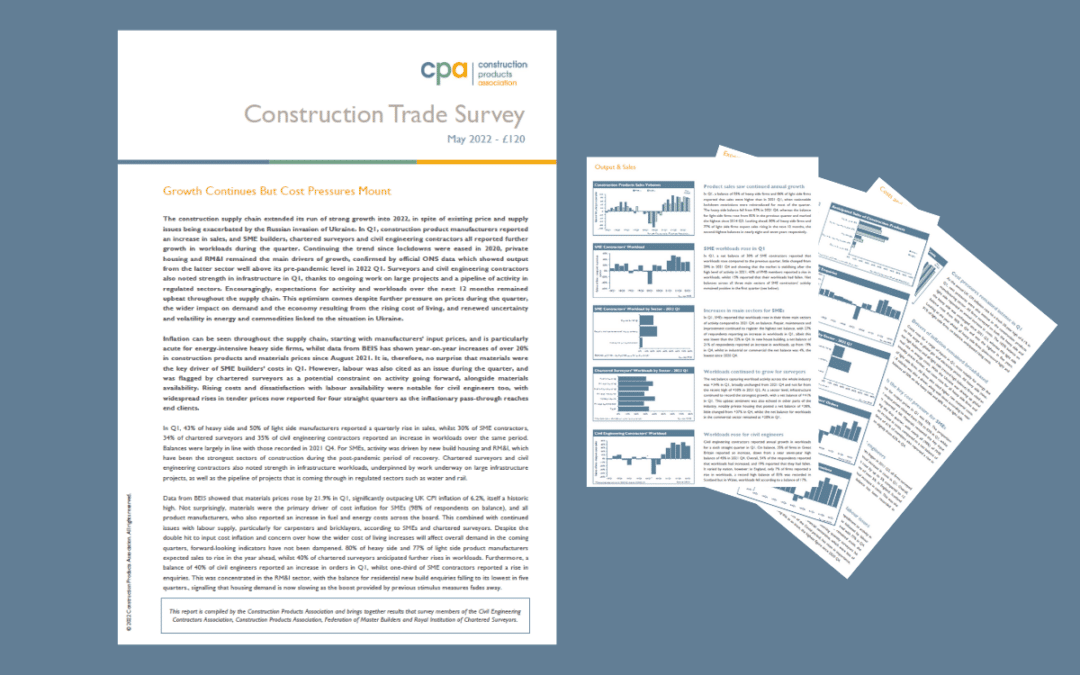
The construction supply chain extended its run of strong growth into 2022, in spite of existing price and supply issues being exacerbated by the Russian invasion of Ukraine. In Q1, construction product manufacturers reported an increase in sales, and SME builders, chartered surveyors and civil engineering contractors all reported further growth in workloads during the quarter. Continuing the trend since lockdowns were eased in 2020, private housing and RM&I remained the main drivers of growth, confirmed by official ONS data which showed output from the latter sector well above its pre-pandemic level in 2022 Q1.

Encouragingly, expectations for activity and workloads over the next 12 months remained upbeat throughout the supply chain. This optimism comes despite further pressure on prices during the quarter, the wider impact on demand and the economy resulting from the rising cost of living, and renewed uncertainty and volatility in energy and commodities linked to the situation in Ukraine

The CPA’s Construction Trade Survey brings together results from surveys of building contractors, specialist contractors, civil contractors and product manufacturers. It provides a pan-industry assessment of current and expected conditions.

FIS members can access the CPA Report here

Making our apprenticeship system simpler for employers, training providers and apprentices

Making our apprenticeship system simpler for employers, training providers and apprentices

A number of improvements and simplifications to apprenticeships will come into force from August 2022.

Over the past five years apprenticeships have been transformed into a high-quality skills programme for learners and employers.  Employers have created more than 640 standards to meet their skills needs, training is delivered by registered providers which are regularly inspected, and apprentices complete rigorous end-point assessment, so employers know that they are fully competent in their role.

Having reformed the apprenticeships programme, the Department for Education now want to make it simpler to use for employers, training providers and apprentices themselves.  To this end, apprenticeships will be further improved from August 2022.

Minister for Skills Alex Burghart said:  “We have transformed apprenticeships so they offer a high-quality route into professions as diverse as engineering, healthcare, and digital for young people starting their careers, or adults hoping to retrain and upskill.  We now want to focus on making the system as simple and user-friendly as possible, reducing bureaucratic burdens on employers and providers and giving apprentices the best possible experience.”

These improvements include:

  • Making it simpler for individuals to accelerate their apprenticeship by placing a greater focus on provider assessment of prior learning and experience.  By improving how providers take account of this at the start of their apprenticeship and funding them to do a robust upfront assessment, apprentices will be able to cut out training they do not require and complete their apprenticeship more quickly.  This means that they can spend more time in the workplace and will become fully competent sooner, boosting employer productivity and their own earnings potential.
  • Introduce a consistent baseline for off-the-job training, specifying the minimum number of hours that a full-time apprentice must spend in training.  This will simplify the reporting for providers and create a level-playing field among apprentices who are on the same standard but working different hours.  This means that apprentices who work more than 30 hours a week will be able to spend more time on the job delivering for employers, while still getting the vital training they need to complete their apprenticeships.
  • Changing English and maths requirements for those Level 2 apprentices who start with the lowest level of prior attainment in English and maths.  People who start a L2 apprenticeship without L1 English and maths will no longer need to automatically attempt L2 English and Maths tests to complete their apprenticeship.  It will mean that thousands of L2 apprentices can focus on securing a L1 English and Maths qualification with only those who are really ready to take the Level 2 tests attempting them.
  • Provide a more efficient payment service for providers by reducing the data needed to make payments and improving Apprenticeship Service financial reports, helping providers understand what they are being paid for each apprenticeship and why.  DfE will start testing these improvements towards the end of the year.  They will also do more to ensure that all employers promptly receive their £1,000 additional support payment if they take on an eligible young apprentice.  Having engaged employers and providers on changing payment profiles, DfE received a clear message that system simplicity is the priority for them, so they are not making changes to our payment profiles.

More details on forthcoming changes

The changes to recognition of prior learning, off-the-job training and English and maths are due to come into effect in August 2022 and are outlined in the draft apprenticeship funding rules for main providers (August 2022 to July 2023), the draft Apprenticeship funding rules for employer-providers (August 2022 to July 2023) and the draft Apprenticeship funding rules and guidance for employers (August 2022 to July 2023)  All three documents are available on GOV.UK.

The rules are issued in draft to give providers and employers an opportunity to provide feedback on how we can make them clearer or better understood.  Please email any suggestions to fundingrules.comments@education.gov.uk by 24 June 2022.  Following a review of feedback, we will then issue a final version of the rules in July.

George Swann FIS Skills and Training Lead says, “Any improvement to simplify the system of qualifying people through apprenticeships is most welcome.  FIS are here to help employer members navigate the process from recruiting apprentices to celebrating achievement.  Take a look at the FIS Apprentice – Guidance for Employers.  Most employers will be eligible for financial support including an extra £2000 grant from CITB.  If you would like to chat through the various options give us a call on 0121 707 0077 or email info@thefis.org”.

FIS Skills and Funding Clinics

Take advantage of one-to-one Skills Funding Clinics to review funding claims and ensure you get back the money you are entitled and find out more about discounts and specialist training available to FIS Members.

Fire Door Safety Alert: Clarification around FD20s

Fire Door Safety Alert: Clarification around FD20s

Approved documents supporting compliance with the Building Regulations refers to an FD20 Fire Doorset in certain circumstances.  This is no longer a commonly tested option with many manufacturers no longer testing to this standard and certification companies not offering 3rd party accreditation for FD20 products.  In January this year, The Building Control Alliance took the decision to withdraw Technical Guidance Note 9 – Fire Doors in Dwellings in January 2022.  This document set down a deemed to satisfy option that supported the determination of an FD20 based on the following descriptor:

It is still common for an FD30 fire rated door leaf to be installed in a site made frame without the installation of intumescent seals. Whilst this practice may not be directly supported by an appropriate fire test or independent certification, this method of installation has been widely accepted by building control (without objection from DCLG) as providing a sufficient level of protection to escape routes within dwellings.

NHBC has this month published, Technical Guidance note 6.7/19 – FD20 Fire doors (England and Wales) to clarify the situation with FD20 doors.  The Guidance asserts:

Where a fire door is required by the building regulations, this includes the complete door assembly, whether assembled on site or delivered as a completed assembly, consisting of the door frame, leaf or leaves, essential hardware, edge seals and glazing, and any integral side panels. Together these components form the fire door, defined as a ‘fire doorset’ within the approved documents England.

Where the building regulations requires a minimum of a FD20 fire doorset and these are not available to purchase, a fire doorset capable of exceeding the minimum requirement should be selected, typically a FD30 fire doorset.

Where a FD30 fire doorset is purchased to meet a building regulation requirement to provide a FD20 fire doorset, the FD30 fire doorset must be installed in strict accordance with the manufacturers guidance to achieve the FD30 fire doorset performance, in order to ensure the minimum FD20 requirement is met.

From the 1st July 2022 NHBC will only accept fire doorsets which meet the requirements of the building regulations. Separate door frames and doors which have not been tested together will not be acceptable.

The full Technical Guidance Note is available to view on the NHBC Website here.

FIS issues technical guidance on requirements to record and photograph junctions to the external wall

FIS issues technical guidance on requirements to record and photograph junctions to the external wall

Recent changes to Part L Conservation of fuel and power come into effect on 15 June 2022 where you are working in residential buildings.

From Wednesday 15 June a requirement to provide photographic evidence of junction of internal walls to external envelope of a building come into force. FIS has produced a technical note to provide members with information and advice on how to meet this requirement.

Part L requirements to record and photograph junctions to the external wall

FIS members can download this guidance, and many others in our Technical Hub.

How the Building Safety Act is Progressing

How the Building Safety Act is Progressing

If you’ve had a go at reading the Building Safety Act, well done!! It was described to me this week as a Lawyers Paradise, it is a complex document that cross references a myriad of different Acts and Secondary Regulation and particularly the latter is yet to be fully written.  We’ve even seen the documents like The Building (Higher-Risk Buildings) (England) Regulations 2022 (which included the provisions for how the Gateways are to be set out) temporarily withdrawn because they developed alongside the passage of the Building Safety Bill, but now don’t reflect the final Act, due to the number of amendments that the Government agreed to.

I spoke to the Regulator (HSE) at a Giri event this week and we talked about timings of the Gateways, the official timeline is looking at October 23 for the introduction of Gateway 2 and 3, but she went on to emphasise the gateways are about proving to the regulator you are compliant.  But, the Act is in force now and ultimately the question we need to answer is “am I certain this building meets the functional requirements of the building regulations when it comes to structural and fire safety and will do for the next 15 years”.   The Gateways are hard stop points that reassures the regulator that “construction won’t start until….” and “occupation will not happen until….” respectively.  There is a lot of detail in “until”, but at it simplest it is “Construction won’t start until we know what we are about to build is designed to be safe and we have effective controls in place to ensure design is achieved” and “Occupation won’t happen until you can convince the Building Inspector that that is what you did”.  They are also about information management to ensure that the buildings can be managed safely – we need to start thinking of the O&M Manual as something that is alive in the building than hidden in a drawer.

We’ve been exploring this all with members and colleagues across the wider construction sector, what it could mean in terms of timings and the order of things and when we need to be ready to work on the consultations around secondary regulations.  One thing that has definitely been missed by some is that it is not just about residential work it is about working on buildings that are deemed higher risk.  A lot falls into scope based on the premise that if the building is greater than 18m and has more than 2 dwellings in it, the entire building is in scope.  So if you are working on a commercial building with a couple of penthouse flats on top, it is in scope (regardless of the fact your work may not touch those residential properties).  The best guidance I have read so far is contained in the Guidance on Collaborative Procurement (link below), this includes some useful Q&A’s.  We are working on our own core guidance and will be fleshing this out over the coming weeks, but if you have any questions don’t hesitate to get in touch and we’ll do our best to unpick things for you.

As an indication of where the problems might be, we can look to the lessons from Gateway 1, where HSE has raised fire safety concerns on planning applications for more than half of the higher risk buildings for which applications were made under the planning gateway one process.  Whilst sadly much of this will be genuine areas of concern, others will be undoubtedly be fraggles in the process.

I remain convinced that the new Gateways are a force for good, they make single stage procurement processes less attractive and put the right emphasis on design development, pre-construction and change control as well as competence and planning, but there will inevitably be some pain in this and we do recommend you start looking out for any clauses that push the cost of delay into the supply chain where there is limited ability to control – remember this is start/stop do a failure to comply could leave e.g. a 12 week hole in a programme.  FIS is picking this up with our legal advisors.

Department for Levelling Up, Housing and Communities Guidance on Collaborative Procurement

FIS high level summary of the Building Safety Act and what we know so far 

Webinar (22nd June): Facing the Building Safety Act with live data capture and Artificial Intelligence


LEXiCON project takes a significant step toward a common approach to construction product information

LEXiCON project takes a significant step toward a common approach to construction product information

The conclusion of LEXiCON’s first phase is a major step toward creating trustworthy and reliable, digital structured product information in a standardised way across the industry.

Developed by the Construction Innovation Hub (the Hub), in partnership with the Construction Products Association (CPA), the LEXiCON project is seeking to standardise construction product information and support manufacturers in sharing product information freely across the industry.

Detailed in a report published today, the first phase of LEXiCON sets out a methodology for the creation and ongoing management of ‘Product Data Templates’. By creating a consistent approach across the building industry, LEXiCON will make it easier for people to upload, categorise and compare data between products. You can find out more information about this latest step from LEXiCON here.

HSE clamping down on dust

HSE clamping down on dust

Every week, workers in the construction industry develop serious lung diseases that can have a devastating impact on them and their families. During June, HSE will be carrying out a health inspection initiative focusing on the respiratory risks to construction workers from exposure to dust. The initiative aims to support industry by raising awareness of health issues in relation to dust exposure to improve the long-term health of those working in construction.  It is part of HSE’s wider-phased, strategic plan developed to improve health within the construction industry.

Rights and responsibilities when working on a construction site

Employers: Regardless of the size of your business, you have a legal responsibility to protect workers’ health.

Plan jobs to eliminate the risks from dust where you can. Otherwise, use measures to control dust and minimise the risk.

Construction workers: Don’t gamble with your future health by taking unnecessary risks today. Talk to your employer about the risks from dust and how to avoid them.

Managing dust in construction| FREE GUIDE

FIS Associate Member Citation has put together this exclusive guide, to help ensure FIS members are ready for an inspection. They cover the basics of what generates dust and how to access and control risk, plus a quick checklist to make sure you’ve covered all your responsibilities.