
by Clair Mooney | 4 Sep, 2020 | Main News Feed
Offering a trainee 2-6 weeks work placement may help bring new talent into our sector and give you first pick.
Your business will benefit from government funding while making use of potential talent currently studying a construction traineeship. Employers can offer a trainee work experience in their business as part of a construction traineeship. Employers who make new work placement opportunities available may also receive an incentive payment of £1000 per learner. The employer commitment is a minimum of 70 hours of work experience, but no more than 240 hours for benefit claimants over the duration of the traineeship (maximum of one year) and as agreed with the traineeship provider. For full details please read guidance on traineeship information for employers.
- Contact the National Apprenticeship Service to register your interest in traineeships. It is the same employer enquiry form as above for apprenticeships.
- Partner with a training organisation to design a traineeship to meet your organisation’s needs. The training organisation will advertise the work experience placement for you.
- Agree with the trainee and the training organisation exactly what you and they expect from the work placement. Register as an employer to track your vacancies on the apprenticeship vacancy system and view applications.
After the work placement ends the employer should offer the trainee an interview for an apprenticeship place. If the trainee is successful, the employer will then be eligible for further funding.
by Clair Mooney | 4 Sep, 2020 | Main News Feed
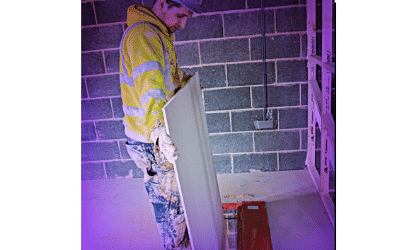
In a bid to curb the nearly seven million workdays lost annually in the UK due to musculoskeletal disorders and to reduce the health risks to construction workers from lifting, moving and handling large amounts of plasterboard, the Finishes and Interiors Sector (FIS) has published a Best Practice Guide, Recommendations for the Safe Ingress of Plasterboard.
The guide was produced by members of the Plasterboard Material Handling Group, which comprises representation from key suppliers, specialist and main contractors in the finishes and interiors sector and the Home Builders Federation (HBF), and is chaired by FIS Technical Director Joe Cilia. Created on behalf of the Health in Construction Leadership Group (HCLG), the Best Practice Guide looks at ways to improve safety when planning for the delivery and movement of plasterboard at each stage and how risks can be reduced.
Commenting on the launch of the guide, FIS chief executive Iain McIlwee said: “Musculosketal disorders (MSDs) cost construction employers £646 million a year and is one of the most common causes of sickness absence and productivity loss at work. The FIS Best Practice Guide, Recommendations for the Safe Ingress of Plasterboard provides clear recommendations on ways to reduce the risk of injury and improve productivity and working conditions on site.”
The aim of the guide is to improve health and safety when plasterboard is delivered, moved and stored. It covers material-handling arising from the journey that plasterboard takes when delivered to sites that include homes, commercial, high-rise multi-occupancy, new builds and refurbishments. The guide is broken down into stages from planning to engagement with manufacturers and distributors, delivery and offloading, storage, vertical and horizontal movement, storage of off-cuts and finally the removal and egress of waste.
“Training, planning and good working practices will ensure that people can work in the industry until they wish to leave it with good health and not have to leave the industry because of debilitating musculoskeletal problems,” added Professor Anthony Woolf of the Bone and Joint Research Group at the Royal Cornwall Hospital, who provided expert advice to the group.
Ian Strudley, who is Chair of the HCLG MSD Task Group and Occupational Health and Hygiene Specialist at Balfour Beatty, said: “This comprehensive guide to the movement and handling of plasterboard will help consolidate the effort to achieve further improvements in musculoskeletal health, and therein achieve additional risk reduction and greater productivity.”
A spokesperson for the HSE said: “Musculoskeletal disorders (MSD) are one of the most common work-related ill health conditions. Reducing the incidence and impact of these on workers’ health is a strategic priority for HSE. Poor materials handling commonly results in MSDs as well as more acute injuries. The construction sector has one of the highest rates of MSDs, and they are amongst the most common cause of sickness absence.
HSE acknowledges the launch of the HCLG’s report and guidance on reducing MSD during the delivery and movement of Plasterboard, and supports the collaborative work of the industry in reducing the incidence of MSDs.”
The HCLG comprises of contractors, clients, professional bodies, trade associations and trade unions. It is supported by the HSE (Health and Safety Executive).
FIS represents suppliers and contractors in the finishes and interiors sector. Its contractor members workmanship is vetted when they join and then every three years and they agree to carry out work in accordance with the FIS best practice guides. All members abide by a code of conduct. A searchable list of members can be found here:
To download the FIS Best Practice Guide, Recommendations for the Safe Ingress of Plasterboard click here.

by Iain McIlwee | 4 Sep, 2020 | Main News Feed, Transformation
A draft recovery plan for the construction sector in Scotland has been launched by the Scottish Construction Leadership Forum (CLF). The plan, which has been created collaboratively with industry, sets out the pathway for joint action between industry and the public sector in response to the impact caused by the global pandemic on the on the construction sector.
The construction industry in Scotland has, like many others, been hit hard by the Covid-19 pandemic. The sector in Scotland which provided £7.8 billion GVA to the Scottish economy and employs 143,000 people in over 50,000 enterprises, is estimated to have contracted by 28.6 per cent in June as a result of the Covid-19 pandemic compared to the same month a year ago (June 2019).
The recovery plan has been created through extensive consultation and collaboration with more than 50 organisations across business, Scottish Government, trades unions and other bodies, including the Construction Industry Coronavirus (CICV) Forum, and represents a shared view from across the sector of a plan to get industry back on its feet.
The plan outlines the immediate and short-term response to Covid-19 and sets out a pathway between this and the longer-term transformation required to build a stronger, fairer and greener economic future for Scotland.
Peter Reekie, chief executive of the Scottish Futures Trust and chair of the editorial group of the Construction Leadership Forum, said: “The construction industry in Scotland has received a major blow from the Covid-19 pandemic. However, the level of collaboration which has gone in to preparing this Recovery Plan is unprecedented and sets a strong foundation for transformative recovery for the industry. I urge all stakeholders with an interest in the construction and related industries in Scotland to feed in your thoughts to make it even stronger.”
Ken Gillespie, chair of the Industry Leadership Group, said: “This plan has only been possible through the depth of collaboration across the sector, and hard work of all involved, and demonstrates the sector’s ability to come together in a time of crisis. This is only the beginning though. The plan will evolve and respond to reflect the feedback and the needs of the sector. We are therefore calling for industry to review and contribute to the plan.”
The plan identifies five areas for concerted and collaborative efforts over the coming months and has established Sub-Groups to develop and progress joint action plans:
- Pipeline & Commercials
- Skills & Workforce
- Transformation
- Supply Chain Resilience & Capability
- Industry Data & Insight
The plan calls for key actions to respond to immediate needs which include:
- A clear pipeline of work brought to market quickly and efficiently on fair commercial terms which reflect the reality of the Covid-19 environment.
- Support of employment, fairness of work and those who may become unemployed through what will be a difficult period.
- Transformation of working practices to maintain and enhance worker safety whilst enabling productivity in the Covid-19 working environment.
Housing Minister Kevin Stewart said: “The construction sector supports many other areas of our economy so it is important that we maintain the health and vitality of the industry. In order to develop this plan, we have reached new heights of collaboration but we are now keen to hear from the wider industry to ensure that we arrive at a plan that will preserve jobs and help to revive our economy.”
The Scottish Construction Leadership Forum (CLF), which has led the development of the plan, is a collaborative initiative of Construction Scotland and the Scottish Government. It was established in March 2019. Chaired by Housing Minister Kevin Stewart for the duration of the crisis, it widened its membership in response to Covid-19 and has already developed and implemented plans to get the industry safely back to work to develop and implement an action plan of improvement initiatives aligned with Government policies and the Construction Scotland Industry Strategy. Several streams of work are ongoing and prior to Covid-19, the Forum was at the early stages of considering a wider agenda for change across the industry.
The CLF shared vision is of an industry that promotes a safe, productive, profitable, digitally-enabled, low-carbon, and socially responsible construction industry which offers quality jobs and fair work to a highly skilled and diverse workforce and a quality and life-time value product to its customers.
The recovery plan is available to view on https://www.constructionforum.scot/.
Industry is invited to send feedback, comments and questions via the website on enquiries@constructionforum.scot by 15 September. CLF will take all feedback on board to help develop the plan further, with regular updates published on the CLF site.
ENDS
by Clair Mooney | 3 Sep, 2020 | Main News Feed
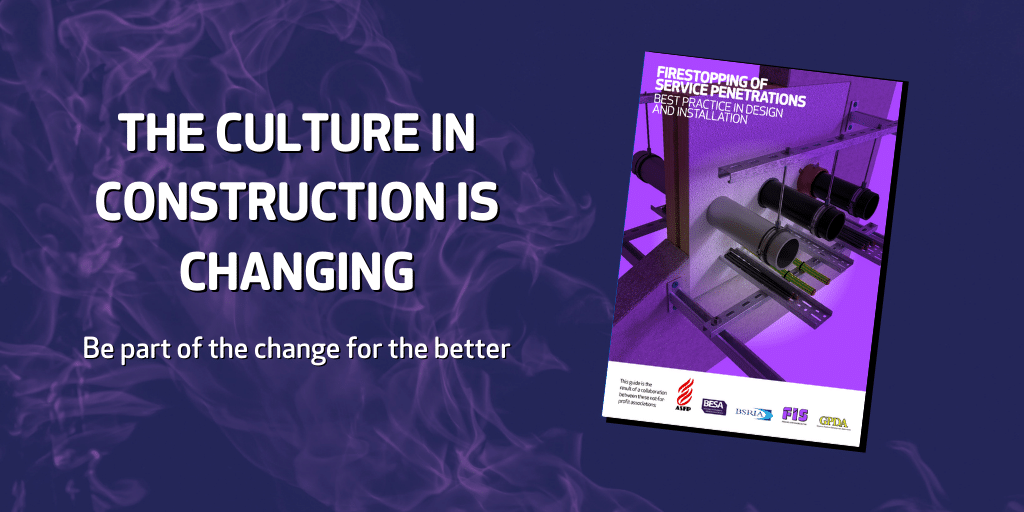
To assist in the design, specification and installation of building services penetrations to ensure fire compartmentation is maintained, five leading not-for-profit organisations have launched a Best Practice Design and Installation Guide, Firestopping of Service Penetrations.
The aim of the guide is to encourage all stakeholders in construction to consider firestopping design earlier in the process in order to avoid problems at a later stage in construction. It is not an installation manual but guidance to a good practice approach. The guide is broken down to provide information on actions that should be carried out during each of the stages one to seven as defined in the RIBA Plan of Work.
With a foreword by Dame Judith Hackitt, who was the Chair of the Independent Review of Building Regulations and Fire Safety, the Best Practice Guide will enable a project team to meet its obligations to deliver a safe and secure project in terms of penetration seals. The guide was produced collaboratively by the Association for Specialist Fire Protection (ASFP), Building Engineering Services Association (BESA), Building Services Research and Information Association (BSRIA), Finishes and Interiors Sector (FIS) and the Gypsum Products Development Association (GPDA) to address service penetrations in buildings and ensure the spread of fire due to inappropriate or poorly installed service penetrations can be eliminated.
Commenting on the launch of the guide Dame Judith Hackitt said: “This document is the result of a collaboration between a number of relevant trade bodies and organisations representing the wider construction and fire safety industries, and it is an example of the collaborative working and acceptance of professional responsibility throughout the supply chain that must become a feature of the industry’s culture from now on.”
Commenting on the launch of the guide, Nick Mead, Mei Systems And Assurance Lead – Meica Systems, Laing O’Rourke Europe said: “Service penetrations in fire-separating elements are in part a minor element of a compartment wall or floor, yet in truth they are one of the most important elements when it comes to ensuring the performance of any compartment wall or floor is maintained.”
The guide was produced with the support of stakeholders across the industry including manufacturers, designers, contractors and specialist fire companies and in particular Rockwool, FSi Ltd, and Warringtonfire.
The Best Practice Design and Installation Guide, Firestopping of Service Penetrations is available to download here.
by Clair Mooney | 3 Sep, 2020 | Main News Feed
On 8 September FIS will be launching its latest Best Practice Guide – Recommendations for the Safe Ingress of Plasterboard
As part of the launch, we are hosting a live webinar on 8 September. This is fully booked but if you are interested in listening to the webinar, you can register to receive a recording of the session here.
This guide looks at ways to improve safety when planning for the delivery and movement of plasterboard and how the risk of Musculoskeletal Disorders (MSD’s) can be reduced.
The aim of the guide is to improve health and safety when plasterboard is delivered, moved and stored. It covers material-handling arising from the journey that plasterboard takes when delivered to sites that include homes, commercial, high-rise multi-occupancy, new builds and refurbishments.
The guide is broken down into stages from planning to engagement with manufacturers and distributors, delivery and offloading, storage, vertical and horizontal movement, storage of off-cuts and finally the removal and egress of waste.
Iain McIlwee, FIS Chief Executive said: “MSDs cost construction employers £646 millon a year and are one of the most common causes of sickness absence and productivity loss at work. The FIS Best Practice Guide, Recommendations for the Safe Ingress of Plasterboard provides clear recommendations on ways to reduce the risk of injury and improve productivity and working conditions on site.”
Tuesday 8 September
Time: 12:00 – 13:00
LIVE SESSION NOW FULLY BOOKED
register to receive a recording direct to your inbox!

by Iain McIlwee | 3 Sep, 2020 | Main News Feed
The Plan for Jobs has introduced new support for FIS members to take on 16-24 for initial six months from the Government’s new Kick-start scheme. The new £2 billion Kickstart scheme is designed to help employers to create new jobs for those aged 16-24, claiming Universal Credit and at risk of long-term unemployment. There is no cap on the number of places per employer.
Funding will be available for each six month job placement and will cover 100% of the National Minimum Wage for 25 hours a week and employers will be able to top this wage up.
Companies who take part in the scheme will have to prove that the jobs they are making available to applicants are new, are not replacing any already existing jobs and are ‘above and beyond any jobs they were expecting to create’. Employers will be required to provide training and support for the kick starter to find a permanent job, in early August the Chancellor said ‘If employers meet the conditions, government will pay young people’s wages for six months, plus an amount to cover overheads.’
Each application should include how you will help the participants to develop their skills and experience, including:
- support to look for long-term work, including career advice and setting goals
- support with CV and interview preparations
- supporting the participant with basic skills, such as attendance, timekeeping and teamwork
Once a job placement is created, it can be taken up by a second person once the first successful applicant has completed their 6-month term.
Applications are being accepted now directly from employers able to offer 30 or more placements.
In addition to the wage support, there is £1,500 per job placement available for setup costs, support and training.
If your organisation is creating fewer than 30 job placements, you cannot apply directly. You must partner with other organisations in order to create a minimum of 30 job placements before applying . These organisations could include:
- similar employers
- local authorities
- trade bodies
- registered charities
FIS has now been approved by The Department of Work and Pensions to act as a gateway for employers who cannot provide 30 placements, but are keen to benefit from the scheme. If you are interested in taking on some young people on this basis we want to hear from you, please email info@thefis.org indicating your interest and the number of places that you would like to offer.
Further Guidance for Employers is available here.
Young people can find out more about the Kickstart Scheme at the jobhelp site here.