
by Iain McIlwee | 18 Jun, 2020 | Main News Feed
A £230 million Return to Work package has been unveiled to help stimulate Scotland’s economy following the coronavirus (COVID-19) pandemic.
The initiative covers construction, low carbon projects, digitisation and business support and will provide a flow of work for businesses and support jobs. It is funded by the reallocation of underspends from schemes interrupted by COVID-19.
New projects featured in the package include:
- £51 million for business support, including boosting high growth companies
- £78 million for construction, including £40 million for regeneration projects and £20 million for roads maintenance
- £66 million to kick-start our green recovery, including £7 million to equip buses for physical distancing and the return to work
- £35.5 million for digitisation, including justice and education services
Finance Secretary Kate Forbes announced the package today as she opened a Scottish Parliament debate on the financial implications of COVID-19. She also sought Parliament’s support for the Scottish Government’s call to be granted additional financial powers to manage the crisis.
Ms Forbes said:
“The impact of COVID-19 has been enormous on both businesses and individuals and the Scottish Government has so far spent more than £4 billion tackling its effects.
“We are also taking steps to accelerate our economic recovery and this package ensures that we can make immediate use of money which, because of the pandemic, might otherwise not have been spent this year.
“I do not underestimate the challenges we face but I also see opportunities. It is important we take this chance to reshape our economy in a way that works for everyone and promotes long-term growth, not just quick fixes.
“This £230 million delivers investment across Scotland and will boost the green recovery, speed up digitisation and bolster construction, supporting hundreds of jobs.
“The Return to Work package is part of a process to harness Scotland’s talent and resources and build a modern economy that is robust, fair and sustainable. But it is only a start. Larger programmes will follow and I will continue pressing the UK Government both for new financial powers and greater certainty over funding.
“These additional powers are now absolutely essential – without them Scotland will be planning for recovery with one hand tied behind our back.”

by Iain McIlwee | 18 Jun, 2020 | Main News Feed
In Scotland today the First Minister has confirmed a gradual introduction of Phase 2 of the National route map for easing COVID-19 restrictions, which means the Construction Sector can move to Phase 3 of the Construction Restart Model from Monday 22nd June.
Phase 3: Steady state operation (where physical distancing can be maintained)
In this phase, the site complement will have reached a steady state level and, depending upon the site parameters, evidence suggest that this could mean that only 30% to 40% of the original workforce are able to be accommodated, due to physical distancing criteria.
As in Phase 1, due to the shortage of medical style PPE supply, only work that can be carried out within physical distancing parameters or with physical barriers will be carried out. Progress throughout Phase 3 will be subject to monitoring and supervision by site management, with any data/evidence gathered (such as site Covid-19 related absences) being used to inform continual review of management practices and arrangements to ensure safe working and physical distancing.
In a subsequent briefing from The Minister for Local Government, Housing and Planning, Kevin Stewart, to members of the CICV Forum (attended by FIS CEO, Iain McIlwee), the Minister expressed his gratitude to the construction sector for their patience and support in providing evidence to support this transition. He emphasised that the plan was centred on small steps taken slowly and carefully – it does not mean a return to normal and that strict adherence to the 2m working rule is essential. He applauded the level of collaboration in the sector, which he recognised was unprecedented. The Minister also highlighted the opportunity to benefit from the £230 million Return to Work Package, launched this week, £78 million of which has been earmarked for construction. He concluded his update by emphasising the importance of the construction sector to the Scottish economy and to ensure that if any difficulties are occurring in the way Public Bodies are managing contracts and not meeting the requirements of CPN 4: Managing Disputes and Cashflow then this should be reported to officials.
Full details of the phased plan are available here.
It has also been confirmed that face coverings will become mandatory on public transport from Monday 22 June. Further details can be found here.
by Iain McIlwee | 17 Jun, 2020 | Main News Feed
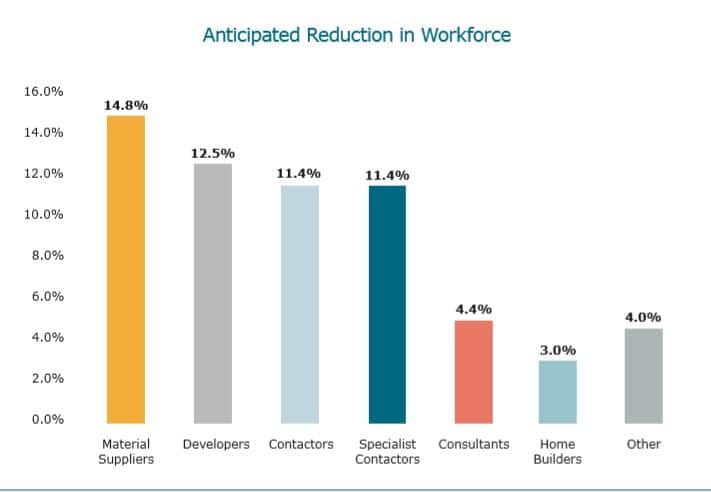
Retaining Talent in Construction reveals an anticipated reduction of 9.9% in the construction workforce by September. In the longer term, 43% of respondents expect to make redundancies, with up to 20% of their workforce being affected. 6.7% of apprentices are likely to lose their jobs by September, and 60% of respondents are looking to take on fewer apprentices at the next intake.
The cross-industry ‘People Survey’ was carried out by Build UK on behalf of the Construction Leadership Council (CLC) at the start of June 2020 to provide a snapshot of how a reduced workload post coronavirus (COVID-19) may affect the construction workforce.
In the wake of recent cuts announced by Travis Perkins, the report reinforces the need to look to targeted support for construction businesses, stimulus for construction works and a supply chain focus on extending the benefit of pipeline through to all employers in the supply chain, through earlier engagement and better planning.
Speaking on the launch of the report FIS CEO, Iain McIlwee commented: “The numbers give us a feel for what the future could look like if key issues related to support for apprentices, encouragement to retain, incentives to build and better planning of the pipeline aren’t addressed. We talk about the new normal, but numbers like this are a stark reminder of how tough it will be for many if swift action is not taken to support the industry. Just to put it in to context, 20% of the construction workforce is around a quarter of a million people! We need to look to Government for stimulus, but better and earlier planning and procurement is in our hands – as well as improving confidence and preventing decisions based on short term survival, it will also lead to better quality and support much needed investment in automation, digital and off-site solutions”.
You can read the full report Retaining Talent in Construction here

by Iain McIlwee | 16 Jun, 2020 | Main News Feed
The procurement pipeline includes over 340 procurement contracts across 269 projects, programmes and other investments. It also sets out a projection of infrastructure procurement over the next year of up to £37 billion.
The procurement pipeline is made up of work packages, projects and programmes that are planned to go out to market for procurement throughout the 2020/21 financial year. rojects where contracts have already been awarded or where funding has already been drawn down will not be included in the procurement pipeline. Projects in the early stages of development are also not included in the procurement pipeline for 2020/21.
The Pipeline aims to provide confidence and certainty to the market during the COVID-19 pandemic – and as such is a key part of the CLC’s ‘Road to Recovery’ .
Andy Mitchell, Co-Chair of the CLC said:
“The Construction Sector is facing an unprecedented challenge as a result of COVID-19. As the largest single client of economic and social infrastructure, a strong and clear pipeline of work from Government is vital to generating confidence and certainty.
I am therefore delighted that the Government has today responded to one of the proposals in the CLC Industry Recovery Plan and look forward to working with Government to deliver these projects over the months and years to come”.
Projects Relevent to the Finishes and Interiors Sector
Within the IPA there are a little over £1.4 billion investment in schools, £2.2 bn new Housing & Regeneration Projects, £1.2 bn investment in prisons and over £100m on cultural and heritage works. The department of Works and Pensions is responsible for £115m of fit-out work across the UK. The full list of projects is available here.
Iain McIlwee, CEO of the FIS responded. “Pipeline and confidence are key to a swift recovery in construction. For me though the benefit of publishing this is limited if it is not matched with a procurement drive that supports early supply chain engagement. We have to remember that the bulk of jobs are in the specialist fields and we need to extend this foresight into the supply chain to support real investment in skills and process improvement. Earlier engagement has the added benefit of ensuring specialist knowledge is available to iron out any design wrinkles and practical issues are addressed in planning rather than on site. Whilst more complex, it we need to try to find a similar process to monitor larger private investments and housing to ensure construction is optimised and ready to meet demand”.
You can view the National Infrastructure and Construction Procurement Pipeline 2020/21 here
For private sector pipeline, you can track projects, FIS works with Barbour ABI who publish a monthly report of key regional contract awards, members can download this report here.

by Clair Mooney | 15 Jun, 2020 | Main News Feed
With 2.3 new claims to Universal Credit and many more people feeling uncertain about their futures, with this in mind, the DWP has launched two practical online support platforms through its new ‘Good Place to Start’ campaign.
jobhelp offers essential advice to those looking for work, on which sectors are recruiting now, how to make the best of transferable skills and how to secure a new role. employerhelp offers business advice on recruiting including the matching service Find a Job.
They have also produced a jobhelp stakeholder toolkit and an employerhelp stakeholder toolkit.
If you’re searching for employment, take a look at the FIS JobSpot www.thefis.org/jobspot/
by Iain McIlwee | 13 Jun, 2020 | Main News Feed
The Government has updated its guidance on the Coronavirus Job Retention Scheme, which confirms how the scheme will change from 1 July 2020 to provide for ‘flexible furloughing’:
- Employers can only furlough an employee who has previously been furloughed prior to 30 June. The exception is employees returning from statutory maternity and paternity leave, provided that their employer has previously furloughed other employees
- Employers can bring furloughed employees back to work for any amount of time and on any work pattern while still claiming grant for the hours not worked. Flexible furlough agreements must be for a minimum of one week, and employees can enter into a flexible furlough agreement more than once
- Employers must confirm in writing with employees and keep records of how many hours employees work and the number of hours they are furloughed
- If an employee is flexible furloughed over two different calendar months, a separate claim must be submitted for each month
- From 1 August, employers will have to contribute towards the cost of furloughed employees’ wages.
When making a claim, employers will need to provide the number of hours an employee would have usually worked as well as the number of hours they actually worked, and the Coronavirus Job Retention Scheme calculator has been updated to assist in working out claim amounts for flexible furloughing.
The first time you will be able to make claims for days in July will be 1 July, you cannot claim for periods in July before this point.
31 July is the last day that you can submit claims for periods ending on or before 30 June.
Visit the FIS Employment Law Toolkit here