
0121 707 0077

CPA Summer Forecast – commercial up, but housing more subdued

CPA Summer Forecast – commercial up, but housing more subdued

The Construction Products Association (CPA) latest Summer Forecasts are predicting growth in the commercial construction sector continuing to 2024, with warehouses particularly driving the sector forwards.

Prospects for the Housing Sector are, however more subdued with just 1.1% growth predicted for 2022 and a static market expected in 2023.

Forecasts have been revised down across both sectors due to the lagged impact of rising inflation and, consequently, slower economic growth prospects on construction industry demand likely to mean that the industry potentially sees the value of output previously expected but not the volume.

Housing

Overall across the public and private housing market CPA predicts new builds to stabilise at a little over 200,000 houses per year.   As economic activity slows, falling consumer confidence and spending, as well as slowing house price growth and the end of Help to Buy in 2023, means that potential homeowners are becoming more risk averse.

Commercial Construction

The CPA report outlines that whilst the pipeline of new towers has improved, they remain a bit thin on the ground compared to historic levels, with concerns around viability linked to inflation and underlying economic conditions potentially causing further delays to planned starts.

Fit-out, however, continues to benefit from the upgrading of existing space and demand for refurbished high-end grade A office space from tenants wishing to downsize to smaller, better quality office space as previous leases finish.  The sector is also benefitting from continued changes in use from commercial to residential or warehouses/logistics.

Energy efficiency considerations as part of net zero and corporate Environmental, Social, and Governance (ESG) requirements are also reported to be driving investment and an interesting point, attributed to Savills in the report, is a widening rent differential between grade A space with strong ESG credentials and grade B or C space.

The report does, however repeatedly highlight the huge variance in forecasts seen for the economy that underpin levels of volatility that add to the downside risks.

For warehouses, the ongoing structural shift towards e-commerce will continue to underpin strong demand for warehousing and distribution space, and this has shored up a pipeline of pre-let and speculative work. At the same time, factories construction activity is set to pick up as progress is made on both existing and planned scheme.

Alongside major capital investment in education, facilities to help compete at a global level, universities and private providers are continuing to invest heavily in purpose-built student accommodation, particularly given the strong growth in international (non-EU) students in recent times.

Public Non Housing

A concern is flagged in the report with publicly-funded projects experiencing strong rates of build cost inflation that may lead to delays.

This is a particular risk for larger planned hospital projects that have already experienced a near-doubling in cost estimates, even before the current inflationary pressures. For fixed-price contracts, it may be the case that higher costs mean the value of work is maintained, but volumes decrease.

Download the latest forecast report here

FIS members can access the latest CPA Forecast.
Latest Construction Product Availability Statement from the CLC

Latest Construction Product Availability Statement from the CLC

Against the backdrop of ongoing volatility, we today received the latest update from the CLC Product Availability Committee.  From an availability perspective the overall tone is positive.  The specific challenges in Northern Ireland aside and despite ongoing reports of chaos at the Ports, the decision to delay the latest round of post-Brexit customs checks means that general product availability continues to improve across virtually all categories.

The Statement also identifies that inflation associated primarily with the ongoing conflict in Ukraine appears to have stabilised, with softening demand, particularly in the retail end of the market contributing.  The underlying conditions remain concerning, however, with many UK manufacturers purchase energy on forward contracts to help manage risk. The current extreme price volatility means that some firms are experiencing electricity cost fluctuating by up to 300% on a day-to-day basis, which may affect the financial viability of some energy-intensive manufacturing particularly during the winter months.

One area for FIS Members to be wary is glass.  There are fresh concerns over the availability and cost of imported glass later in the year, with European plants anticipating reduced production stemming from uneconomic energy costs.

You can read the full statement here.

For all the work FIS is doing around inflation and availability click here


Construction product sales growth eases as costs start to bite

Construction product sales growth eases as costs start to bite

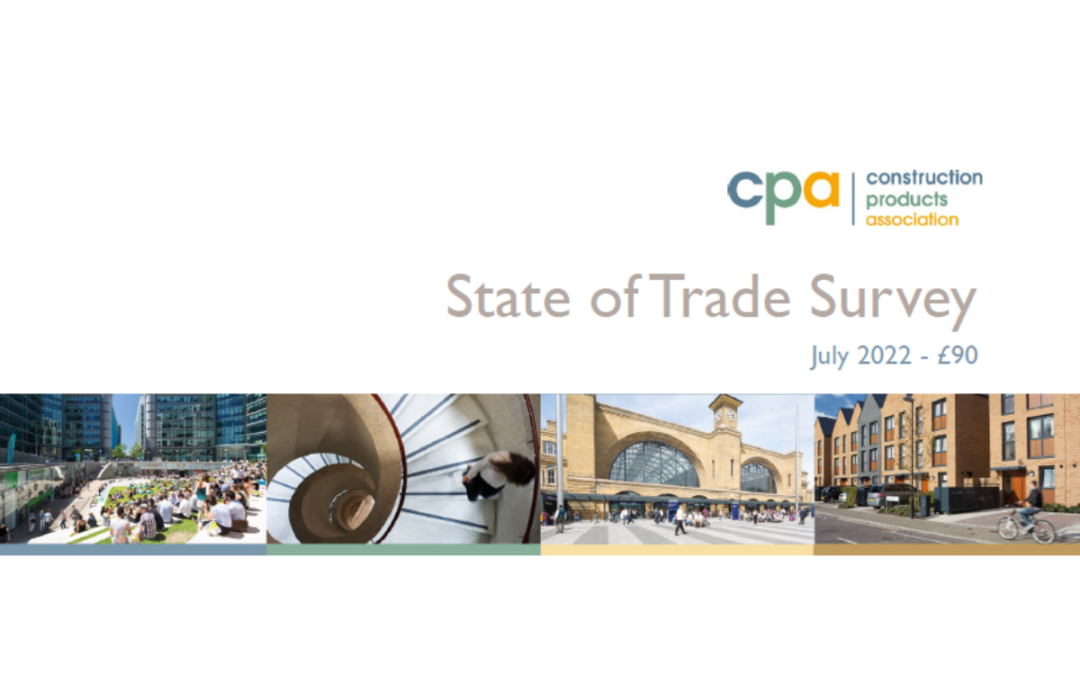
Construction product manufacturers reported an eighth straight quarter of sales growth in Q2, according to the Construction Products Association’s State of Trade Survey. Combined with another quarter of broad and accelerating cost inflation, expectations have been dampened for the year ahead, however.

In Q2, 30% of heavy side manufacturers and 17% of light side manufacturers reported that product sales increased compared to 2022 Q1. Alongside this, all heavy side firms and 94% of those on the light side reported an annual rise in costs. For the heavy side, this was the fourth consecutive quarter of universal cost increases that span across inputs such as fuel, energy, raw materials and labour.

Against a broader economic backdrop of rising inflation, manufacturers cited that demand is likely to be the key constraint on activity going forward, leading to the first negative balance for expected sales since mid-lockdown in 2020. On balance, 30% of heavy side firms, whose products tend to feed into the earlier stages of construction, anticipate a decrease in sales in Q3 and one-third anticipate a fall in 12 months. As a result, 11% also envisage a decrease in their labour force in the year ahead.

Rebecca Larkin, CPA Senior Economist said:

“In recent quarters, construction product manufacturers have reported escalating inflationary pressures across fuel, energy, raw materials and wages. Added to this, there are early reports that higher costs further down the supply chain for transport, insurance, reverse charge VAT, and the removal of the red diesel rebate are starting to be reflected in lower confidence and delayed decision-making for new construction projects.”

She also adds: “Demand currently remains strong, particularly in the housing, RM&I, industrial and infrastructure sectors, but the headwinds related to costs are intensifying. Consumer price inflation is yet to peak too, which poses a downside risk if households and businesses rein in spending as disposable incomes and margins are eroded.”

Key survey findings include:

  • A balance of 30% of heavy side firms and 17% of light side firms reported that construction products sales rose in Q2 compared with the previous quarter, the eighth consecutive quarter of growth
  • Sales balances weakened from 43% (heavy side) and 50% (light side) in Q1
  • 30% of heavy side manufacturers anticipate a fall in sales in Q3, whilst 17% of light side firms expect an increase, the lowest balance since the first national lockdown in 2020 Q2
  • Costs for fuel, energy, raw materials and wages & salaries rose for all heavy side manufacturers
  • Costs are expected to increase over the next year according to balances of 78% on the heavy side and 94% on the light side
  • Weaker hiring intentions were reported by both heavy side and light side manufacturers

Overall, the Q2 survey results provide the first indication that the inflationary backdrop is now starting to impact on confidence around the near-term outlook for construction.

FIS members can download a copy of the full CPA report via the link below.

36% of construction companies anticipate a rise in business activity

36% of construction companies anticipate a rise in business activity

The latest weekly update from CPA is available to members here.   The updated issues are in Pages 1-6 of the weekly update whilst subsequent pages have existing data and information that remain relevant. This update includes:

  1. UK Housing and Construction Ministers (July 2022)
  2. S&P Global/CIPS UK Construction PMI (June 2022)
  3. BEIS UK Building Materials Prices (May 2022)
  4. Bank of England UK Mortgage Approvals (May 2022)
  5. Persimmon Trading Update (July 2022)
  6. Vistry Trading Update (July 2022)


    Market Data

    FIS has access to a wide range of market data from sources including the CPA, Barbour ABI and Builders’ Conference. In addition, FIS produces a state of trade survey specifically for the finishes and interiors sector.

    36% of construction companies anticipate a rise in business activity

    CPA releases UK Economic and Construction Update

    The latest weekly update from CPA is available to members here.  The updated issues are in Pages 1-5 of the weekly update whilst subsequent pages have existing data and information that remain relevant. This update includes:

    1. Insolvency Service UK Construction Insolvencies (April 2022)
    2. DLUHC House Building Starts and Completions in England (2022 Q1)
    3. HMRC UK Property Transactions (May 2022)
    4. ONS/Land Registry UK House Price Index (April 2022)

    The next CPA forecasts (Summer) will be published on Monday 25 July and there will be a CPA webinar on the forecasts at 11.00 on Wednesday 27 July.

      Market Data

      FIS has access to a wide range of market data from sources including the CPA, Barbour ABI and Builders’ Conference. In addition, FIS produces a state of trade survey specifically for the finishes and interiors sector.

      FIS Wage Rate Index – Half 1 2022

      FIS Wage Rate Index – Half 1 2022

      To help track movement of wage rates in the UK FIS launched in 2021 The FIS Wage Rate Index.  The aim of this work is to support contract negotiations and to help track the impact of shortages on the cost breakdown of projects.

      The survey is conducted every six months and FIS is encouraging all contractor members to take part to add to the rigour and value of the survey.  Data is published as a price index to allow for regional rate variations and all company specific data is managed in the strictest of confidence.  The survey covers core trade roles, labourers, apprentices and construction and site managers.

      THE DETAILED RESULTS OF THE SURVEY WILL BE MADE AVAILABLE EXCLUSIVELY TO CONTRIBUTERS.

      You can complete the survey via the link here. The survey will close on 8th July 2022.