0121 707 0077

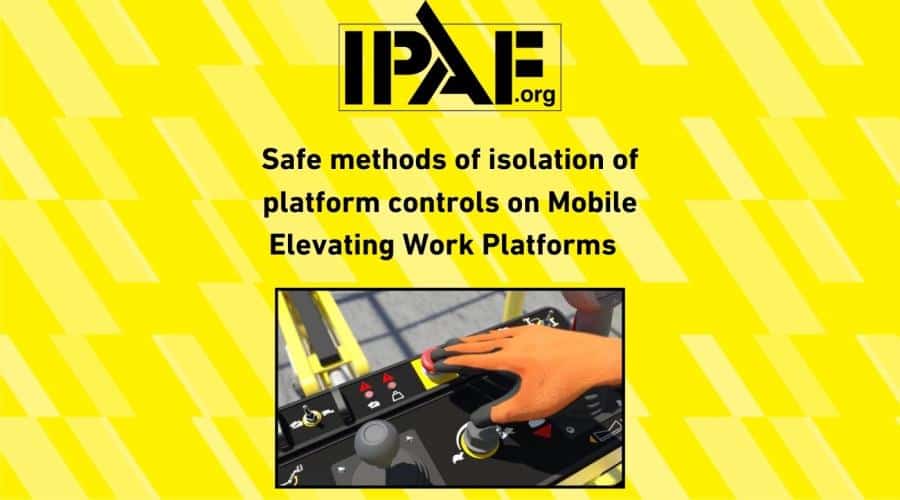
Safe methods of isolation of platform controls on Mobile Elevating Work Platforms

Safe methods of isolation of platform controls on Mobile Elevating Work Platforms

The International Powered Access Federation (IPAF) has worked with the UK Health and Safety Executive (HSE) to develop the following guidance on the safe methods of isolation of platform controls for Mobile Elevating Work Platforms (MEWPs).

Background

HSE are investigating an incident involving a MEWP which has found that when at height, the method of isolating the controls on the MEWP can introduce a hazard to the occupants of the platform. The investigation is ongoing.

The emergency stop control on the MEWP platform has been used in the powered access industry for a number of years to achieve isolation of controls and/or power source when the MEWP has reached its place of work.

This practice was first introduced on older machines, not designed to current standards, to reduce the risk of entrapment and inadvertent operation of controls. As the standards have evolved and designs have changed, this practice may no longer be appropriate to reduce the risk as other methods are now used in control designs.

Safe Isolation of the platform controls

The operator of a MEWP may be required to isolate the controls and/or power source using platform controls. Where the machine is equipped with an “engine on/off” control at the platform control console, this should be used to switch the engine off during normal operation rather than the emergency stop control, unless the manufacturer indicates that it would be unsafe to do so.

Where machines are not equipped with a dedicated “on/off” control at the platform control console, the MEWP operator should follow the manufacturers’ operating instructions as to how this should be achieved.

It is the user’s responsibility to ensure the correct MEWP has been selected for the task, and that a suitable and sufficient risk assessment has been carried out and documented.

HSE endorses this jointly developed guidance and has encouraged IPAF to communicate it to MEWP users.

New Code of Practice for fire and escape door hardware published

New Code of Practice for fire and escape door hardware published

A comprehensively revised Code of Practice for the selection of building hardware for fire-resisting and escape door assemblies and doorsets has been published by The Guild of Architectural Ironmongers (GAI) and the Door & Hardware Federation (DHF).

This new edition, issue No. 5, is the first revision in more than a decade, and represents a significant update and consolidation of previous guidelines to reflect the very latest legislative requirements and best practices in the industry.
It provides an essential reference and resource for a broad spectrum of construction industry professionals including architects, building control officers, fire officers, responsible persons, duty holders, manufacturers, specifiers, and suppliers of building hardware and fire doors.

GAI technical manager Douglas Masterson said: “The primary goal of this Code of Practice is to ensure that key stakeholders throughout the construction industry have access to the most current and comprehensive advice on selecting hardware that meets the stringent requirements for fire safety and escape routes
“While the Code is advisory, it is designed to provide robust guidance that aligns with the latest legal standards.
“While compliance with the Code does not confer immunity from legal, local authority or insurance requirements, it will significantly enhance the safety and reliability of fire-resisting and escape door assemblies.”

The Code addresses a wide range of legislative requirements, including:
· Construction Products Regulations in both the EU and UK.
· Building Regulations throughout the UK and Ireland, including the Building Regulations 2010 (England & Wales), Building (Scotland) Regulations 2004, Building Regulations (Northern Ireland) 2012, and Building Regulations 1997-2021 (Ireland).
· Workplace Fire Safety Legislation across the UK and Ireland, such as the Regulatory Reform (Fire Safety) Order 2005.
· Equality Legislation applicable in Great Britain, Northern Ireland, and the Republic of Ireland.

Additionally, the Code considers third-party certification schemes and declarations of conformity with relevant standards, ensuring that the guidance provided is both comprehensive and up to date.
The Code applies to building hardware used on timber fire doors with up to two hours of fire resistance and steel fire doors with up to four hours of fire resistance.
The hardware items covered are categorised into essential items necessary for the successful operation of the doors (such as pivots and hinges, door closing devices, latch or locks, intumescent and smoke seals, and panic bolts), and optional (non-essential) items that could potentially cause door failure if not properly selected or installed.
As a part of this revision there are several new sections relating to electric locking and access control, which are of increasing importance in the world of building hardware.
Issue 5 of the Code replaces the previous issue 4, as well as all previous codes of practice published by both the Association of Building Hardware Manufacturers (now DHF) and the Guild of Architectural Ironmongers, all of which have been withdrawn to ensure that professionals are working with the most current and relevant information.

DHF general manager Michael Skelding said: “This revision is the result of more than two years work by the teams at the DHF and GAI in conjunction with technical specialists at the leading companies in our industry.
“The result should be seen as an essential reference document for anyone involved in the selection, installation and testing of building hardware and furniture for fire and escape doors.”

Code of Practice: Hardware for Fire and Escape Doors edition 5 can be downloaded for free at www.firecode.org.uk

Saving Lives: The Critical Importance of Defibrillator Training and Awareness

Saving Lives: The Critical Importance of Defibrillator Training and Awareness

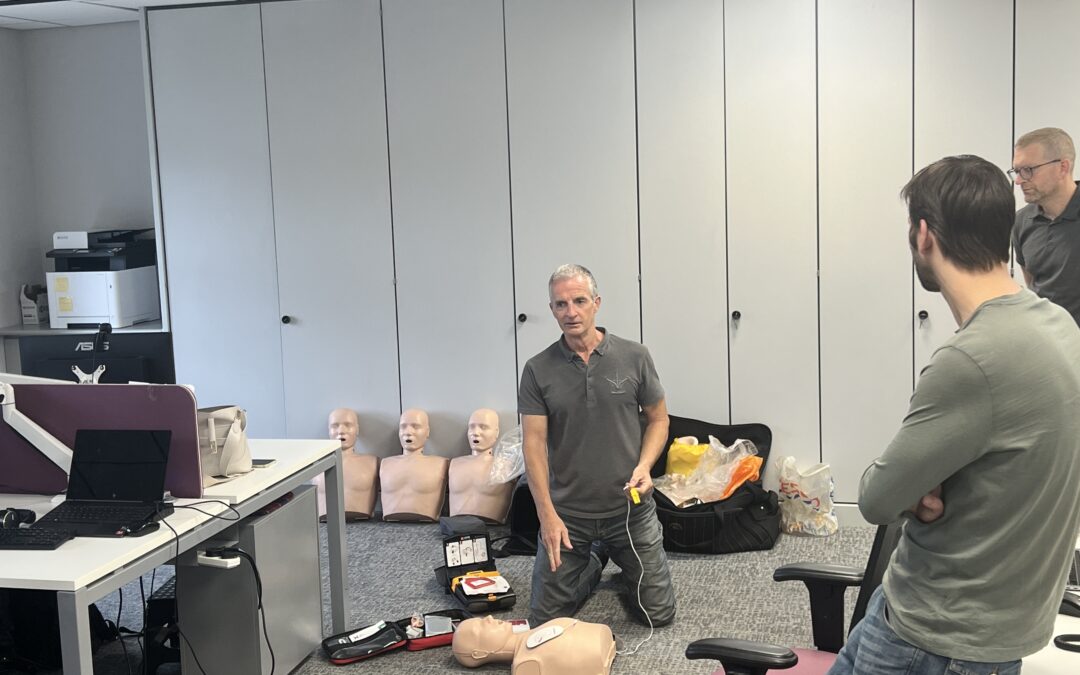
In readiness for Restart a Heart Day, the FIS (Finishes & Interiors Sector) team undertook Basic Life Saving training to understand what to do when faced with an emergency situation. Here, Hermione Neale, FIS Marketing Apprentice, highlights what the team learnt and how early defibrillation can save lives.

In this article, I will cover the effectiveness of defibs, the action to take in an emergency, what CPR (Cardiopulmonary Resuscitation) is, The Circuit and how to access defibrillators, storage of defibrillators, number of first aiders, statistics and Cardiac Awareness week.

Giving people a chance

Statistics show that using a defibrillator within the first minute can have a survival rate as high as 90%, however every minute that passes after this, the survival rate drops by 10%. This proves the effectiveness of defibrillators and how much of a difference they can make in saving lives. With manual compressions the survival rate is between 5-10%, with 1 in 10 people surviving resuscitation.

CPR (Cardiopulmonary Resuscitation) is rescue breaths and compressions in an attempt to bring back the patient’s heartbeat and breathing. CPR (Cardiopulmonary Resuscitation) is different for adults, children over a year and infants under a year. A defibrillator is a device used to restore a regular heartbeat by an electric current.

In the case of an emergency check your surroundings for danger, begin compressions, call 999, call for a defibrillator, turn on the defibrillator, cut off clothing covering chest, place pads as shown, follow defibrillators verbal instructions, if there are signs of responsiveness place them in the recovery position and monitor.

Finding a Defib

The Circuit is the national defibrillator network that is used by the 14 ambulance services across the UK. This allows ambulance services to locate the nearest defibrillator upon arrival of a cardiac arrest. These defibrillators are connected to each of the 14 ambulance services and there are an estimated 90,000 defibrillators currently in the UK. Through calling 999, the operator can tell you where the nearest defibrillator is and then what the code to access it is.

Defibrillators should be stored in a case to protect it from damage and the recommended temperature range is between 0 to 50 degrees. The AED needs to be kept within this temperature range due to the adhesive gel on the pads melting and not sticking to the patient properly, therefore preventing the electrical shock from getting to the heart. In the winter months the defibrillator should be stored in a heated outdoor cabinet. Defibrillators should be checked every day including the batteries to ensure that the defibrillator is ready for use.

It could be you

Every year in Britain, 30,000 people have cardiac arrests outside of a hospital and statistics show that 1 in 10 patients survive due to lack of education and training. 72% of cardiac arrests happen at home and 15% happen at a workplace. Half of out of hospital cardiac arrests are witnessed by a bystander and 7 out of 10 attempt CPR (Cardiopulmonary Resuscitation). However, public defibrillator use is reported at being used less than 1 in 10. The average ambulance response time is 6.9 minutes, which means by the time a call is made and the wait time for the ambulance, the patients survival rate from defibrillation will have dropped by 70%. In 2018, 59% of the public were trained in CPR (Cardiopulmonary Resuscitation) training, however only 19% knew how to use an AED, which means that the chance of cardiac arrest patients has a significantly lower chance of survival.

In a workplace with 25 employees, the minimum legal requirement is one appointed first aider.

This information and statistics show how important informative first aid is to the survival rate of cardiac arrests. It is important for employers to take the time to train their employees and ensure they all have awareness surrounding cardiac arrests, the signs and how to use a defibrillator.

Restart a Heart Day

Restart A Heart Day took place on the 16 October. The Day helps raise awareness of cardiac arrests. This program encourages confidence in CPR (Cardiopulmonary Resuscitation) practice and allowing them to learn lifesaving skills. The focus for this year’s Restart A Heart Day was to aid equal access to defibrillators, which will increase the chance of survival rates. This is now an internationally celebrated day.

Preventing deaths from cardiac arrest

Find out more and see some key questions and answers

Enhancing Safety in Construction: Addressing Moment Connection Design and Reporting Procedures

Enhancing Safety in Construction: Addressing Moment Connection Design and Reporting Procedures

A recent safety report from Collaborative Reporting for Safer Structures UK (CROSS) has highlighted a consideration for contractors around the design of moment connections in staircase stringers that have be under designed. Mandatory occurrence reporting procedures that are required under the building safety act in higher risk buildings demand that anyone on site report issues whenever and wherever we see them, and this could be crucial where a specialist sub-contractor has any interfacing works or is responsible for elements that conceal or clad these details.

Ensuring that all parties involved in the construction and design process are aware of their responsibilities is essential for maintaining safety standards. This includes conducting thorough inspections and collaborating closely with design engineers to verify that all moment connections are correctly specified and installed. It also emphasises the importance of continuous training and communication among team members to recognise and address potential risks before they escalate into safety hazards.

Moreover, the report underscores the value of fostering a culture of transparency and accountability, where every worker feels empowered to voice concerns without fear of repercussions. By doing so, the industry can work towards a safer built environment, minimising the likelihood of structural failures and ensuring the well-being of all building occupants.

In light of these findings, contractors and subcontractors should prioritise regular audits of design specifications and site practices, ensuring compliance with safety regulations and adapting to emerging challenges with agility and diligence

Want to see the full report?

See the full report from CROSS UK

World Suicide Prevention Day – the importance of starting the conversation

World Suicide Prevention Day – the importance of starting the conversation

Tuesday 10 September marks World Suicide Prevention Day, part of National Suicide Prevention Month. This campaign aims to raise awareness about suicide preventionand how we can work together to create a world where fewer people die by suicide.

Currently, more than 700,000 people a year take their life around the world and by raising awareness, reducing the stigma and encouraging action, we can help to reduce the instances of suicide around the world.

This year’s theme is ‘Changing the Narrative on Suicide’, which serves as a chance to #StartTheConversation around suicide and shift the culture to one of openness, empathy and support. Every chat, no matter how small, will build a supportive and understanding society and help provide support to anyone who is struggling.

There are lots of available services that can be accessed for anyone who is struggling:

https://www.samaritans.org/support-us/campaign/world-suicide-prevention-day/

FIS has a Mental Health Hub where you can find information and resources to help you with your mental health and wellbeing.

FIS announces new partnership with UK Asbestos Training Association (UKATA)

FIS announces new partnership with UK Asbestos Training Association (UKATA)

FIS is thrilled to announce a new partnership with UKATA, a leading authority in asbestos training. This partnership solidifies the collaboration between the two organisations and aims to further enhance the education and training opportunities related to asbestos across the construction and interiors sectors.

This new relationship reflects the commitment of both organisations to work closely together in advancing asbestos awareness and safety measures across the industry. By combining their expertise, resources, and industry knowledge, UKATA and FIS intend to strengthen efforts to prevent asbestos-related diseases and ensure the highest standards of safety in asbestos management.

Debbie Nixon, UKATA Senior Operations Manager expressed her excitement about the partnership saying,

“We are delighted to formalise our collaboration with the Finishes and Interiors Sector, and I look forward to contributing to our collective efforts to raise awareness about the dangers of asbestos.”

Iain McIlwee, Chief Executive of FIS commented,

‘Asbestos has slipped out of the headlines a bit in recent times, but we cannot get complacent. It is true that usage has been banned since the turn of the century, but it was so widely used historically that we will continue to encounter it in refurbishment works for many, many years to come. If disturbed and inappropriately managed, it is a killer and one of the worst we have known in construction – there is no safe level of exposure. It is critical that construction workers know how to identify and react when they encounter asbestos, not just for their own safety, but for all those around them. This new partnership is about ensuring that the next generation of construction workers have access to the training they need and are not at risk from decisions made in the past and eminently avoidable mistakes that ignorance and complacency may allow today’.

Both UKATA and FIS share a common commitment to asbestos awareness, training, and safety.