
by Clair Mooney | 6 Feb, 2023 | Building Safety Act, Main News Feed
The Health and Safety (HSE) and Building Safety Regulator (BSR) have recently launched several consultations and research in connection with building safety.
Professional Conduct Rules for Registered Building Control Approvers (RBCAs)
The BSR will be operating as part of the HSE from April 2023. Building control professionals will have to register with the BSR to perform building control work in England. The professional conduct rules sets out standards of professional conduct and practice that registered building control approvers are expected to meet.
The professional conduct rules are mandatory principles of conduct and standards applying to all who wish to register with the BSR as Registered Building Control Approvers (RBCA) in the private sector.
The HSE are seeking views on the proposals and the consultation closes on 17 February 2023.
Draft Code of Conduct for Registered Building Inspectors
Building control professionals will have to register with the BSR to perform building control work in England. The code of conduct sets out standards of professional conduct and practice that registered building inspectors (RBIs) are expected to meet.
The code of conduct are mandatory principles of conduct and standards of behaviour for RBIs, whether they work in the private or public sector.
HSE are seeking views on the proposed code of conduct and the consultation closes on 17 February 2023.
Managing Building Safety
The BSR is inviting views on their information document that highlights the necessary competency for those managing high risk buildings (HRBs), including a summary of the recent British Standard, publicly available specification (PAS):
- PAS 8673:2022 Built environment – Competence requirements for the management of safety in residential buildings – Specification
The consultation will close on 24 April 2023 and can be found here.
Building Safety Competence Information for Principal Contractors and Principal Designers
The BSR is inviting views on their information document that highlights the necessary competency for the new principal designer and principal contractor roles, including a summary of the recent British Standards, publicly available specifications (PAS):
- PAS 8671:2022 Built environment – Framework for competence of individual Principal Designers – Specification
- PAS 8672 Built environment – Framework for competence of individual Principal Contractors – Specification
The consultation will close on 24 April 2023 and can be found here.
HSE Research Project – Accountable Person and Principal Accountable Person
The HSE has commissioned an independent research agency, Kantar Public, to interview people working in private and public sector housing organisations who will be an Accountable Person or Principal Accountable Person; will make decisions about the role; are knowledgeable about the role; and/or who will work on important aspects of the role (such as building registration, resident engagement and complaints handling).
All interviews will be conducted by independent, experienced researchers at Kantar Public. For further information or to register your interest to participate in this research, please email marios.zampetis@kantar.com
by Clair Mooney | 30 Jan, 2023 | Building Safety Act
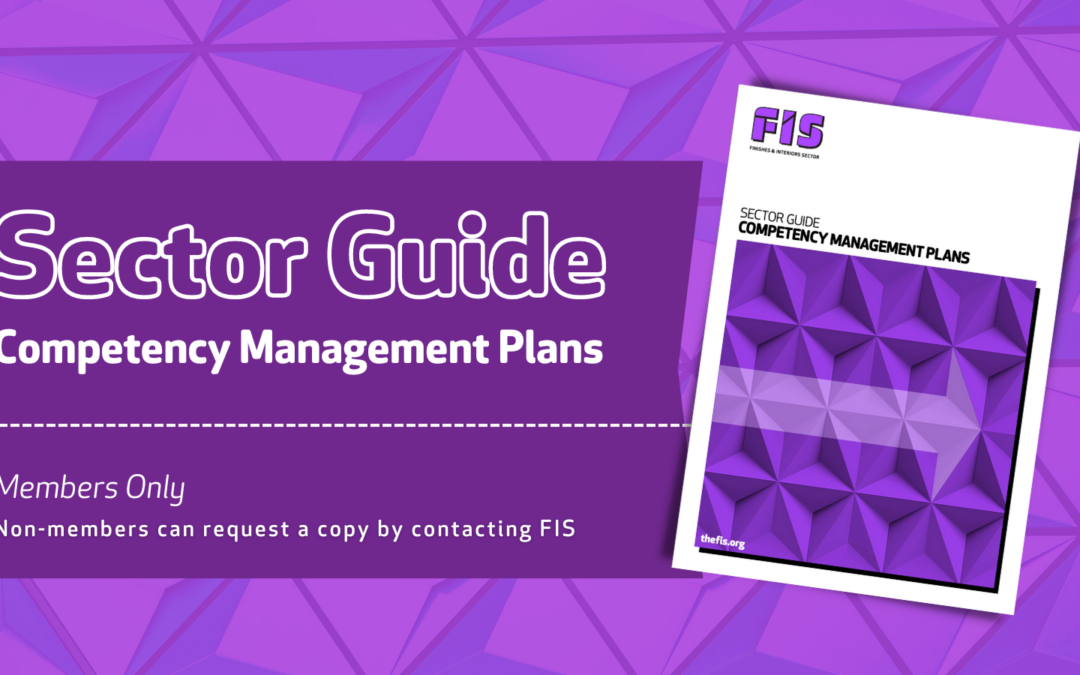
With the construction sector under ever-closer scrutiny in relation to competency, a new Sector Guide – Competency Management Plans has been launched by the Finishes and Interiors Sector (FIS) to assist organisations in the improvement of quality and safety and ensure they meet new regulatory requirements.
This new Sector guide – Competency Management Plans will provide examples and signposts to available information and assist organisations in improving quality and safety whilst at the same time ensuring that they meet the requirements of legislation and avoid any enforcement penalties.1 The guide aims to address the regulatory regime as part of the long-awaited Building Safety Act which sets out clear duties and responsibilities for those who commission, design, construct and refurbish higher-risk buildings as well as those responsible for ensuring buildings are safely managed when occupied.
A Competency Management Plan is a critical document for any organisation working in the finishes and interior sector of the construction industry and must be embedded within the culture of the business and embraced within any quality management process.
The guide has been produced by FIS and is designed to contextualise and help to structure and improve existing processes. It is structured to help form a strategy for assessing competence and provides guidance to suggested CMP content including organisational and occupational competence, functional requirements, creating job descriptions, competency and training plans, appraisal process and succession plans.
Commenting on the guide, Iain McIlwee, Chief Executive of the FIS said:
“The Building Safety Act has become law and we need as a sector to ensure we have robust processes in place to meet the exacting competency requirements. This new FIS sector guide will provide the necessary guidance to enable organisations to formulate a Construction Management Plan, which will be key to progressing through the relevant gateways and ensuring the Building Safety Regulator can allow a project to proceed.”
In addition to the availability of the new Sector Guide – Competency Management Plans, FIS has been working with My Professional Pass (MPP) to help support a universal approach to competency passports in the sector. The FIS Competency Passport system will store, retrieve, view and monitor training and qualification achievements of individuals and records of experience. Individuals registered with MPP, self-employed or directly employed can give organisations access to their records.
The Sector Guide – Competency Management Plans is freely available from the FIS website here https://www.thefis.org/skills-hub/competency/
1 At the time of writing penalties have not been published for failure to comply with the Building Safety Act, but consultations on this and enforcement associated to wider changes to the building regulations are taking place.

by Iain McIlwee | 30 Jan, 2023 | Building Safety Act
This weekend we heard Rt Hon Michael Gove’s (Secretary of State for Levelling Up, Housing and Communities) candid admission that Building Regulations were “faulty and ambiguous” in the run-up to the Grenfell Tower fire. This was, however, backed up with an assertion that there had been an “active willingness” on the part of developers to endanger lives for profit.
Gove’s mantra remains “polluter pays” and these comments were followed by a letter issued to developers today (30 January 2023) saying that Government expects them to sign a newly published ‘developer remediation contract’ as soon as possible.
Last year, 49 developers signed a public pledge committing to do the right thing to protect leaseholders and residents. Once signed, the contract will make those commitments legally binding., the contract will require developers to:
- Take responsibility for all necessary work to address life-critical fire-safety defects arising from design and construction of buildings 11 metres and over in height that they developed or refurbished over the last 30 years in England.
- Keep residents in those buildings informed on progress towards meeting this commitment.
- Reimburse taxpayers for funding spent on remediating their buildings.
The government has made clear that developers who refuse to sign the contract or fail to comply with its terms face significant consequences.
Commenting on the letter FIS CEO Iain McIlwee stated:
“This letter is a significant moment for construction and, whilst it is positive that the weight has rightly been lifted from the leaseholder, it darkens the shadow that hangs over the construction sector.
The inevitable next step is, for the developers that sign, to start to look to offset their liabilities onto the supply chain. They will engage lawyers to pull out heavily ammended standard form contracts, contracts that even the Government’s own Industrial Strategy recognise “can unfairly transfer legal risk” and that did not reflect the true working practices at the time. Cases like LDC vs GDC vs ESL and Mulallely vs Martley Homes start to give us insight into how this will play out.
The Building Safety Act is undoubtedly a force for long term good, but to truly support transformation in the shorter term it needs to be mirrored by a tightening of the Construction Act and some protection to SMEs in the supply chain. My fear now is that this opens the door to conflict and cost – adversarial behaviours will undermine change and resources that would be better expended on transformation and putting right mistakes of the past will be wasted”.
You can read the full letter from Richard Goodman, Director General, Safer and Greener Buildings Department for Levelling Up, Housing and Communities and view the proposed contract here
Read FIS Overview of the Building Safety Act here

by Clair Mooney | 26 Jan, 2023 | Building Safety Act
The Building Safety Act is the foundation of a new building safety regime for the construction sector and represents the most significant change to industry regulation in a generation. With many of the new requirements coming into force this year, FIS members have access to a newly published comprehensive overview of the regime, compiled by Build UK. This guidance will ensure all members are aware of their responsibilities and includes information on:
- New bodies that will provide effective oversight of the new regime
- New responsibilities for all those who design, build, own or manage Higher Risk Buildings
- New systems designed to improve levels of competence and formalise processes
- Existing legislation which will be reformed
- Other activities outside the scope of the Act but related to building safety.
The guide will be regularly updated as secondary legislation and supporting guidance from industry is published. It has been welcomed by Dame Judith Hackitt, Chair of the Industry Safety Steering Group, who said:
“This guide provides Build UK members across the supply chain with a clear and accessible summary of what the Building Safety Act means for them and their organisation. I urge you to not just read this guide but to then discuss what it means for your organisation and how your practices need to change.”

by Iain McIlwee | 20 Jan, 2023 | Building Safety Act
New Guidance has been published by the Home Office to help conduct routine checks on fire doors and provide information to residents. This guide is aimed at Responsible Persons carrying out simple checks upon a fire door. It is based on the assumption that the fire risk assessment has already assessed the suitability of the fire doors.
This short guide is intended to assist those with duties under the Fire Safety (England) Regulations to comply with regulation 10, which makes requirements about fire doors in all buildings that contain two or more domestic premises and that contain common parts, through which residents would need to evacuate in a fire.
Regulation 10 makes requirements in relation to two matters, namely:
- information about flat entrance doors that the Responsible Person must give to all residents (whether tenants or leaseholders) – this requirement relates to all blocks of flats
- routine checks of fire doors that the Responsible Person must ensure are carried out – these checks are only required in blocks of flats in which the top storey is more than 11m above ground level (typically, a building of more than four storeys)
The guidance includes a simple checklist.
The Fire Safety (England) Regulations 2022 were placed on the statute book on 18 May 2022, and came into force on 23 January 2023.
The full guidance is available here

by Clair Mooney | 19 Jan, 2023 | Building Safety Act, Technical
With the Building Safety Act now in force, we are seeing changes to the wider building regulations continuing apace. Below are two key changes of significant note.
- The ban on the use of combustible materials in and on the external walls of buildings with a storey at least 18 metres above ground level has been extended to include hotels, hostels and boarding houses. Metal Composite Material panels with unmodified polyethylene core (MCM PE) have been banned on all new buildings of any height.
- Announced last year, Approved Document B (Fire Safety) also now includes new requirements for external walls and balconies on new residential buildings between 11 and 18 metres in height to limit the combustibility of materials.
FIS is working on summarising key changes to Approved Document B across the wider scope of interior products, so watch out for this guidance in the coming weeks.
There also remains an open consultation on national classifications as a way of demonstrating compliance within Approved Document B. To find out more and feed your views into the FIS survey about this consultation, click here.
Page 12 of 24« First«...1011121314...20...>Last