by Clair Mooney | 10 Oct, 2022 | Technical
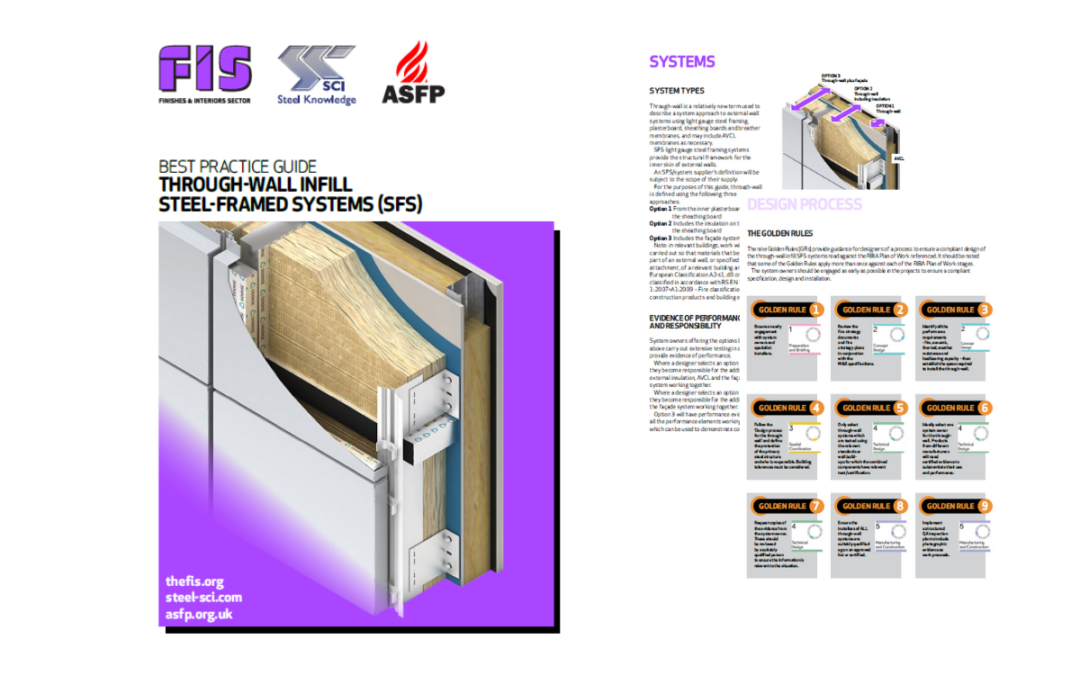
FIS has launched a new Best Practice Guide for Through-wall infill steel framed systems (SFS) to provide a standard definition of ‘through-wall’ and assist in the design, specification and installation of SFS ‘through-wall’ systems.
‘Through-wall’ has become a generic term used by suppliers of systems to describe infill exterior walls constructed from Light Gauge Steel Frame (LGSF) sometimes described as steel framing systems (SFS) where frame, inner plasterboard and external sheathing boards are tested and sold as a system. However, in a similar way that the framing can be defined as LGSF and SFS, there is no consistency in what constitutes ‘through-wall’.
The guide has been drafted by a panel of experts from the FIS SFS working group in conjunction with the Steel Construction Institute (SCI) and the Association for Specialist Fire Protection (ASFP).
Aimed at everyone in the delivery chain from design to specification, fire engineers, contractors, site managers and installers, it explains the three options:
- From inner plasterboard to external sheathing board
- From inner plasterboard to external sheathing board and external wall insulation
- From inner plasterboard to external sheathing board, external wall insulation and façade system
Commenting, Andrew Way, Associate Director at the SCI, said:
“The term ‘through-wall’ has been in common use in the construction industry for many years now, but its precise meaning is still unclear for many people. This is not surprising as a recognised definition of ‘through-wall’ has not been provided up until now. This joint publication from FIS and SCI addresses the need by providing a clear definition and presenting useful information about the topics and performance characteristics related to ‘through-wall’ systems. The leadership of FIS in driving this publication has been critical in achieving this new guide for the industry to utilise”.
Dr Andrew Taylor, Technical Officer at ASFP said:
“Understanding the impact of different component materials on the ability of a constructed system to perform, together with how the system interacts with the structure and any potential movement, is fundamental to the delivery of a successful installation.”
“LGSF, SFS and through-wall are still emerging technologies and solutions as part of Modern Methods of Construction (MMC). It’s vital that their integration and interface into the building structure to ensure the performance requirements can be met and what clear evidence of compliance is required is addressed as early in the design stage as possible,” added FIS Technical Director Joe Cilia.
The guide is freely available to FIS members from the FIS website at https://www.thefis.org/membership-hub/publications/best-practice-guides/through-wall/ and will be used to form the basis of Continuous Professional Development programmes going forward. Copies are available to non-members on request.

by Clair Mooney | 6 Oct, 2022 | Insurance
To help manage risk and provide additional support to its members on insurance matters,FIS has partnered with specialist insurance consultants Construction Shield and AWL Homeproof Limited.
This new service will enable members to test the effectiveness of existing cover and secure an alternative quote. It will also open-up exclusive access to specialist insurance products at highly competitive prices. Members will be supported with Professional Indemnity, Contractors All Risk, Commercial Combined Business Insurance, Directors and Officers Insurance, Motor, Performance Bonds and a range of other relevant specialist insurance products.
FIS is focused on compliance and improved risk management in the finishes and interiors sector. In the past couple of years members have increasingly raised concerns related to rising insurance premiums, reduced cover, onerous endorsements and at times the inability to gain access to the correct cover.
The aim of this new service is to leverage the collective power of its membership to create greater awareness of the risks faced in our sectors and enable meaningful research and development to be carried out, driven from claims and risk data for our members.
This new partnership will support the development of a deeper understanding of claims, how risk is being assessed and to develop different and a more progressive relationship with the insurance sector, one that offers a truly bespoke service whilst also allowing for greater access to insurance products at improved pricing structures.
Commenting on the scheme, FIS CEO Iain McIlwee said:
“The insurance market has hardened significantly in recent years and created a real challenge for members in large parts of our market. This new relationship is structured to help us to better understand and attack this problem and work better as a community.
Our mission is all about building an effective compliance environment and reducing risk for members. Understanding the scope and causes of any claim is key to this, as is establishing a closer working link with the insurance sector to help manage out the causes of claims. We see this as very much a first step in terms of developing a healthier insurance umbrella for our community and focusing our technical and commercial services on reducing risk.”
Mark Potter from Construction Shield added:
“We are enjoying working with FIS who have shown themselves to be a progressive and innovative trade body and very dedicated to the needs of their community. We look forward to working more closely with this community and better understanding pricing and helping to manage risk and also present a healthy and attractive sector to the insurance world. This is something we see progressing over the next few years and we have some exciting ideas around creating a captive and possibly one day a mutual solution that could serve this sector”
The service was officially launhed at the FIS AGM and Regional Conference on 6 October in London.
To obtain a quote, members need to contact Construction Shield on 0121 726 5130 at least 6 weeks prior to their renewal date. They will ask you to provide the schedule from last year’s policy and any details that may have changed or evolved in your business. Construction Shield and AWL Homeproof will aim to secure the best possible price for you.

by Clair Mooney | 6 Oct, 2022 | Main News Feed
At its AGM on 6 October, FIS announced its newly elected Board Directors, along with its new President.
Philip Brown, Director of contractor member Meronden, has been on the FIS Board of Directors for five years and will now start his two-year Presidency, following his appointment by his fellow directors.
Philip has more than 45 years’ experience in the construction industry. He started out as an apprentice before going on to project manage numerous interior works, gaining indepth knowledge and experience within the industry before joining Meronden Ltd in 1997 as director.
At his first address to members, Philip said:
“I am a living and breathing contractor – none of this is academic to me, the work that FIS is doing, our vision of the future has to be grounded in the reality of today and we need FIS has to be reactive and flexible, to be there, not just with helpful insight into the future, but to be focussed on helping us to navigate there, to take the next step.”
Also joining the Board from 6 October as executive directors are, Will Hart of Taylor Hart and Kate Hawkins of Stanmore, both contractor members of FIS, and Nigel Watkins of Rockfon, Alan Brown of Forza Doors and Jonathan Cherry of British Gypsum, all supplier members of FIS.
Iain McIlwee, FIS Chief Executive welcomed new Board members and said:
“We’re delighted to announce these appointments to continue the strong leadership at FIS and take FIS on to its next chapter of growth and success.”
He also thanked outgoing President, Helen Tapper for her phenomenal leadership and dedication to the industry. Helen will remain on the Board as Immediate Past President.
Full details on the FIS Board is available at https://www.thefis.org/about-us/board/

by Clair Mooney | 6 Oct, 2022 | Skills
The City of London Corporation is leading ‘Skills for a Sustainable Skyline,’ a three-year Taskforce. It aims to identify and fill emerging ‘green skills’ gaps within Central London’s commercial built environment. This work is being lead by a Board of Industry Experts including FIS CEO, Iain McIlwee and a number of volunteer groups, some of which are supported by FIS Members.
As part of this work they are reaching out to businesses and individuals involved in delivering sustainable commercial buildings to gain deeper insight in the skills needed to deliver these projects and the barriers to recruiting, retaining and training them,
Please complete this short questionnaire (8 mins) to help inform the Taskforce on emerging issues facing the sector. Answers to this survey will inform the Taskforce’s evidence base and the interventions in 2023-25. The detail contained in responses will be kept anonymous
You can complete the survey here.

by Clair Mooney | 5 Oct, 2022 | Main News Feed
FIS is delighted to announce the appointment of Beena Nana as Head of Skills and Training. In her first three months Beena will be concentrating on the FIS BuildBack programme which ends this year, before taking over from Skills and Training Lead George Swan who retires in March.
Beena has extensive experience in the skills and training arena. She is particularly well versed in SME liaison and apprenticeship, having worked for the Department of Education for many years.
In her new role, Beena will continue to develop the company’s skills strategy including integrating the ground-breaking work FIS is doing on Competency Passports and Frameworks into FIS sector recruitment activity.
Working with industry stakeholders such as CITB and DWP, Beena will lead the company’s efforts to attract new entrants to the sector, qualify the workforce, develop competency plans and support members with their training needs.
Beena commented:
“I am truly excited with my appointment, working in an organisation where I have the opportunity to make a real difference to the sector. Having worked in a similar role, I’m looking forward to working with our members and on the exciting projects ahead of us.”
FIS CEO Iain McIlwee said:
“Beena brings a wealth of experience and some new ways of thinking to the FIS team. Without doubt the shortages in our workforce and the new and more onerous requirements to demonstrate and manage competency are the biggest systemic challenge we face as a sector. Whether you believe recruiting more people, working more productively or evolving to new ways of working are the answer, and the truth is likely to be a combination of the three, the answer is in training and development. We have an ambitious and progressive plan in place to support our community in terms of the recruitment of new people and development of competency plans – Beena will be working with our members to take this to the next level.”

by Clair Mooney | 4 Oct, 2022 | Main News Feed
The Welsh Government is committed to a greener, fairer future. Improving existing homes helps tackle fuel poverty and create much-needed jobs, training opportunities, and supply chains.
In Wales, 1.4 million homes are responsible for 27% of all energy consumed and 15% of all demand-side GHG emissions. The free market cannot be relied upon to deliver it. The Warm Homes Programme is therefore designed to support lower-income households in improving the energy efficiency of their home to reduce fuel bills and carbon emissions. It is focused on the owner-occupier and privately rented sectors. The private rented sector accounts for 15% of all households in Wales.
BRE is working with Welsh Government to support their work on developing the next iteration of the Warm Homes Programme. This survey will help provide valuable insight from contractors to do this.
You can access the survey at https://bregroup.com/services/insights-consultancy/advisory/welsh-government-contractor-survey/

by Clair Mooney | 3 Oct, 2022 | Main News Feed
The Scottish Government recognises the significant pressures currently faced by the construction industry due to the dramatic rise in the cost of fuel and materials, inflation, and stretched public budgets. These pressures, coming on top of the continued impact from COVID-19, material supply issues and wider economic climate changes, are significantly impacting both public client bodies and members of the construction industry.
In order to help address and mitigate these challenges, Scottish Government have a number of guidance measures that public sector bodies should be aware of when procuring and managing their construction projects. As a reminder, these are set out below.
Construction Policy Note (CPN 3/2021)
Scottish Procurement and Property Directorate issued CPN 3/2021 in 2021 providing advice for Contracting Authorities to manage and mitigate market pressures affecting the availability and affordability of construction sector resources. If a contactor seeks relief from or waiver of their contractual obligations, the contracting authority should refer to the relevant terms and conditions and seek legal advice as needs be to inform their decision. Contracting authorities should also re-examine their models for the design, procurement and delivery of their forward construction portfolio programme. This advice still stands and should be reviewed where applicable in relation to recent and future cost rises.
Prompt payment and Project Bank Accounts
Delayed payments can cause significant pressures in the construction industry, especially on sub-contractors and further down the supply chain. The Scottish Government have addressed this by providing guidance for wider public sector contracts encouraging prompt payment and the use of Project Bank Accounts.
The Scottish Government’s Client Guide to Construction Projects includes a chapter on Fair Payment, where advice on Prompt Payment is consistent with the wider Scottish Government procurement policy Scottish Procurement Policy Note 2/2022. This provides a standard clause for public bodies’ use, requiring contractor and sub-contractor invoices to be paid within 30 days throughout the supply chain of public contracts. A point of contact in the public body must also be provided should the sub-contractor have any difficulty in securing the timely payment of an invoice. The SPPN also asks public bodies to consider the past payment performance of those bidding for public sector contracts. The Scottish Government is committed to paying our contractors promptly, targeting to pay valid invoices within 10 days of receipt, going beyond our contractual commitment to pay within 30 days. Further advice on contract payment terms is included in Construction Policy Note 9/2020.
To ensure that payments are made directly and simultaneously from public sector clients to members of a construction contract supply chain, bodies subject to the Scottish Public Finance Manual must include Project Bank Accounts in tender documents for contracts over the applicable value thresholds. The Scottish Government Project Bank Accounts Guidance defines these thresholds as £2M for building projects and £5M for civil engineering projects.
Sustainable tender pricing
Although costs are increasing, it remains important the public sector actively seek to identify abnormally low tenders to encourage sustainable prices and successful delivery of projects and services. Construction Policy Note 1/2021 reminds the public sector clients of their responsibilities in handling abnormally low tenders and highlights the importance of bidders putting in realistic and sustainable bids.
Whilst Local Authorities, or other bodies not governed by the Scottish Public Finance Manual, are not under obligation to take or follow Scottish Government advice, they are strongly encouraged to carefully review Scottish Government guidance and apply it where appropriate.
The Scottish Government will continue to liaise with both public sector bodies and construction industry representatives and continue their ongoing work with the Construction Leadership Forum to support the sector in managing the current sector challenges.

by Iain McIlwee | 3 Oct, 2022 | Building Safety Act
Last week, FIS Technical Director, Joe Cilia joined representatives of the CPA to discuss a new white paper on new requirements for competence in the construction products sector.
The White Paper outlines proposals for a standard to unite everyone who uses or works with construction products under a single consistent way of defining construction product competence. It will apply to all the built environment sector, so this is one of a series of webinars for the different industries and this webinar is particularly aimed for manufacturers of construction products..
The panel discussed various topics ranging from implementation to how the white paper will take a coordinated approach for the built environment to unite behind this standard.
You can download your copy of the white paper here.
Rewatch the discussion here.

by Iain McIlwee | 2 Oct, 2022 | Material Shortages
It is still clearly early days into the chaos in the financial markets following the Chancellor’s ‘Mini Budget’. The CPA Summer forecasts certainly didn’t have banks stopping lending for mortgages (40% of all mortgage products had been withdrawn as of Thursday morning) or the Bank of England having to do £65 billion of Quantitative Easing otherwise all pension providers becoming insolvent on our list of key risks. However, there are some impacts for UK construction that we can identify.
The depreciation in Sterling will lead to further increases in construction materials inflation. It’s worth keeping in mind that construction materials prices in July 2022 were already 24% higher than a year earlier and 46% higher than in January 2020, pre-pandemic. Sterling has depreciated 12% against the Dollar since the end of July. This will exacerbate cost inflation as depreciations in Sterling increase the price of imports.
FIS Members can read the full report CPA – Impacts of Recent Market Chaos on UK Housing and Construction here