0121 707 0077

Lens Blog: Termination

Lens Blog: Termination

FIS Consultant Len Bunton talks termination of contracts. This is another minefield, and another good reason you should read contracts.

Here, Len discusses what can you do to reduce exposure to a threat of termination.

Members can see the full blog

These monthly Blogs are designed to help FIS Members avoid common traps and build on our focus on collective experience.  They share ideas about improving the commercial management of your contracts. In other words, instilling best practice into the way FIS members run and manage their business. What I have endeavored to suggest is ways to ensure you get paid on time, and what you are due.

Operational Standards Rules and Building Inspector Competence Framework

Operational Standards Rules and Building Inspector Competence Framework

The Operational Standards Rules (OSRs) will apply from April 2024 and set out the practices, procedures, and performance standards that the Building Safety Regulator expects from Local Authorities and Registered Building Control Approvers (RBCAs) in relation to their building control functions.

This is underpinned by monitoring arrangements that include key performance indicators and reportable data.

The OSRs can be found here.  

Building Inspector Competence Framework (BICOF)
The Building Safety Regulator (BSR) oversees building control bodies (individual professionals, local authorities, and registered building control approvers). From Spring 2024 building control bodies and professionals must follow mandatory codes and standards for building control. All registered building inspectors, public and private sector, must demonstrate competence against the building inspector competence framework. It sets out the necessary skills, knowledge, experience, and behaviours required of individuals performing their role as a building inspector registered with the Building Safety Regulator.

The register will open in October, the framework can be found here. 

FIS CEO Iain McIlwee commented:

“We are now starting to see the detail emerge into how the Building Control Process will function for Local Authorities and Registered Building Control Approvers (RBCAs).  Looking at the expectations that the Building Safety Regulator is placing on Building Control to demonstrate competence is helpful as it gives us insight into how the direction of travel they expect for all Duty Holders and those give responsibility for compliance in the construction process”.

FIS Competency Management Plan

Retaining key industry legislation

Retaining key industry legislation

The Government has announced this week that the Retained EU Law (Revocation and Reform) Bill will be amended. Instead of including a ‘sunset’ date of 31 December 2023, by which all remaining retained EU law (close to 4,000 still in effect in the UK) will either be repealed or assimilated into domestic law, the Bill will now be updated with a specific list of regulations which will be removed by this date. Further EU regulations will be repealed or amended after this date following proper assessment and consultation.

Commenting on this announcement FIS CEO responded:

“I know many are keen to see an end to the influence of EU Law in UK Statute, but this is very much a common-sense approach.  Whilst it may feel glacial, the complex and interconnected legislative framework has built up over nearly five decades and it will take more than a red pen to ensure that the changes needed are focussed and interrogated properly.  In construction we are already wrestling with the implementation of the Building Safety Act and the raft of  secondary regulation that follows, there is only so much we can manage at any one time and we need a focussed and resourced civil service supporting our efforts, not a mad rush to appease a political agenda.”

FIS work with the CLC Regulatory Reform Working Group to help co-ordinate any necessary amends to, particularly working time health and safety legislation (e.g. the Working Time Directive, Personal Protective Equipment at Work Regulations, Construction (Design and Management) Regulations (CDM), and Work at Height Regulations).

UPDATE 16th MAY 2023 –

A REUL explainer has been published and is available on GOV.UK.  It shows the Schedule of REUL to be revoked at sunset.

FIS aligns vetting process with Common Assessment Standard

FIS aligns vetting process with Common Assessment Standard

As part of measures taken to improve and streamline the FIS membership vetting standards, we have aligned the FIS audit criteria with those of the Common Assessment Standard developed by Build UK.

Build UK developed the common assessment standard to improve efficiency and reduce cost in the construction pre-qualification (PQ) process.

The Common Assessment Standard comprises an industry-agreed question set and corresponding assessment standards for the pre-qualification of suppliers. Companies that have the Common Assessment Standard are certified once a year by a Recognised Assessment Body and this is accepted by a long list of Contractors and Clients who will accept the common assessment standard from any recognised assessment body.

The current pre-qualification schemes from Recognised Assessment Bodies are as follows:

  • Achilles BuildingConfidence Gold
  • CHAS Elite or Assured
  • Constructionline Gold or Platinum
  • CQMS Safety-Scheme Premium or Elite
  • SCCS Build Assured CAS Lite or CAS Elite


FIS is adding its name to a growing list of trade associations that also accept the standard as part of their audit scheme.

This means that in accordance with the principles of the standard, those contractors who are applying for membership of the FIS or have their ongoing vetting due, can have significant aspects of their audit “deemed to satisfy” when already accredited by one of the above schemes without un-necessary duplication of audit processing.

Commenting on this alignment, FIS CEO Iain McIlwee stated:

“The whole point of a Pre-Qualification Questionnaire (PQQ process) is to bring consistency, support compliance and reduce admin.  The system has evolved and proliferated over time and, in admin terms, the opposite is now true for many in the supply chain who are uploading basically the same information and answering the same information over and over again.  The duplication is a pointless waste of time and with new procurement guidance from Government underpinning the need to look to the Common Assessment Standard and more and more organisations getting on board, accepting Common Assessment Standard, we should now be turning a corner.  It is a natural step and the right time for us now to align the work that we are doing in vetting members to recognise the core compliance aspects in the Common Assessment Standard so that we don’t waste their or our time in rechecking paperwork and can focus on the values and work on site that exemplifies members uphold the values on which FIS is founded”.

Please contact jamesparlour@thefis.org if you have questions about FIS membership vetting.


Interest rates rise, CPA downgrades housing forecasts, but some bright spots for FIS members in spring forecasts

Interest rates rise, CPA downgrades housing forecasts, but some bright spots for FIS members in spring forecasts

Yesterday, the Bank of England implemented the 12th  consecutive rise in interest rates to attempt to deal with “sticky” inflation.  In more positive news the Bank also upgraded growth forecasts and lowered forecasts for unemployment.

According to the CPA, construction output is forecast to fall from a record-high level and contract by 6.4% in 2023 according to the CPA’s Spring Forecasts. This is a downgrade from a fall of 4.7% expected in the Winter, driven primarily by sharp falls in the two largest construction sectors – private new housing and private housing repair, maintenance and improvement (rm&i) – together with recent government announcements of delays to major infrastructure projects.

Private housing new build, and private housing rm&i account for around 40% of total construction output and are forecast to be the sectors in which demand is most affected by a macroeconomic backdrop of falling household incomes and higher interest rates. In infrastructure, the third-largest sector, growth is expected but has been downgraded from the Winter Forecasts owing to government delaying HS2 work at Euston station and work on major road schemes. A wider recovery in economic growth in 2024 is expected to boost demand for both new build housing and rm&i activity and total construction output is forecast to return to growth, rising by 1.1%.

Private housing is the sector forecast to experience the sharpest contraction in 2023, with a 17.0% fall in output in 2023. Following the government’s disastrous Mini Budget last Autumn which directly led to interest rates rising to a 14-year high, the resulting higher mortgage rates combined with broader cost of living increases and falling real incomes led to a significant weakening in homebuyer sentiment and a sharp drop in demand heading into this year. Continued pressure on household budgets and the absence of stimulus for homebuying in the Budget, particularly first-time buyers, means that demand from a key segment of the market will remain subdued. The forecast assumes a pickup beginning in the traditional Spring selling season with mortgage interest rates settling at current levels – lower than at the end of 2022 but still significantly higher than 12 months ago and the ultra-low rates of the last decade. However, a gradual improvement in demand will need to be maintained throughout the Summer and beyond to shore up house builder confidence to start new developments and drive the recovery in building activity in 2024.

Private housing rm&i is similarly exposed to the fall in real incomes but is also experiencing slower demand. This is due to the fading impact of the one-off boost to activity during and immediately after the pandemic, when increased working from home, a ‘race for space’, and accumulated savings and housing wealth saw households investing in large improvements projects. A drop in planning applications in the second half of 2022 and the return of competing spending decisions such as overseas holidays point to a reduced pipeline of improvements work and discretionary r&m projects for this year. As a result, output is forecast to fall 9.0% in 2023, which is partly offset by strong activity on energy efficiency retrofit and solar/PV work, before a broader economic recovery that drives output growth of 2.0% in 2024.

In infrastructure, forecast growth rates have been downgraded in the Spring Forecasts to 0.7% for 2023 and 1.2% for 2024, from 2.4% and 2.5% respectively in Winter. Activity on regulated frameworks in water & sewerage, road and rail provides sizeable activity, but growth in the sector tends to be driven by large projects, most recently by HS2, the Thames Tideway Tunnel and Hinkley Point C. Nonetheless, in the space of six months the UK government has gone from announcing it would bring forward 138 infrastructure projects to start by the end of this year to cancelling this and delaying HS2 Phase 2a and Euston station, the Lower Thames Crossing and other roads projects by two years in an attempt to reduce government spending near-term. HS2 Phase 2a is beyond the scope of the forecasts and previous forecasts had factored in delays and cost overruns on current phases, but the pause of work at Euston, for which preparatory work had begun, will adversely affect activity during the forecast period.

CPA Head of Construction Research Rebecca Larkin:

“Despite the improvement in the outlook for the UK economy compared to six months ago, the headwinds of falling real incomes and interest rate rises remain. For construction, the most acute effects of this will be felt in the two largest sectors of activity and those that are most exposed to a slowdown in discretionary household spending: private housing and private housing rm&i. The sharp falls that are forecast for housing in 2023 mean that overall, a construction recession will be unavoidable. However, it is important to emphasise that the starting point is a record-high level of activity and the 6.4% contraction expected is smaller than during the construction recessions of 2008/09, 2012 and 2020.

“In previous years, infrastructure activity has helped cushion falls elsewhere, but recent government announcements delaying HS2 work at Euston station and on major roads schemes including the Lower Thames Crossing have weakened the near-term growth prospects for the third-largest sector of construction. Unlike the relatively fast bounce back that is expected in housing in 2024, the prospect of delays leading to even greater cost overruns on large infrastructure projects poses a risk to longer-term activity. This shines a light on the government’s decision to keep capital spending budgets unchanged in cash terms from 2024/25.”

FIS CEO Iain McIlwee added:

“Interest rates rising is seldom good news for construction, particularly new build commercial and private house building, impacting the viability of investment.  This change has, however been factored in to the CPA work and whilst there remain some areas of concern, there are more positive indicators in the house building arena and commercial refurbishment and conversion of industrial and commercial to residential (both strong areas for FIS members) have been isolated as a strong performing areas of the sector.  Inflation remains a challenge and the level of insolvencies is a worry, but the mists seem to be clearing and the medium to long term prospects for the construction sector remain strong”.


FIS Members - download your copy below

Mixed performance for construction product manufacturing in Q1

Mixed performance for construction product manufacturing in Q1

The Construction Products Association’s latest State of Trade Survey for 2023 Q1 highlighted the continued mix of fortunes in the construction product manufacturing industry. For a third consecutive quarter a fall in sales for heavy side producers contrasted with continued growth for manufacturers on the light side. Forward-looking sales expectations improved, however, but the strength of demand in construction remains the key concern for sales over the next 12 months.

The CPA State of Trade Survey reports the results of the Association’s quarterly survey of construction products manufacturers, providing a timely assessment of current and expected conditions in the sector.

Market Data

FIS has access to a wide range of market data from sources including the CPA and Barbour ABI.  In addition, FIS produces a state of trade survey specifically for the finishes and interiors sector.

Fully Funded L2 Passive Fire Protection NVQs

Fully Funded L2 Passive Fire Protection NVQs

FIS approved training provider The Skills Centre is offering 40 free fully funded NVQs L2 Passive Fire Protection (OSAT).

To be eligible, the employees (trainee) residential address and CIS must be within non-devolved Council areas in England. If unsure we are happy to advise.

Funding will be offered on a first come, first served basis and priority will be given to FIS members. The employee must register before 31 May 2023.

If you are CITB registered and up to date with your levy you can also claim £600 on completion of the NVQ.

For more information, contact Marie Flinter on marieflinter@thefis.org or call 07799 903 103.

Independent review of the construction product testing regime

Independent review of the construction product testing regime

Last week saw the publication of The Independent Review of the Construction Product Testing Regime which was announced by government in April 2021 and was led by Paul Morrell OBE and Anneliese Day KC.

The purpose of the Review was to

  • to identify any potential weaknesses in the system and
  • to make recommendations for improvement.

It undertook a critical assessment of the system for testing and certifying construction products and how the system could be strengthened to provide confidence that construction products are safe and perform as labelled and marked.

It is a wide ranging report and recognises contributions from FIS.  Key points to draw out include:

  • Concerns remain over fragmentation and there is a greater focus required on how products work within systems and understanding responsibility
  • Recommendatons around the definition of “safety critical products”, to include; Fire resisting construction (eg in compartment walls), including glazing, Class A1 material for shaft construction, Fire doors and doorsets, door closers, Cavity barriers, Fire resisting ceilings, Fire-stopping
  • Regulations to be tightened to ensure all products have a “general safety requirement” and are embraced by the Construction Products Regulation, requiring them to report consistently on essential characteristics through adoption of the Declaration of Performance process.
  • The need to strengthen enforcement and importance of getting behind the Code for Construction Products Information
  • The call for a Standard to support assessment of performance to augment testing and scope

The report also touches on the suggestion of licensing for main contractors to help improve the safety culture.  We are not expecting a formal response from Government to the recommendations, but they will inform the Building Safety Regulator as they develop the regulatory and enforcement landscape over the coming months.

You can view all the documents relating to the independent review led by Paul Morrell OBE and Anneliese Day KC here.  FIS is currently working on an executive summary for members.

For all information related to helping members comply with the new regulatory requirements and the Building Safety Act here

FIS calls for payment and retention overhaul

FIS calls for payment and retention overhaul

FIS had today responded to the Amendments to the Payment Practices and Performance Regulations consultaton calling for an overhaul that will better support SMEs in the sector.

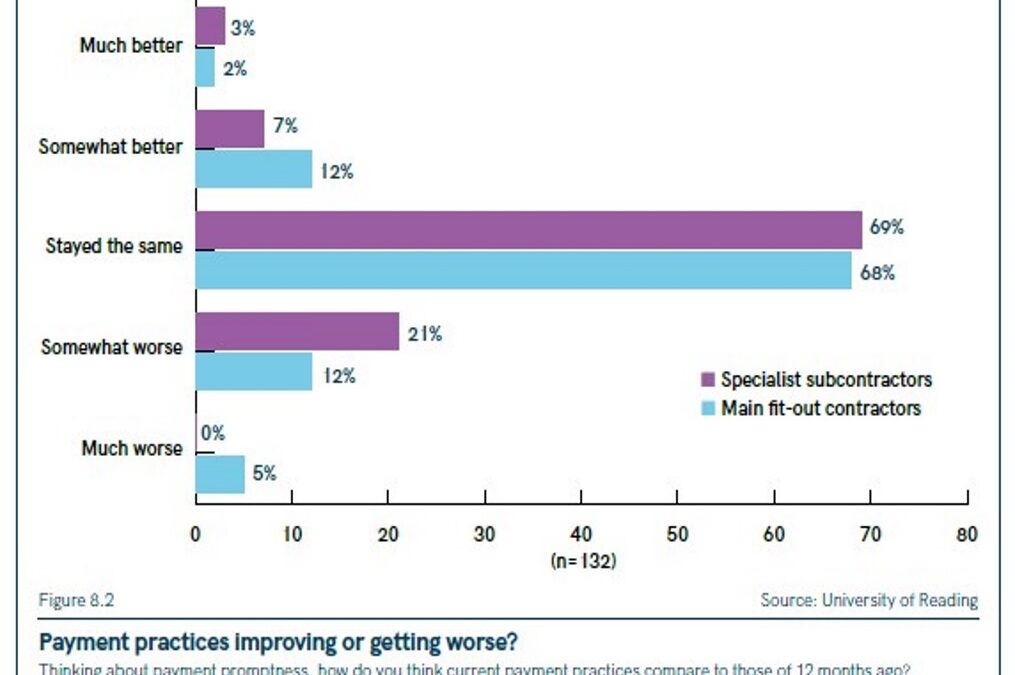
The FIS response draws on recent research conducted by the University of Reading into procurement, contractual and payment practices in the sector.  It challenges headlines indicating that payment in construction was improving, on the basis of flawed data that fails to measure the value of invoices paid and is opened to being gamed.  As it stands companies only need to report on the percentage of invoices paid, but does not measure value.  Whilst the guidance does make clear that invoice in construction should mean application, this is not regulated and there is little to no enforcement of how companies are reporting.   This misleading dataset masks a cancer at the core of construction that is killing businesses and ruining lives.

In the response FIS makes it clear that whilst metrics on the average percentage of volume of payments made are useful but fail to give us a true picture of payment performance.  As it stands efficient payment of small invoices for e.g. business facilities or stationary could mask differing practices within the construction sector, typified by larger payments. The FIS also recommends that Duty to Report obligations should be incorporated into annual Audit requirements to ensure that there is third party scrutiny of auditing practices.

The FIS is also calling for a clampdown on retention practices.  FIS Research dentifies 33% of main contractors always secure retention, compared to 14% of specialists.  This concern here is that a significant proportion of retention that should cascade through the supply chain is actually realised as profit.  FIS continue to advocate for the ultimate abolition of retention, but in the interim, to ensure that retentions are protected, associated only with the work packages undertaken and AUTOMATICALLY RELEASED based on a defined date (rather than abstract event).  This should be Regulated and monitored to prevent nefarious practices.

In a seperate consulation the FIS has applauded the efforts of the Small Business Commissioner recommending that the Office is strengthened, responsibility in the construction sector is extended and that the office is given more resource and greater powers to support SMEs in the supply chain.

You can read the full FIS Payment and Retentions Submission 2023 here and response to the Small Business Commissioners Consultation here.

The consultation closes at 11:45pm tonight and FIS has also prepared a template response to encourage members to feed their views in here.