
by Clair Mooney | 9 Jun, 2023 | Main News Feed, Sustainability
Minister for Industry and Economic Security Nusrat Ghani MP joins industry leaders today to launch a plan to eliminate the use of diesel from most UK construction sites.
Over the last year, representatives from across the industry have collaborated on the development of Zero Diesel Sites Route Map, a key element of the Construction Leadership Council’s CO2nstruct Zero programme to decarbonise the industry.
The launch took place on HS2’s Old Oak Common Station construction site, which is progressing towards cleaner construction as part of HS2’s target for all its sites to be diesel-free by 2029.
Following consultation on a draft plan late last year, today’s Route Map confirms the industry will:
• Put in place support to roll out hydrogen, electricity and other cleaner power sources;
• Promote early wins by boosting efficiency and cutting diesel use by existing plant, and asking companies to reduce the use of diesel generators;
• Helping businesses to develop their own company’s diesel reduction plans;
• Engaging with clients to secure commitments that ban diesel use and
• Tracking data on industry diesel consumption to confirm progress over time.
There are currently an estimated 300,000 items of Non-Road Mobile Machinery (NRMM) used by the UK construction sector. Typically, such plant is powered by diesel consuming 2.5 million tonnes of oil equivalent (Mtoe), generating significant carbon emissions.
The Zero Diesel Sites Route Map sets out practical measures to reduce this volume by 78 per cent by 2035, in line with the UK’s Sixth Carbon Budget published in 2021.
Minister for Industry and Economic Security Nusrat Ghani said:
“Cutting carbon emissions in construction is vital to achieving our net zero ambitions by 2050. That’s why I’m pleased to see the leadership the sector is showing by publishing this new Route Map, helping us move forward towards a cleaner, greener industrial future.”
Neil Wait, Head of Environmental Delivery at HS2 Ltd and Chair of the Zero Diesel Route Map Working Group, said:
“The carbon challenge we face is significant and can only be overcome if we show real determination in a push for change. HS2 Ltd has played a key role in the development of the Route Map and is already making great progress with 19 diesel-free construction sites on the project. Today’s launch is a tangible demonstration of the industry’s shared commitment to radically cut our reliance on diesel. I would encourage companies to get involved and support the move towards cleaner, greener construction.”
Matt Palmer, CO2nstruct Zero Programme Sponsor and Executive Director, Lower Thames Crossing said:
“One of the strengths of the Construction Leadership Council is its ability to bring the industry together to identify and commit to actions that will change our sector for the better. The Zero Diesel Route Map is a perfect example of this, setting a clear mission that everyone can sign up to support.

by Clair Mooney | 26 May, 2023 | Skills
Funding is available to support individuals achieving a Level 2 NVQ in Drylining (London based) and a Level 3 NVQ in Occupational Working Supervision (London and Birmingham based only).
Candidates must be 19+ years old and if the employer is CITB registered and up to date with its levy return, there are substantial grants available to cover the cost of the training. Full details below.
London ONLY
Level 2 NVQ in Drylining – heavily discounted and if you are CITB registered and up to date with your levy you may receive £600 grant cover plus cash back.
200 places remaining.
Level 3 NVQs in Occupational Working Supervision – FREE and you will be able to claim back £600pp if you are CITB registered and up to date with your levy return.
70 places remaining.
Birmingham – ONLY
Level 3 NVQs in Occupational Working Supervision – FREE and you will be able to claim back £600pp if you are CITB registered and up to date with your levy return.
10 spaces remaining.
Don’t miss out on accessing this valuable funding. For more information contact Marie Flinter at FIS on 0121 707 0077 or email marieflinter@thefis.org

by Clair Mooney | 26 May, 2023 | Building Safety Act
Build UK has updated its comprehensive guide to the building safety regime to reflect the latest secondary legislation and guidance that has been published. Changes in the May 2023 version include:
- Updated guidance on the Safety Case which must be prepared by the Principal Accountable Person
- The latest information on the new building control system, including the Operational Standards Rules for Building Control Bodies and competence framework for Building Inspectors
- A link to the Independent Review of the Construction Products Testing Regime led by Paul Morrell OBE, Testing for a Safer Future
- A link to the guide on safety‐critical elements published by the CIOB in partnership with RIBA.
Build UK has also published a timeline showing when key changes are taking effect to support the implementation of the Building Safety Act. There will be further changes over the next 12 months, including the introduction of new regulations, and the timeline will be regularly updated alongside the guide to help provide clarity for members.
by Iain McIlwee | 25 May, 2023 | Market data
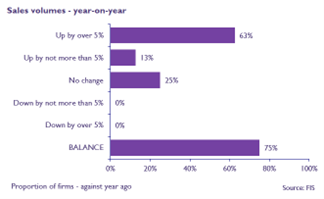
Uncertainty surrounded the start of 2023 in the finishes and interiors sector with concerns (particularly in the housing sector) resulting in 32% of respondents seeing a reduction in workloads. Whilst there remain underlying concerns related to ongoing inflation and a rising cost of capital impacting viability and delaying starts, 37% did experience increases and confidence has built through the quarter.
Commenting on the release, FIS CEO Iain McIlwee said:
“The data here was timely as we met wiith Bank of England representatives this week along with a small delgation of construction organisatons led by BuildUK. The overall situation remains that things are more positive for most than many had anticipated. There remain some clear risks and uncertainty that will mean growth overall in the economy is likely to remain subdued and this will have an impact on construction. Interest rates will be key, with inflation reports this week slightly higher than anticipated and consequently the 5.0% peak anticipated rates is already being talked up and we have seen a reaction from certain high street banks increasing mortage rates. The cost of mortgages and finance for large commercial projects will remain a key risk.
The election will also have a distorting effect, with Autumn 2024 a probable date. How policy adapts to drive home ownership and construction and encourages investment from business will again be key. The long term need to get building homes and hospitals as well as redeveloping commercial space to meet modern requirements and sustainable goals is all positive, but how policy drives this may be limited by political motivations.
Resiliance in the supply chain too remains a concern with higher levels of insolvency in construction driven by aggressive procurement and cash/credit issues that are being cascaded through the supply chain and leaving SMEs vulnerable. The full impact of the Building Safety Act and legacy are still to be fully understood.”
Read the full state of FIS State of Trade Survey Here – FIS State of Trade Survey Q1 2023
See Also – CPA survey reveals a cautious improvement in Q1
After the uncertainty-filled end to 2022, conditions have become more settled in Q1 with product manufacturers’ sales and contractors’ workloads indicating an improvement in conditions for construction.

by Clair Mooney | 25 May, 2023 | Sustainability
The Carbon Reduction Code for the Built Environment has been updated to Issue 3.0 May 2023. The Code provides a mechanism that enables individual organisations to publicise their annual decarbonisation progress, and thereby collaborate and share best practice on their journey to Net Zero with the intention of accelerating progress across the industry.
Part of the Construction Leadership Council’s Construct Zero initiative, the Code brings together and aligns the plethora of sector wide initiatives. It is referenced in key documents such as the UK Construction Playbook, September 2022, the UKGBC Roadmap, and the UK Government Guidance Note Promoting Net Zero Carbon and Sustainability in Construction, September 2022. The new version of the Code and the sign-up process are available on the CSIC website.
Who is the Code for, and what makes it different?
The Code is designed for clients, contractors and supply chain members working in the built environment. In order to enable wide participation, organisations may join at a global, national or regional level as well as at a major project level.
The Code is also not prescriptive, but instead asks organisations to report their progress year on year, to keep their accreditation, setting it apart from standards. It is also designed to be collaborative, with the ability to influence the onward supply chain.
What do organisations need to do to comply with the Code?
The Code offers three levels of commitment:
- Core commitments for all organisations;
- Core commitments for client organisations and further commitments to facilitate the transition to Net Zero;
- Core commitments for supply chain organisations and further commitments to facilitate the transition to Net Zero.
All organisations must be in accordance with the minimum entry level of compliance to attain Pledger status. This means agreeing to the core commitments of setting out plans to meet net zero by 2045, including annual targets, and publishing these and the progress made against them every year. Pledger levels also requires setting an interim target to reduce net direct and indirect carbon emissions for 2030, which aligns with or exceeds government strategy. Signatory level requires signing up to additional core commitments relevant to the organisation – be it client or supply chain, and Champion level sees commitments to more ambitious collaborative progress.
What has changed since the last issue?
A complete list of changes from the last issue of the Code are listed in the Code FAQs. A key addition is that of a third core commitment – Commitment 1.3 – which requires organisations to provide clarity on which carbon-offsetting schemes they are using if any. Current Code compliant organisations should also consult the Code FAQs, which explain the version of the Code with which organisations would need to comply at renewal.
How do organisations sign up to the Code?
The Code signup form is available on the on the CSIC website. The form is accompanied by a downloadable Excel spreadsheet listing all the information required to make the sign-up process easy to complete. There is no cost to signing up to the Code.
Dr Jennifer Schooling OBE, Director of CSIC, states:
“The Code recognises that we must start making meaningful change, and we have to start making it today. Not tomorrow, not next week and certainly not next year. I urge you to visit the CSIC website to read this new issue of the Code to understand what is required and sign up. By working together towards a greater good we all make progress. Collaboration and commitment will be key to success, and with alignment of ambition across all parties we can progress towards net-zero carbon at the pace required. The Code provides an encouraging, supportive and collaborative approach to reducing carbon. It is essential that our industry reduces carbon emissions and the more organisations that sign up to the Code, the more we will achieve.”
by Clair Mooney | 25 May, 2023 | Main News Feed, Market data
Surveys from across the construction supply chain showed a more encouraging performance in the first quarter of the year after the uncertainty-filled end to 2022. Looking back to what preceded the opening three months of 2023, the failed Mini Budget from the short-lived Truss government resulted in financial market turmoil, consecutive interest rate rises from the Bank of England, a collapse in housing market demand and widespread reticence to start new projects. As conditions became somewhat more settled in the new year, product manufacturers’ sales, and SME contractors’, civil engineering contractors’ and chartered surveyors’ workloads indicate that there has been an improvement in conditions for construction. However, this is from a low point and net balances remain muted which, in turn, points to only a cautious pickup as the economy still struggles to gain momentum in the light of high rates of inflation and limited growth. Certainly, cost inflation across inputs within construction are still reported as being historically high, exerting downward pressure on margins and likely adding to client hesitation in signing off new work. Forward-looking indicators such as enquiries and new orders point to weakness lingering in new house building, commercial and industrial, but demand strengthening in public non-housing, RM&I and, in particular, infrastructure work linked to energy generation or storage.

by Clair Mooney | 18 May, 2023 | Main News Feed
Following the decision by the Competition and Markets Authority (CMA) earlier this year to fine 10 demolition and asbestos removal firms almost £60 million for colluding to rig bids for contracts, Build UK has updated its guidance on preventing anti‐competitive behaviour in construction.
The guidance, which is available to FIS members here, has been written by Wedlake Bell LLP and explains common violations of competition law, such as cartel activities and cover pricing, with the latest CMA decision now included as a case study. It is designed to help businesses and directors comply with their legal obligations by explaining the risks and the steps they should take.
by Clair Mooney | 18 May, 2023 | Material Shortages
Statement from John Newcomb, CEO of the Builders Merchants Federation and Peter Caplehorn, CEO of the Construction Products Association, co-chairs of the Construction Leadership Council’s Product Availability working group
For the first time since this group began meeting at the height of the pandemic, there is good availability of the vast majority of building materials across the UK, with increasing reports that availability is back to pre-Covid levels.
Some issues continue around products reliant on semi-conductors, but the general feeling is that this is slowly improving.
While there has been a slight decline in construction activity, the industry overall is performing better than forecasted six months ago. With demand lower than at this time last year, there is also less pressure on prices. As a result, early indications suggest prices for many products appear to be stabilising and in isolated cases even declining from recent highs, though volatility persists.
This does, however, vary by sector and sub-sector. For example, RMI work in both the public and private sector housing to support decarbonisation and improve energy efficiency is driving sales of insulation products Manufacturers in this area are seeing volumes ahead of expectations but are managing supply.
As reported last month, brick stocks have increased due to a slowdown in the housing market and increased production. There are approximately 8 weeks of bricks in stock and, with new plants in the UK coming on stream over the next 6-12 months, the UK’s reliance on more expensive imports to top up stocks will fall rapidly.

by Oscar Venus | 16 May, 2023 | Main News Feed
Since the year began the FIS team have been hard at work and achieved some brilliant results across out Technical, Business Development, Skills and Training, and Lobbying efforts. Here’s a short look back at the first 3 months of 2023
Key technical work
Business support and guidance
- New Best Practice Guide to help contractors and subcontractors improve cashflow and prevent costly and damaging disputes
- New FIS Standard Terms and Conditions for England, Scotland and Wales launched
- Wage Rate and State of Trade Surveys published
- New QS helpline has been instrumental in a number of disputes being resolved positively.
Lobbying and representation
- Procurement Research published, and data featured in Times Article
- Responded to Fire Classification and BS476 withdrawal from Building Regulations
- FIS work on the interim review by the Migration Advisory Committee saw Dry Lining as the only trade reviewed and moved to the Skilled Worker list and a number of FIS Trades added to the Shortage Occupation List
- FIS invited to speak and support workshops hosted by the Construction Leadership Council, Department for Business and Trade and Small Business Commissioner on payment practices
- Invited to attend the inaugural Building Safety Conference, hosted by the Building Safety Regulator
- Responded to RICS professional statement consultation for whole life carbon
Skills and training
Key Events
- FIS Conference at Workspace Design Show at the Building Design Centre in Islington
- Hosted Inaugural FIS Innovation Awards
- Manchester Regional Meeting
- Webinar on Increasing circularity and reuse in fit-out projects
Download this doc here