
by Oscar Venus | 17 Aug, 2023 | Contractual and Legal, Main News Feed
The last few months have been hectic working for several construction organisations who are members of the various bodies that make up CICV.
I have seen an alarming increase in the number of organisations that are suffering from payment and cash flow issues, and these are probably putting a strain on the finances of the business and more strain on the mental health of those who run the businesses. What appears to be a regular feature is that organisations don’t respond to payment applications, don’t respond to emails requesting information and just put up a wall of silence, and then they start to reduce payment applications with some spurious excuses, and contracting organisations go round and round not knowing where they are going.
By inventing all sorts of excuses one can keep a subcontractor at arm’s length for weeks if not months, providing prevaricating excuses for not paying.
Members can see the full blog by clicking the button below

by Oscar Venus | 17 Aug, 2023 | Health and Safety
The BSR’s recent webinar provides an overview of the new building control process, as well as the new duty holder roles and three Gateways, and members can register to watch it back on demand.
Starting from October 1st, the Building Safety Regulator (BSR) will officially take on the role of Building Control Body for higher-risk buildings, with plans to provide a transitional period for ongoing projects. For all other buildings, the Building Control Body can be either a department in the Local Authority or a Building Control Approver, a private company that provides Building Inspectors. Building Inspectors will be required to undergo an assessment and certification process in order to register with the BSR between October 2023 and April 2024. The Chartered Association of Building Engineers (CABE) and the Building Safety Competence Foundation have been announced as the first independent competence assessors to partner with the BSR.
The BSR recently conducted a webinar that provides an insightful overview of the new building control process, the new duty holder roles, and three Gateways. Members who missed the webinar can register to watch it on demand at their convenience. The BSR’s new role as the Building Control Body for higher-risk buildings is a significant step in ensuring the safety of building occupants and reducing the risk of future disasters.

by Iain McIlwee | 16 Aug, 2023 | Health and Safety
From September – HSE site inspections across Great Britain to focus on moving and handling materials
Starting in early September 2023, HSE will be undertaking construction site inspections, focusing on moving and handling construction materials. The inspections will be checking employers and workers know the risks, plan their work and are using sensible control measures to protect workers from injuries and aches, as well as pain and discomfort in joints, muscles and bones known as musculoskeletal disorders (MSDs).
These injuries can have a serious impact on workers’ ability to perform tasks; their quality of life; and in some cases, their ability to stay in work and earn a living.
This latest health inspection initiative is supported by the ‘Work Right Construction: Your Health Your Future’ campaign to improve the long-term health of those working in construction.
Find out more about the campaign by visiting:
The supporting resources from HSE includes a range of posters and site signage and guidance in the form of:
Commenting on this campaign FIS CEO Iain McIlwee stated:
“The concept of Occupational Health is an area that there has been growing understanding of in recent times. We have a responsiblity, not just in terms of safety, but looking after the long term health of our workers and limiting the potential damage that can result from lifting heavy items. There is more work to be done here to support a more inclusive workforce too as well as helping to extend careers in the sector and ensure that we optmise productivity and attack the labour shortage from all angles.”
Specialist advice is available from FIS to support activities including a free helpline and Health and Safety Working Group that convenes to review accidents and exchange best practice where necessary, latest guidance includes:
FIS Manual Handling Guide: Safe handling of plasterboard (which is relevant for all moving board type material) and Recommendations for the safe ingress of plasterboard (which looks at how material should be moved through the site). Members also have access to AWCI: Safe Work Practices for Wall and Ceiling Industry Construction Workers, a guide developed for the US market, but has been made available to FIS members through our partnership with AWCI).
The FIS Health and Safety Toolkit is available here
by Clair Mooney | 8 Aug, 2023 | Market data
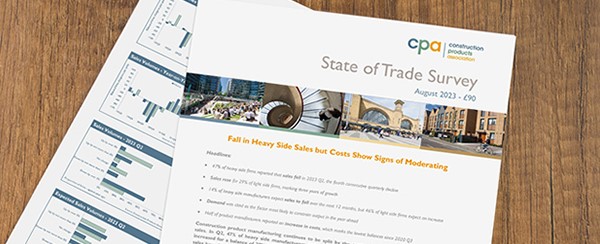
The Construction Products Association’s latest State of Trade Survey for 2023 Q2 showed a continued split in performance in the construction product manufacturing industry. Heavy side manufacturers’ sales decreased for a fourth consecutive quarter whereas sales from light side producers registered another quarterly increase, adding to a run of growth that began in 2020 Q3. Forward-looking sales expectations suggest these varied fortunes will persist over the next 12 months.
Rebecca Larkin, CPA Head of Construction Research said:
“The mixed fortunes for heavy side and light side sales growth perfectly illustrates the areas of strength and weakness that are appearing in construction right now. Heavy side sales have no doubt been hindered by the sharp slowdown in new house building and hold-ups in starting large new build commercial and factories projects.”

by Clair Mooney | 8 Aug, 2023 | Main News Feed
This time of year brings open consultations on the changes the government may introduce next year. The next big thing coming in our direction from the Treasury is a raft of new proposals relating to the use of umbrella companies. If you use umbrella companies, we recommend having a look at the consultation document and adding your voice to the discussion.The consultation is open until 29 August.
In other tax news:
- HMRC has confirmed that the CIS helpline remains open
- There is an online guide to check if you can correct a mistake in your VAT return
- National Insurance numbers can now be saved to and downloaded from the iPhone Apple Wallet
- Ensure you have the correct classification for diesel cars
Lastly on 18 July, the government released draft legislation for next year’s Finance Bill and introduced consultations on future tax policy changes. These inlcude:
- Companies: Consultation on merging R&D Tax Reliefs into a single scheme.
- Plastic Packaging Tax: consultation on using a mass balance approach to determine the amount of chemically recycled plastic in packaging.
Full details on all of the above, plus more is available exclusively to FIS members, here.

by Oscar Venus | 8 Aug, 2023 | Drylining, Labour, Skills
Sector Based Work Academy – West London College
Registration – Friday 22nd September, 10am
Starts – Monday 25th September, 10am
Location – Southall Community College , Beaconsfield Road, Southall, UB1 1DP
What we are asking members to do is to support with the work experience and guaranteed job interview
✔Pre-employment training – focusing on requirements for the construction sector
✔Relevant sector ‘tickets’ including Health and Safety
✔Work experience placement – a great opportunity for a business to identify talent and for the individual to cement their knowledge and understanding of the required role
✔A guaranteed job interview or help with an employer’s recruitment process
Sector-based work academies are a valuable resource for those looking to transition into a new field of work. These academies provide training and education to individuals who are currently receiving unemployment benefits, with the goal of preparing them to apply for jobs in a different sector.
The placements offered through sector-based work academies are specifically designed to meet the immediate and future recruitment needs of employers. By providing individuals with the skills and knowledge necessary to succeed in a particular field, these academies help to recruit and sustain a workforce that is equipped to grow and develop a business.
Overall, sector-based work academies are a powerful tool for both job seekers and employers. They provide a pathway for individuals to transition into new fields of work and help businesses to find employees with the right skills to thrive.
The 2 Week program is designed with the aim of preparing individuals for employment in the construction sector. The program is made up of various components including pre-employment training, sector tickets, work experience placement and guaranteed job interviews. These components are put together to ensure that individuals are equipped with the necessary skills and experience to succeed in the construction sector.
Pre-employment training is an important aspect of the program as it focuses on the requirements for the construction sector. During this training, individuals will be taught about the various roles in the sector and the skills required to succeed in these roles. The training will also cover topics such as health and safety, communication and teamwork.
Relevant sector tickets, including health and safety, will also be provided to individuals as part of the program. These tickets are important as they demonstrate that individuals have the necessary skills and knowledge to work in the construction sector. Employers in the sector often require individuals to have these tickets before they can be employed.
The program also includes a work experience placement which provides individuals with the opportunity to gain practical experience in the sector. This is a great opportunity for businesses to identify talent and for individuals to cement their knowledge and understanding of the required role.
Finally, the program includes a guaranteed job interview or help with an employer’s recruitment process. This ensures that individuals have the best possible chance of securing employment in the construction sector.
For more information or to sign up to the course please email Beena Nana

by Clair Mooney | 8 Aug, 2023 | Membership
Entry is now open for the 2024 FIS Innovation Awards.
Now in their second year, the Innovation Awards are open to all companies operating in the finishes and interiors sector and focus on ideas that help support improvements in efficiency, productivity, performance, quality or perception of the finishes and interiors sector.
The Award categories are:
- Product Innovation – Fit-Out
- Product Innovation – FF&E
- Digital Innovation
- Sustainable Innovation
There will also be an overall Innovation of the Year. This will be chosen live by the audience during the awards ceremoney from the winners of the above four categories.
The awards will be judged by a panel of experts and winners will be announced at the FIS Conference, which is taking place during the Workspace Design Show in February 2024.
Entry will close on 31 October 2023. For more information and to enter click here.
FIS Chief Executive Iain McIlwee said:
“There remains a perception that construction is not an innovative sector, our aim with these awards is to debunk this myth and celebrate innovation in our sector across a number of categories. We are looking for innovation that meets a need in the sector and has evidence of adoption or planned use in a commercial environment. So, the successful exploitation of new ideas and bringing creative ideas to life.”
Joe Cilia, FIS Technical Director, added:
“I can think of at least four products which I have seen in the last few years that have been developed by both large and small
organisations based on need to improve quality, address sustainability or save time and I am looking forward to these awards
to be the showcase they need to get to a wider audience.”
The FIS Conference will be a two-day programme on 27-28 February at the Business Design Centre in London. There will be several 1-hour workshops each day, with the winners of the Innovation Awards announced at the Awards Ceremony on 27 February.
More information on the Conference will be available shortly.

by Iain McIlwee | 1 Aug, 2023 | Main News Feed
It has been confirmed that the next edition of JCT (JCT 2024) is anticipated to be issued in the early part of next year. The final decision on the release date will be determined by when the secondary legislation necessary to implement many of the provisions of the Building Safety Act 2022 has been published (expected to be finalised by October 2023).
What are the key changes:
Modernising and streamlining: changes will include the adoption of gender-neutral language, provision for execution by electronic signature and the facility for notices to be sent electronically.
Fluctuation provisions: Price uncertainty is set to continue and the JCT has launched a new fluctuations hub to offer guidance on its Fluctuation Options and also plans to move the fluctuation provisions to an online document to increase prominence and accessibility. Currently, fluctuation Options B & C are available online while Option A features in the JCT contracts.
Extensions of Time: There will be new relevant events to cover epidemics, updates to how ‘statutory powers’ are dealt with and ‘Statutory Undertakers’ will be redefined to ‘Statutory Providers’. In addition, the period of time for the Employer to assess an interim extension of time will be reduced from 12 weeks to 8 weeks from receipt of the Contractor’s particulars. The relevant event dealing with antiquities will be extended to deal with UXB’s, contamination and asbestos.
Loss and expense: The Contract Particulars will provide for parties to include optional additional grounds for the contractor to claim loss and expense. These include epidemics and the exercise of statutory powers by the UK Government which directly affects the works. The relevant matter dealing with antiquities will be extended to deal with UXB’s, contamination and asbestos.
Liquidated damages: The JCT is also making amendments to reflect the Supreme Court’s decision in Triple Point Technology Inc (Respondent) v PTT Public Company Ltd (Appellant) (2021). The decision restores the orthodox position that liquidated damages clauses apply up to termination of a contract, but not thereafter. Clear wording must be used if parties want to agree a different approach. The planned updates to the JCT will provide that where works are not complete at termination, LDs can be levied up to termination and only general damages for delay can be claimed thereafter.
Resolving disputes, arbitration and adjudication: Parties will be able to choose a nominating body or appointer of their choice, as opposed to the original short list. However, it is anticipated that the particulars will still include a list of bodies, as the AICA is being removed (due to it now being defunct). The notification and negotiation of disputes, set out at Supplemental Provision 10, will no longer be an optional provision. Subject to the parties right to refer a dispute to adjudication, this provision deals with the avoidance or early resolution of disputes or differences by requiring each party to promptly notify the other of a matter that is likely to give rise to a dispute or difference. It also requires senior executives to meet “as soon as practicable, for direct, good faith negotiations to resolve the matter”.
Allocation of risk: There will be a new provision added to the contract to deal with unexploded ordnance, contaminated materials and asbestos.
Legislative changes: There will be updates to reflect recent legislation including the Building Safety Act and its secondary legislation (once this has been finalised) and the two new insolvency grounds that were introduced under the Corporate Insolvency and Governance Act 2020 will be added.
Construction Act: There will be revisions to termination accounting provisions to reflect the requirements of the Construction Act, in particular a due date for the final payment after termination will be added.
Future proofing: The contract has been drafted with consideration to the Construction Playbook, sustainable development, collaborative working and environmental considerations.
In addition, a new set of contracts will be added to the suite. The Target Cost Contract, the Target Cost Sub-Contract and the Target Cost guide will be published alongside the updated suite.
While the final amendments are not released yet, the above is understood to be a good guide for the changes that are being implemented.
Commenting on the changes, FIS CEO Iain McIlwee stated:
“Changes to JCT are long overdue, there has been a lot of water under the bridge since 2016! But, whilst the changes are welcome, recent research by Reading University points to the fact that the very concept of a standard form of contract is to all extent and purposes almost dead.
It is vital that these changes are heralded with some real leadership making it clear that the contracts are designed to be used in an unamended format. Where amends are deemed necessary the users should be cautioned against “risk dumping” and the contracts should be deemed invalid unless changes are clearly marked up in the body of the contract instead of included in an unwieldy schedule of amends.
The new Building Safety Regulations emphasise that risk should be dealt with by the person most able to manage it – there is a huge opportunity for JCT to get behind this principle and champion the import of standard and unamended contracts.”
This summary of the changes is based on content in the latest edition of JCT News

by Iain McIlwee | 1 Aug, 2023 | Technical
The Department for Business and Trade announces an indefinite extension to the use of CE marking for UK businesses, but DLUHC (who regulate Construction Products) have indicated that this extension will not apply to construction products.
The Department for Business and Trade (DBT) has announced today a package of smarter regulations designed to “ease business burden” that includes recognition of the CE mark in the UK beyond the 2024 deadline. This means British firms will be able to continue the use of CE marking alongside UKCA in perpetuity. But, FIS have been informed that this easement relates only to the 18 sectors that fall under DBT – it does not apply to construction products.
Announcing the change Business Minister Kevin Hollinrake stated:
“The Government is tackling red tape, cutting burdens for business, and creating certainty for firms – we have listened to industry, and we are taking action to deliver. By extending CE marking use across the UK, firms can focus their time and money on creating jobs and growing the economy.”
DLUHC have indicated to the Construction Products Association (who are leading representation on this matter through the Construction Leadership Council) that recognition for construction products will continue until 30th June 2025 ONLY. The rationale offered is that the Government remains committed to ensuring the testing regime for construction products is effective and inspires public and market confidence. DLIHC have indicated that they will set out their proposals for reform of the construction products regime in due course.
Commenting on this announcement FIS CEO Iain McIlwee stated:
“The logic is hard to follow here. All the arguments about red-tape, business burden, avoiding cliff edges and refocussing on innovation and growth that apply are replicated, even magnified, in the construction sector. The unnecessary re-testing of product that transitioning to UKCA necessitates is a waste of resource and, particularly in the case of fire safety, precious furnace time. The Government talk about pragmatism, but this is not extending to construction and that is disappointing and frustrating in equal measure. I only hope that “due course” considers, but doesn’t conflate the need to focus on product safety, which is a very separate and significantly more important issue to address.”
You can read the full announcement here.
