
by Iain McIlwee | 2 Sep, 2020 | Main News Feed
The new UK domestic regime will cover most goods currently subject to the EU’s CE marking. The technical requirements for these goods will be the same on 1 January 2021 as they are now. However, there will be certain changes, including the introduction of the UKCA marking and a system of third-party conformity assessment by UK-recognised approved bodies, in place of the current EU system of notified bodies.
There will be a ‘standstill period’ which for most CE marked goods will last from 1 January 2021 the 31 December 2021. During this time businesses are encouraged to be ready for full implementation of the new UK regime as soon as possible after 1 January 2021. However, to allow businesses time to adjust, CE marked goods in scope of this guidance that meet EU requirements (where these match UK requirements) can continue to be placed on the GB market until 1 January 2022 where EU and UK requirements remain the same. This includes goods which have been assessed by an EU recognised notified body.
These transitional measures will only apply until the 1 January 2022. From this point the UKCA mark will be required to be displayed on products, where the CE mark is currently used, to show compliance to the UK domestic regime. To ease the burden on businesses, until the 1 January 2023 for most UKCA marked goods you have the option to affix the UKCA marking on a label affixed to the product or on an accompanying document. The economic operators (whether manufacturer, importer, or distributor) should take reasonable steps to ensure the UKCA marking remains in place. From 1 January 2023, the UKCA marking must, in most cases, be affixed directly to the product. You should start building this into your design process ready for this date.
There are four links to guidance we would like to bring to your attention:
- Placing UKCA and CE marked goods on the GB market from 1st January 2021: www.gov.uk/guidance/placing-manufactured-goods-on-the-market-in-great-britain-from-1-january-2021
- Placing manufactured goods on the EU market from 1st January 2021: www.gov.uk/guidance/placing-manufactured-goods-on-the-eu-market-from-1-january-2021
- Prepare to use the UKCA marking from 1st January 2021: www.gov.uk/guidance/using-the-ukca-mark-from-1-january-2021
- Conformity assessment bodies: status from 1st January 2021: www.gov.uk/guidance/conformity-assessment-bodies-change-of-status-from-1-january-2021
Specific additional guidance has been provided for products covered by the Construction Products Regulation from 1 January 2021.
The Construction Products Association have produced an excellent summary for FIS Members in terms of what we currently understand about the Construction Products Regulations from 1st January 2021.
To access the FIS Ready for Brexit Toolkit, click here

by Clair Mooney | 1 Sep, 2020 | Main News Feed
Calling all apprentices, employers, and individuals who champion apprenticeships… the National Apprenticeship Awards 2020 are now open for entries!
Back for their 17th year, the National Apprenticeship Awards are a fantastic opportunity to showcase the apprentices, employers and champions who have gone above and beyond, in spite of the challenges faced during this pandemic.
Entries to the awards are open until 25 September 2020 and this year’s winners will be recognised via virtual ceremonies. It is free to enter the awards, and all entries must be made through www.appawards.co.uk
There are nine categories to recognise exceptional employers, apprentices and apprenticeship champions:
Employer of the Year categories
• SME Employer of the Year (for organisations with 1 to 249 employees)
• Large Employer of the Year (for organisations with 250 to 4,999 employees)
• Macro Employer of the Year (for organisations with 5,000+ employees)
• Recruitment Excellence (the winner is selected from Employer of the Year award entries, and will be awarded to an organisation that has recruited a diverse and high quality apprenticeship workforce).
Apprentice of the Year and Apprenticeship Champion categories
• Intermediate Apprentice of the Year (level 2)
• Advanced Apprentice of the Year (level 3)
• Higher or Degree Apprentice of the Year (level 4 or higher)
• Rising Star of the Year* (nominated by their employer, this award recognises apprentices that have made impressive progress in their career to date, and have the potential to go even further)
• Apprenticeship Champion of the Year (recognises individuals who go ‘above and beyond’ to champion apprenticeships. The nomination is made by a colleague or contact who recognises an individual’s ‘champion’ credentials).
* The Rising Star category will not include a public vote this year due to the condensed format of the awards
There are two webinars to explain the awards process in more detail, including hints and tips on completing your application. These can be accessed here:
• Employer and Rising Star webinar
• Apprentice and Apprenticeship Champion webinar
Regional Ceremonies will take place online between 2 and 6 November, with the national ceremony taking place online on Wednesday 25 November.
To find out more about the National Apprenticeship Awards 2020 please visit: appawards.co.uk

by Clair Mooney | 1 Sep, 2020 | Main News Feed
CITB is looking to offer remote learning as a permanent delivery format. To ensure that what they offer really meets industry needs CITB would like to collect information on the following areas:
- Which employers are requesting and/or would be interested in remote learning continuing to be on offer from CITB?
- What employers reflect are the benefits and/or advantages of remote learning continuing? (i.e. easier for the workforce to undertake, reduces costs, travel, overnight stays etc.)
- Which training courses would employers like to remain as part of the remote learning offer from CITB?
Responses can be sent directly to Julia Stevens Julia.stevens@citb.co.uk. The closing date is Tuesday 8 September. Please indicate your membership of FIS on your response.

by Clair Mooney | 28 Aug, 2020 | Main News Feed
A draft recovery plan for the construction sector in Scotland has been launched today by the Scottish Construction Leadership Forum (CLF). The plan, which has been created collaboratively with industry, sets out the pathway for joint action between industry and the public sector in response to the impact caused by the global pandemic on the on the construction sector.
The construction industry in Scotland has, like many others, been hit hard by the Covid-19 pandemic. The sector in Scotland which provided £7.8 billion GVA to the Scottish economy and employs 143,000 people in over 50,000 enterprises, is estimated to have contracted by 28.6 per cent in June as a result of the Covid-19 pandemic compared to the same month a year ago (June 2019).
The recovery plan has been created through extensive consultation and collaboration with more than 50 organisations across business, Scottish Government, trades unions and other bodies, including the Construction Industry Coronavirus (CICV) Forum, and represents a shared view from across the sector of a plan to get industry back on its feet.
The plan outlines the immediate and short-term response to Covid-19 and sets out a pathway between this and the longer-term transformation required to build a stronger, fairer and greener economic future for Scotland.
Peter Reekie, chief executive of the Scottish Futures Trust and chair of the editorial group of the Construction Leadership Forum, said: “The construction industry in Scotland has received a major blow from the Covid-19 pandemic. However, the level of collaboration which has gone in to preparing this Recovery Plan is unprecedented and sets a strong foundation for transformative recovery for the industry. I urge all stakeholders with an interest in the construction and related industries in Scotland to feed in your thoughts to make it even stronger.”
Ken Gillespie, chair of the Industry Leadership Group, said: “This plan has only been possible through the depth of collaboration across the sector, and hard work of all involved, and demonstrates the sector’s ability to come together in a time of crisis. This is only the beginning though. The plan will evolve and respond to reflect the feedback and the needs of the sector. We are therefore calling for industry to review and contribute to the plan.”
The plan identifies five areas for concerted and collaborative efforts over the coming months and has established Sub-Groups to develop and progress joint action plans:
- Pipeline and Commercials
- Skills and Workforce
- Transformation
- Supply Chain Resilience and Capability
- Industry Data and Insight
The plan calls for key actions to respond to immediate needs which include:
- A clear pipeline of work brought to market quickly and efficiently on fair commercial terms which reflect the reality of the Covid-19 environment.
- Support of employment, fairness of work and those who may become unemployed through what will be a difficult period.
- Transformation of working practices to maintain and enhance worker safety whilst enabling productivity in the Covid-19 working environment.
Housing Minister Kevin Stewart said: “The construction sector supports many other areas of our economy so it is important that we maintain the health and vitality of the industry. In order to develop this plan we have reached new heights of collaboration but we are now keen to hear from the wider industry to ensure that we arrive at a plan that will preserve jobs and help to revive our economy.”
The Scottish Construction Leadership Forum (CLF), which has led the development of the plan, is a collaborative initiative of Construction Scotland and the Scottish Government . It was established in March 2019. Chaired by Housing Minister Kevin Stewart for the duration of the crisis, it widened its membership in response to Covid-19 and has already developed and implemented plans to get the industry safely back to work to develop and implement an action plan of improvement initiatives aligned with Government policies and the Construction Scotland Industry Strategy. Several streams of work are ongoing and prior to Covid-19, the Forum was at the early stages of considering a wider agenda for change across the industry.
The CLF shared vision is of an industry that promotes a safe, productive, profitable, digitally-enabled, low-carbon, and socially responsible construction industry which offers quality jobs and fair work to a highly skilled and diverse workforce and a quality and life-time value product to its customers.
The recovery plan is available to view on https://www.constructionforum.scot/ Industry is invited to provide feedback to the plan via the website by 15 September. CLF will take all feedback on board to help develop the plan further, with regular updates published on the CLF website.

by Clair Mooney | 27 Aug, 2020 | Main News Feed
Today NBS, the leading specification platform for the construction industry, has announced a partnership with trade association Finishes & Interiors Sector (FIS) to drive up standards and compliance through information sharing and best practice amongst construction professionals.
Fit-out is an essential aspect of the construction process, impacting the way a building looks and how it performs. NBS and FIS’s strategic partnership will ensure industry-wide compliance and best practice are pooled, and shared with specifiers, to drive further innovation in the sector.
In line with evolving design standards, this collaboration is part of a mutual commitment to improving the accuracy and quality of specifications, helping to support architects, designers and specifiers’ interpretation of information, and their ability to make informed choices.
For a specifier, interior fit-outs can be complex since there is so much to consider. The partnership seeks to overcome this challenge and provide specifiers with access to latest guidance documentation, informing best practice and validated by industry standards. High quality content and multiple content sets, linking to official design and specification standards are available to download here.
Together, NBS and FIS seek to drive efficiencies, value and better design through specification content and improve the competencies of all that use an NBS Specification, reducing misunderstandings. Utilising NBS Source and NBS Chorus to deliver the most comprehensive, consistent and up-to-date catalogue of building product information and specifications.
Iain McIlwee, CEO at FIS says, “This partnership strengthens our relationship with NBS, taking it to the next level. It draws on the expertise of both organisations to deliver a more consistent and targeted approach in understanding and supporting specifiers’ needs for bold design, better risk management, and compliance.
“Too often detailed design happens long after the building process has started and practical problems undermine intent. Simultaneously, information is not always presented in a way that enables specifiers to make informed choices and compare products and solutions”.
Richard Waterhouse, CSO, NBS, adds, “We are at the epicentre of an evolving construction product landscape, from procedure to policy and with high demand for improved collaboration. With the emphasis of the Golden Thread of Information on the entire design process, manufacturers are being compelled to create a unified and consistent approach to product information, placing accountability at the forefront of decision-making. Specifiers, for their part, are also expected to streamline processes and record details to ensure a safe environment.”
He adds, “Our partnership will enable us to work closely with the FIS and its members to deliver the best quality guidance and consistent standard of information on a single platform that is quickly understood”.
Commenting on the partnership, Sascia Elliott, Head of Partnerships, NBS, says, “Providing high quality information efficiently and accurately, in a cohesive way, promotes best practice and ensures industry structures align. This digital approach to help professionals do their jobs accurately is crucial to promote best practice within the wider construction industry.”

by Clair Mooney | 25 Aug, 2020 | Main News Feed
Raw monthly data underlines growth trend with value of £6.3 billion.
Whilst overall construction output fell by a record 35.0% in Q2, the bulk of that decline occurred in April with data for both May and June showing record output growth. Whilst the normal focus for construction output would be on the more stable quarterly figures, the unusual situation in 2020 means that changes to monthly output data are now in sharper focus. The latest data release from ONS shows that overall construction output increased by 23.5% in June and follows the previous record of 7.6% increase in May. However, despite the strong growth over the last two months construction output in June 2020 is 24.8% below that of February 2020, immediately priorto Covid-19 lockdown. Data for June shows 22.5% increase for new work compared to May whilst RMI output increased by 26.0%. New housing was particularly positive with 39.0% increase for the public sector whilst private sector housing output increased by 42.3%.
The private commercial sector registered a 25.5% increase on the previous month whilst infrastructure new work was more subdued with 6.7% increase.
The UK construction sector in August 2020 is firmly on the path to recovery with output for May and June showing some bounce back. In addition, contract awards data for June and July is extremely positive indicating that the 51.1% slump in new orders in Q2 might be allayed to some extent in Q3. In addition, the Business Impact of Coronavirus Survey undertaken by ONS indicates that the construction sector had 75.5% of staff working at their normal place of work or working remotely between the 15 and 28 June 2020.
FIS members can access the full report here.

by Clair Mooney | 20 Aug, 2020 | Main News Feed
The Construction Leadership Council Smart Construction Dashboard demonstrates housing sector performance using a set of agreed KPI’s and Benchmarks. The dashboard contains maturity metrics for cost, digitisation, waste, energy, productivity (pre-manufactured value), carbon, health, safety and speed of build, and wellbeing. Since the first release of the dashboard in October 2018the sector has evolved. The UK government’s construction transformation funds has enabled housing projects to focus on future performance and innovation. Covid-19 has substantiated the requirement for an accelerated approach to deliver Smart construction. Digital technologies are gaining momentum in the sector, with leading contractors embracing and investing in advanced manufacturing and measurement. We are observing substantial progress with investment to transform the sector, such as the Urban Splash £90M deal with Sekisui, as well as TopHat receiving investment of £75M from Goldman Sachs.
In 2019 our CLC Innovation in Buildings workstream measures working group merged with the demonstrator projects and business case working group enabling the set metrics to be specified on housing projects and to demonstrate best housing practices against the UK Government’s Construction 2025 goals.
I’m pleased to announce the release of our second Housing Dashboard incorporating new data from 2019 to show the performance of the sector against the metrics. Greater guidance will be given for housing providers, developers and contractors to measure the performance on their own housing projects. We have introduced a new health and wellbeing measure, and made enhancements to the dashboard which consist of some new benchmarks, created by gathering better data sources with improved methodologies. The 2020 target is set at a 20% improvement on the benchmark target.
Along with each metric, there is a progress box containing a circle with a number in the middle. The number in the middle of the circle represents the % change between the 2019 benchmark figure and the 2018 benchmark figure. The circles round the outside represent the % progress towards the 2020 target, with the white line representing the % progress made. See below.
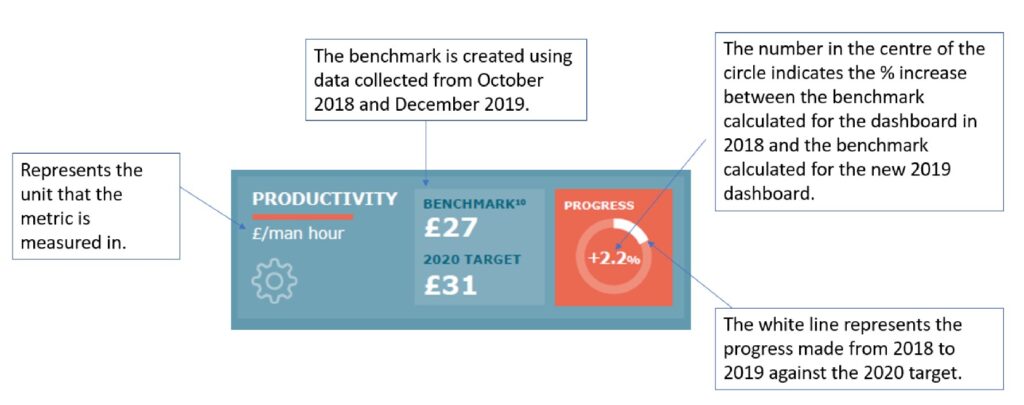
It is encouraging to see new built housing completions were rising in 2019. Based on the data set, improvements have been made across the sector with a lower number of injuries compared to the previous dashboard. Productivity has also improved for the sector. We have recalibrated the capital cost metric and the embodied carbon with new data, added prelims and the new health and wellbeing measure. Waste on site has gone up and time on site has increased in the new build homes sector, this could be for a number of reasons, including reasons like sales rate and Brexit impacts. Quality has not changed, and we are working towards a revised method in the next dashboard release.
I’m also excited to announce a new case study will be shortly available.
The housing sector is, all things being relative, at a “start point” when compared to other advanced industrialised sectors, and much more can be done to adopt innovation, deliver significant increases in productivity, satisfy end customers, and improve construction safety and wellbeing.
The CLC workgroup approach is to create demand and gain buy in for measuring project performance for the housing sector. We want to normalise performance measurement. We know the measures still need to be significantly improved, and we are working towards an improved dashboard later in 2020. Homes England, and innovative housing organisations, like Your Homes Newcastle are applying measures directly on projects, enabling their supply chain to respond to the challenges. The CLC team are determined to work with everyone to make this right, and move the sector forward.
A link to the new dashboard is here.
The Housing Industry Metrics report upon which the Dashboard it is based is linked here.

by Iain McIlwee | 18 Aug, 2020 | Main News Feed
FIS has launched a new factsheet focusing on the detailing of Prepared Service Openings commonly referred to as Builders Work Holes.
In launching the factsheet, FIS Technical Director Joe Cilia stated: “We have had a number of enquiries through our helpline in recent weeks looking at the proximity and permitted sizes of service openings.
Anyone following the Grenfell Inquiry and the cross examining of the various construction and site managers will see how it is possible for details to fall between cracks – all to often we we hear phrases like “the architect says it is the contractors choice”. This is the sort of area where design liability can be assumed and decisions must be informed by test evidence and properly signed off.
This factsheet isn’t so much about the definitive answers as these will depend on materials and environment and what the supplier/ manufacturer of the system states is required to maintain performance, but it is about making sure that the right process is followed and ultimately ensuring that a safety first approach is adopted.
The key point we are making is that early engagement in the design process is absolutely essential – we have to get away from the culture where the detailing is left to the last minute and the contractor expected to carry all the risk!”
The factsheet is Preparing Service Openings (Builders Work Holes) is available to download here
For the full range of technical support from the FIS visit our FIS Technical Knowledge Hub
by Clair Mooney | 18 Aug, 2020 | Main News Feed
The latest Constuction Trade Survey which captures the second quarter of 2020 reveals the extent to which the construction supply chain was affected by public health measures as a result of the nationwide lockdown in response to COVID-19.
Construction was permitted to continue during lockdown in England, but was restricted to coronavirus-related work and essential repairs or maintenance only in Scotland, which accounts for around 8% of construction output in Great Britain. However, widespread pauses in site activity were reported across the UK, particularly in house building and commercial. Not surprisingly, sales of construction products and materials, contractor workloads and surveyor workloads all experienced one of their worst contractions in history in Q2.
FIS members can access the CPA report here.
Additional Market Data is available in our Membership Hub.