
by Iain McIlwee | 20 Nov, 2020 | Main News Feed
Following a discussion with Sharon Miller of Scottish Government, she has advised that Scottish Government has issued further guidance for Level 4 restrictions on construction work in homes. The guidance states:
Tradespeople should only go into a house in a level 4 area to carry out or deliver essential work or services, for example:
to carry out utility (electricity, gas, water, telephone, broadband) safety checks, repairs, maintenance and installations
- to carry out repairs and maintenance that would otherwise threaten the household’s health and safety
- to deliver goods or shopping
- to deliver, install or repair key household furniture and appliances such as washing machines, fridges and cookers
- to support a home move, for example furniture removal
When working in someone’s house tradespeople should stay 2 metres apart from the people who live there, wear a face covering and follow good hand and respiratory hygiene.
Visit the FIS COVID-19 hub for the latest updates and information
by Clair Mooney | 19 Nov, 2020 | Main News Feed
Following the publication last week of HMRC’s guidance on the extended furlough scheme which stated that the government was reviewing its stance on furlough being claimed during notice periods, this section of the guidance has now been updated.
Citation has outlined the key points from this update:
- With effect from 1 December, employers will not be able to claim furlough pay for any period where the employee was serving either a contractual or statutory notice period.
- Although the new guidance appears in the ‘If you’ve made your employees redundant’ section – the rule seems to apply regardless of how the notice has come about as it specifically includes resignations and retirements.
- If an employer has claimed in advance and the employee subsequently starts a notice period on a day covered by the claim, the employer will have to adjust their claim.
- It will be irrelevant whether notice of termination was given before 1 December. The critical issue is whether the employee is serving notice, not when that notice was served.
For example, if an employer gives an employee 4 weeks-notice starting on 23 November and ending on 18 December, furlough pay can be claimed for the notice days falling within November but no furlough claim can be made from 1 December for the days when the employee was serving the remainder of their notice period.
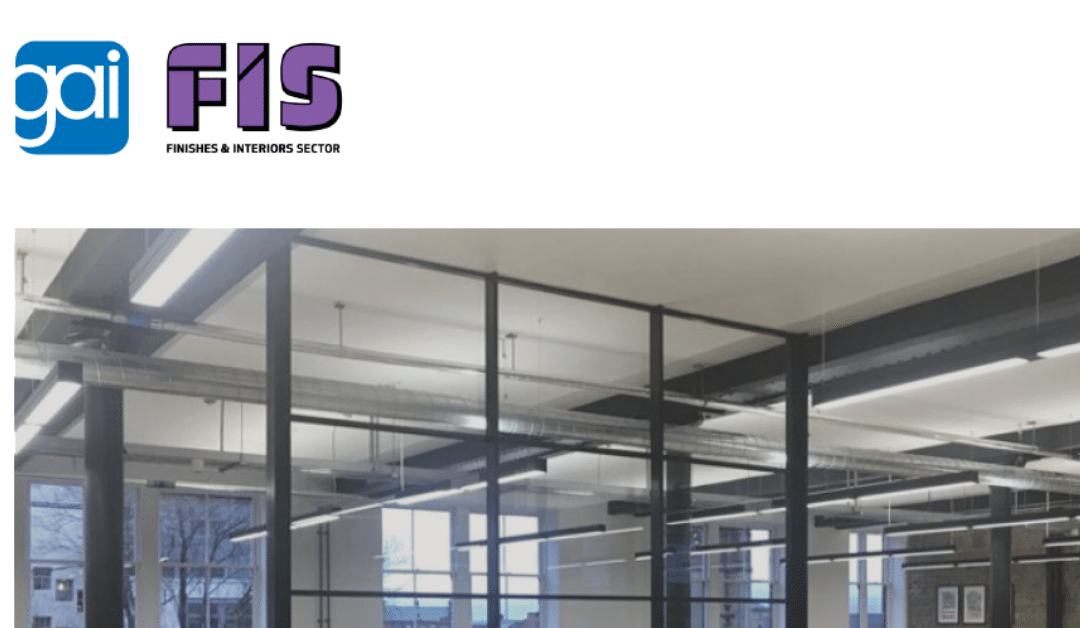
by Clair Mooney | 19 Nov, 2020 | Main News Feed
A new guide that helps business owners understand the needs of its workforce and help plan safe working spaces that enable social distancing and help companies work effectively during the COVID-19 pandemic has been published today.
Entitled “How Business Owners Can Use Partitioning and Ironmongery to Help Manage Social Distancing” it has been created by two of Britain’s leading construction interior trade organisations – the Guild of Architectural Ironmongers (GAI) and the Finishes and Interior Sector (FIS).
The guide, which calls for changes to the style and layout of traditional open plan offices and other workspaces as a result of the pandemic, provides practical guidance to help business owners understand key considerations they need to make when adapting their workplaces. It aims to provide advice as to how to create the correct solution, addressing the issue of DIY screens that all too often fail to perform properly and can have unforeseen consequences with lighting, ventilation and even escape routes.
The GAI and FIS call the process re-cellularisation – the opposite to creating open plan spaces – and is intended to provide cellular space where social distancing can be provided, where teams can collaborate, and where individuals can find safe concentrated spaces when they are in the office.
“Within less than a year, Covid-19 has impacted every aspect of our lives. We’ve already seen big changes to the way that buildings operate, such as one way systems, and workplaces will need to continue to be responsive as new Government advice is released,” said Douglas Masterson, Technical Manager at the GAI. “Businesses need to protect staff, adhere to social distancing and maintain high standards of hygiene without compromising safety and security.
“This guide will be useful to employers who are looking for proactive solutions. It will help them to identify where measures should be implemented and the types of products that can deliver a safe and secure working environment.”
Cellularisation, as explained in the guide, is the creation of spaces using partitioning, raises several questions which include:
- What are my needs?
- What else should I consider?
- How do I select a partition system?
- What are my ironmongery requirements and can I introduce a touch free or antimicrobial solution?
- Will I need to control the doors through hold open devices or door automation?
- Is there a part that access control and electronic locking can play?
- How do I organise the installation?
Performance considerations, including fire resistance of the partitioning and doors, reducing sound transmission and privacy, also must be considered along with the need for increased ventilation which has a substantial impact on reducing viral infections between occupants.
The guide also shows ways in which new partitions can look by using solid, glazed, part glazed and double glazed elevations, and adding blinds or manifestation which can reinforce a corporate identity or add images of outdoor landscapes to the space.
Joe Cilia, Technical Director at FIS, added, “We wanted to produce an accessible and useful guide that can be used by any business to understand how to approach the issue. The flow chart that we produced with the GAI is easy to follow and ensures that any unknown unknowns are dealt with.”
The guide discusses all aspects of partitioning and how employers can sub-divide working space to protect staff, including using the right ironmongery and how to reduce infection via touch points.
The guide can be downloaded from www.thefis.org or www.gai.org.uk/IndustryUpdates

by Clair Mooney | 19 Nov, 2020 | Main News Feed
This year, after speaking to the Prescribed Organisations and some employers, CITB decided that it was inappropriate to run the Consensus process when the external environment was so unstable and uncertain. Their expectation is that, although some COVID-related uncertainty will remain, the external environment will be sufficiently stable to run the Consensus process next year. The final decision will be taken by the CITB Board in February 2021 and before doing so they will seek views from the
Prescribed Organisations, which are made up of several trade federations, as well as analysing other economic and industry insights to inform their recommendations to the Board.
In the meantime, CITB has been setting up the Levy Strategy Committee of employers and experts to recommend new Levy Proposals and support a longer term review of the Levy. The committee met for the first time in November, but there is one vacancy for an independent member that isn’t employed by a Levy-registered employer. If you have extensive experience of the industry and you work in an organisation that isn’t a CITB registered employer, please consider joining

by Clair Mooney | 19 Nov, 2020 | Main News Feed
Government Response to the consultation on the Energy Performance of Buildings: Changes to the Energy Performance of Buildings Regulations 2012 No. 3118
- This consultation sought views on the proposals to amend the existing regulations for domestic and non-domestic buildings to improve their energy efficiency and provide a reduction in their carbon emissions by increasing the threshold of the current air-conditioning inspection regime to include only air-conditioning systems and combined air –conditioning and ventilation systems with an effective rated output of more than 70kW
- This would lead to savings for some building owners but at some cost to energy assessor businesses while recognising that some carbon savings from smaller systems would be lost
Government Decision
- The UK Government intends to diverge from the European Commission’s proposal and retain the existing threshold for the inspection of energy efficiency of air-conditioning systems and combined air-conditioning and ventilation systems that have an effective rated output of more than 12kW.
- Government will be making a minor technical amendment to the existing 2012 regulations to ensure that the capabilities of air-conditioning systems and combined air-conditioning and ventilation systems are considered to optimise the system’s performance under typical operating conditions.
Stakeholders Responses leading to the above decision
- Majority of stakeholders favoured retaining the existing regime
- A significant improvement in enforcement and sanctions would be required for greater comparative savings from targeted larger units to be realised
- Responses also favoured the retention of the opportunity for inefficient lower output air-conditioning systems to be identified and the wider energy efficiency advice that building owners received when inspections are undertaken.
- The cost benefit analysis within the wider climate change targets did not warrant a change
A copy of the Government’s response can be downloaded here.

by Clair Mooney | 18 Nov, 2020 | Main News Feed
FIS Associate Member Citation is running a webinar entitled ‘Navigating Business Change’, which is aimed specifically at businesses in the construction and trades sector.
This webinar aims to assist members in getting to grips with the latest changes and guidance covering key HR and Health & Safety Considerations, such as how to pass a COVID-Secure inspection and managing employees and long-term homeworking.
Date: Wednesday 25 November
Time: 10am
How to join: REGISTER NOW
The webinar is free of charge, however spaces are limited so we suggest members register in advance of the session. The webinar will cover important topics such as those listed below, and there will be an opportunity to put questions to Citation’s experts on the day.
- How to successfully pass a COVID-secure inspection, in light of the Health & Safety ramping up their spot checks;
- Ensuring a reasonable and cautious approach is taken when handling COVID-related issues;
- Challenges managing your employees in the workplace, the implications of travel-related quarantine periods for employers, long-term homeworking, and employee wellbeing;
- The Good Work Plan and its impact on using casual staff
- The importance of having good HR and Health & Safety foundations in place, such as policies, contracts, handbooks and risk assessments
They will be on hand to answer your business-specific queries, so come along armed with any questions you may have.
We really hope you can make it.

by Clair Mooney | 18 Nov, 2020 | Main News Feed
We know that the Covid-19 outbreak has had a seismic effect on the economy, and that some apprentices have been made redundant without completing their apprenticeships, while others are at risk of redundancy. To help provide guidance to both employers and apprentices facing redundancy, the National Apprenticeship Service has introduced a Redundancy Support Service for Apprentices.
The service provides clear, accessible advice and guidance to individuals on the impact of redundancy, their options and next steps. There will also be opportunities to help redundant apprentices to identify new apprenticeship and employment opportunities, and, where they are eligible, complete their current apprenticeship.
The service is made up of three main elements:
• Providing apprentices with advice and guidance on the impact of redundancy
• Signposting apprentices to local and national support services
• An apprenticeship vacancy sharing service to make redundant apprentices aware of new opportunities
If you are aware of any employers who would like to recruit a redundant apprentice or offer new apprenticeship opportunities, please ask them to visit Hiring an apprentice who has been made redundant or call 0800 015 0600 to find out more.
If you are aware of any apprentices who have been made redundant please encourage them to visit Facing redundancy during your apprenticeship or call 0800 015 0400 to speak to an adviser.
More information is available at https://help.apprenticeships.education.gov.uk/hc/en-gb/articles/360015641099-Redundancy-Support-Service-for-Apprentices

by Clair Mooney | 18 Nov, 2020 | Main News Feed
The Government is proposing changes to the Construction Industry Scheme (CIS) to be introduced from April 2021.
These include giving HMRC the power to amend CIS deductions in the event of errors or omissions and requiring businesses to apply the CIS when construction expenditure exceeds £3 million over the preceding 12 months. Exemptions to CIS deductions will also be limited going forward and there will be penalties for providing false information.
Proposed revisions in detail
CIS set-off amendment power
Some sub-contractor companies are entitled to set CIS deductions suffered in-year against their employer liabilities as provided by section 62(3) FA04 and regulation 56 S.I. 2005/2045. Where, upon challenge from HMRC, the sub-contractor employer cannot provide satisfactory evidence to support the CIS deductions claimed, and when asked the employer does not amend the CIS entry on their EPS within a certain timeframe, HMRC will instead amend the CIS deduction figure claimed on an EPS. The HMRC amendment will match the CIS deductions sum supported by any evidence held by or provided to HMRC.
HMRC will remove the claim altogether where there is no evidence of any CIS deductions in respect of that company or where the employer is not entitled to set-off in this way. The employer liabilities will be recalculated following the amendment. Where HMRC has to amend the CIS credit claimed on an EPS, the employer may also be prevented from making further CIS set-offs in the same tax year. HMRC’s new powers to amend set-off claims and prevent further set-off claims will be decisions subject to review and appeal, unless the claimant is not a sub-contractor company suffering deductions under the CIS. The new powers will be contained in amendments to section 62 FA04, and the operative detail will be contained in regulations by way of amendments to S.I. 2005/2045.
Cost of materials
The current rule regarding the cost of materials to be taken into account by a contractor when operating the CIS on a payment to a sub-contractor is set out at section 61(1) FA04. This provision must be read with the definitions of a “construction contract” at section 57 FA04 and of a “contract payment” at section 60 FA04. The newly substituted provisions of section 61 FA04 will clarify that, on making a contract payment to a sub-contractor, the contractor must deduct a sum from the payment which is equal to the relevant percentage of the net payment. In calculating the net payment, the contractor must work out the amount of the contract payment less deductible materials costs. A materials cost will only be deductible if it represents the direct cost of materials purchased by a sub-contractor in respect of that particular contract. The change to these provisions will ensure that it is clear that only the sub-contractor directly purchasing materials to fulfil their own contract with their contractor is entitled to a reduction to account for materials costs from the gross contract payment before the CIS deduction is calculated.
Deemed contractors
Section 59 FA04 sets out the rules for bringing deemed contractors into the CIS. The general rule to determine whether a non-construction business has to operate the CIS is found at section 59(1)(l) FA04. It requires a turnover threshold for expenditure on construction operations to be met, and that the business reviews this expenditure at the end of each period of account. If average annual expenditure on construction operations exceeds £1 million in each of the last 3 years, the business has to operate CIS on any construction expenditure from the start of the next period of account. When average expenditure is less than £1 million in each of three successive years the business no longer has to operate the CIS on construction expenditure: see section 59(3) FA04. The new rules will require a business to monitor construction expenditure more regularly. When the cumulative expenditure on construction operations exceeds £3million within the previous 12 month period, the business will have to register for the CIS as a contractor (if not already registered) and begin operating the CIS on their next payment to a sub-contractor for construction operations. Deemed contractors will be able to stop operating the CIS when expenditure on construction operations falls below £3m within the previous 12 month period, or when no further payments on construction operations (including retention or management/administration payments) are expected to be made under that or any other construction contract.
CIS registration penalty
HMRC can penalise a person for providing false information when registering for payment under deduction under the CIS or for GPS (section 72 FA04). This penalty applies only to the individual or business to whom the registration applies. The scope of this penalty will be expanded to apply to a wider group of individuals or companies who are able to exercise influence or control over a person who is registering for the CIS, this will include agents, directors, company secretaries, or anyone HMRC believes is in a position to exercise influence and control over the business and/or the person making the CIS registration.
Such persons will be liable to a penalty in two circumstances:
- where they themselves make a false statement or furnish a false document for the purpose of enabling another individual or business to be registered or
- where they encourage an individual or business to make a false statement or furnish a false document for the purpose of enabling themselves to be registered for the CIS
The changes to primary legislation to deliver this measure will be published for consultation alongise this TIIN.
If you have any feedback or concerns, please send your comments to iainmcilwee@thefis.org.

by Iain McIlwee | 17 Nov, 2020 | Main News Feed
The Secretary of State has written to a number of sectors with the top asks that businesses within those respective sectors should take, as part of their preparation for EU transition. These letters have been issued through Companies House. I attach the construction letter which has started to permeate through the sector.
The full text is provided below:
Urgent message from the Business Secretary
Are you ready for new rules for business with the EU?
There is just over a month to go until the end of the transition period and there will be new rules to follow from 1 January 2021 onwards. As Business Secretary, I urge you to ACT NOW to avoid your business operations being interrupted when the transition period ends.
As a business in the construction sector, you can find out what you need to do by going to gov.uk/construction-2021. The top actions you can take now to prepare are:
- Check the new rules on importing and exporting goods between the EU and Great Britain from 1 January 2021. Different rules will apply in Northern Ireland.
Your business could face delays, disruption or administrative costs if you do not comply with new customs procedures from 1 January 2021.
- Use GOV.UK to identify changes affecting manufactured goods, such as new marking requirements or approvals needed, to ensure your business is ready to sell them in the UK and EU.
You may not be able to sell your goods in the UK and the EU from January 2021.
- If you are planning to recruit from overseas from 1 January 2021, you will need to register as a licensed visa sponsor.
You may not be able to legally hire people from outside the UK if you do not have a licence. New employees from outside the UK will also need to meet new job, salary and language requirements. Irish citizens and those eligible under the EU Settlement Scheme are not affected.
- If you are moving goods into, out of, or through Northern Ireland, check the latest guidance.
At the end of the transition period, the Northern Ireland Protocol comes into force. There will be special provisions which only apply in Northern Ireland so if you move goods into, out of, or through Northern Ireland make sure you check the latest guidance at: gov.uk/northern-ireland-trade
THE CHANGES CAN TAKE LONGER THAN YOU THINK, SO START TODAY
The Government is providing a range of support, including webinars to walk you through the changes. These are available to watch on demand at: gov.uk / transition-webinars. You should also check with your suppliers and customers that they are taking action.
These are challenging times, but the transition period is ending on 31 December 2020 and there will be NO EXTENSION . Unless you take action, there is a risk your business operations will be interrupted. The Government will be there to help you to take advantage of the many new opportunities that being an independent trading nation will bring.
Yours sincerely,
The Rt Hon Alok Sharma MP
Secretary of State for Business, Energy & Industrial Strategy
The transition website can be accessed here
You can access the FIS Brexit Toolkit here