0121 707 0077

New Construction Playbook – A new approach to procurement

New Construction Playbook – A new approach to procurement

The Construction Leadership Council was created with a remit to drive improvement within the construction sector. Since its creation, it has worked to encourage collaboration to build a better industry, and to act as a bridge between the public and private sectors in pursuit of this objective. The challenge of responding to the Covid19 pandemic has emphasised the importance of this, and the necessity of creating a more robust and sustainable industry which can build back better as the UK enters the period of recovery. This is why the CLC, through its own members and also through its wider links with the industry, has collaborated and supported the combined efforts of the Cabinet Office and Infrastructure & Projects Authority, with input from across the public sector, to develop and publish the Construction Playbook, and to endorse its aim of creating a more strategic relationship between Government and the construction sector.

Government Departments, other public bodies and the wider public sector represent key construction clients, investing in nationally significant infrastructure projects, capital programmes such as those in education and healthcare, projects that improve our cities and towns, and supporting the delivery of new homes. This spectrum of activity across the sector means the public sector has the potential to drive industry transformation, and how it approaches the development and delivery of construction can provide a powerful impetus for changes in industry practice and culture that extends beyond the projects it funds directly.

That is why the publication of the Construction Playbook is significant. It aims to embed a new approach to the procurement and delivery of construction projects and programmes, which is more collaborative, engages the whole supply chain, encourages investment in innovation and skills, and supports a more sustainable, resilient and profitable industry, capable of delivering higher-quality, safer and better performing built assets for its clients. It will create the foundation for a new approach to construction, where we can utilise digital and offsite manufacturing technologies to increase the capability of the industry, and accelerate the delivery of built assets.

It will also aim to deliver a better and fairer industry, with stronger and more open relationships between the industry and its clients, fewer disputes, and more equitable contractual terms, that ensure prompt and fair payment and a balanced allocation of risk, where these are managed by the organisation best placed to do so. Finally, it will help ensure that investment in construction projects creates the greatest economic, social and environmental value possible, and contributes to the delivery of strategic policy objectives such as our legal obligation to achieve net zero carbon by 2050 and levelling up across the UK.

These goals are our goals at the CLC. We share the Government’s desire to improve performance through new ways of working. But publishing the Playbook is just the first step in the process. For real change to happen, it is important that both Government and the industry embed the principles of the new approach, and invest in their capability to deliver this. The Government will be working to implement this across all central government Departments and public bodies, and mandating the adoption of this approach whilst recognising there is no-one-size-fits all approach to delivery. The CLC will work with organisations across the industry to ensure that this effort is matched, and that the public and private sectors can support each other in this shared endeavour.


Andy Mitchell
Co-Chair
Construction Leadership Council

What's in the UK Government's new "Construction Playbook" and how will it impact the industry?

Fred Mills,  Co-Founder and Managing Director at The B1M, spoke to the Government and the industry’s leaders to find out.

Brexit: The Big Three Issues for the Finishes and Interiors Sector

Brexit: The Big Three Issues for the Finishes and Interiors Sector

Brexit looms, a deal remains elusive and we continue to be inundated by messages from the Secretary of State and various government departments to, “get ready”, but there remain some real challenges and uncertainty.  There are some practical things you can do, but “Get ready” may mean in some cases “brace yourself and be prepared to flex fast”.  At FIS we have produced the Risk Assessment Toolkit and continue to run webinars on key issues (next is the 10th December at Midday).  Here we look at three of the big issues impacting the Finishes and Interiors Sector.

ISSUE 1: People (The Points Based Immigration System)

The new points-based system means there is additional cost to bring workers in, even if you can get to the 70 points required, which is very difficult for most occupations in our sector.

The Home Office have not, in the opinion of FIS, adequately considered the COVID effect when applying the Points Based Immigration System.  It is creating a real concern on three levels.  Firstly many skilled workers have left the UK due to COVID and a combination of currency fluctuation and work at competitive rates in or near their home country means that they do not now intend to return.  Across the sector we employ around 175,000 people, circa 40% of all workers are from the EU and according to the ONS the number of these workers available has declined by 40% to Q3 2020.  The Home Office have not adequately taken this into account when appraising the shortage occupation list.  Secondly they are relying on out-dated Standard Occupational Codes (2010 as opposed to 2020) with no granularity applied to the occupational areas included in “other” categories.   As a consequence, trades such as ceiling fixing and drylining have been classified wrongly as semi-skilled.  Finally the system fails to recognise and guidance is not forthcoming about workers employed through the Construction Industry Scheme (CIS), via agencies and through umbrellas, the tax system recognises the need for a contingent workforce in construction, the immigration system does not.

Whilst we had been reassured that the Points Based System was designed to be flexible, a recent meeting with the Home Office advised that no change is likely until 2022.  We are optimistic that we can increase our trainee and apprenticeship programmes, BUT we need time to train (e.g. 18 months to train a dryliner).  A drive to employment seems to be motivating Government, but this requires a radical rethink of procurement practices in construction.  In the interim this leaves us with the potential of a shortfall in labour that could inflate rates, delay programmes and projects starts and could even make it difficult to fulfil existing contracts.

The solution must be to look at phasing the changes in over a longer period, allowing applications for pre-settled status to run into next year.  We can then work with the Migration Advisory Committee to understand the impact and how we can progressively tighten the immigration process together, controlling flow of workers at the same time as improving the training infrastructure. The alternative is huge uncertainty and business failures damaging our ability to adapt as a sector.  This will in turn impact the nations home building and infrastructure programmes and constrain the potential of construction for the UK economy.

FIS continues to lobby on behalf of our community here, but if you are impacted, we have prepared a template letter that you can use to contact your MP.  To receive a copy of this template, simply email iainmcilwee@thefis.org

You can access a further details and advice on the Points Based Immigration System Here.

ISSUE 2: Product (Movement and Marking)

For many who already export or import products, change will largely mean a bit more admin, tariffs and communication to reassure your clients.  If you are already trading internationally, then it should be relatively straightforward.  

First time importers and exporters (i.e. those that have not previously purchased product or sold product from outside the EU) you will need to add some new processes, make sure they understand the product marking and consider tax implications and any tarriffs, but beyond a bit of bureaucracy it should be manageable.  We have had questions raised as to whether UK Test Standards will still be applicable for export – realistically there should be no change if Building Regulations or Codes in the respective country are not altered to remove reference.

However, there is a big BUT…. 

If your products are currently subject to the Construction Products Regulation and rely on CE marking then it may not be so straightforward.   Whilst there is a 12-month transition (to January 2022) before UKCA and UK NI marks become mandatory, as far as the EU is concerned all UK notified bodies lose their status to issue CE Marking Certificates from midnight on the 31st December 2020.  Exporters need to be working now with their notified body (or notified test laboratories) about transfer of certificates to European Notified Bodies and validity of evidence for ongoing CE Marking if declaring using The Assessment and Verification of Constancy of Performance (AVCP) System Level 3 (e.g. Gypsum Products, Flooring and Internal and external wall and ceiling finishes) .  

The impact goes beyond exporters, this EU Commission stance means than any Declaration of Performance (to support CE Marking) that relies on Engineered Technical Assessments (ETAs) from a UK Notified Body or where CE marking declarations is made using AVCP System Level 3 and where Tests have been conducted in a UK Notified Laboratory, will be invalidated from 1st January 2021.   Government has confirmed that, if you cannot switch to an EU Notified body to continue CE Marking, you will be expected to start UKCA Marking with immediate effect from 1st January 2021. 

Above applies to all supplying the GB market from 1st January 2021 (regardless of whether you are an importer, exporter or domestic manufacturer).  UK Approved Bodies will be allowed to issue the UKCA mark from 1st January 2021, but the legal structure is not yet in place and concerns are mounting that it may not be in time.   Time is running away to manage the associated logistics of stamping or labelling products, uploading and replacing declarations of performance and updating manuals/marketing literature and packaging.

A question therefore remains what to do if you cannot maintain your old CE certificate (due to the status of your notified body) and UK Approval Bodies are not ready to issue a UKCA certificate to allow the UK company to operate legally?   Government Guidance on UKCA confirms that “in some cases you will need to apply the new UKCA marking to goods being sold in Great Britain immediately from 1 January 2021”.  It is important to remember that the entity “placing the product” on the market will have responsibility here.  

As well as what to put on the product when you make it, you must also consider stock and  if you have manufactured for stock that has not yet been “placed on the market” or wish to supply into Northern Ireland (where UK Approved Bodies can play more of a role initially and support the issue of the UK NI mark).  It is also vital to consider if your product is a system or an assembly (a set of discrete components), if the latter, you will need to consider the CE marking of each individual item.

BREXIT: CLC Guide to Conformity Marking of Construction Products

Brexit Update: Demystifying Product Marking post Brexit

ISSUE 3: Process (Possible Delays, Costs and Tarriffs)

There are growing concerns around delays at UK ports holding up crucial deliveries. This weekend the Builders Merchant Federation warned that the ports were becoming a “major issue” for its members with products that would normally take one week to clear, taking up to four.

Since September, the country’s biggest container port, Felixstowe, has been handling about 30% more goods than usual, with businesses rushing to replenish stock after the end of lockdowns and building stockpiles before the end of the Brexit transition period.  As a consequence of hold-ups there have even been reports that loads destined for the UK being partially onloaded or dumped at European ports.

According to the BMF the high level of demand has prevented the building trade from stockpiling in the run-up to Brexit.  Shortage areas mentioned include screws, timber, ironmongery, tiles, fixings and electrical products.  A fear is that this could drive further inflation.

Clearly depending on your position in the supply chain, the impact will impact you in different ways, but one thing that is vital is that we must all check our contracts to ensure that any responsibility and impact of delays is not unfairly set as our responsibility.

You can access contractual advice via the FIS Brexit Toolkit here

Ongoing work

FIS will continue to represent your interests through the Construction Leadership Council and with the various Government Departments calling for flexibility and stronger guidance.

In the meantime, we encourage you to visit our Brexit Toolkit here

Our next Brexit Webinar takes place on 10th December at Midday

BREXIT: CLC Guide to Conformity Marking of Construction Products

Blog prepared by Iain McIlwee 8th December 2020, updated on the 10th December (correct to the best of our knowledge at the time of writing!).

Industry engagement – short duration training standards – Basic Fire Safety – post-Grenfell

Industry engagement – short duration training standards – Basic Fire Safety – post-Grenfell

CITB would value employer input on the proposed content and implementation approach for a new Training Standard on basic fire safety. CITB is currently working as part of the Competence Steering Group, designed to tackle the shortcomings identified in the Hackitt Review after the Grenfell fire. The consultation on Basic Fire Safety runs from 23 November – 11 December. Please share your views here.

Apprenticeship support expanded to all levy-registered construction employers

Apprenticeship support expanded to all levy-registered construction employers

CITB is changing its apprenticeship support to enable all levy-registered construction employers to benefit from an expanded support service.  Currently, CITB offers employer and apprentice support for its 7,000 contracted apprenticeships, about a third of the total number across the industry.  Under the new plans, throughout 2021, CITB will withdraw from the direct, funded delivery of apprenticeships in England, and instead provide a support service to all employers with construction apprentices.  Funded apprenticeship support will continue in Scotland and Wales, and the wider offer will also apply in those nations.

Support for employers will include help accessing grants; choosing the right apprenticeship standard and the right training provider; guidance through the Government’s online apprenticeships system; and building partnerships with colleges and training providers.  CITB will continue to offer recruitment support to employers who recruit large numbers of apprentices each year.

FIS is happy to support employer members apprenticeship needs.

FIS Calls for Reverse Charge VAT plans to be scrapped

FIS has joined a powerful coalition construction bodies in calling for reverse charge VAT plans to be scrapped.  In a letter signed by 44 bodies, the coalition points out that many SMEs in the supply chain are critical to delivering the Government’s ‘Build Build Build’ strategy.  The introduction of Reverse Charge VAT will have a significant negative impact on the industry, substantially increasing the burden on business and restricting cash flow in what is already an extremely difficult economic climate.

As a result the changes will particularly impact SMEs that provide both services and materials. This is because they will have to pay VAT on the materials they purchase, including extremely costly elements such as steel, cladding and concrete, but will not be paid the VAT by their customer. For a significant number of companies this will be unsustainable and three case studies are set out are below.

FIS CEO, Iain McIlwee commented – “Whilst construction has powered through the COVID crisis, it has called on a deep reserve of determination and resilience, but we must not make the mistake of thinking all is well and Government can pile on more pressure.  The next few months will be incredibly challenging for construction businesses as we try to manage the pipeline and programme issues that COVID has thrown up and confront the very concerning issues linked to the new immigration system and the potential labour shortage issues that this exacerbates as well as other potential inflationary pressure linked to Brexit.  Many companies are simply battered and bruised and, with cash reserves depleted, facing further challenges from an unprecedented period of change – the Reverse Charge VAT could be the knock-out blow.”

Iain also expressed his gratitude to the working group that FMB have been chairing that has helped to keep this issue on the agenda and bring this coalition together to make a stand.

A full copy of the letter is available here – Joint letter to Rt Hon Rishi Sunak MP

The FIS Reverse Charge VAT toolkit is available here.

FIS raises serious immigration concerns and advises on action to prepare

FIS raises serious immigration concerns and advises on action to prepare

In the wake of growing concerns over immigration in 2021 and the impact of tighter rules on the finishes and interiors sector, trade body FIS, supported by Seddons Law LLP, Indigo Group, Lignum Group and Bamboo Project Solutions hosted a webinar explaining how companies should react.

At the FIS AGM (24th November 2020) it was revealed in data provided by economist Dr Noble Francis that EU workers had since 2018 fallen by 40% to Q3 2020, accelerated by a return home linked to COVID this year.  New data from the FIS indicates that 30% of members are already experiencing labour shortages and 62.5% are concerned for what the New Year brings.  FIS has been raising these concerns with Government and continues to lobby for a more phased approach to the new points based system.

The challenge for the finishes and interiors sector:

  • The Shortage Occupation List: The common issue for all of construction is the lack of recognition on the Skills Shortage list.
  • The Skilled Worker List:  Vital trades across construction are lost in catch-all “other” categories and have been overlooked in the definition of Skilled Worker (e.g. Drylining and Ceiling are included in SOC8149 Construction Workers Not Elsewhere Classified).
  • High Reliance on Flexible Workforce:  Contractors in our sector operate in a project lead, phased trade environment and as a consequence of the nature of work and procurement practices relies heavily on contingent workers, this is not well recognised in the new system.

The webinar now freely available online here outlined how the new points based system will operate and how companies should start preparing for initial changes in January, followed by further tightening in June 2021. The event also warned of new company responsibilities and growing concerns about the potential for abuse of the system through modern slavery.

FIS continues to lobby government on these issues and has a meeting, with colleagues from the wider construction sector and the Home Office on the 4th December.  If you haven’t completed our labour market survey before this point, please do so here.

The FIS has set up a dedicated section on immigration in their Brexit Toolkit here.

 Mapping out the road to competency and compliance

 Mapping out the road to competency and compliance

Joe Cilia Technical Director FIS

Joe Cilia Technical Director FIS

Dame Judith Hackett was clear in her interim report of Building Regulations and Fire Safety that there has been a lack of evidence of compliance and competency and even clearer that the industry needed to address this. So, what has happened since February 2018 and do we have a clear roadmap?

A complex problem has been broken up into its constituent parts and addressed by over a hundred organisations, including FIS dedicating cumulative thousands of hours to interrogate information and advice and propose on a better way of working.   With work led by the Industry Response Group (IRG) and the Technical Expert Panel (TEP), the work of these groups and the draft Building safety Bill and Fire Safety Bill, are all coalescing to provide a clear direction of travel addressing the linked issues of Competency and Compliance.

To help structure our efforts and uncover how a number of new initiatives will lead to tangible changes to the way we market performance products, the words we use to describe them and the Skill, Attitude Knowledge and Experience needed to specify, purchase, supervise, install and maintain them; we have pulled together this new Map that starts to identify the initiatives are linked and give us an idea of where this will lead in the next year.

It’s about competency…

A Competency Steering Group was established to oversee the issue and twelve working groups were established to address the issue across the supply chain with one overarching group to coordinate the results and a Market Integrity Group (MIG) who would look specifically at how performance products were described and the performance verified.

The twelve working groups are:

  • Overarching Competence Body (WG0)
  • Engineers (WG1)
  • Installers (WG2)
  • Fire engineers (WG3)
  • Fire risk assessors (WG4)
  • Fire safety enforcing officers (WG5)
  • Building standards professionals (WG6)
  • Building designers, including architects (WG7)
  • Building safety managers (WG8)
  • Site supervisors (WG9)
  • Project managers (WG10)
  • Procurement professionals (WG11)
  • Products competence (WG12)

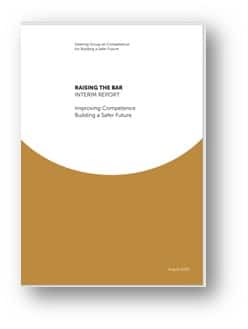
The first output from the group is a document called Raising the Bar which was presented at a conference in October 2019 HERE

The report represents twelve months’ work by more than 150 organisations from across the construction, built environment, fire safety and owner/manager sectors, which have come together to improve the competence of those procuring, designing, constructing, inspecting, assessing, managing, and maintaining Higher Risk Residential Buildings (HRRBs).  The work is in response to recommendations in the Independent Review of Building Regulations and Fire Safety, conducted by Dame Judith Hackitt.

Setting the Bar is the second and final report of the Competency Steering Group (CSG) and is an update of the Interim Report, Raising the Bar, published in August 2019.
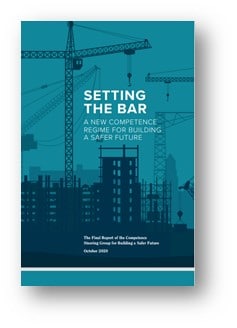
Feeding into this report, for example, is the work I’ve been involved in from WG12 on Products Competence is the development of a Construction products Matrix, which will help manufacturers define the level of expected competence to specify, procure, supervise and install their products. Based on Skill, Knowledge and Experience it will help ensure the correct products are used alongside all products they interact with to create building systems.

The Built Environment competency standard group (BECS) The industry-led programme sponsored by MHCLG will deliver an overarching competence framework standard for everyone working on a building. This is intended to be used by key professions and trades including designers, contractors, fire risk assessors, building managers and others in specialist technical or corporate roles. The framework will provide a set of core principles of competence, including leading and managing safety, communicating safety, delivering safety, risk management, regulations & processes, building systems, ethics, and fire/life safety. The competence framework is being developed using an iterative and dynamic process, in line with our new flexible route to standardization, called BSI Flex.

BSI Flex 8670 v1.0 Built environment – Overarching framework for competence of individuals – Specification is designed to provide a framework for the development of three new PAS documents to describe the competency levels for the three new positions described in the (Draft) Building Safety Bill:

  • Building Safety Manager
  • Principle Designer
  • Principle Contractor

The competency of these people will be overseen by the new Building Safety Regulator (HSE).  There will also be an overarching publicly available Specification (PAS) that can be used by industry and trade bodies to develop competency schemes in a consistent way specific to their sector.

Building a safer future Charter In April 2020, the UK Government encouraged industry-wide commitment to sign-up to the Charter, in its response to the ‘Building a Safer Future’ consultation ‘A reformed building safety regulatory system’.   In early 2020, the Considerate Constructors Scheme (CCS) was appointed to develop and manage the Charter and FIS is proud to be amongst the first signatories.

It’s about compliance…

Looking beyond competency to other elements of compliance, another new group formed is the Construction Products Standards Committee.  This Committee will be comprised of technical experts and academics and it will advise the Secretary of State for Housing on whether voluntary industry standards for construction products should also become UK regulatory standards, a role currently undertaken by the European Commission. The Construction Products Standards Committee will also provide advice and recommendations on the conformity assessment process and product test standards. In particular the Construction Products Standards Committee will advise on:

  • the assumptions and weaknesses within the current testing regime, including the effectiveness and accuracy of current tests;
  • ways to improve the testing regime and new tests to address the weaknesses; and
  • innovation in how construction products are tested.

Organisations, such as FIS will be feeding into this group (via the Construction Products Association), helping to deliver a new rigorous and proportionate process for proving compliance.

Alongside this work the Market Integrity Group (MIG) published their initial findings ahead of developing a Code for Construction Product Information (CCIP).  The CCIP will provide a code for all construction product manufacturers (including distributors) to ensure that consistent terminology  is used and performance claims are evidence based and have been signed off by the competent technical person in the organisation.

A new body (also formed under the auspices of the CCS) will provide a verification scheme for suppliers wishing to sign up to the code.   Its clear that we are reaching a stage where the wind of change is coming and the framework for measuring competence and compliance is being constructed using new overarching legislation that will be built on rapidly over the next months and years.

It’s about collaboration…

In this Map I have attempted to show how these committees, working groups, legislative changes standards, documents, reports and bodies come together and how they will start to lead to a more compliant built environment in the months and years ahead.  An encouraging start has been the spirit of collaboration across the sector, bringing us into contact with new individuals, organisation and perspectives on some age-old problems.

I am sure this map will evolve, but as the structures start to settle and the next stage of this huge change begins, if you see anything missing or want to discuss how it all fits together, please don’t hesitate to get in touch.
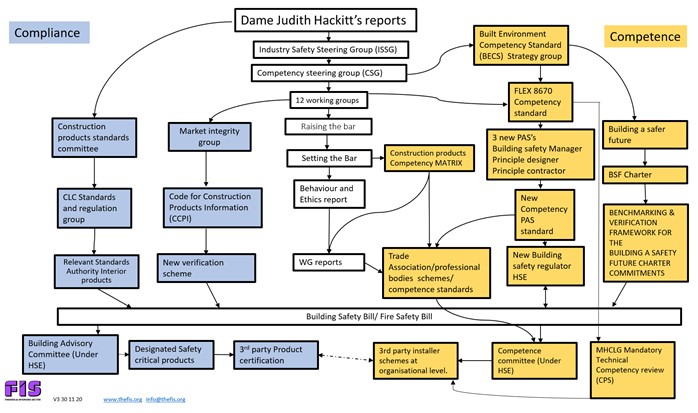
You can download a copy of the Competence and Compliance landscape map here

 About Joe

Joe is the Technical Director at FIS which represents the Finishes and Interior Sector, he is responsible for Standards guides and legislation, environmental and sustainability issues.  Joe works closely with BSI where he chairs a mirror group and a major review of the drylining standard.

He Co-Chaired the production of Fire-stopping of service penetrations – best practice in design and installation and has been pivotal in developing the FIS Product Process People (PPP) Quality Management Framework.

Joe is the immediate past Chair of the Construction products Association Technical committee and represents the finishes and interior sector on the CPA Technical panel as part of the MHCLG Industry Response Group to the Grenfell inquiry alongside Build UK and CIC.

Contact details

joecilia@thefis.org

Brexit Update: Supply of materials

Brexit Update: Supply of materials

Build UK has worked with the CIPS to publish a detailed report on the impact of the UK leaving the EU on the supply of construction materials from 1 January 2021. The report identifies whether materials may be in short supply or have longer lead times and it will be regularly updated. Whilst no material is currently identified as being high risk, early engagement with suppliers and manufacturers is strongly recommended to avoid delays and disruption.

Using power tools: avoiding the need for RPE during the pandemic

Using power tools: avoiding the need for RPE during the pandemic

HSE has published advice explaining alternative ways of working to reduce risk which may mean you no longer need to use respiratory protective equipment (RPE) for working with power tools.

We have guidance explaining the control measures employers should consider when dealing with (RPE) supply issues during the pandemic.

The new webpage on power tools outlines control measures, including using alternative ways of working, to reduce the risk of exposure to hazardous substances. There is advice on working with tools such as:

  • power or masonry drills
  • cut-off saws
  • handheld pneumatic breakers or jackhammers
  • core drills
  • angle grinders

Putting in place improved control measures may mean that you no longer need to use RPE or can use RPE with a lower assigned protection factor (APF).

For all the latest information and advice around workplace health and safety during the pandemic visit the HSE coronavirus website at www.hse.gov.uk/coronavirus/