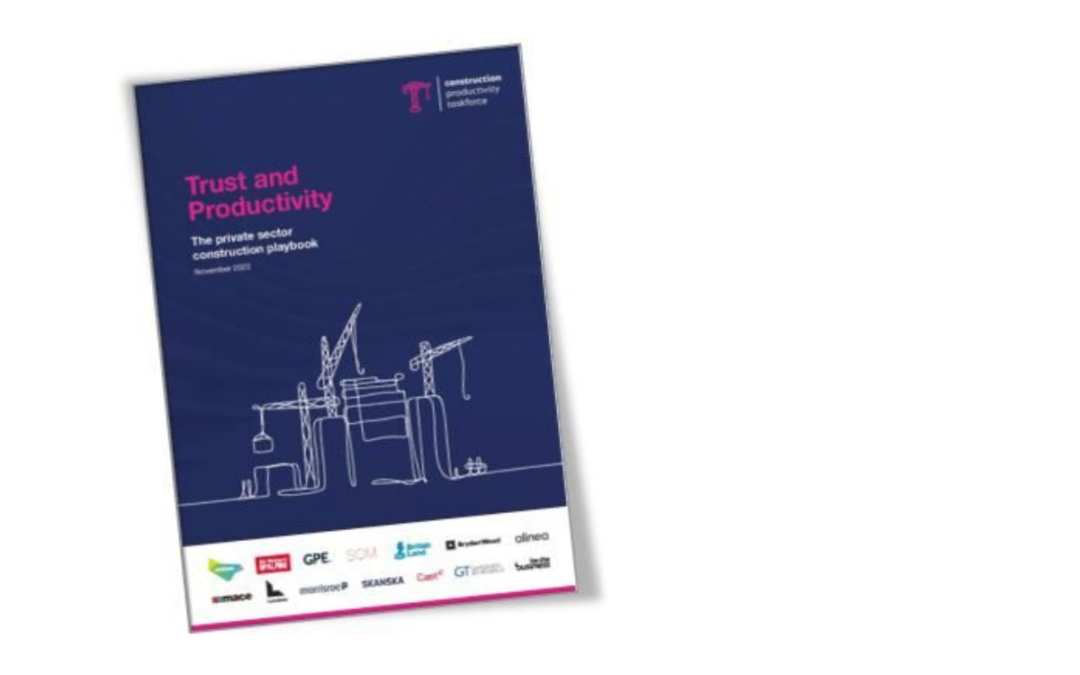
A group of businesses within the construction sector have joined forces to produce a landmark publication aimed at combatting low productivity in the industry.
The goal is to promote trust and collaboration in a highly fragmented industry that can lack transparency. This in turn will help the industry reduce waste, address the skills shortage, and reduce the impact of low margins and investment in UK construction.
The need for action is clear: UK construction productivity growth fell by an average of -0.6% each year between 1997 and 2019 according to Oxford Economics. Over the same period, the productivity of the whole UK economy rose by 2.8%, while the productivity of manufacturing grew by 3.9%.
In real terms, this means that a larger workforce is now required to match historical output, making construction increasingly expensive and leading to a downward spiral of low margins and low investment. Operating under such conditions makes innovation more challenging.
The playbook aims to tackle these problems by encouraging clients, their construction teams and suppliers to work in a more collaborative way to help boost productivity, quality and value. In doing so, they can improve the health, safety and wellbeing of the workforce, reduce carbon and positively impact both the performance and image of the industry.
‘Trust and Productivity: the private sector construction playbook’ has been produced by some of the UK’s leading developers, contractors, architects, engineers, professional services providers and suppliers, under the umbrella of the Construction Productivity Taskforce – a specialised cohort founded by productivity champions Be the Business. Their view is that increasing productivity is essential if we are to cope with increasing skills shortages, use resources more effectively and be able to invest in sustainable infrastructure that meets net zero carbon commitments.
Simon Gorski, Executive Sponsor of the Private Sector Construction Playbook Working Group, and Managing Director, Construction, Europe, Lendlease, said:
“This landmark publication sets out a more productive and sustainable way forward for our industry. Productivity in the UK private construction sector has long been an issue, and while progress has been made in trying to address this, our industry is still blighted by a lack of openness and transparency. I’d like to thank my colleagues across the industry whose leadership has been essential in developing this document. Alongside the Government’s Construction Playbook, I am pleased that the whole industry now has the opportunity to deliver better project and programme outcomes for clients across the private and public sector.”
‘Trust and Productivity’ draws on the experience and expertise of some of the most successful organisations in the UK’s construction sector to set out ten key drivers for success that should underpin any project, while also providing a guide for all points in the project life cycle, from concept through to aftercare. Those ten drivers are:
- Form effective partnerships: Teams not collaborating effectively, team members pulling in different directions, and too much risk unfairly loaded onto one of the parties to a contract creates tension and mistrust from the start. Defined goals need to be agreed at the outset. These should be embedded in a project charter, which sets out clearly the shared objectives, values and measures of success.
- Adopt portfolio and longer-term contracting: Historically, there has been a perception that partnering-based approaches do not deliver value and can stifle innovation. However, when applied in a transparent way, partnering can deliver value and drive innovation, while also providing consistency, improved quality and reduced risk. The business resilience of the supply chain is boosted by a longer-term pipeline of future work. This also encourages investment in innovation and the workforce. In return, clients benefit from improved delivery.
- Take an outcome-based approach: This should resolve gaps between design intent and in-use performance, emphasising the need for improving whole-life value, performance measurement, sustainability, programme and cost certainty, and allow for innovative solutions from the supply chain.
- Embed digital information flows across the whole life of the asset: Increased use of digital information processes and technologies will reduce programme time and whole-life cost, and enable buildings to be delivered more cost effectively, while reducing risk and enabling the smart use of buildings during operation.
- Involve the supply chain early: Early engagement with manufacturers and specialist contractors improves the efficiency of the design and the design process through a better understanding of manufacturing capabilities, logistics constraints and on-site buildability.
- Benchmark objectives: By using key performance indicators across a range of criteria, teams can see where they are succeeding and where they are not. If the project is falling behind its benchmarks, action can be taken swiftly to get back on track. One of the aims of teams should be to measure productivity.
- Allocate risk fairly and appropriately: The allocation of risk needs to be decided by evaluating the project, using experience, expertise and knowledge. The party best placed to manage the risk should take the leadership role and should also encourage collaborative thinking among all parties.
- Pay fairly: Trust and collaborative partnerships can only be established if fair payment is in place. Best practice, as set out in the Construction Act 2011 amendment, should be adhered to at the very least, and embedded in all construction contracts, with any amendments taking into consideration supply chain implications and risk allocation.
- Assess the economic and financial standing of suppliers: Minimising the risk of failure in the supply chain is crucial for the efficient delivery of a project. The financial strength of all supply chain partners should be assessed during the selection process. Assessments should be transparent, objective and non-discriminatory.
- Promote innovation and continuous improvement: Innovation through using digital information processes and digital technology, adopting modern methods of construction and designing for manufacture and assembly can improve productivity, reduce waste and drive significant reductions in lifetime carbon emissions.
‘Trust and Productivity: the private sector construction playbook’ has received endorsements from industry bodies including the Construction Leadership Council and British Property Federation.
Anthony Impey MBE, CEO, Be the Business, said:
“I’m delighted to see the construction industry taking such positive steps to increase their productivity. The private sector construction playbook should act as the cornerstone of a more productive sector and provide inspiration to other industries to do the same.
“Placing collaboration at its core, this document provides clear guidance on how to drive higher productivity outcomes for the sector, key to sustainable growth within the industry and the UK economy as a whole.”
Nigel Webb, Chair of the Construction Productivity Taskforce, and Head of Development, British Land, said:
“By increasing productivity, the construction industry can play a vital role in driving economic growth, supporting the UK’s net zero ambitions and improving the economic health of the sector. This playbook seeks to identify ways to address some of the issues limiting construction productivity. I would encourage clients, contractors, designers and supply chain members to engage with the playbook and start to measure and identify ways to improve productivity.”