by Iain McIlwee | 28 Apr, 2026 | Main News Feed
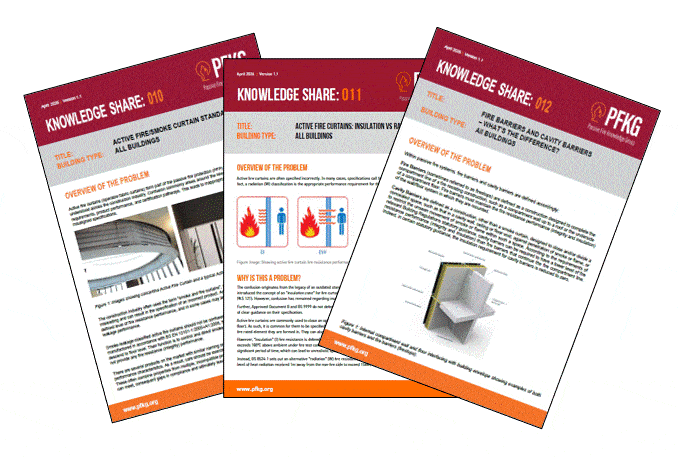
The Passive Fire Knowledge Group (PFKG), supported by FIS, has published three new Knowledge Shares to address widespread misunderstanding in the specification of passive fire protection systems across the built environment.
The new publications are:
· PFKG Knowledge Share 10: Active Fire Curtain Standards
· PFKG Knowledge Share 11: Active Fire Curtains – Insulation vs Radiation
· PFKG Knowledge Share 12: Fire Barriers and Cavity Barriers – What’s the Difference?
Together, the documents provide clear, practical guidance in areas where poor terminology, legacy standards, and inconsistent interpretation continue to undermine compliance.
Knowledge Shares 10 and 11 focus on common specification errors associated with active fire curtains. Knowledge Share 10 addresses frequent confusion between smoke-leakage-classified active fire curtains and simple smoke curtains. Simple smoke curtains are intended solely to control and direct smoke towards smoke control systems and provide no fire resistance (integrity) performance. This is in contrast to smoke-leakage-classified active fire curtains, which are tested to fire resistance standards. The document cautions against the use of the term “smoke and fire curtains” in specifications, as it is misleading and can result in the selection of incorrect products.
Knowledge Share 11 highlights the frequent misapplication of insulation (I) performance where radiation (W) classification is more appropriate for active fire curtains. Insulation fire resistance (I) refers to the time taken for the temperature on the non-fire side of a curtain to rise more than 180°C above ambient under test conditions, a performance that most active fire curtains do not achieve for any significant duration. By contrast, the radiation criterion (W) measures the time taken for heat radiation at 1 m from the non-fire side to exceed 15 kW/m². This typically provides a more realistic and meaningful measure of performance for active fire curtains, particularly when combined with integrity (E) to form an EW classification.
Knowledge Share 12 addresses another long-standing area of confusion: the distinction between fire barriers and cavity barriers. The document explains the different regulatory roles these systems perform, along with the differing fire resistance requirements that apply to each. It also highlights how misunderstanding can lead to non-compliance, particularly where products are installed within cavities, above ceilings, or beneath raised access floors without appropriate supporting evidence.
Across all three publications, PFKG emphasises the importance of early engagement between fire engineers, designers, contractors, and manufacturers to ensure specifications are clear, achievable, and supported by suitable test evidence.
“These Knowledge Shares are about removing ambiguity from some of the most frequently misunderstood aspects of passive fire protection,” said Will Pitt, Chair of PFKG. “Incorrect assumptions around standards or performance don’t just create technical issues — they introduce avoidable compliance risk into fire strategies and ultimately undermine safety. Clear terminology and evidence-led specification are fundamental.”
All three Knowledge Shares are available now as free downloads from www.pfkg.org, supporting PFKG’s ongoing commitment to improving competence and consistency across the fire safety community.
by Oscar Venus | 24 Apr, 2026 | Main News Feed
FIS, as an active member of the Construction Industry Collective Voice, is encouraging members to take part in a unique opportunity to directly influence future National Minimum Wage policy.
Following ongoing engagement through the CICV Skills & Employment Group, FIS has been involved in discussions with the Low Pay Commission regarding the pace and scale of recent National Minimum Wage increases and the impact this is having on the sector, particularly in relation to the affordability of apprenticeships.
As a direct result of this engagement, the Low Pay Commission has invited trade body members to attend a series of small, employer-led workgroup sessions to help shape future policy decisions.
Workgroup Details:
- Dates: 13–14 May 2026
- Location: Aberdeen (venue and timings to be confirmed)
- Format: Small groups of up to six employers
- Duration: 1 hour sessions
These sessions are invitation-only and offer a rare opportunity for employers to:
- Share real-world insight on wage pressures
- Highlight challenges around recruitment and apprenticeships
- Help influence future Government thinking
Have Your Say
FIS is now gathering interest from members who would like to participate.
If you would like to be considered for a place, please register your interest as soon as possible. Places are limited and will be allocated based on availability.
Contact FIS to express your interest
This is a valuable opportunity to ensure the voice of the finishes and interiors sector is heard at a national level, and to help shape policies that directly impact your business and workforce.

by Oscar Venus | 24 Apr, 2026 | Main News Feed, Skills
The Government has launched a consultation on proposals to merge the Construction Industry Training Board (CITB) and the Engineering Construction Industry Training Board (ECITB) into a single, unified Industry Training Board (ITB).
The consultation will remain open until 14 June 2026, providing a defined window for industry stakeholders to shape the future of skills and workforce development across both sectors.
The proposed merger could mark a major change in the way training is organised, funded, and delivered across the industry. The consultation looks at important areas such as future skills needs, how accessible and effective current training provision is, and how levy arrangements can best support ongoing investment in the workforce. While bringing the sectors together under a single ITB may offer better alignment, it is vital that the distinct requirements of different parts of the industry are properly recognised.
As a CITB Prescribed Organisation, FIS is gathering member feedback to inform its formal response. To support this, we have developed a short survey to capture your views on the proposals and their potential impact. Your input will help ensure that our response is evidence based and fully reflects the priorities and challenges faced by our sector.
This is an important opportunity to influence how industry training and funding will be shaped in the years ahead. We strongly encourage all members to take a few minutes to complete the survey by 29 May and share their views.
A strong response will enable FIS, in its role as a Prescribed Organisation, to represent our sector with authority and ensure your voice is heard.
Full details of the consultation are available here Industry Training Board reform – GOV.UK, and members can also submit their views directly via the ITB Reform Consultation portal

by Oscar Venus | 24 Apr, 2026 | Main News Feed
Why interiors and fit‑out specialists need to engage now
The government’s 2026 consultation on Approved Document B (Fire Safety Guidance to support compliance with the Building Regulations) proposes a wide‑ranging set of changes that will directly affect interior systems, partitions, ceilings, fire‑stopping, service coordination and refurbishment work.
While much of the language is technical, the real‑world consequences for FIS members are significant – particularly around responsibility, product selection and buildability.
We’ve carried out a forensic review of the proposals, and we’re now seeking member feedback to shape the FIS response.
We’ve carried out a forensic review of the proposals, and we’re now seeking member feedback to shape the FIS response.
Key headlines for the finishes and interiors sector:
- Greater scope in existing buildings
- Minor refurbishment works could now trigger wider fire safety upgrades.
- New expectations for realistic vertical evacuation of disabled people will affect stair cores, lift lobbies, partitions and interface tolerances.
- Revised definitions mean some internal walls may now be considered loadbearing during fire, raising questions about specification, testing and liability.
- Tighter controls on combustible elements and more emphasis on smoke
- More emphasis on consistency of performance within systems
- New limits on exposed structural elements, and knock‑on implications for linings and encapsulation, will directly affect interior detailing.
- Revised and updated guidance on external wall systems and balconies and review the scope of the ban on combustible materials in, and on, external walls and specified attachments
- Cavity and fire‑stopping rules rewritten
- The move to performance‑based cavity barriers and higher fire‑stopping standards increases reliance on correct specification, coordination and installation
- Expanded fire safety information requirements (including service life and O&M data as well as tighter definitions of high‑risk areas) have implications for handover, records and long‑term accountability
FIS is developing a clear, evidence based response, but it must reflect the real experience of members delivering work on site. At this stage we are asking members to review the schedule of change. This will be discussed specifically at relevant upcoming FIS Working Groups, but we will be arranging online events closer to the deadline 1st July so that we can debate any issues raised.
Please send you questions, comments, concerns or highlights to jamesparlour@thefis.org.
We are specifically looking for areas where:
- Where the proposals appear unclear, unrealistic or disproportionate
- There are obvious omissions or failure to absorb new and better thinking or eliminate existing uncertainty
- Where buildability, coordination or sequencing will be impacted
- Any unintended consequences you foresee for interiors and fit out work
To help navigate changes, FIS has produced a detailed change register for Parts 1 (Dwellings) and 2 (Buildings Other than Dwellings) separately below.
Please do review, your insight will directly influence the FIS submission and ongoing engagement with regulators.
You can see the full consultation here. Members are encouraged to respond directly, but to advise FIS of any changes or concerns they have with the consultation so that this can be fed into our wider sectoral response. To raise concerns, email the technical team on info@thefis.org or phone the FIS on 0121 707 0077.

by Oscar Venus | 17 Apr, 2026 | Main News Feed, Material Shortages
FIS is highlighting important changes to UK steel import rules, alongside wider global pressures that continue to drive cost volatility across construction supply chains. Members pricing work, particularly on fixed-price contracts, should take note of the potential impact.
New UK Steel Trade Measure from July 2026
On 19 March 2026, the Government announced a new steel trade measure, which will come into force on 1 July 2026 under the Taxation (Cross Border Trade) Act 2018.
The key change is a significant restriction on tariff-free steel imports:
- Tariff-free quotas will be reduced by 60%
- Imports above quota will face a 50% tariff
- The measure applies to steel products that can be manufactured domestically in the UK
Final product scope and quota levels are subject to confirmation ahead of implementation.
Global Context: Ongoing Supply Pressure
This move sits against a backdrop of significant global overcapacity in steel production, which continues to distort markets and pricing.
According to the Organisation for Economic Co-operation and Development (OECD), the gap between global steel capacity and demand is expected to reach 721 million tonnes by 2027.
At the same time, UK steel production has declined by over 50% in the past decade, driven by:
- Persistent global oversupply
- High domestic operating costs
- Increased international competition
The Government’s intervention forms part of a wider strategy to protect domestic production and ensure resilience in critical sectors such as infrastructure, energy and defence.
Implications for the Finishes and Interiors Sector
Whilst aimed at supporting UK steelmaking, these measures are likely to contribute to continued price volatility and inflationary pressure across construction materials.
FIS members should take proactive steps to manage risk:
- Review Fixed-Price Contracts
Carefully consider exposure to material price fluctuations, particularly where steel-based products are involved.
- Assess Fluctuation Clauses
Check existing contracts for provisions that allow for cost adjustments, and ensure these are clearly understood and applied where appropriate.
- Engage with Supply Chains
Maintain close communication with suppliers and manufacturers to anticipate pricing changes and availability risks.
- Factor Risk into Future Pricing
Ensure that tender pricing reflects the potential for ongoing market instability.
What This Means Going Forward
With global pressures unlikely to ease in the short term, this policy reinforces the need for robust commercial awareness and risk management across the sector.
FIS will continue to monitor developments and provide updates to support members in navigating these changes

by Oscar Venus | 17 Apr, 2026 | Main News Feed
The latest measures under the Employment Rights Act came into force on 6 April 2026, introducing new ‘day one’ rights for employees and placing greater obligations on employers regarding fairness, equality and wellbeing. Described by the Government as the ‘biggest upgrade to rights at work for a generation’, the recent changes include:
- Employees are now entitled to Statutory Sick Pay from the first day of illness, instead of the fourth day, and the lower earnings limit has been removed.
- Paternity leave and unpaid parental leave has also become a ‘day one’ right, and the restriction on taking paternity leave after shared parental leave has been removed. There is also a new statutory right to take bereaved partner’s paternity leave.
- Sexual harassment is now a protected disclosure under whistleblowing law, meaning that employees making a sexual harassment disclosure are protected from unfair dismissal.
- The maximum ‘protective award’ for failure to meet collective redundancy consultation obligations has doubled from 90 days’ pay to 180 days’ pay.
- Large employers are being encouraged to publish Equality Action Plans to address their Gender Pay Gap and support employees affected by the menopause. These will become mandatory from spring 2027.
To assist employers to comply with the changes, the Government has created a dedicated webpage with guidance and practical tools, which will be updated as more measures are introduced under the Act throughout 2026 and 2027. The Government has also launched the Fair Work Agency, combining the Gangmasters and Labour Abuse Authority, the Employment Agency Standards Inspectorate, and HMRC’s National Minimum Wage enforcement team, to enforce workers’ rights, with penalties for businesses that don’t comply.