

0121 707 0077

CPA response to the Chancellors Autumn Statement 2022

CPA response to the Chancellors Autumn Statement 2022

Chancellor Jeremy Hunt highlighted ‘stability, growth and public services’ as the three main priorities of his Autumn Statement 2022. For construction product manufacturers, as well as the wider construction industry, the announcements made under the ‘growth’ priority will perhaps be most pertinent.

While the Chancellor announced that the UK economy is now in recession, his aim was to regain credibility following the previous Chancellor’s ‘Mini-Budget’ – to calm markets, tackle inflation, and bring down interest rates through a mixture of tax increases and longer-term public spending cuts. His fiscal position will be crucial to our overall economic outlook, but the big announcements that are likely to directly impact construction looking ahead fell under his announcements for ‘Energy, Infrastructure and Innovation’.

Key announcements include:

  • New funding for a further £6.6bn for retrofitting buildings starting from 2025, aimed at reducing energy consumption from buildings and industry by 15% by 2030
  • Launch of a new Energy Efficiency Taskforce
  • A commitment to local infrastructure projects by matching Round One levels of funding in Round Two of the Levelling Up Fund
  • A commitment to key national infrastructure projects including HS2 to Manchester, Northern Powerhouse Rail and East-West Rail as well as gigabit broadband rollout, and a feasibility study of A75 to go ahead with no cuts from capital budgets for the next two years
  • Proceeding with a new nuclear power plant at Sizewell C, subject to final approvals
  • The stamp duty cut announced in the previous Mini Budget won’t be indefinite and will end on 31 March 2025

Commenting on the Autumn Statement, CPA Economics Director Professor Noble Francis, said: “While the additional funding for energy efficiency from 2025 is welcome news, this funding is for further years after the current £6.6 billion finishes and clearly delivery in 2030 still signifies a longer-term goal for Government rather than a quick win. The detail of delivery for energy efficiency is crucial given previous flops in Government policy, and the CPA will closely follow further details as they emerge. Retrofitting our existing housing stock is crucial both for growth in the sector and to meet our net zero targets.

The commitment to infrastructure projects at both a local and national level will be welcome news to the industry, given some calls to reduce HS2 to Birmingham to help avoid tax increases. However, the announcement that funding for infrastructure would be “maintained in cash terms” in times of double-digit construction cost inflation means that we will see less activity down on the ground, particularly for financially constrained councils. Levelling Up through investment in infrastructure is a crucial way in which the construction industry can support wider economic growth, as well as its own, so it is vital that it is fully funded.

For housing, the stamp duty cut is likely to have only a marginal impact given the greater issue of interest rate rises and negative housing market sentiment. As a result, substantially more will be needed to stimulate both housebuilding over the coming years.”

Initial summary of the Autumn Statement and the OBR Economic Analysis

CPA - UK Economic and Construction Update

Workloads in the finishes and interiors sector hold up

Workloads in the finishes and interiors sector hold up

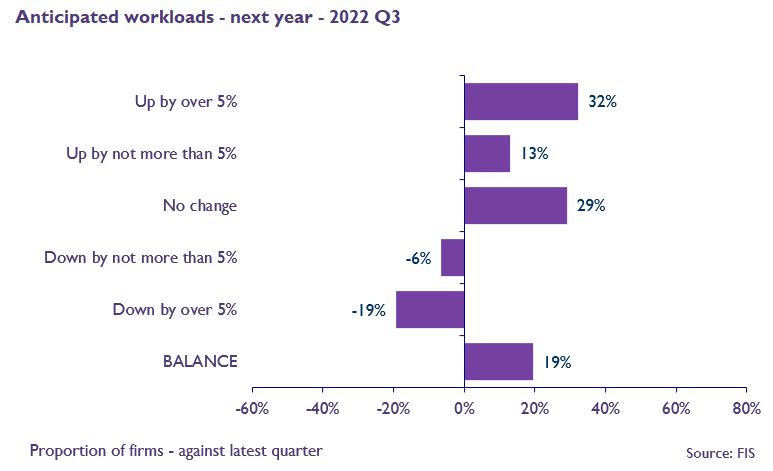
Whilst uncertainty has dominated headlines, workloads in the finishes and interiors sector held up well in the quarter.  The picture is more mixed when we look to sales, with the balance experiencing growth reducing from 29% to 17% (when comparing to the last survey period) and those experiencing a decline increasing from a fifth to a third of respondents.

Against a backdrop of uncertanty, looking ahead to 2023, those predicting growth in sales are in the minority (just a fifth of responses). Those seeing the market as static or declining are equally split leaving an overall balance of 20% anticipating a reduction in sales. Again the picture for workload is more optimistic with sales from 2022 washing through and a balance of 19% still anticipating growth.  Concerns were experessed about the sub-contractor squeeze as tender price increases do not fully reflect the significant increase in operating costs.

Uncertainty is casting doubt on the viability of some future projects with nervousness amongst investors linked to political and economic uncertainty. It is therefore not surprising to see demand move ahead of labour shortages as the biggest expected constraint for the marke, however, commentry still flags the “alarming lack of quality and reliable labour”.

The full FIS State of Trade Survey Q3 2022 can be downloaded here.

Construction output expected to fall significantly in 2023 amid looming UK economic recession

Construction output expected to fall significantly in 2023 amid looming UK economic recession

Construction output is forecast to fall by 3.9% in 2023 following a rise of 2.0% in 2022, as activity currently continues at a high level. The fall for 2023 is a sharp downward revision from -0.4% in the Lower Scenario of the CPA’s Summer Forecasts. This is mainly due to the impact of a wider economic recession, exacerbated by the effect of the ‘Mini Budget’, and the consequent fallout from recent political uncertainty.

There are still many factors which will adversely affect the construction forecast such as falls in real wages and potential further rises in interest rates, which will likely lead to further falls in consumer spending decisions. On top of these issues, the wider uncertainty around the UK economy means that demand for private housing new build and private housing repair, maintenance, and improvement (rm&i) is expected to fall. Other key construction sectors such as commercial and infrastructure are also expected to be affected by increasing concerns over construction cost inflation, which are likely to hinder project viability.

With an annual turnover of £37 billion, private housing is the largest sector in the construction industry. Activity is currently strong with most major house builders sold through to 2023 Q1. However, after the ‘Mini Budget’ announced in October 2022 and the resulting financial market chaos, interest rates are expected to peak at 4%. Activity was already expected to slow due to rising interest rates to 3% but the announcement worsened this forecast. The repercussions of this on mortgage rates will dampen potential demand and house prices for new homeowners. Furthermore, after more than a decade of low mortgage rates, some existing homeowners will be faced with the pressure of increased mortgage repayments and some may be forced sellers, adding further pressure to the housing market. As a result, property transactions and prices are likely to fall over the next year, with house builders likely to reduce house building targets. After growth of 3.0% in 2022, private housing output is now forecast to fall by 9.0% in 2023 before returning to 1.0% growth in 2024.

Following a record level of £24 billion last year, private housing rm&i output, the third largest construction sector, has been decreasing since March 2022. With a drop in real wages and sharp increases in mortgage payments for many households, there is likely to be a further fall in smaller, discretionary improvements and renovation spending. Output in this sector is expected to decline by 4.0% in 2022 and 9.0% in 2023, before marginal growth of 1.0% in 2024.

Commercial output is forecast to remain flat in 2022 before a fall of 5.1% in 2023. This comes as buoyant fit-out and refurbishment activity is offset by a hiatus in major new office and mixed-use tower projects, which dominate the sector. Commercial towers are reliant on large, up-front investment for a long-term rate of return. There are currently major projects in the pipeline over the next 12 months that were signed up to last year. With accelerating costs and worsening economic prospects, however, it raises the question of whether those projects will break ground in the near-term or whether they will be paused and pushed back into 2024 or, potentially even cancelled.

Infrastructure, the second largest construction sector, should be the least affected by issues of household finances and rising interest rates. Nonetheless, it is not immune to the impacts of both sharp cost rises and government making clear that it will not increase departmental budgets to deal with rising costs. Therefore, we are likely to see the value of activity that we expected previously but not the volume. In the medium-term, projects towards the end of the government’s Spending Review will get pushed back into the next review. Councils, which are already financially constrained, are also expected to cut spending on new infrastructure projects and divert finance to cover the rising costs of basic repairs and maintenance. Overall, after 5.2% growth in 2022, infrastructure output is forecast to rise by 1.6% in 2023 and 2.6% in 2024. This will be driven by larger projects already underway such as HS2, Hinkley Point C and Thames Tideway despite the cost overruns and delays.

Overall, given that construction output is expected to fall significantly over the next 12 months, it is critical that new government is focused on delivering its targets including 300,000 net additional homes per year, levelling up, and bringing forward infrastructure activity. Additionally, as part of its movement towards Net Zero, the UK must prioritise the energy-efficiency of its new and existing homes.

Professor Noble Francis: “With the UK economy expected to fall into recession, the construction industry will also fall into a recession. It is worth keeping in mind that activity in the industry currently remains at a historically high level, but it will not be immune to the effects of falling real wages and spending at the same time as the cost of construction continues to rise at double-digit rates.

“The largest effects will unsurprisingly be on private housing and private housing rm&i, given that they are reliant on households’ willingness and ability to spend. Activity in both sectors will fall significantly, albeit from a high point. Major clients’ willingness to invest in new commercial developments will also be tested given concern over the UK economy and rising construction costs. Furthermore, infrastructure will be adversely affected by central government and local authority spending constraints as well as increased pressure for austerity despite continual government announcements and reannouncements of more and more infrastructure.”

FIS members - download your copy

CPA response to the Chancellors Autumn Statement 2022

CPA provides economic update

The CPA has produced an economic update which details

  1. Insolvency Service UK Construction Insolvencies (August 2022)
  2. ONS/Land Registry UK House Price Index (August 2022)
  3. Bellway Preliminary Results (October 2022)
  4. Travis Perkins Trading Update (2022 Q3)

The CPA draft Autumn forecast figures will be available from Monday 24 October although the CPA will confirm the figures and publish the pdf document in November after the Chancellor’s Medium-term Fiscal Plan and Office for Budget Responsibility (OBR) analysis alongside it have been released as well as the impacts of these on the financial markets, given the currently uncertainty regarding the UK economy and volatility in the financial markets.

Price inflation remains the biggest issue for industry

Price inflation remains the biggest issue for industry

The Bank of England has increased interest rates to 2.25%, their highest level since 2008, and ‘will not hesitate’ to raise them further to reach its target of 2% inflation. Inflation remains high at 9.9% and the latest statement from the CLC Product Availability Group confirms it is still the ‘biggest issue’ for the industry.

It is most recent strategy, CLC outlines the four priorities to transform construction ‐ Net Zero and Biodiversity, Next Generation Delivery, Building Safety, and People and Skills ‐ as well as more immediate challenges, including inflation, forward pipeline, and business sustainability.

What are we doing about this?

See all of our campaigns and including what to do about materials cost and inflation

CPA response to the Chancellors Autumn Statement 2022

CPA provides economic update

THe CPA has produced an economic update which details

  • the CBI’s Industrial Trends Survey for the three months to September.
  • ONS figues for public sector net borrowing
  • Housing including the number of property transactions in the UK for August; and
  • The CPA’s analysis of the Chancellor’s Growth Plan 2022 – highlighting key policies affecting construction

FIS members can access the full information here (scroll to Weekly Notes – 23 September 2022)