by Clair Mooney | 19 Nov, 2020 | Main News Feed
Following the publication last week of HMRC’s guidance on the extended furlough scheme which stated that the government was reviewing its stance on furlough being claimed during notice periods, this section of the guidance has now been updated.
Citation has outlined the key points from this update:
- With effect from 1 December, employers will not be able to claim furlough pay for any period where the employee was serving either a contractual or statutory notice period.
- Although the new guidance appears in the ‘If you’ve made your employees redundant’ section – the rule seems to apply regardless of how the notice has come about as it specifically includes resignations and retirements.
- If an employer has claimed in advance and the employee subsequently starts a notice period on a day covered by the claim, the employer will have to adjust their claim.
- It will be irrelevant whether notice of termination was given before 1 December. The critical issue is whether the employee is serving notice, not when that notice was served.
For example, if an employer gives an employee 4 weeks-notice starting on 23 November and ending on 18 December, furlough pay can be claimed for the notice days falling within November but no furlough claim can be made from 1 December for the days when the employee was serving the remainder of their notice period.

by Clair Mooney | 19 Nov, 2020 | Main News Feed
A new guide that helps business owners understand the needs of its workforce and help plan safe working spaces that enable social distancing and help companies work effectively during the COVID-19 pandemic has been published today.
Entitled “How Business Owners Can Use Partitioning and Ironmongery to Help Manage Social Distancing” it has been created by two of Britain’s leading construction interior trade organisations – the Guild of Architectural Ironmongers (GAI) and the Finishes and Interior Sector (FIS).
The guide, which calls for changes to the style and layout of traditional open plan offices and other workspaces as a result of the pandemic, provides practical guidance to help business owners understand key considerations they need to make when adapting their workplaces. It aims to provide advice as to how to create the correct solution, addressing the issue of DIY screens that all too often fail to perform properly and can have unforeseen consequences with lighting, ventilation and even escape routes.
The GAI and FIS call the process re-cellularisation – the opposite to creating open plan spaces – and is intended to provide cellular space where social distancing can be provided, where teams can collaborate, and where individuals can find safe concentrated spaces when they are in the office.
“Within less than a year, Covid-19 has impacted every aspect of our lives. We’ve already seen big changes to the way that buildings operate, such as one way systems, and workplaces will need to continue to be responsive as new Government advice is released,” said Douglas Masterson, Technical Manager at the GAI. “Businesses need to protect staff, adhere to social distancing and maintain high standards of hygiene without compromising safety and security.
“This guide will be useful to employers who are looking for proactive solutions. It will help them to identify where measures should be implemented and the types of products that can deliver a safe and secure working environment.”
Cellularisation, as explained in the guide, is the creation of spaces using partitioning, raises several questions which include:
- What are my needs?
- What else should I consider?
- How do I select a partition system?
- What are my ironmongery requirements and can I introduce a touch free or antimicrobial solution?
- Will I need to control the doors through hold open devices or door automation?
- Is there a part that access control and electronic locking can play?
- How do I organise the installation?
Performance considerations, including fire resistance of the partitioning and doors, reducing sound transmission and privacy, also must be considered along with the need for increased ventilation which has a substantial impact on reducing viral infections between occupants.
The guide also shows ways in which new partitions can look by using solid, glazed, part glazed and double glazed elevations, and adding blinds or manifestation which can reinforce a corporate identity or add images of outdoor landscapes to the space.
Joe Cilia, Technical Director at FIS, added, “We wanted to produce an accessible and useful guide that can be used by any business to understand how to approach the issue. The flow chart that we produced with the GAI is easy to follow and ensures that any unknown unknowns are dealt with.”
The guide discusses all aspects of partitioning and how employers can sub-divide working space to protect staff, including using the right ironmongery and how to reduce infection via touch points.
The guide can be downloaded from www.thefis.org or www.gai.org.uk/IndustryUpdates

by Clair Mooney | 19 Nov, 2020 | Main News Feed
This year, after speaking to the Prescribed Organisations and some employers, CITB decided that it was inappropriate to run the Consensus process when the external environment was so unstable and uncertain. Their expectation is that, although some COVID-related uncertainty will remain, the external environment will be sufficiently stable to run the Consensus process next year. The final decision will be taken by the CITB Board in February 2021 and before doing so they will seek views from the
Prescribed Organisations, which are made up of several trade federations, as well as analysing other economic and industry insights to inform their recommendations to the Board.
In the meantime, CITB has been setting up the Levy Strategy Committee of employers and experts to recommend new Levy Proposals and support a longer term review of the Levy. The committee met for the first time in November, but there is one vacancy for an independent member that isn’t employed by a Levy-registered employer. If you have extensive experience of the industry and you work in an organisation that isn’t a CITB registered employer, please consider joining

by Clair Mooney | 19 Nov, 2020 | Main News Feed
Government Response to the consultation on the Energy Performance of Buildings: Changes to the Energy Performance of Buildings Regulations 2012 No. 3118
- This consultation sought views on the proposals to amend the existing regulations for domestic and non-domestic buildings to improve their energy efficiency and provide a reduction in their carbon emissions by increasing the threshold of the current air-conditioning inspection regime to include only air-conditioning systems and combined air –conditioning and ventilation systems with an effective rated output of more than 70kW
- This would lead to savings for some building owners but at some cost to energy assessor businesses while recognising that some carbon savings from smaller systems would be lost
Government Decision
- The UK Government intends to diverge from the European Commission’s proposal and retain the existing threshold for the inspection of energy efficiency of air-conditioning systems and combined air-conditioning and ventilation systems that have an effective rated output of more than 12kW.
- Government will be making a minor technical amendment to the existing 2012 regulations to ensure that the capabilities of air-conditioning systems and combined air-conditioning and ventilation systems are considered to optimise the system’s performance under typical operating conditions.
Stakeholders Responses leading to the above decision
- Majority of stakeholders favoured retaining the existing regime
- A significant improvement in enforcement and sanctions would be required for greater comparative savings from targeted larger units to be realised
- Responses also favoured the retention of the opportunity for inefficient lower output air-conditioning systems to be identified and the wider energy efficiency advice that building owners received when inspections are undertaken.
- The cost benefit analysis within the wider climate change targets did not warrant a change
A copy of the Government’s response can be downloaded here.

by Clair Mooney | 18 Nov, 2020 | Main News Feed
FIS Associate Member Citation is running a webinar entitled ‘Navigating Business Change’, which is aimed specifically at businesses in the construction and trades sector.
This webinar aims to assist members in getting to grips with the latest changes and guidance covering key HR and Health & Safety Considerations, such as how to pass a COVID-Secure inspection and managing employees and long-term homeworking.
Date: Wednesday 25 November
Time: 10am
How to join: REGISTER NOW
The webinar is free of charge, however spaces are limited so we suggest members register in advance of the session. The webinar will cover important topics such as those listed below, and there will be an opportunity to put questions to Citation’s experts on the day.
- How to successfully pass a COVID-secure inspection, in light of the Health & Safety ramping up their spot checks;
- Ensuring a reasonable and cautious approach is taken when handling COVID-related issues;
- Challenges managing your employees in the workplace, the implications of travel-related quarantine periods for employers, long-term homeworking, and employee wellbeing;
- The Good Work Plan and its impact on using casual staff
- The importance of having good HR and Health & Safety foundations in place, such as policies, contracts, handbooks and risk assessments
They will be on hand to answer your business-specific queries, so come along armed with any questions you may have.
We really hope you can make it.

by Clair Mooney | 18 Nov, 2020 | Main News Feed
We know that the Covid-19 outbreak has had a seismic effect on the economy, and that some apprentices have been made redundant without completing their apprenticeships, while others are at risk of redundancy. To help provide guidance to both employers and apprentices facing redundancy, the National Apprenticeship Service has introduced a Redundancy Support Service for Apprentices.
The service provides clear, accessible advice and guidance to individuals on the impact of redundancy, their options and next steps. There will also be opportunities to help redundant apprentices to identify new apprenticeship and employment opportunities, and, where they are eligible, complete their current apprenticeship.
The service is made up of three main elements:
• Providing apprentices with advice and guidance on the impact of redundancy
• Signposting apprentices to local and national support services
• An apprenticeship vacancy sharing service to make redundant apprentices aware of new opportunities
If you are aware of any employers who would like to recruit a redundant apprentice or offer new apprenticeship opportunities, please ask them to visit Hiring an apprentice who has been made redundant or call 0800 015 0600 to find out more.
If you are aware of any apprentices who have been made redundant please encourage them to visit Facing redundancy during your apprenticeship or call 0800 015 0400 to speak to an adviser.
More information is available at https://help.apprenticeships.education.gov.uk/hc/en-gb/articles/360015641099-Redundancy-Support-Service-for-Apprentices

by Clair Mooney | 18 Nov, 2020 | Main News Feed
The Government is proposing changes to the Construction Industry Scheme (CIS) to be introduced from April 2021.
These include giving HMRC the power to amend CIS deductions in the event of errors or omissions and requiring businesses to apply the CIS when construction expenditure exceeds £3 million over the preceding 12 months. Exemptions to CIS deductions will also be limited going forward and there will be penalties for providing false information.
Proposed revisions in detail
CIS set-off amendment power
Some sub-contractor companies are entitled to set CIS deductions suffered in-year against their employer liabilities as provided by section 62(3) FA04 and regulation 56 S.I. 2005/2045. Where, upon challenge from HMRC, the sub-contractor employer cannot provide satisfactory evidence to support the CIS deductions claimed, and when asked the employer does not amend the CIS entry on their EPS within a certain timeframe, HMRC will instead amend the CIS deduction figure claimed on an EPS. The HMRC amendment will match the CIS deductions sum supported by any evidence held by or provided to HMRC.
HMRC will remove the claim altogether where there is no evidence of any CIS deductions in respect of that company or where the employer is not entitled to set-off in this way. The employer liabilities will be recalculated following the amendment. Where HMRC has to amend the CIS credit claimed on an EPS, the employer may also be prevented from making further CIS set-offs in the same tax year. HMRC’s new powers to amend set-off claims and prevent further set-off claims will be decisions subject to review and appeal, unless the claimant is not a sub-contractor company suffering deductions under the CIS. The new powers will be contained in amendments to section 62 FA04, and the operative detail will be contained in regulations by way of amendments to S.I. 2005/2045.
Cost of materials
The current rule regarding the cost of materials to be taken into account by a contractor when operating the CIS on a payment to a sub-contractor is set out at section 61(1) FA04. This provision must be read with the definitions of a “construction contract” at section 57 FA04 and of a “contract payment” at section 60 FA04. The newly substituted provisions of section 61 FA04 will clarify that, on making a contract payment to a sub-contractor, the contractor must deduct a sum from the payment which is equal to the relevant percentage of the net payment. In calculating the net payment, the contractor must work out the amount of the contract payment less deductible materials costs. A materials cost will only be deductible if it represents the direct cost of materials purchased by a sub-contractor in respect of that particular contract. The change to these provisions will ensure that it is clear that only the sub-contractor directly purchasing materials to fulfil their own contract with their contractor is entitled to a reduction to account for materials costs from the gross contract payment before the CIS deduction is calculated.
Deemed contractors
Section 59 FA04 sets out the rules for bringing deemed contractors into the CIS. The general rule to determine whether a non-construction business has to operate the CIS is found at section 59(1)(l) FA04. It requires a turnover threshold for expenditure on construction operations to be met, and that the business reviews this expenditure at the end of each period of account. If average annual expenditure on construction operations exceeds £1 million in each of the last 3 years, the business has to operate CIS on any construction expenditure from the start of the next period of account. When average expenditure is less than £1 million in each of three successive years the business no longer has to operate the CIS on construction expenditure: see section 59(3) FA04. The new rules will require a business to monitor construction expenditure more regularly. When the cumulative expenditure on construction operations exceeds £3million within the previous 12 month period, the business will have to register for the CIS as a contractor (if not already registered) and begin operating the CIS on their next payment to a sub-contractor for construction operations. Deemed contractors will be able to stop operating the CIS when expenditure on construction operations falls below £3m within the previous 12 month period, or when no further payments on construction operations (including retention or management/administration payments) are expected to be made under that or any other construction contract.
CIS registration penalty
HMRC can penalise a person for providing false information when registering for payment under deduction under the CIS or for GPS (section 72 FA04). This penalty applies only to the individual or business to whom the registration applies. The scope of this penalty will be expanded to apply to a wider group of individuals or companies who are able to exercise influence or control over a person who is registering for the CIS, this will include agents, directors, company secretaries, or anyone HMRC believes is in a position to exercise influence and control over the business and/or the person making the CIS registration.
Such persons will be liable to a penalty in two circumstances:
- where they themselves make a false statement or furnish a false document for the purpose of enabling another individual or business to be registered or
- where they encourage an individual or business to make a false statement or furnish a false document for the purpose of enabling themselves to be registered for the CIS
The changes to primary legislation to deliver this measure will be published for consultation alongise this TIIN.
If you have any feedback or concerns, please send your comments to iainmcilwee@thefis.org.
by Clair Mooney | 16 Nov, 2020 | Main News Feed
In an open letter to the construction sector, The RT Hon Alok Sharma MP, Secretary of State for Business, Energy & Industrial Strategy has paid tribute to the efforts of the construction sector in supporting the UK economy in difficult times. The full text from the letter is displayed below:
To everyone working in the construction sector
On 31 October, the Prime Minister announced further measures in England to curb the spread of Coronavirus. From 5 November, people may only leave home for specific reasons, including for work, if you cannot work from home. The Prime Minister explained that workplaces should stay open where people cannot work from home, for example in the construction or manufacturing sectors.
The construction sector, which is a key part of our economy, remains open. Where it is essential to travel to your place of work to do your job, you should continue to do so. Building merchants and hardware stores will be able to stay open to support this as normal or through click-and-collect services.
The Government continues to update our safe working guidance. Updated guidance for England for working from your place of work from 5 November is available on https://www.gov.uk/guidance/working-safely-during-coronavirus-covid-19
During this difficult Autumn, I want to pay tribute to you and express my admiration for all the work you are doing. Whether working on large or small construction sites, in peoples’ homes across the country, in builders’ merchants, designing and project managing schemes or producing construction and mineral products, you are making an invaluable contribution in supporting the economy.
Since the outset of the pandemic in March, you have performed a vital role. In the past six months we have seen the industry build the Nightingale Hospitals, accelerate the delivery of infrastructure projects, support vital public services and help the country adapt buildings to become Covid-Secure. Whilst doing this, the industry has itself had to innovate and adapt, changing the way it operates on sites, finding more efficient ways of delivering projects, and collaborating effectively throughout the supply chain.
My Department and I are in regular contact with industry leaders about the risks, issues and challenges you face.
Thank you again to everyone operating in the UK construction sector. You are making a hugely valued and critical contribution to our country.
Yours sincerely,
THE RT HON ALOK SHARMA MP
Secretary of State for Business, Energy & Industrial Strategy
You can download a copy of the letter here – https://www.gov.uk/government/publications/coronavirus-covid-19-letter-to-the-construction-sector-november-2020

by Clair Mooney | 13 Nov, 2020 | Main News Feed
From 1 January 2021, a new Find a Tender Service (FTS) will be used to post public procurement notices published by UK contracting authorities, which have previously appeared on the European Tenders Electronic Daily (TED) portal. Contracts Finder will still be available for certain notices, and companies registered with Contracts Finder will automatically be transferred to the new service when it goes live.
To find out more, there is a helpful 30‐minute CLC webinar where Crown Commercial Service demonstrates how the new FTS will work.

by Clair Mooney | 13 Nov, 2020 | Main News Feed
FIS is delighted to announce that 16 new product ranges have been verified through the FIS Acoustic Verification Scheme. The Scheme was established in 2019 to introduce standard methodology and support honest and consistent declaration of acoustic performance, encouraging best practice and preventing inaccurate or misleading information from undermining the market and responsible manufacturers in the Partitions and Operable Wall Sector.
On achieving accreditation for their partitions Director of iWall Ltd, Adrian Law stated “iWall is pleased to be part of the FIS Acoustic Verification Scheme as it creates a standard within the industry helping us to deliver what our customers expect from us. It gives our clients confidence that the product they select from our range has been thoroughly tested and the data produced is accurate”.
Sales Manager, Alex Stewart at Acoustic Wall Systems Limited (who have verified 5 operable wall systems through the scheme) commented “The Movable Wall Industry has long been tainted with false misleading data when it comes to Acoustics, we therefore did not hesitate to participate in the FIS Acoustic Verification Scheme that champions integrity within the office fit out industry. Acoustics are an essential criteria when considering a movable wall system, we are therefore proud to be part of the FIS verification scheme that provides a database that customers and specifies can use with confidence’’
The FIS Acoustic Verification Process
The process for verification to the FIS Acoustic Verification Scheme Standard is as follows:
- All data is supplied using an agreed FIS data sheet
- Test report and certificate and covering information must be supplied in English and be translated by the original test house.
- Traceable evidence on the independence of the test facility must be supplied
- Photographs of the test if available must be supplied
- Drawings of the installation of the test sample must be supplied
- The independent verification will be carried out by Cundall Johnston and Partners LLP
- All companies must be full members of the FIS
You can download our FIS Datasheet here. Full details of the technical requirements are available in the FIS Acoustic Verification Scheme Manual, available on request via info@thefis.org

by Clair Mooney | 12 Nov, 2020 | Main News Feed
The Q3 Construction Trade Survey follows one of the worst quarters in history for sales of construction products and materials, and contractor and surveyor workloads. The seven-week coronavirus lockdown in Q2 saw the industry bear the brunt of pauses in activity in March, April and May. An easing of restrictions from mid-May and a change in seasons in terms of the weather kicked off the subsequent returns to site and rebound in activity throughout Q3.
FIS member can access the findings here.

by Clair Mooney | 12 Nov, 2020 | Main News Feed
Ofqual publishes regulatory arrangements on adapting vocational and technical qualifications and assessments in 2021.
In recognition that some learners taking vocational and technical qualifications (VTQs) have experienced lost teaching and training time as a result of COVID-19 and that appropriate arrangements need to be put in place to mitigate the impact of this disruption and respond to any ongoing or future public health measures. Ofqual consulted on proposals to permit awarding organisations to adjust their qualifications and assessments, which took account of the different ways in which the qualifications are used ranging from those taken alongside, or instead of general qualifications, to those used to signal occupational competency. On 7 September, Ofqual confirmed their decisions and the proposed arrangements will be implemented in full.
On 12 October 2020 Ofqual published the Extended Extraordinary Regulatory Framework (ERF), to put the arrangements into effect. The Extended ERF sets out the regulatory arrangements and statutory guidance with which awarding organisations must comply when adapting their qualifications. It includes 4 principles with which awarding organisations must comply when making their decisions around adaptations, supported by statutory guidance. Ofqual have also included statutory guidance on Special Consideration within the regulatory framework.

by Clair Mooney | 12 Nov, 2020 | Main News Feed
At a time when many programmes have been paused, CITB has maintained its support for a nationwide network of local and specialist Training Groups, so that employers who are Training Group members can access the local training they need.
However, CITB need to look at costs given the significant reduced levy income for the foreseeable future. At the same time, they need to consider what are the most effective ways to help companies access training at a local level, while ensuring value for money and quality of provision.
On Wednesday 11 November 2020, CITB launched an industry wide consultation on how best to provide support in future. This will help them understand the biggest benefits of Training Groups to employers and gather thoughts on the options CITB are presenting.
You can find the full options paper and the survey on the CITB website. If you need more information, please contact the CITB Partnership Team or give George a call.

by Clair Mooney | 6 Nov, 2020 | Main News Feed
With the second lockdown for England now in force, education and training is set to continue across the country for all industries and sectors. Awarding Organisations are providing information to centres on acceptable approaches and contingencies to ensure government guidance aimed at reducing infection is applied. From what we have seen so far Training Providers for the construction industry are being encouraged to continue delivering training, assessment and qualifications, including end point assessments. Special measures that have enabled 25,000 apprentices to complete their end-point assessment during the Covid-19 pandemic will be retained until at least March 2021.
The FIS Approved Training Provider network will continue to deliver training and qualifications for FIS members and there are discounts and offers available, have a look at membership benefits on the membership hub. FIS is happy to help identify a supplier for your training needs, a list of available training and qualifications and suppliers can be found here or give us a call on 0121 707 0077 or email info@thefis.org.

by Clair Mooney | 6 Nov, 2020 | Main News Feed
CITB has confirmed the Skills and Training fund can continue to support business with Covid-19 related resilience support. The deadline for reverting the
Skills and Training Fund will be extended to 31 December 2020. The fund was expanded earlier this year to include skill retention and sustainability projects and had been scheduled to revert on 1 December to supporting productivity and innovation projects only. CITB adapted to the COVID-19 situation by amending the scope of activity to support what businesses can apply for. The fund comprises two streams:
- A Skills and Training fund for micro and small businesses where businesses can apply for a maximum of £10,000 (full details and how to apply) depending on the size of the employer.
- A Skills and Training fund for medium-sized businesses where employers with up to 250 employees are eligible to receive up to £25,000 (full details and how to apply).
If you have not applied for CITB Skills and Training Fund, FIS will be happy to help. Call us on 0121 707 0077 or email info@thefis.org or you can book a Skills and Funding Clinic online at https://www.thefis.org/skills-hub/skills-clinics/

by Clair Mooney | 5 Nov, 2020 | Main News Feed
The new points based system that will be implemented to control immigration from 1 January 2021 will have a significant impact on how and who we can engage individuals from outside the UK to work. With most of the detail available, FIS is conducting a snap survey to assess the impact on your business and to support our representative work in this area. Our concerns stem from how occupations have been determined “skilled” and the surprisingly hard line the Home Secretary has taken on shortage occupations. This will not impact those workers already working in the UK and successfully applying for pre-settled or settled status, but will have a profound impact on our ability to attract new people (or indeed those who have returned home for a period before securing any kind of settled status).
To support our attempts to assess the impact, we have created a short survey in which we would like to gather your best estimates for your business. We will be using the survey on a rolling basis and will keep it open until the 15th November.
In terms of immediate actions, there is new guidance from the CLC that FIS helped to pull together Movement of people – what should you be doing now? From this page you can also follow links to a more detailed explanation of how the new system will work, the scale of the problem and why FIS is concerned.
We are planning a planning a webinar to look at actions and options for later November, so keep an eye on our events page for details.

by Clair Mooney | 5 Nov, 2020 | Main News Feed
Following the development of a new pandemic Standard announced back in August, an eCourse, ‘Setting up and operating a safe construction site during COVID-19’ is now live on CITB’s eCourses platform.
Government guidance is for construction sites to remain open, with a reminder to review social distancing measures and comply with the Site Operating Procedures ‐ Version 6. The COVID-19 eCourse can be used alongside existing guidelines to ensure sites remain open safely, and as the Standard is not grant supported, CITB is offering this online course FREE of charge. Aimed primarily at managers and supervisors, the course will enable the confident and knowledgeable delivery of toolbox talks, and cover topics such as, ‘Understanding a Virus’ and ‘Social Distancing’.

by Clair Mooney | 2 Nov, 2020 | Main News Feed
Unemployment starts its anticipated upwards trajectory.
The ONS’ publication of August GDP all but confirmed a “square root” shaped recovery for Great Britain as the economy started to plateau. Growth was 2.1% in August, a sharp fall from 6.4% in July and 9.1% in June, and well below forecasters’ expectations of 4-5%. The result was surprising as the scene was set for a further strong recovery with low Coronavirus circulation and the Government’s July mini-budget providing a sugar-rush for benefitting sectors. A “V-shaped” recovery is now highly unlikely, and many commentators will be revising down their forecasts.
Nonetheless, two thirds of March and April’s fall in output has now been recovered. The economy remains 9% smaller compared to February: output is now at 2014 levels.
August’s result underlines the danger of relying on transient stimulus measures. A robust infrastructure to manage the virus, minimising fatalities while allowing as much normal activity to resume is now vitally important. The likelihood of activity inhibiting measures such as regional lockdowns are now all but certain. It appears that SAGE recommended a “circuit-breaker” mini lockdown four weeks ago among other measures that were not acted upon.
The Construction Sector – Awards values climb 21.2% in September as upward trend continues
According to the latest data release from ONS, construction output increased by 3.0% in August following 17.2% uplift in July and record 21.8% increase in June. Whilst the upward trend has been extremely positive since April 2020, overall construction output in August is still 10.8% lower than February 2020, immediately prior to the Covid-19 lockdown. Comparisons on a year ago show total construction output is 13.0% lower than August 2019 with new work 13.9% lower and repair & maintenance 11.3% lower than a year ago. With the exception of
infrastructure new work which showed annual increase of 1.3%, all other construction sectors showed output decreases compared with August 2019. The most notable of these were the private industrial sector showing output decline of 42.5% on a year ago with the private commercial sector down 22.0% and public sector new housing down 25.2%.
FIS members can access the full report here.
by Clair Mooney | 2 Nov, 2020 | Main News Feed
CITB has today published a new construction industry forecast in which it states that Government investment is needed to support skills in the coming year to prevent a generation of talent being lost.
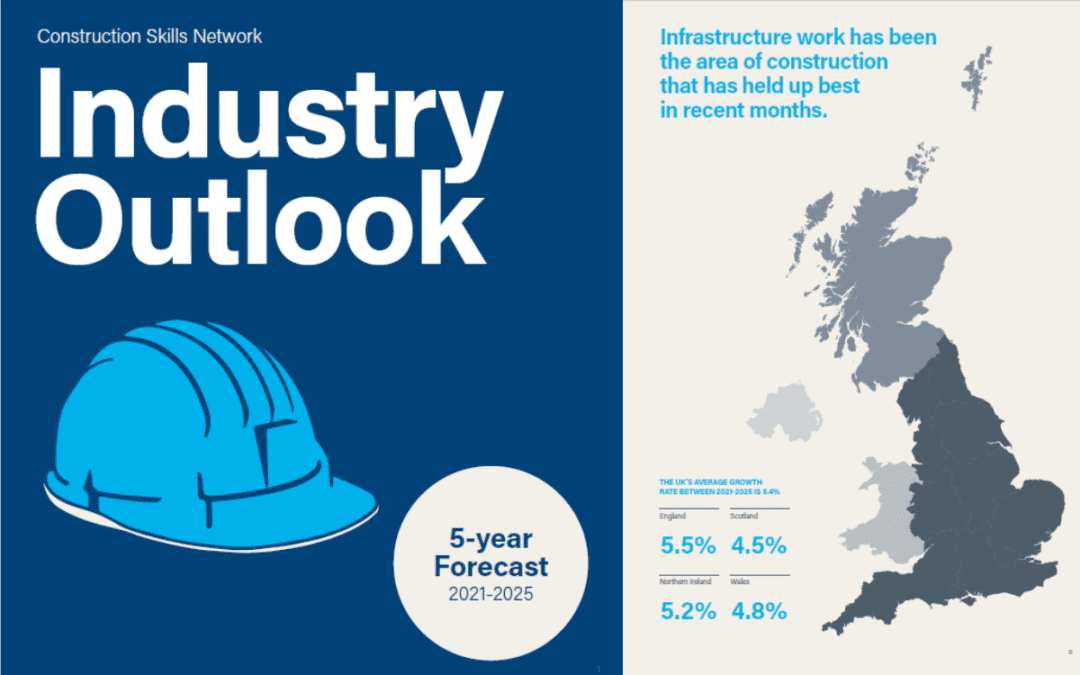
The CITB Construction Skills Network (CSN) report for 2021-25 outlines three scenarios for how the construction sector might recover from the current recession.
Under the best-case scenario, UK Gross Domestic Product (GDP) would return to pre-Covid-19 levels in 2022, whereas it is likely to be 2025 or later for the mid-case or worst-case. The forecast fall in construction employment varies between 10% and 14% of the workforce, or 286,000-372,000 sector workers. The numbers employed will only approach pre-Covid levels from 2025 onwards.
Action is essential to ensure that this loss of skilled workers does not hold industry back from delivering on its pipeline of work, meeting the governments ambitions for infrastructure, new homes and zero carbon or modernising to boost productivity.
CITB is working with industry to make it easier for people to join construction, to place people who have lost their jobs, to help learners complete their apprenticeships and to carry out essential training and retraining.
The report makes four key recommendations for Government to build on this. These are:
- Protect and retain as much of construction’s existing talent as possible
- Make construction a priority sector in the new National Skills Fund
- Reform the Apprenticeship Levy so that more money can be spent on smaller companies in the supply chain
- Help get more college students into construction jobs and apprenticeships
FIS Skills and Training Lead George Swann said: “The coronavirus pandemic has led to the economy taking a severe hit, with many sectors struggling. This Construction Skills Network, Industry Outlook provides three economic recovery scenarios for the construction industry, categorised as base, mid and worst cases. Each case predicts a steady rise in workforce numbers, which means employer investment in recruitment selection and induction then training and qualifying individuals. FIS can help not only with recruitment and training activities, but in identifying, sourcing and securing funding finishes and interiors employers are eligible for. If you need any information, advice or guidance, please give FIS a call”.
Steve Radley, CITB Policy Director, said: “This forecast shows that a recovery will be slower than previously hoped but that construction will grow and create more jobs over the next five years. This will create skills challenges and it is vital that CITB, industry and government work together to meet them.
“CITB is investing levy funds to make it easier for people to join construction, to place people who have lost their jobs, to help learners complete their apprenticeships and to carry out essential training and retraining.
“Government can play a key role and providing certainty on its infrastructure pipeline, working with industry to help more college students into construction jobs and apprenticeship and prioritising construction in the new National Skills Fund to help it recruit and train fresh talent. It should also look at reforming the Apprenticeship Levy to allow employers to pass on unspent vouchers in bulk.”
CSN’s annual average sub-sector growth rates over the next five years see public housing in the strongest position (8.2%), while private housing (7.8%) and infrastructure (5.5%) are also expected to grow strongly and be key drivers for recovery.
Growth is expected to be evenly spread across all nations, with a UK average rate for 2021-2025 at 5.4%, England at 5.5%, Northern Ireland at 5.2%, Wales at 4.8%, and Scotland at 4.5%.
In the short term, 2021-2022, limited recruitment of new entrants and apprenticeship starts is expected, with a rise in unemployment but demand for skilled workers in infrastructure. In 2023-2025 recruitment of new entrants and apprenticeships should pick up with increased demand for training from employers.

by Clair Mooney | 30 Oct, 2020 | Main News Feed
As the UK leaves the EU on 1 January 2021 new rules come into force for construction products that are currently covered by the European Construction Regulation (CPR). This requires products covered by a harmonised European Norm (hEN) to carry a CE mark when placed on the market. From January new rules in the UK require a new mark of conformity Assessment (UKCA) mark to be applied to products put on the market in the UK; Northern Ireland has separate rules where CE marking will be acceptable if the product comes from the EU or a UKNI mark for products coming from outside the EU which includes the UK.
Placing products in the UK market will require the Notified Body to be in the UK and in the EU where manufactures from the UK are exporting to the EU
To help, The Brexit working group of the Construction Leadership Council has published advice and information on the conformity marking of construction products
Read the full press Release here.
And the new guidance EU EXIT BUSINESS READINESS: CONFORMITY MARKING OF CONSTRUCTION PRODUCTS HERE