0121 707 0077

New Hospital Programme Industry Day

The New Hospital Programme (NHP) will be holding an Industry Day on Tuesday 13 December to outline how businesses across the supply chain can play a role in the biggest hospital building programme in a generation. With a target to develop 48 hospitals by 2030, the NHP will provide further information on how it is building better, faster and greener, following publication of its first commercial pipeline earlier this year providing visibility of contract opportunities up to 2024.

Places at the Industry Day are limited and members can register their interest to attend either in‐person at the Vox Conference Venue in Birmingham (B40 1PU) or online.

Working Rule Agreement Revised

Working Rule Agreement Revised

The Construction Industry Joint Council (CIJC) Working Rule Agreement (WRA) has been updated, following the 5% increase in the national pay rates in July 2022. The WRA ‐ also referred to as ‘The Pink Book’ ‐ sets out the terms and conditions for use across the industry and there are changes to the provisions relating to benefit schemes, pensions and temporary lay‐off.

As set out in the CIJC Holiday Entitlement 2022, this year’s two‐week Winter Break (Christmas shutdown) will run from normal finishing time on Friday 23 December 2022 to normal starting time on Monday 9 January 2023.

Build UK executive summary helps whole supply chain understand the Playbook’s key policies

Build UK executive summary helps whole supply chain understand the Playbook’s key policies

Following publication of the revised version of the Construction Playbook, Build UK has updated its executive summary which is designed to help the whole supply chain understand the Playbook’s key policies and its potential to transform the delivery of public sector projects.

The executive summary, which is endorsed by the Cabinet Office, now incorporates the additional and updated guidance provided in version 1.1 of the Playbook on key topics such as Modern Methods of Construction and Promoting Net Zero Carbon and Sustainability.

CPA provides economic update

CPA provides economic update

The CPA has produced an economic update which details

  1. Insolvency Service UK Construction Insolvencies (August 2022)
  2. ONS/Land Registry UK House Price Index (August 2022)
  3. Bellway Preliminary Results (October 2022)
  4. Travis Perkins Trading Update (2022 Q3)

The CPA draft Autumn forecast figures will be available from Monday 24 October although the CPA will confirm the figures and publish the pdf document in November after the Chancellor’s Medium-term Fiscal Plan and Office for Budget Responsibility (OBR) analysis alongside it have been released as well as the impacts of these on the financial markets, given the currently uncertainty regarding the UK economy and volatility in the financial markets.

Increased grant for drylining apprenticeships

Increased grant for drylining apprenticeships

CITB-registered employers can now receive an additional £2,000 on top of the existing grant (£2,500 per year for attendance and £3,500 for achievement) for Dry Lining Apprenticeships that started from 1 April 2022 onwards.  This is applicable for employers in each of the home nations.

  • £1,000 paid with first quarterly attendance payment (13 weeks),
  • £1,000 paid with the final quarterly attendance payment.

Your apprentice must complete 13 weeks of the apprenticeship before there is entitlement to the first £1,000 increase.  A maximum drylining increase of £2,000 is payable per apprentice.

In instances where apprentices change employers:

  • The first £1,000 grant is paid to the employer with which the apprentice first completes 13 weeks of their apprenticeship.
  • The final £1,000 grant is paid to the employer with which the apprentice completes their attendance.

You must use an approved apprenticeship provider that is on the Register of Apprenticeship Training Providers:  Download the Register of Apprenticeship Training Providers (RoATP) (education.gov.uk)

How to apply for the Grant

If CITB are your Apprenticeship provider, your dedicated Apprenticeship Officer will help you complete your application correctly.  If they receive your application within 20 weeks of the start date of the apprenticeship, they will begin making your grant payments, backdated to this start date.  The attendance grant will be paid automatically every 13 weeks.

If CITB are not your apprenticeship provider, you will need to complete an application form.  Download and save the 2022-2023 Apprenticeship Attendance Grant application (Excel, 207KB) and ensure you complete all sections before submitting.

Please note: Use Chrome or Firefox to download the application.  CITB recommend that you do not use Internet Explorer as you may have problems downloading.

You must provide evidence from your college or training provider that your apprentice is registered onto an approved apprenticeship programme.  This evidence must be provided from the college or training provider on either their headed paper or from their email address and it must contain the following information:

  • The full name of the apprentice.
  • The full apprenticeship standard course title and level including the pathway if applicable.
  • The apprentice’s start date with the college or training provider.

Evidence directly from an employer, certificates or unit credit reports are not acceptable evidence.

Send your completed application and supporting evidence as detailed above to Customer.servicesYNET@citb.co.uk.

New CITB Skills and Training Fund for subcontractors

New CITB Skills and Training Fund for subcontractors

There is a new £2.5k Skills and Training Funding opportunity for Employers with CIS only (No PAYE).  This is an enhancement to the Skills and Training Funds currently available: Skills and Training Fund funding from £2,500 to £25,000 over a 12‐month period for companies with 250 or fewer employees to train and develop their workforce. Detailed guidance on how to apply is available for both small and micro‐sized and medium‐sized businesses.

To apply for grant, applicants should visit CITB’s website.  The requirements specific to each grant type should be checked prior to submitting an application as some grants operate restrictions.  If you are unsure please contact Marie Flinter 07799 903103 or email marieflinter@thefis.org

Training qualification for dryliners working on house building

Training qualification for dryliners working on house building

FIS worked with NOCN to create a much needed training qualification for Dryliners working on house building projects.  Recent information received from NOCN shows there are 24 Centres approved to deliver with 40 Tutors and 37 Assessors assigned to the qualification.  If you are working in house building and need to train new entrant this is a perfect qualification to start their learning journey with.

For more information contact George Swann, FIS Skills and Training Lead on 07553 874838 or take a look at the NOCN web site: Dry Lining (housing)

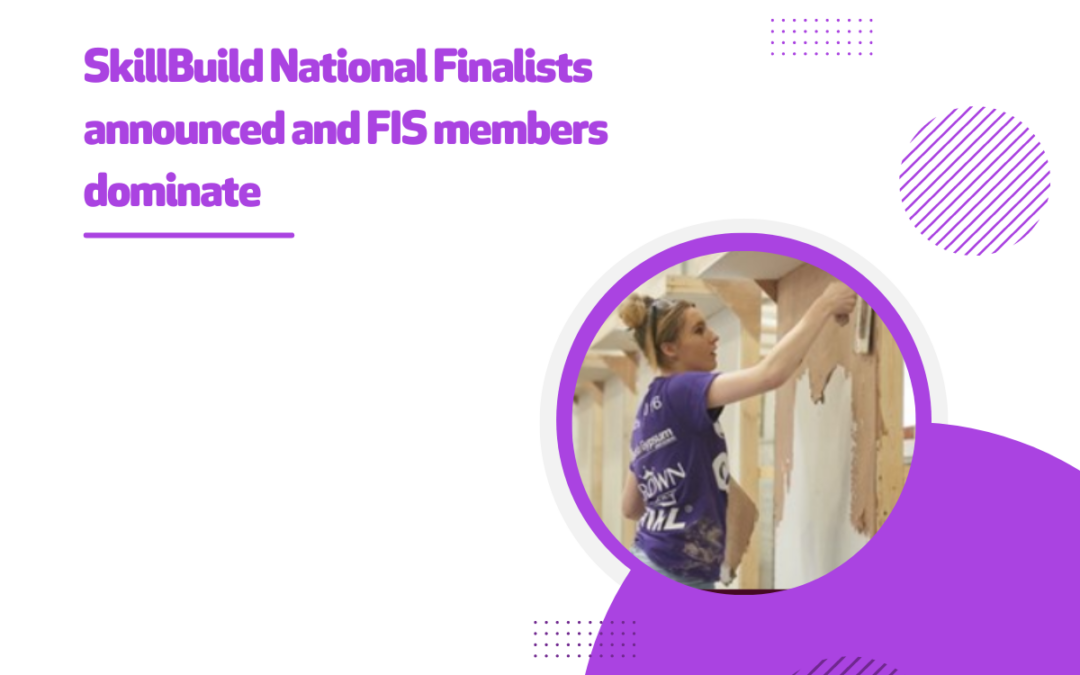
SkillBuild National Finalists 2022 announced and FIS members dominate

SkillBuild National Finalists 2022 announced and FIS members dominate

After coming first in their regional qualifiers over 85 finalists will compete in the finals of SkillBuild 2022.  Described as “the UK’s construction’s Olympics”, SkillBuild will be delivered by CITB in conjunction with WorldSkills and will take place at Edinburgh College from 14–17 November 2022.

All eight finalists in the Plastering and Drywall category are from FIS members:

  • George Batchelor and Archie Downham – Measom Dryline East Midlands
  • Ben Henry, Ashley Carragher, Hugh Treanor and Shaun McKenna – Errigal Contracts Northern Ireland
  • Zara Dupont is a student at Leeds College of Building
  • From Neath Port Talbot College Sammy Young will compete in the Carpentry category, Paul Mason will compete in Painting and Decorating, Jack Holmes and Jonathan Donaldson are competing in Plastering.

You can see the full list of finalists on the WorldSkills website

George Swann FIS Skills and Training Lead said:

If you are an employer and you have an opportunity it is well worth a visit to see what the competition is about.

Construction Product Availability Statement from the CLC

Construction Product Availability Statement from the CLC

Construction Product Availability: 17 October 2022

Statement from John Newcomb, CEO of the Builders Merchants Federation and Peter Caplehorn, CEO of the Construction Products Association, co-chairs of the Construction Leadership Council’s Product Availability working group

As we move into the fourth quarter of 2022, all regions are reporting the best product availability in two years, both in the range and volume of products available and delivery/lead times.

Availability of bricks has significantly improved and deliveries of aircrete blocks are being managed.  Aircrete block manufacturers report strong sales of foundation blocks.  Historically this leads to increased sales of above ground blocks 4-6 weeks later. This year there is less correlation, and the increased below ground activity is likely due to builders seeking to get new starts registered before changes in Part L regulations next June.

While longer delivery times for gas boilers remain and early ordering is recommended, availability is more positive than for some months.

The situation is somewhat different for electro-technical products which continue to be affected by the restricted supply of semi-conductors.  Now, with rising interest in products related to energy saving, renewable energy production, storage and heating, there are further concerns over both availability and price escalation for electrotechnical products that may impact both the construction and facilities management sectors.

Although many construction sectors remain resilient and infrastructure and housebuilding activity has remained strong, there are early signs of softening in demand.  This is most clearly seen in the home improvement sector where the rising cost of living and increased costs of finance are denting consumer confidence, but also in a reduction in the number of large commercial construction contracts being placed.

Softening demand has led overall product price inflation to moderate slightly, dropping from 25% to around 17%.  Nonetheless, concerns remain over inflation tied to energy costs for manufacturers, despite the Energy Bill Relief Scheme announced by government last month and the fact that many manufacturers have already hedged energy costs.  The concerns are greatest for energy intensive products such as bricks, blocks, glass, steel, cement and ceramics that have already seen sustained price increases during 2022.  Some suppliers have already announced further increases from January.

Timber prices have fallen and there is plenty of stock on the ground, especially standard softwood sizes.  There are, however, gaps in speciality markets such as birch plywood, which is affected by sanctions against goods from Russia.  Anyone sourcing birch plywood should request full due diligence documentation to ensure it is legally sourced from Finland and Latvia.  We are aware of cheap birch plywood coming from China and Vietnam, where there are no birch forests, and is likely sourced from Russia.  Russian birch logs processed elsewhere cannot be legally sold in the UK.

Availability is not an issue for steel but rising rebar prices may be, again due to increased energy costs throughout Europe.  This has led to importing products from more unusual markets including Egypt, which may be of lesser quality.  The EU has also banned the import of semi-finished steel product from Russia, which may affect the availability of some steel products, particularly steel plate.

We note that shipping and logistics costs, capacity constraints and delays remain problematic but appear to be easing, though this is still very volatile depending on the products, countries and mode of transport involved.  For example, in general container shipping prices from Asia to the UK have dropped over 50% since January and punctuality has improved.  That said, the consensus amongst industry analysts is that high oil prices, strained global infrastructure, labour issues, Covid shutdowns in China and the war in Ukraine will cause logistics-related problems to persist and costs to remain elevated for the foreseeable future.

For all the work FIS is doing around inflation and availability, including recommended contractual terms click here