
by Clair Mooney | 13 Jul, 2023 | Main News Feed
The Cabinet Office is consulting on the secondary legislation required to implement the new public procurement regime set out in the Procurement Bill, including the financial thresholds that will mean contracts need to comply with the regime. The deadline for responses is Friday 28 July.
This is a technical consultation, split into two parts. This first part of the consultation refers predominantly to areas of the Bill which require lists, calculations or further definitions to be used in practice. Questions seek to understand to what extent the draft secondary legislation provisions implement the policy intent as established in the Bill.
The closing date for Part 1 of the consultation is 28 July 2023.
Part 2 of the consultation is expected to launch in July 2023.

by Clair Mooney | 13 Jul, 2023 | Main News Feed
The FIS team have been hard at work and achieved some brilliant results across out Technical, Business Development, Skills and Training, and Lobbying efforts. Here’s a short look back at Q2 of 2023
Key technical work
- Update to workmanship on construction site standards – design and installation of drylining systems (the working group for BS8000 Part 8 was chaired by Technical Director)
- Working with Imperial college and the Steel Construction Institute testing the impact of building
- FIS announces updated vetting process aligned to Common Assessment standard
- Surveyed drylining and ceiling market for Autumn report
Business support and guidance
Lobbying and representation
- FIS invited to join the new Home Building Skills Partnership Sector Panel (chaired by Matthew Pratt, CEO Redrow)
- FIS responds to consultation on measuring embodied carbon and carbon leakage
- FIS met with senior members of Build UK and the Bank of England on a roundtable discussion on prospects and forecasts for UK construction (with input from the FIS Q1 State of Trade survey)
- FIS joins the RICS Conflict Avoidance Coalition Steering Group
- FIS responds to Government consultation on payment and retention overhaul
- FIS responds to RICS consultation on Whole Life Carbon Assessment for the Built Environment
- FIS takes a lead role in the new HSE campaign about the hidden dangers associated with asbestos
Skills and training
Key Events
- Contractors Awards Lunch – record attendance
- Industry Days – Commercial Fit-Out and D&B and Housebuilding
- Scottish regional event
- FIS Technical team active at a number of workshops / events at Clerkenwell Design Week
- FIS supported the Construction Industry’s ‘Inspiring Change’ Conference and Awards
- FIS Technical Director delivered a speech at the Fire Safety Event at the NEC
Download this document Q2 2023

by Clair Mooney | 12 Jul, 2023 | Building Safety Act, Main News Feed
Ahead of the next phase of the building safety regime coming into effect from 1 October, Build UK has updated its guide and timeline to reflect the regulations and supporting guidance that have recently been published. Changes in the July 2023 version of the guide, which is supported by the CLC, include:
- Clarifying the definition of a Higher‐Risk Building
- A link to the guidance on Key Building Information (KBI), which can now be submitted as part of the registration process for High‐Rise Residential Buildings
- Updated information on the new building control framework
- New guidance on Planning Gateway One and confirmation that hospitals and care homes are excluded from the requirements
- An updated link to guidance on the Regulatory Reform (Fire Safety) Order.
To ensure businesses across the supply chain are aware of their responsibilities under the new regime, Build UK is sharing its guide through Building Magazine. In an article published yesterday, Build UK Chief Executive Suzannah Nichol explained: “We believe that helping the whole supply chain to see the bigger picture will make it easier for everyone to understand where they fit in and what their responsibilities are…No one company or organisation can do this alone. We talk a lot about collaboration and this really does need a combined effort from Team Construction.”
by Clair Mooney | 7 Jul, 2023 | Health and Safety
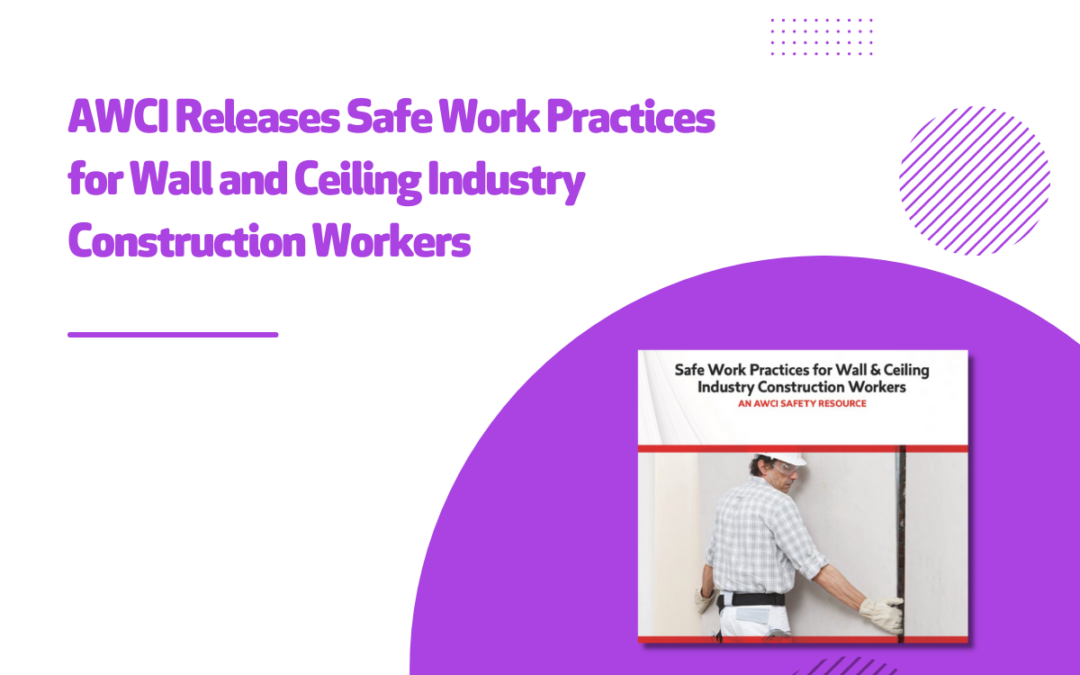
AWCI has released “Safe Work Practices for Wall & Ceiling Industry Construction Workers, an AWCI Safety Resource,” a publication on best practices for construction site safety.
Targeted to construction professionals in the wall and ceiling industry, the 28-page document provides summaries of safety best practices and principles on 41 potential hazards in the drywall and plastering fields. The subject matter ranges from aerial lifts to welding and includes several topics specific to drywall construction, such as drywall carts and stilts.
FIS Chief Executive Iain McIlwee said:
“We enjoy a great relationship with the AWCI built on shared values and collaboration. We are grateful that we can bring this fabulous resource, developed in the US, to support safety in the UK”.
The information provided is a quick read and easy to understand, and is useful for toolbox-talk presentations as well as a year-round resource.

by Clair Mooney | 4 Jul, 2023 | Market data, Material Shortages
The Department for Business and Trade is asking FIS Product Supplier members to respond to a short survey which is being conducted by their Global Supply Chains and Economic Security Directorate to identify businesses’ experiences of managing their critical supply chains and protecting against disruption.
The pandemic, as well as changes in the global economy, geopolitical environment and climate, have recently increased the frequency and magnitude of both demand and supply shocks to industry globally. Government and industry have worked closely on responding to this challenge over the past few years. Supply chain disruption continues to be a Government priority.
Through this survey, government is seeking to reach those who are responsible for trade and supply chain decisions within your business. All responses to the survey will be anonymised and any report produced will ensure that no individual respondents can be identified.
Click here to access the survey. It will be open until 17 July 2023.

by Clair Mooney | 29 Jun, 2023 | Skills
The deadline for employers registered with CITB to submit their completed 2023 Levy Return is tomorrow (Friday 30 June). Failure to submit it on time will result in grant claims being withheld until it is received, and employers who do not submit a completed Levy Return by 30 November 2023 will lose eligibility for all grant claims.
More information is available at https://www.citb.co.uk/levy-grants-and-funding/citb-levy/levy-return/

by Clair Mooney | 29 Jun, 2023 | Main News Feed
The CIJC has agreed new pay rates effective from Monday 10 July. There is a 6% increase in pay (8% for general operatives), as well as increases in travel and subsistence allowances and sick pay. There will be further increases from 1 January 2024 and the rates should be read in conjunction with the Working Rule Agreement and Holiday Entitlement 2023.

by Clair Mooney | 29 Jun, 2023 | Main News Feed
Earlier this month, JCT announced that the next update to its suite of contracts will be the JCT 2024 Edition.
Digital working will continue to be a main feature of the JCT suite with JCT 2024, which will be published exclusively via JCT’s Construct subscription service, as well as On Demand digital and traditional hardcopy.
The main features of JCT 2024 include updates and changes corresponding with the following workstreams:
- Modernising and streamlining – including adoption of gender neutral language, and increased flexibility around the use of electronic notices.
- New for JCT 2024 – the introduction of a new contract family, JCT Target Cost Contract (TCC), comprising main contract, sub-contract, and guide.
- Legislative changes – major updates in relation to the Building Safety Act, Termination accounting and payment provisions reflecting the Construction Act, new insolvency grounds reflecting the Corporate Insolvency and Governance Act 2020.
- Future proofing – including changes to reflect the objectives of the Construction Playbook, and the incorporation of previously optional supplemental provisions relating to Collaborative Working, and Sustainable Development and Environmental Considerations, into the main document.
More information is available here

by Clair Mooney | 29 Jun, 2023 | Building Safety Act
The Department for Levelling Up, Housing and Communities has issued guidance which relates to the legal criteria for determining whether a building is considered a higher-risk building under the Building Safety Act 2022 and the Higher-Risk Buildings (Descriptions and Supplementary Provisions) Regulations 2023. It relates to the definition of higher-risk building during the occupation phase of the higher-risk regime only.
This guidance sets out the criteria for a building to be a higher-risk building during the occupation phase of the higher-risk regime. Higher-risk buildings are subject to the requirements of the new higher-risk regime directly overseen by the Building Safety Regulator (the Regulator).
Higher-risk buildings, for the in-occupation requirements under Part 4 of the Building Safety Act 2022 (the Act), are defined in section 65 of the Act and the Higher-Risk Buildings (Descriptions and Supplementary Provisions) Regulations 2023 (the Regulations).
The obligations in Part 4 of the Act largely apply to occupied buildings and this is, therefore, referred to as the ‘in-occupation’ part of the regime. To understand whether a building is a higher-risk building, the Act and the Regulations need to be considered together.
For the in-occupation part of the regime, higher-risk buildings are defined as buildings with at least two residential units which are at least 18 metres in height or have at least seven storeys. The definition of “higher-risk building” is only for the purpose of the new higher-risk regime. The definitions in the Act and Regulations do not amend definitions in other legislation or definitions of building in other parts of the Act, such as the definition of “relevant building” under section 117 of the Act which defines a ‘relevant building’ for the purpose of the leaseholder protections under sections 119 to 125 and Schedule 8 of the Act.
This guidance document includes the relevant text from the Act and Regulations with explanations and diagrams. It is a tool to help potential principal accountable persons and accountable persons determine if the building they are responsible for is a higher-risk building. This guidance and the specifics and circumstances of your building need to be considered by you when discharging your duties under the Act and the Regulations. Diagrams in this guidance document show examples of potential buildings and are for illustrative purposes only. You will need to consider the legislation carefully to understand whether you are responsible for a higher-risk building in scope of the higher-risk regime. You may wish to seek legal advice on this.
In addition to becoming a higher-risk building under the Act and the Regulations, your building may also be subject to other legislation and statutory duties, such as the Regulatory Reform (Fire Safety) Order 2005. You will need to work with the relevant dutyholders in the building to ensure it is safe.