by Clair Mooney | 5 Oct, 2020 | Main News Feed
A blueprint to improve competence for those working on higher-risk buildings and drive culture change has been set out by a cross-industry group representing more than 150 organisations (including FIS) in the fire and built environment industries.
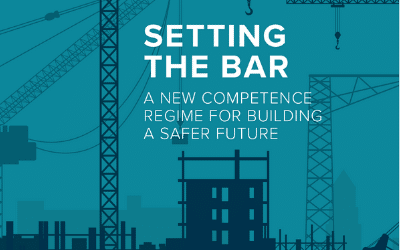
Setting the Bar is the second and final report of the Competence Steering Group [CSG] and is an update of its Interim Report, Raising the Bar, published in August 2019. The work was initiated by the recommendations in Dame Judith Hackitt’s review Building a Safer Future.
The proposed overarching system of competence set out in the report is made up of four key elements:
- a new competence committee sitting within the Building Safety Regulator
- a national suite of competence standards – including new sector-specific frameworks developed by 12 working groups
- arrangements for independent assessment and reassessment against the competence standards
- a mechanism to ensure that those assessing and certifying people against the standards have appropriate levels of oversight.
Since the publication of Setting the Bar, the CSG and its working groups have consulted widely and taken on board feedback as they have continued to develop sector frameworks and overarching competence frameworks. These frameworks will provide the skills, knowledge, experience and behaviours needed to carry out specific roles, and deliver a more rigorous approach to the essential training and assessment that is required.
CSG Chairman, Graham Watts, Chief Executive of the Construction Industry Council, said: “We would see higher-risk buildings as an essential starting point for the new competence frameworks for the whole of the built environment, which would result in a step change across the sector and change of industry culture.”
The CSG has worked closely with the Ministry of Housing Communities and Local Government and some of the Report’s key recommendations have already been adopted, including the proposal for a Committee on Industry Competence as set out in the draft Building Safety Bill.
The CSG is urging government to make mandatory the assessments against the frameworks for those working on higher-risk buildings, and is calling on government to take the lead by requiring that the competence framework set out within this report [subject to their review against the Overarching Competence Framework Standard currently being developed through BSI] must be met by any company or individual working on any higher-risk building.
Watts said: “There is no time to lose in casting aside the substandard practices that have shamed the industry. In this document we have set a new bar and we would urge all those working in life-critical disciplines to attain these higher levels of competence. Only then can we rebuild the trust of those who occupy and live in the buildings we design, construct and manage.”
FIS CEO, Iain McIlwee responded “This is a huge body of work that FIS and colleagues from across the industry have dedicated a huge amount of time to. Our efforts have been very much focussed on Working Groups 2 and 12 looking at competency in the supply and installation of products respectively. For me this report starts to set down what is reasonable and we are focussing our efforts on helping members to implement the changes recommended and get ahead of the regulatory requirements that will follow. Through our working group we have been focussing on the FIS Competency SAKE framework based on the Skills, Attitude, Competence and Experience and have started to develop frameworks for each of the occupational areas that we represent. As Graham says, we simply cannot wait.”
Additional to the launch, the competence requirements for the new role of Building Safety Manager have also been completed – which has been a major element of the CSG’s work. Setting the Bar includes a summary of the key points under the Working Group 8 section, but there is a full and separate report published by WG8 alongside this report, Safer people, safer homes: Building Safety Management, reflecting the fact that WG8 is establishing a completely new role and the competence needed.
The Full Report Setting the Bar and accompanying Annexes can be downloaded here.
The Executive Summary is available here.
WG8 Report Safer people, safer homes: Building Safety Management is available here.

by Clair Mooney | 5 Oct, 2020 | Main News Feed
The JRB was announced as part of the Chancellor’s Plan for Jobs. The JRB allows employers to claim a one-off payment of £1,000 for every eligible employee they have furloughed and claimed for through the Coronavirus Job Retention Scheme (CJRS) and kept continuously employed until at least 31 January 2021. Employers do not have to pay this money to their employee.
The guidance published today further sets out details of employees who can be claimed for and specific cases such as employees who have been transferred under TUPE and claiming for individuals who are not employees.
The guidance also sets the timeline for when the bonus can be claimed. Employers will be able to claim the bonus from 15 February until 31 March, after they submit PAYE information for the period to 5 February 2021.
Finally, the guidance sets out some technical examples regarding how the minimum income threshold criteria works in practice when determining eligibility for the JRB.
For more information, the full guidance can be found at https://www.gov.uk/guidance/check-if-you-can-claim-the-job-retention-bonus-from-15-february-2021
Coronavirus Job Retention Scheme
Updated CJRS guidance details how the scheme closes on 31 October and employers will need to make final claims on or before 30 November. They will not be able to submit or add to any claims after this date.
For more information, the full updated guidance can be found at https://www.gov.uk/guidance/claim-for-wages-through-the-coronavirus-job-retention-scheme

by Iain McIlwee | 2 Oct, 2020 | Main News Feed
Health and safety inspectors across Great Britain will be targeting construction firms to check that their health standards are up to scratch during a month-long inspection initiative, starting on Monday 5 October 2020.
This is the fourth health-focused initiative of its kind. As in previous years, inspections will focus on respiratory risks and occupational lung disease; looking at the measures businesses have in place to protect their workers’ lungs from the likes of asbestos, silica and wood dust. This is part of HSE’s longer term health and work strategy to improve health within the construction industry.
While the primary focus will be on health during this programme of inspections, if a HSE inspector identifies any other areas of concern, they will take the necessary enforcement action to deal with them. This will include making sure that businesses are doing all they can to protect their workers from the risk of coronavirus and make workplaces COVID-secure.
Inspectors will also be looking for evidence of employers and workers knowing the risks, planning their work and using the right controls. If necessary, they will use enforcement to make sure people are protected.
The construction initiative will be supported by HSE’s ‘Dustbuster’ campaign, aimed to influence employer behaviour by encouraging builders to download free guidance and advice, increasing knowledge and capability to protect workers’ health.
More than 3,500 builders die each year from cancers related to their work, with thousands more cases of ill-health and working days lost.
HSE’s chief inspector of construction, Sarah Jardine, said: “Around 100 times as many workers die from diseases caused or made worse by their work than are actually killed in construction accidents.
“Our inspection initiatives ensure that inspectors are able to speak to dutyholders and visit sites to look at the kind of action businesses in the construction industry are taking right now to protect their workers’ health, particularly when it comes to exposure to dust and damage to lungs.
“There are a few simple things that everyone can do to make sure they are protecting their health and their future. Be aware of the risks associated with activities you do every day, recognise the dangers of hazardous dust and consider how it can affect your health. We want businesses and their workers to think of the job from start to finish and avoid creating dust by working in different ways to keep dust down and wear the right mask and clothing.”
For more information click here

by Iain McIlwee | 2 Oct, 2020 | Labour, Main News Feed
In a disappointing report from the Migration Advisory Committee, there appears to be little hope of seeing the Shortage Occupations List (used within the new proposed Points Based Immigration System) of large parts of the construction industry being able to rely on any new immigration. Only shortages in Bricklayers and Welders were deemed significant enough for medium-skill occupations to be included in the shortage occupation list ahead of the introduction of a points-based immigration system on 1 January 2021.
FIS has raised concerns with officials from The Department of Business Energy and Industrial Strategy (BEIS) that interior systems installers have not been included as an eligible occupation for the skilled worker route in the outline plans for a UK Points Based Immigration System post Brexit and continues to lobby through the Construction Leadership Council that urgent review is required.
A new points‐based immigration system which will apply to EU and non‐EU citizens and require those that want to work in the UK to meet a specific set of requirements. In addition to passing the relevant UK criminality checks, the job must have a salary of at least £20,480, and 50 points are ‘earned’ by meeting the following mandatory criteria:
- The applicant must have an offer of a job from a licensed sponsor
- The job must be at or above the minimum skill level: RQF3 level or equivalent (A level or equivalent qualification). Workers will not need to hold a formal qualification; it is the skill level of the job they will be doing which is important
- The applicant must speak English to an acceptable standard.
The report notes in key areas that a high proportion of self-employed workers within key trades means that there would be limited benefits even if it were added to the SOL.
The MAC provides independent advice on which medium-skill occupations should be included in the shortage occupation lists ahead of the introduction of a points-based immigration system on 1 January 2021.
Commenting on the report FIS CEO, Iain McIlwee stated: “We are being hit by a double whammy here, the nature of construction means how we engage labour is not akin to other parts of the economy and this simply hasn’t been reflected in Government thinking, added to this, the incentives to push through to Level 3 qualifications have not been strong enough and they have withered on the vine in some key trades. I also think that the impact of COVID adds to the problem, rather than alleviates as this report seems to suggest and if we are going to Build Build Build as the Prime Minister is suggesting, we need the bodies to do this. I think few would disagree that we do need to invest more in training as a sector, but the timing here means that we are expecting things to be tight in the New Year, this will impact programme and potentially quality. We are already getting reports from members that the availability of skilled workers in parts of the country is tight as workers from parts of Europe went home to ride out the pandemic and have decided not to return. We are recommending all members as a matter of urgency talk to their workers about applying for settled and pre-settled status under the EU Settlement Scheme.”
You can read the full report here.
For information on the EU Settlement Scheme click here
FIS has prepared an overview paper based on concerns with the proposed UK Points Based Immigration System here.

by Clair Mooney | 2 Oct, 2020 | Main News Feed
(25 November & 27 January)
ACT is offering free places on a Welsh-medium assessors Training, Assessment & Quality Assurance (TAQA) Level 3 course, financed by the Coleg Cymraeg Cenedlaethol.
The online course aims to give qualified assessors the knowledge, resources and motivation to develop their provision and work confidently through the medium of Welsh. You can register your interest by contacting Non Wilsha on nonwilshaw@acttraining.org.uk

by Iain McIlwee | 2 Oct, 2020 | Main News Feed
The Prime Minister has unveiled new plans to expand the training and skills system, which will see adults without an A‐level or equivalent qualification entitled to a free college course in England from April 2021. Greater flexibility will also be given to higher education loans to encourage take up of vocational courses by both young people and adults. But as written they will miss the mark for construction.
In the plan, the Prime Minister announced that apprenticeship opportunities will also be increased, with more funding for SMEs taking on apprentices, and greater flexibility in how their training is structured – especially in sectors such as construction and creative industries where there are more varied employment patterns. The pan will be backed by continued investment in college buildings and facilities, including over £1.5 billion in capital funding, and more details will be set out in a white paper later this year.
The plan sets out to reverse an ongoing decline in technical qualifications – in 2000, over 100,000 people were doing Higher National Certificates and Diplomas, but that has reduced to fewer than 35,000 now. Those doing foundation degrees has declined from 81,000 to 30,000. As a result, only 10% of adults hold a Higher Technical Qualification as their highest qualification, compared to 20% in Germany and 34% in Canada.
Speaking about the announcements, FIS CEO Iain McIlwee said “the capital funding elements to college is certainly good news, but as written, many occupations in the construction sector, certainly those working in the Finishes and Interiors Sector will not benefit directly. Funding is targeted at those starting a Level 3 qualifications, but those progressing to Level 3 tend to be assessed through the vocational qualification route, following introduction through a Level 2 option. We will be raising this point with Government and looking at how we can work through our Approved Training Provider Network to see how we can leverage some of the support, we are going to need all the help we can get given recent announcements about immigration that are going to leave a concerning shortfall in competent people available for construction works.”
For full details of the announcement click here.

by Clair Mooney | 25 Sep, 2020 | Main News Feed
FIS has recently entered a new partnership with NBS focussed on knowledge exchange and better collaboration. To highlight the potential we jointly hosted an event that interrogated a typical fit-out project and looked at the challenges and practicalities, questioning whether greater collaboration is a pipe dream or becoming a reality.
It was a fascinating debate and we’d be keen for it to continue. We welcome your views on how we can, together, improve our supply chain.
You can access a free recording of the debate “Deconstructing Fit-out: Is greater collaboration a pipedream? here
This was followed by a workshop that focussed on the process of specification sales in an environment where architects and designers adopt more and more technology and digital solutions to assess, develop and protect specifications. We discussed how to position your product and influence the different people involved in the decision making process.

by Oscar Venus | 25 Sep, 2020 | Main News Feed
The results of the first industry‐wide People Survey, carried out by the Construction Leadership Council (CLC) in June and reported in Retaining Talent in Construction, helped to secure funding for the Construction Talent Retention Scheme. To understand the ongoing impact of the coronavirus pandemic on the construction workforce, the CLC has launched a second People Survey. Another great response from all sectors of the industry will help to prioritise the support required by construction employers between now and the end of the year.
Please complete the online survey which should take no longer than 10 minutes by Friday 2 October. The information provided will be confidential with no company details required.

by Clair Mooney | 25 Sep, 2020 | Main News Feed
In an earlier email this month, CITB informed employers of their latest Levy Proposals, which they are proposing should be used in the Levy Assessment to be raised in August 2021. As well as a cut in Levy rates by 50% for all employers, the proposals will also mean that an extra 5,000 small employers will no longer have to pay any CITB Levy.
These rates will be applied to the information you provide in your 2020 Levy Return (covering 6 April 2019 – 5 April 2020), which you’ll receive for completion at the end of this month. All Levy Registered Employers have a requirement to complete this and submitting your Levy Return by 30 November 2020 allows you to access our 2020/21 Grants Scheme and ensures that any outstanding grant payments can be made.
If you have any questions on how to complete your Levy Return, please contact CITB on 0344 994 4455 or email levy.grant@citb.co.uk. You can also complete your return online here.