0121 707 0077

Amendment to Approved Document B Vols 1 & 2

Amendment to Approved Document B Vols 1 & 2

MHCLG today published updated copies of Approved Document B (Fire Safety) Vols 1 & 2: 2019 incorporating the 2020 amendment covering sprinklers, wayfinding signage and a correction to the boundaries information.

The amendments do not apply where a building notice or an initial notice has been given to or full plans deposited with a local authority and either the building work to which it relates has started before 26 November 2020 or is started before 29 January 2021.

There are three main changes/additions to AD B Vols 1 & 2:

Sprinklers

  • Paragraph 7.4 Vol 1 has been amended to reduce the trigger height for sprinklers in blocks of flats from 30m to 11m.
  • Table B4 Vols 1 & 2 (Minimum periods of fire resistance) has been updated to include a new category height of buildings up to 11m

Wayfinding signage

  • Vol 1 now includes new paragraphs 15.13 to 15.16 providing guidance on signs to assist the fire service identify each floor and flat  in a block of flats 11m or more in height
  • The new signage will be found:
    • On the landings of every protected stairway
    • In every protected lobby or corridor into which a firefighting lift opens
    • Guidance id provided on the minimum letter height, wording, style and positioning/legibility  of the signs.

Boundaries

  • A correction to an error which appeared in the 2019 edition of AD B
  • Vol 1 (paragraph 11.5) and Vol 2 (paragraph 13.5) have been amended to include purpose group,2 (Residential – Institutional/Other) for application of a ‘notional boundary’ between two buildings on the same site.

To view these updated documents please click here


FIS President, Helen Tapper, Address to AGM 2020

FIS President, Helen Tapper, Address to AGM 2020

Welcome to the 2020 FIS ‘Virtual’ AGM and conference. This is certainly a novel format and I very much hope one of a kind.

2020 has been a year of nightmare scenarios. When I addressed you last year none of us could have predicted the sinister turn that life would take. My business plans, just like yours, are in the bin and I have had to re-evaluate my aspirations for the future.

It was amongst this mayhem that the value of the FIS really crystallised. The whole team ‘stepped up’, took on the challenge and in a matter of weeks produced the Covid-19 Hub. This provided guidance on the maze of procedures that left us confused and anxious. It provided the Risk Management Toolkit and the H&S Taskforce, a group that sprang up overnight and supported by members, provided crucial guidance on site procedures.

There were daily mailshots, twice weekly webinars and most importantly of all, a friendly voice at the end of the phone when you needed moral support and one that could carry our concerns into the wider industry and economic debate – straight to the Construction Leadership Council, Civil Servants and Ministers.

The board also did their bit with weekly meetings and offers of support to members who needed it, I have never been prouder to be a part of that team.  I have also never been prouder to be part of our industry, which has demonstrated incredible resilience, whether building Nightingale hospitals or simply holding our end up in keeping at least some of the economic lights switched on.

I know what it’s like to be a small business owner, swimming in a sea of regulations. I know what it’s like to not be able to afford expensive consultants or accountants to give me regulatory or financial advice. I know what it’s like to sometimes make decisions that I don’t feel qualified to make and bear the responsibility for that. Here’s an amazing statistic for you, nearly 60% of our contractor members turn over less than £5m and in fact only 17% turnover more than £10m and we never forget that statistic. You, like me, need the advice, technical guidance and moral support more than anyone and once again FIS membership pays dividends.  It is these companies that we are targeting our new Business Risk Management Tool that is now available to download from our website.

As well as helping with the day to day, FIS keeps an eye on our future.  The Building Safety Bill will have enormous repercussions for our sector. In response Joe Cilia has collaborated with other leading bodies to produce the guide to ‘Firestopping of Service Penetrations’, a guide that gets to the heart of safety issues in our sector. Another well received publication was the ‘Safe Ingress of Plasterboard’, essential for the prevention of Musculoskeletal disorders so prevalent in our sector.

The training team, hit badly by the withdrawal of CITB funding, has under new leadership in George Swann been working to find ways to continue resourcing the leading work that we have been delivering through the Fit-Out Futures program and set a more standard framework for competence through our sector.  Again vital work.

So we move into the formal part of the day today, the AGM, I hope you have felt the benefit of being part of this amazing community.  At the heart of this, Jane Knight, our Operations Director, who last week celebrated 30 years at the FIS.  This is quite a landmark, congratulations Jane and thank-you for your immense contribution to FIS.

What will 2021 look like. That is our focus for today, building a phoenix from the flames of a pandemic. In January we have Brexit and the repercussions for labour shortages and product certification, The Building Safety Bill, Reverse Charge VAT and that’s just the first quarter. Our headline topics cover some of the biggest issues and discuss how we foster healthy relationships in our supply chain, replace mistrust and combat with cooperation and collaboration and give our sector the best chance of succeeding, with of course the FIS backing us up.   Because above all else,

IT’S ABOUT COMMUNITY… TOGETHER WE ARE STRONGER.

Members can read the minutes of the 2020 Annual General Meeting here.

Concerns over negative impact of new immigration system from 62.5% FIS members

Concerns over negative impact of new immigration system from 62.5% FIS members

New data from the FIS indicates that 30% of members are already experiencing labour shortages and 62.5% are concerned for what the New Year brings.  FIS is hosting a workshop on 1st December at Midday with experts to review and advise on how members need to prepare for the new points based system.

In a recent survey FIS asked members a number of key questions around the new points based system.  Concerns are amplified in the larger specialist employers, where 40% were currently experiencing shortages and 74% believe the new system will have a negative impact on their business.  Other interesting data revealed that respondents relied on labour gangs/agencies for an average 11% of the workforce, this again rises for the larger businesses.

FIS CEO, Iain McIlwee stated “The figures presented by Noble Francis at our AGM show that we have already seen an exodus of EU workers and this snap survey has not allayed our concern that we could be facing a real challenge in the New Year.  Clearly the difficulty is that these are unprecedented times and making sense of any data is difficult.  Will COVID restriction soften and ease travel concerns? How hard will Brexit be? What will the impact on currency be here and across Europe? How will this impact rates here and abroad and how attractive will that make UK versus other possible work locations?

We need a crystal ball to know for certain what people, who do not necessarily have deep roots in the UK, might decide to do.  But, when we need the UK to be primed to Build Build Build, the Government have taken an unnecessarily hard line on construction workers, which could come back to bite us by shortening labour supply, impacting programme and driving wage inflation.  More of a staged approach would be better for industry, particularly given the huge dent in training and recruitment activities we have seen in 2020 due to COVID.”

FIS is attending a roundtable on the 4th December with the Home Office and colleagues across construction.  We are still gathering information to feed in, if you wish to feed your views in, please contact iainmcilwee@thefis.org or phone 07792 959481 or you can still add you results to the final survey here.


North West out in front in terms of contract awards

North West out in front in terms of contract awards

Construction Sector

A new report produced for FIS Members by Barbour ABI indicates that the total value of construction contract awards in October was £4.9 billion based on a three month rolling average.   This is a decrease of 9.4% on September and follows three consecutive months of good growth (see fig. 2.3). Annual comparison shows it is also 1.1% lower than for October 2019. In the three months to October 2020, total contract awards were valued at £14.7 billion which is 75.7% higher than for the previous quarter and is also 1.3% higher than for the comparable quarter ending October 2019.

There was an increase of 8.7% for contract award numbers this month at 871 compared to September.   Annual comparisons show marginal (0.8%) improvement.

Project by Region

The North West was the leading region in October with 19.8% of awards and a total of 120 projects. The second largest region was London with value share of 13.8%, whilst tying for third place was the East of England and Scotland both with 11.1% of awards (see fig. 2.2).

Cumbria was the location for the largest contract award in October which was the £175 million Woodhouse Colliery Cumbrian Deep Coal Mine and which was awarded to Hargreaves Services. The second largest award this month was the £126.7 million Gull Wing Lake Lothing Third Crossing in Lowestoft and the successful contractor was Farrans Construction.  The One City Road Redevelopment in Manchester was the third largest award at £121.4 million which was awarded to Marshall Construction (West Yorkshire).

Types of Project

The residential sector maintained its leading position in October accounting for 36.8% of contract awards and 202 projects. Underpinned by some major civils awards, infrastructure was the second largest region this month with 22.2% of awards and 131 projects. Accounting for 14.3% of awards and 148 projects, the commercial and retail sector was the third largest in October.

The leading residential award was the £94 million Strawberry Place development in Newcastle upon Tyne which will include 328 flats as part of a mixed use development and was awarded to Tolent Construction.  The Metallurgical Coal Project Woodhouse Colliery was the largest infrastructure project valued at £175m which will see the development of a new Cumbrian deep coal mine. The largest commercial and retail award this month was the £121.4 million One City Road Redevelopment
in Manchester where Marshall Construction (West Yorkshire) will provide 48,570 sq m of new office space.

FIS members can read the full report here.

CPA Analysis of the Spending Review 2020

CPA Analysis of the Spending Review 2020

The Construction Products Association’s economics team has analysed the government’s ‘Spending Review 2020’ released today.  As expected, the focus of the announcement has primarily been on aiding the recovery from the virus and furthering support for public services.  Compared to strong statements from government earlier in the year around “build, build, build”, we have much less to go on today.

That said, with our forecasts showing that infrastructure will be one of the few bright spots for UK construction in the coming year, we are pleased to finally see that government has listened to the CPA and that the National Infrastructure Strategy has some of the detail we’ve long been calling for around the government’s project plans, funding and the path to net-zero.  Together with the spring 2021 launch of a new National Infrastructure Bank, we have reason to be encouraged that government is taking real steps, beyond simple headlines, in delivering an infrastructure sector that truly underpins UK construction and the wider economy.”

Announcements relevant to construction and manufacturing are summarised here (FIS members only).

CPA questions raised in Parliament during post-Brexit CPR Motion

CPA questions raised in Parliament during post-Brexit CPR Motion

The Shadow Minister for Housing and Planning, Mike Amesbury MP, highlighted the Construction Products Associations’ (CPA) and questions about product testing regimes post-Brexit on the floor of the House of Commons this week in a debate with the Housing Minister about the Construction Products Regulations.

CPA has been in frequent and productive discussions with MHCLG to clarify these points, but have concerns in particular about whether many products presently made in the UK will be legally allowed for sale on the UK market post-Brexit, as they might not be able to be tested and/or proven to conform with the regulatory requirements.  Despite this very late stage of the transition period, with only 1.5 months to spare, it remains unclear if the current free trade negotiations with the EU will conclude matters of mutual recognition. Find out more.

FIS launch new Business Risk Management Tool

FIS launch new Business Risk Management Tool

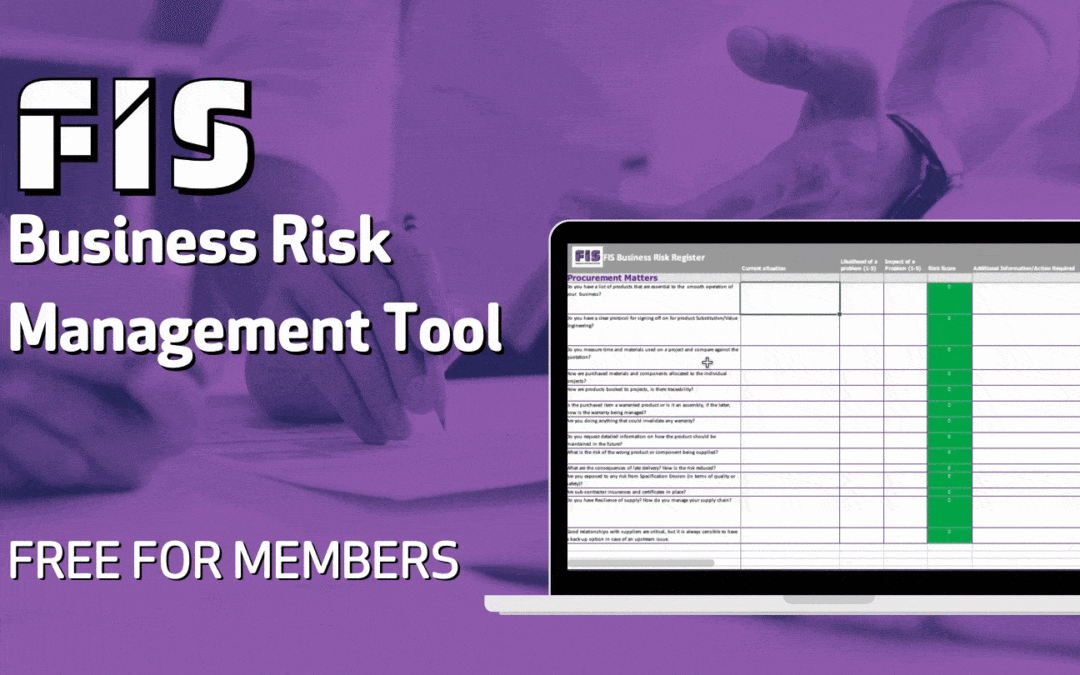
The Finishes and Interiors Sector (FIS) has launched a new Business Risk Management Tool to support contractors and help them adopt a structured approach to understanding risk and reducing uncertainty.

Launched at the FIS Virtual AGM and Conference on the 24 November, the Business Risk Management Tool identifies over 120 common risk areas for contractors against the categories including Business Management, Contractual, Financial, Quality, H&S and Procurement,  providing a mechanism to score and rank risk and advice on mitigation and management.

A risk management matrix ranks risk in term of probability of an event occurring and the severity of the impact should the event occur. It can be used to identify and prioritise activity so that a contractor can then make informed business decisions and improve their resilience.

In her AGM speech, FIS President and Operations Director at Tapper Interiors, Helen Tapper stated: “I know what it’s like to not be able to afford expensive consultants or accountants to give me regulatory or financial advice. I know what it’s like to sometimes make decisions that I don’t feel qualified to make and bear the responsibility for that. Here’s an amazing statistic for you, nearly 60% of our contractor members turn over less than £5m and in fact only 17% turnover more than £10m and we never forget that statistic. You, like me, need the advice, technical guidance and moral support more than anyone and once again FIS membership pays dividends. It is these companies that we are targeting our new Business Risk Management Tool that is now available to download from our website.”

Commenting on the launch of the risk management tool, FIS CEO Iain McIlwee said: “We have learned in the past few years that basic risk management in construction needs to improve. Beyond the obvious, the worst thing for any business is getting smacked in the side of the head by something they didn’t see coming on a busy Tuesday afternoon. Our hope is that this risk management tool at least helps protect people from the unknown unknowns.  It is built on the collective wisdom of our community and a tried and tested framework. It isn’t a static thing and we can develop and evolve it as we help members front up to daily problems in the 21st Century.  We don’t have to learn from our mistakes, we can communicate and collaborate and learn as a community from each other – this way the sector gets better”.

The Risk Management Tool is available to download free for members of the FIS community here – FIS Business Risk Management Tool.


CITB funds Academy for Construction People’s pilot apprentice programme

CITB funds Academy for Construction People’s pilot apprentice programme

The Academy for Construction people, based in Glasgow, has secured funding from CITB to offer a Specialist Applied-Skills Programme at VQ 2 level (/SCQF Level 5 over the next 18 months. This is a Pilot Training Scheme for 24 trainees in the following occupations; Interior Systems / Dryliner Fixer and Passive Fire Protection.  The Academy also supports Programmes for Asbestos Removal and Demolition operatives.

The Academy has the backing of the Association for Specialist Fire Protection (ASFP www.asfp.org.uk) and the Finishes and Interior Sector (FIS) www.thefis.org who will work with the Academy to monitor the training standards.

The Passive Fire SAP training will commence in the Training Centre in Nisbet Street, Glasgow on 18 January 2021. Interior Systems/Dry liner Fixer trainees commence training in February/March. The Academy has worked with industry specialists to ensure the integration of training and assessment to meet the requirements of the two qualifications.

Both training programmes will therefore share key technical information so that trainees in each discipline can demonstrate that they understand the need to work collaboratively on site to produce quality work to the required safety standards.  Several companies have pledged support for this predominately on-the-job 18-month training programme for both new young entrants and upskilling for existing operatives. On the job assessment is carried out by appropriately trained assessors with proven track records in their trade. All assessment is subject to external verification and mentoring support is given to the trainees on site. The SAP programmes also have the support from the Scottish Specialist Contractors Training Group.

On completion of the 18-month programme, all operatives will have achieved a VQ Level 2/SCQF Level 5 in their area of expertise.

Ian Hughes, CITB Partnerships Director Scotland, said: “We’re really pleased to be able to work with the Academy for Construction People, and look forward to seeing the new Pilot Training Scheme come to fruition in the coming months. At such a crucial time, it provides an excellent opportunity to involve more young people in the sector, while still protecting the existing workforce through chances to upskill.”

ASFP Head of Training Phil Brownhill: “The provision of a formal training and educational route to becoming a competent installer of passive fire protection systems is something that ASFP has consistently supported. We applaud the efforts of the Academy, Avesta Group and ASFP members in Scotland.”

FIS Skills and Training Lead George Swann said, “This is a great opportunity for finishes and interiors sector employer to get their work force qualified.  The Academy for Construction People are commended for the work they have done in securing this funding that will directly benefit the sector.  As an FIS Approved Training Provider, we fully support this offer and have confidence in the quality of the training provided by the Academy for Construction People.”

Ian Main Chairman of the Academy Steering Group said “This is really good news for the Academy and the Specialist Contracting sector in Scotland and North England.”


Changes to COVID Guidance on Showrooms in England

Changes to COVID Guidance on Showrooms in England

The Government has added further guidance on the closure of non‐essential businesses. The list now includes showrooms for products used in homes, including bathrooms, kitchens and glazing, which should be closed to the public, including where they are located as distinct sections within hardware stores and builders’ merchants. Delivery and click and collect services may continue to be offered. Each business should assess whether they are required to close having considered the regulations as well as the guidance, and Build UK has made the point that changing guidance midway through a lockdown is unhelpful and will have a major impact on businesses and their supply chains.

The updated guidance does not affect construction sites, manufacturers, storage and distribution facilities, or builders’ merchants without showrooms. Tradespeople may also continue to work in people’s homes following the the Safer Working guidance.

You can access the FIS COVID-19 hub here