by Iain McIlwee | 23 Feb, 2021 | Main News Feed
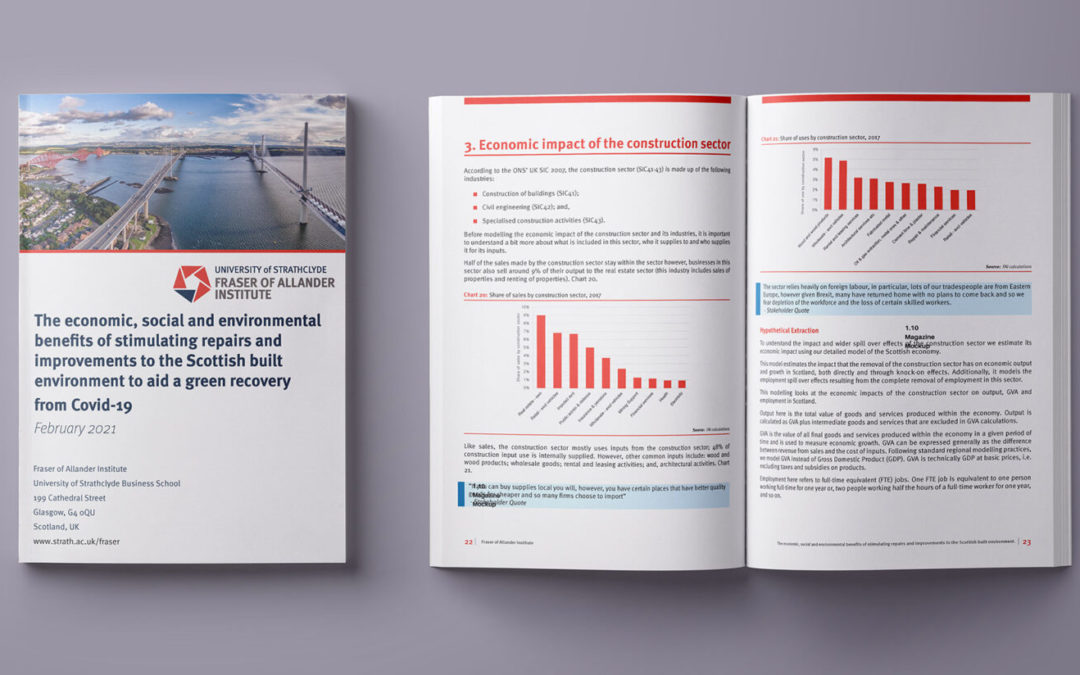
The CICV Forum (supported by FIS) has published an in-depth report aimed at helping public bodies make decisions on where public funding in construction gives the highest economic returns to help support a green recovery.
The report, carried out by Fraser of Allander Institute at University of Strathclyde, was commissioned by the Forum to improve understanding of how investment in construction activity creates multiplier effects across social, economic, and environmental impact measures. It also aims to support policy makers, clients and investors in understanding the return on investment associated with repair and maintenance activity.
John McKinney, Regional Manager of the NFRC, said: “The report highlights that investment in construction, including repairs and improvements, can play a vital role in a green recovery, and the important role Scotland’s existing buildings have in that recovery.
“We will look to highlight this report to the Scottish Government and funding bodies to assist in maximising the economic and carbon benefits of investment in the built environment.”
The report highlights that the construction sector is an important contributor to the Scottish economy supporting almost £16bn in Scottish GVA and almost 300,000 full-time equivalent jobs across the Scottish economy through both direct and indirect and induced economic activity.
The report also reveals that every million pounds spent on specialised construction activities, which includes repairs and improvements, generates £1.09m GVA return to the Scottish economy and supports 21 full-time equivalent jobs.
VAT rebate research as part of this study, also looked at how such a scheme could stimulate the repair, maintenance and improvement element of construction work. The research found that if VAT is cut from 20% to 5% in the specialised construction sector this could generate between £80m – £400m in Scottish GVA and support between 1,500 – 7,500 full-time equivalent Scottish jobs.
Mairi Spowage, Deputy Director of the Fraser of Allander Institute, said: “the construction sector is a significant contributor to the Scottish economy and will play an important role in Scotland’s green recovery from COVID-19.
Our analysis finds that specialised construction activities, which includes retrofitting and home improvements and repairs, has larger economic multipliers than the rest of the construction sector and the Scottish average across all industries.”
The report was commissioned by the CICV Forum with funding by Construction Scotland Innovation Centre (CSIC) though an i-Con Challenge Innovation Grant aimed at helping the sector to recover from the pandemic. The project had input from Historic Environment Scotland and a number of private and public organsations provided insight to the study.
A webinar to present and discuss the findings in more detail will take place at 2pm on Wednesday 10 March. Information on how to join the webinar will be available shortly.
The report can be viewed here.

by Iain McIlwee | 23 Feb, 2021 | Main News Feed
The Prime Minister has confirmed the Government’s four‐step plan for a ‘cautious’ route out of lockdown in England. The current restrictions will be gradually relaxed, beginning with schools and colleges reopening from 8 March, and four specific tests will need to be met at each stage before further restrictions are lifted. The comprehensive roadmap confirms that individuals should continue to work from home where they can until at least 21 June, which is the fourth step and when social distancing measures will be reviewed. The Scottish Government is expected to set out its plans for easing restrictions this week, with the Welsh Government due to review its current measures on 12 March and the Government of Northern Ireland on 18 March.
Build UK has published a simple guide to the Government’s workplace testing programme, which enables sites with 50 or more workers to undertake asymptomatic Lateral Flow Device (LFD) testing. The guide explains the testing process and sets out the steps required to set up a testing site. Tests are being provided free of charge until at least 31 March 2021, and companies should read the guide before signing up via the Government’s online portal.
Businesses with fewer than 50 workers are currently not eligible for workplace testing; however, they can access the Community Testing Programme in their local area by using the new postcode checker or visiting their local authority website and searching ‘LFD testing’
Visit the FIS COVID-19 Hub here
Secretary of State Open Letter to Industry on Mass Testing

by Clair Mooney | 22 Feb, 2021 | Skills
On 1 April 2021 CITB will be increasing the price of the Health, Safety and Environment (HS&E) test products by £1. This price increase was delayed by a year due to COVID-19. It will ensure that CITB can continue to invest in the test, so that it remains up to date against the expanding H&S requirements of construction and that delivery is accessible and trustworthy.
The new prices will be £22.00 for the test, the CITB HS&E revision test app will be £6.99 and mobile testing will cost £31.00. You can book a test here, and if you would like more information regarding this price change, please contact the CITB HS&E testing service team at hsetestdev@citb.co.uk

by Clair Mooney | 22 Feb, 2021 | Skills
A proposed offer to industry stating what priorities CITB has identified in order to train and qualify the construction industry and how CITB levy will be collected for the next three years, 2022 to 2025, will be distributed in April 2021.
This is not a vote to retain or close CITB, that decision is a lot more complicated and involves the Minister of State and Parliament. To ensure members of the Finishes and Interiors Sector get a say in how much Levy CITB can collect from the construction industry you must ensure:
- You complete your CITB Levy return on time.
- You ensure you state you are a member of the Finishes and Interiors Sector at section 1a of the return. Levy_Return_Guidance_Notes
Further guidance will be available from 1 March 2021 when the CITB proposed offer (the priorities for construction and levy collection) will be distributed via multiple means eg online, websites and news media. CITB will confirm to FIS the number of Levy paying employers and the value of their CITB Levy contribution. The final amount of levy to be collected will be confirmed in CITB’s final offer in June 2021, once the proposed plans are approved.
In order to provide information so that members can make an informed decision The Finishes and Interiors Sector will produce a position statement in June 2021. We will also be dealing directly with our Levy paying employer members and will have already been in regular contact with their Levy contact. When issuing the survey, we will send this directly to our Levy contacts and the CEO, as we will expect the CEO to be responding to the question on behalf of the company. We do however expect the Levy contact to ensure the CEO has all the relevant information to allow them and their Board to decide on how the organisation should respond to the question.
Although it is yet to be confirmed the Finishes and Interiors Sector will distribute the CITB consensus survey when it is available. Your responses will be presented to the FIS Board in early September 2021. The final response must be sent to CITB before the end of September 2021. The Consensus Survey window will close on Sunday 15 August 2021.
The two measures used to demonstrate consensus has been achieved using reasonable steps to consult will be:
- More than 50% of levy payers.
PLUS
- More than 50% of levy payable by employers that support the proposals (the value of what is to be collected)
Data from the 2017 Levy Consensus Results for Build UK:
|
Trade Associations |
Levy Payable |
| FINAL TRADE ASSOCIATION TOTAL |
26 |
£25,513,143 |
| Yes |
21 |
91% |
£20,911,130 |
98.21% |
| No |
2 |
9% |
£381,218 |
1.79% |
| Abstains |
2 |
N/A |
£4,075,216 |
N/A |
| No Response |
1 |
N/A |
£145,580 |
N/A |
Please remember to ensure you have an opportunity to vote:
- You complete your CITB Levy return on time.
- You ensure you state you are a member of the Finishes and Interiors Sector at section 1a of the return.
by Clair Mooney | 22 Feb, 2021 | CSCS, Main News Feed
Update 22.1.2021
HS&E Tests
There have been updates to the provision of HS&E Testing across all three nations. Testing remains in place in England and has resumed again in Wales, but in Scotland, updated government guidance has meant Pearson VUE have ceased delivery of testing. Ensure you check CITB’s Urgent Messages page for the latest information before trying to book. Or check the Pearson- VUE web site and look at country-specific testing information https://home.pearsonvue.com/coronavirus-update
Pearson Vue have are regularly updating their Country-specific testing information with details of what is happening in each country. The latest information includes this statement: You must bring and wear your own face mask while at a Pearson VUE-owned test centre and throughout your exam. Any surgical or cloth face mask, including a homemade face mask, is acceptable as long as your nose and mouth are fully covered. Face masks with exhalation valves and face shields are not acceptable. Candidates without a face mask will be denied testing services. Pearson Vue are unable to provide face masks to candidates.
Candidates are encouraged to check your test confirmation email or letter for details of safety measures at the Test Centre including the requirement to wear face coverings, or for any changes to your scheduled appointment. Limited capacity may cause delays in booking a test.
Visit CITB’s urgent messages page for further information on test centre availability across the whole of the UK. CITB are working alongside their partners to increase the testing capacity, so please continue to visit the CITB website to check for availability and to book your test.
COVID – 19 Position CSCS
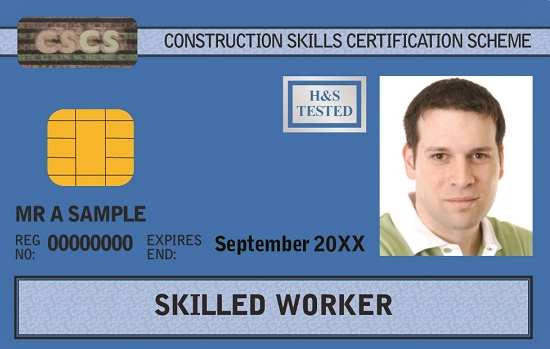
A key requirement for all applications (new or renewal) is proof that the applicant has passed the relevant CITB Health, safety and environment (HS&E) test within the last 2 years. Based on COVID-19 issues CSCS is requesting employers and those responsible for site access and card checking procedures to use their discretion towards workers whose cards have expired since mid-March onward and who can provide evidence that they have been unable to sit their test or undertake the required training as a result of the closure of Test and Training centres. This is at the employer’s discretion until the situation has stabilised.
What steps are CSCS taking?
CSCS recognise that construction workers may face delays in obtaining a card while test centres cannot run at full capacity or are required to close. Therefore, they are asking the industry to continue to support the following temporary measures:
- Employers and those responsible for site access and card checking procedures to use their discretion towards workers whose cards have expired since March onward. But a worker must always hold the correct card for the job they do on site.
- CSCS has extended the grace period for card renewals from 6 months after the card expires to 12 months. This means that the card can be renewed, once the CITB HS&E test has been passed, up to one year from the card’s expiry date. This will assist those applicants struggling to find availability to sit the test and renew their card.
CSCS will continue to monitor the situation and where necessary introduce further proactive measures to limit the impact on CSCS applicants and the wider industry. You can visit www.cscs.uk.com/covid19 for the latest updates from CSCS.
What to do if your card has been expired for more than a year
If your CSCS card was issued via Industry Accreditation you will be required to appeal for late renewal, the appeals process can be found at
www.cscs.uk.com/appeals. If you achieved your CSCS card by achieving the NVQ or SVQ you can submit a new application and provide a copy of your NVQ or SVQ along with confirmation of passing the CITB Health, safety and environment test within the last 2 years.
“Lite Health and Safety Test”
Where it is not currently possible for individuals to renew their CSCS Cards or take the H&S Test. CITB has initiated a ‘lite’ Health and Safety test as a temporary measure, so employers can assess the health and safety knowledge of individuals.
Note this is an interim and only to be used where testing capacity is limited. It is designed to help employers run their own in-house interim testing to give a level of local assurance that an employee is safe to work on their site. Permission to allow the employee on site is at the discretion of the employer. Suggested test delivery guidelines are available to download here.
This product is free to download from the following sources:
CITB: LITE Operatives and Specialist HS&E TEST only
CITB: LITE Managers and Professionals HS&E TEST only
Further Information
CSCS for information on card registrations and renewals and more detail on the H&S Test click here.
The easiest way to apply for a CSCS card is online: https://www.cscs.uk.com/applying-for-cards/ or download the App MyCSCS (in Android or iOs)
More information is available online from CITB on CSCS Tests is available here.
Important test delivery information pertaining to COVID-19 (coronavirus) (note the section for various parts of the UK, construction is deemed as essential, so testing should carry on, but check the status for your local test centre to ensure there are no local issues).
Further information from CSCS is shown here.
To visit the FIS COVID-19 Hub Click here

by Clair Mooney | 22 Feb, 2021 | Market data
The Q4 Construction Trade Survey signals a continued, but tentative, recovery for the construction industry following the disruptions to activity from Covid-19 between March and May. SME building contractors and chartered surveyors recorded an increase in workloads during Q4, whilst product manufacturers on both the heavy side and the light side reported quarterly increases in sales.
FIS members can download the report here. More data from the CPA is available within our Membership Hub.
by Iain McIlwee | 19 Feb, 2021 | Main News Feed
Finishes and Interiors Sector CEO, Iain McIlwee, has written to the chancellor ahead of budget supporting the CLC submission and seeking additional support to manage Reverse Charge VAT implementation and flexibility in Apprenticeship funding. The full text of the letter is available below.
Dear Chancellor,
I write on behalf of the Finishes and Interiors Sector, which accounts for around £10 billion of UK Construction work and over 200,000 workers. Our community do the refurbishment, fit-out and finishing work to buildings of all types (homes, hospitals, offices etc), constructing internal walls, ceilings and adding the fixtures – over the lifetime of a building, there is typically upwards of 30 re-fits. We support the work of the Construction Leadership Council (CLC) and have had input into and support the Budget submission already made by the CLC.
Since the New Year, pressure on our sector has become even more palpable as we adapt to the Reverse Charge VAT introduction, off-payroll working, changes to the CIS and new immigration policies. I have outlined below two critical areas where Treasury could help us to avoid insolvencies and encourage investment in new jobs.
Extension of the VAT Deferral Scheme
The Domestic Reverse Charge (DRC) creates an immediate working capital impact on many of our members who operate as sub-contractors. We are already working less productively in the wake of COVID, facing additional costs associated with logistics of Brexit and shortages of materials like timber and steel and are staring in the face of potentially severe labour shortages (which is driving up rates and will necessitate additional investment in training).
Example:
I am a the Financial Director of XX a construction business employing around 70 people through PAYE, CIS and which includes two young trainees. I write to express my concern that the government is pressing ahead with implementation of the Domestic Reverse Charge VAT for construction. Our turnover is around £5 million and we estimate the cash cost to the business will be around £156,250.
With many contracts stalled, working capital is tight and this kind of dent to our cash position will limit our ability to adapt, scale up and invest as the market recovers. We had hoped for a delay, but failing that, extending the VAT Deferral Scheme to support construction companies who may be struggling to pay as a result of the DRC would be a potential life safer. The process already exists with the COVID scheme (giving those that deferred in March to June 2020 even more time), but it is not open to new entrants. If we allowed construction companies to access deferral to get over the hump of cash flow problems this would undoubtedly limit the worst of the impact.
The Impact of Immigration Policy and English Apprentice Vouchers
The nature of our work and construction procurement practices, means many in our community undertake relatively large projects with relatively short lead times that involve the deployment of large numbers of people with a variety of trade skills that work in controlled sequence. As a result we have always relied on a flexible workforce (historically through the “cards”, latterly leaning on the labour only sub-contractor model). This enables firms to manage risk and individuals to optimise worktime by moving between projects and companies. The make-up of our workforce was, pre-COVID, over 40% EU worker. As a consequence of changes to the immigration system and the relative high dependence on EU work, our Annual Recruitment Target from the UK labour pool has virtually doubled this year. For every 5% of migrant workers that do not return post COVID or decide not to settle beyond the summer, the target doubles again. This necessitates a major overhaul of how we recruit and train.
We are working with CITB and engaged through the Construction Leadership Council in optimising the Plan for Jobs, as an organisation we have schemes in place to support unemployed workers into construction (pre-COVID, our BuildBack programme had delivered 440 unemployed people into sustained employment over a c2 year period), we are a Kickstart Gateway and we are working hard with employers and providers to build apprentice provision. Our Apprenticeship Standard is new (completed in 2019) and we are doing all we can (in a difficult environment for training) to help build demand and provision. Delivery requires capital investment in materials, tools and space as well as investment in trainers, assessors and materials. We would urge Treasury to consider ringfencing and relaxing the criteria for trading of English Apprentice Vouchers and, where businesses paying cannot utilise directly, vouchers are not just cascaded to support non-levy payers in the supply chain but, where this is not feasible or practical, redirected to investment in the training centres and resources needed to support the delivery of apprentices. In this way large businesses will be incentivised to get involved to help drive change, work with providers and develop those vital links between industry and skills provision. We need this engagement to support businesses and FE colleges in making the investment to run programmes that lead to jobs and to reward progression to employment rather than simply focus on completing courses.
These are vital times for our economy and the construction sector has done all we can to keep building through the pandemic, showing, at times amazing flexibility, inspiring innovation and humbling resilience. The suggestions above are vital keys to help us to unlock the power of this industry to help build our way to a better future, support the much needed investment in digitisation and net zero and ensure that the UK Construction sector is truly the world leader that we have the potential to be.
Yours faithfully,
Iain
Iain McIlwee
CEO, Finishes and Interiors Sector (FIS)
Find out more about the FIS Three Steps to Rebuilding Construction.

by Iain McIlwee | 17 Feb, 2021 | Building Safety Act, Insurance
Companies from across the industry are being asked to take part in the biggest ever review of construction’s growing professional indemnity insurance crisis.
In recent years firms from across the industry have reported sharp increases in premiums for PI insurance, while also seeing stricter curbs on the levels of cover. Some firms have reported four-fold increases in policy costs, while others have said that they can no longer secure cover.
This has been driven by multiple factors including a response to higher historic claims from the sector, as well as a cyclical hardening of the insurance market.
The Construction Leadership Council is planning steps to relieve the crisis. This includes developing a robust evidence base, identifying in detail the areas where the
industry is facing the most significant difficulties. The CLC is asking for companies from across the industry to take part in an on-line survey
It asks companies to provide confidential feedback on the costs and policy exclusions that they have experienced when renewing their cover. The poll is entirely confidential, but firms are asked to indicate
their type of business to help target any future support on those areas of greatest need.
Construction Leadership Council Professional Indemnity Insurance Group lead Samantha Peat said: “The Covid-19 pandemic has dominated headlines for the last year, but there is a second crisis that has been quietly growing for businesses across our industry.
“We are speaking to the UK Government and insurers to find ways to help businesses that could otherwise face an uncertain future due to the nature of their PI renewals. We want businesses from across the industry to give us their views – whether you are affected or not – to help us shape the way we prepare a response from the whole sector.
CLC chair Andy Mitchell said: “We have seen in the last year that our industry can deliver real positive change when we work together to tackle shared challenges. Given the feedback from across construction about the difficulties faced by companies, I want to strongly encourage companies to take part in this survey, letting us know about their experiences”
FIS CEO, Iain McIlwee added, “It is good to see CLC drilling down into this issue, we have growing concerns that the market for PI cover is breaking. Companies are being charged more and more for cover that covers less and less and this is now a regular part of our discussions with members. With the number of underwriters willing to look at construction having reduced in recent years, it is only getting worse. Integrated Project Insurance is still scarce, but potentially offers a more effective way of managing our insurable risks – it aligns the insurance to the risk management process, it has added benefits of encouraging earlier engagement and a more collaborative approach to construction. Whatever the solution, something needs to be done as we are heading into an insurance crisis.”
The survey will be live until 12 March 2021. Industry-level details of the results will be published by Construction Leadership Council and will be used to inform ongoing work to support the sector.
FIS is encouraging all members of our community to complete the on-line survey here

by Clair Mooney | 16 Feb, 2021 | Main News Feed
The rules for using the UKCA and the UKNI images have added additional instructions regarding the height of the markings. This now state under “Rules for using the UKCA image” and “Rules for using the UKNI image”:
- “the UKCA marking is at least 5mm in height for the whole logo, not individual letters – unless a different minimum dimension is specified in the relevant legislation.”
- “the UKNI marking is at least 5mm in height for the whole logo, not individual letters – unless a different minimum dimension is specified in the relevant legislation.”
Previously this only stated “the UKCA (or the UKNI) marking is at least 5mm in height – unless a different minimum dimension is specified in the relevant legislation.
Please click here to view the updated government guidance for using the UKCA marking and here for using the UKNI marking.