
by Nicky Smith | 2 Feb, 2018 | Main News Feed
Survey respondents reported a subdued start to 2018, with a return to contraction in residential building activity. New orders declined, linked by many companies to market uncertainty. On a more positive note, confidence towards future growth prospects improved, with many firms anticipating an increase in new project wins later in the year. Meanwhile, intense cost pressures continued across the UK construction sector.
The seasonally adjusted IHS Markit/CIPS UK Construction Purchasing Managers’ Index® (PMI®) posted 50.2 in January, down from 52.2 in December. The figure was just above the neutral 50.0 no-change mark, thereby signalling a fractional rate of growth that was the weakest for four months.
Duncan Brock, Director of Customer Relationships at the Chartered Institute of Procurement & Supply, said: “The construction PMI delivered meagre results for January as any hopes for a stellar start to the year were eclipsed by a surprisingly poor show from the housing sector, offering its worst performance since July 2016. With construction teetering on the edge of contraction, this surprise outcome will serve as a jolt to policymakers, that the impact of political and economic uncertainty remains large at the beginning of 2018.”
Download the full report here.

by Nicky Smith | 1 Feb, 2018 | Main News Feed
CITB has contacted over 40,000 construction employers for placement of Carillion apprentices under a £1.5m cash incentive programme. More than 850 employers have responded and offered job opportunities. As of 31 January 2018, of the 1,400 apprentices affected, 553 have received job offers.
To continue the support of the apprentices and the wider Carillion workforce and supply chain, CITB is offering an apprentice adoption grant:
- An adoption grant of £1,000 will be paid to those employers who adopt a Carillion apprentice. The grant will be paid in two parts – £500 on sign-up, £500 after 3 months
- A standard attendance grant will be paid on the basis that if a learner is in the 1st, 2nd or 3rd year, regardless of their progress in that year, they will receive the remainder of the attendance grant for that year
- All achievement grants will be payable on full framework achievement
More information on CITB grants can be found via the link on the right. If you would like to find out more, telephone 0344 994 4010 (England) 0300 456 8784 (Scotland) or email carillionapprenticeshipsupport@citb.co.uk
CITB is supporting former Carillion employees and their supply chain associates by giving them access to a newly created jobs board, visit via the link on the right.
by Nicky Smith | 1 Feb, 2018 | Main News Feed
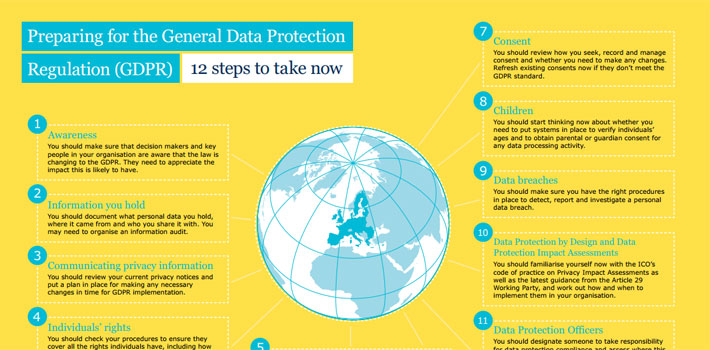
Like it or not, GDPR is going to impact all companies. As an example, consider the amount of personal data you hold on just your employees and LOSCs!
GDPR came into force in May 2016, with a two-year transition period becoming enforceable from 25 May 2018. The principles are very similar to EU Data Protection Directive, however, the GDPR contains a number of changes including:
- Enhanced documentation to be kept by data controllers
- Enhanced privacy notices
- More prescription rules on what constitutes consent
- Mandatory data breach notifications requirements
- Enhanced data subject rights
- New obligations on data processor
- Expanded territorial scope
- Appointment of Data Protection Officers
- Significant increase in the size of fines and penalties
What is covered by GDPR?
Both personal data and sensitive personal data are covered by GDPR. Personal data can be anything that allows a living person to be directly or indirectly identified. This may be a name, an address, or even an IP address. It includes automated personal data and can also encompass pseudonymised data if a person can be identified from it. Sensitive personal data encompasses genetic data, information about religious and political views.
Who enforces GDPR?
GDPR is governed by the Information Commissioners Office (ICO), which has the authority to enforce stiff fines for non-compliance. Before you panic, the ICO is not out to get you, and as long as you have shown due diligence if you fall foul of GDPR it will be understanding.
Who needs to be aware of GDPR in your company?
In the first instance, directors and senior managers need to be aware of GDPR and take steps to ensure that the company meets its obligations. This will then need to filter down to other members of your organisation to ensure they are following procedures.
What‘s next?
We would love to be able to give you a template/action plan to ensure you are compliant. However, how each company approaches GDPR will differ depending on the data the company processes and who has access. In the first instance, you will need to access where, and how, personal data you hold is being processed. This will dictate your action plan moving forward.
What is important is that you take action NOW!
Links
There is a huge amount of information out there relating to GDPR. Just a few of the links we have found useful can be found on the right.

by Nicky Smith | 30 Jan, 2018 | Main News Feed
During January, we welcomed four new companies to the FIS membership; Bournes of London Projects Ltd and Keylon Interiors Ltd are contractor members and we have two service providers – Endeavour Recruitment Services Limited and Chalkstring Limited.
We look forward to a long and successful relationship with our new and existing members going forward in 2018. A range of membership benefits, Special Interest Forums, events and publications are available in the FIS Membership Hub.
Look out for news from the President’s Lunch on 6 February!


by Nicky Smith | 22 Jan, 2018 | Main News Feed
Comments are invited on the final peer review of the Steel Construction Institute’s document Design and Installation of Light Steel External Wall Systems. All comments received will be collated and discussed at a meeting of the Steel Framed Systems forum in February/March 2018; please inform Dan Cook, FIS technical assistant, if you would like to attend: dancook@thefis.org
The document has already gone through two extensive reviews which can be read in ‘track changes’ here. If you would like to submit any comments they should be recorded here and returned to dancook@thefis.org no later than 19 February 2018.
The FIS Steel Framed System Forum can be found here.
If you have any questions please email joecilia@thefis.org

by Nicky Smith | 16 Jan, 2018 | Main News Feed
The main topics from January’s tax update include the news that The Chancellor of the Exchequer has announced that the first spring statement, where the government will respond to the forecast from the Office for Budget Responsibility (OBR), will be held on Tuesday 13 March.
If any business is unable to pay tax on time (because money due to the business has not been received) then HMRC must be contacted before the due date to ask for permission to pay late. HMRC will grant this if permission is sought BEFORE the due date.
Ahead of the reverse charge VAT – which will start in October 2019 – businesses should begin to focus on improving their cashflow control.
In 2017-18 Scottish taxpayers will pay the higher rate of tax (40%) when they earn £43,000 as opposed to £45,000 in the rest of the UK. HMRC is now trying to establish who Scottish taxpayers are and employers are asked to check and maintain a careful record of all changes of address for employees.
For more information, download the latest edition of the Joint Taxation Committee’s Newsline for January here.