
by Nicky Smith | 21 Dec, 2017 | Main News Feed
UPDATE – Deadline for submissions has been extended to Tuesday 6 February, 5pm.
FIS Skills has launched the new sector-wide digital Training Needs Analysis (TNA) for 2018.
We urge all FIS members to complete the TNA and submit by 6 February 2018. Submissions will provide evidence for the FIS Skills whitepaper on the overall skills need and workforce sustainability of our sector. All those completing the TNA will automatically receive a digital copy.
The skills team will be able to make year-on-year comparisons from the previous TNA results. This sector engagement process will continue up to 2020.
The result also allows the skills team to accurately forecast the demand needs for skills and technical qualifications required to meet your contractual obligations over the next financial year. To ensure we meet our membership’s reported demand and engage our supply chain of approved training providers and partners to fill demand, your response is critical.
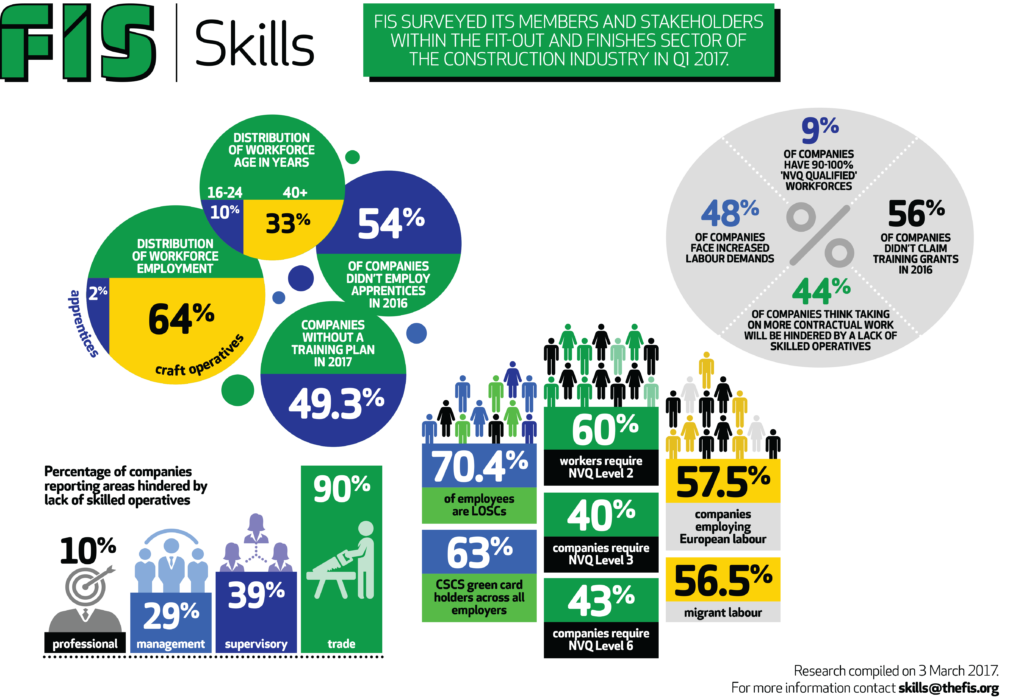
The infographic below highlights some of the key analysis findings of the TNA 2017.
General Information
• Ideally, this survey should be completed by the dedicated person in your organisation responsible for training and development planning, such as a training officer or human resources officer
• All responses for future forecasts should be accurate based on the date of return
• Your TNA returns will be held in confidence and in line with the FIS privacy and data protection policy
• The TNA has an inbuilt save function. You will be asked for your email address and a unique link will be sent to your address returning you to the last question you worked on
Should you require any assistance in completing any section(s) please contact the Project Manager Amanda Scott by email: amandascott@thefis.org where individual appointments can be booked. Amanda will be in touch with all members from 2 January onwards.

by Nicky Smith | 21 Dec, 2017 | Main News Feed
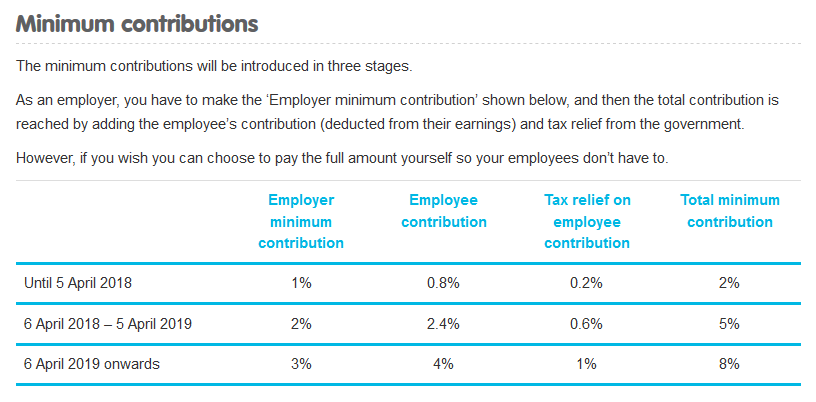
In line with the April 2018 change, The People’s Pension has confirmed that they will automatically increase the percentages for schemes that have been set up on the minimum contributions (1% employer, 1% employee and both based on ‘qualifying earnings’) and have just one worker group. This will ensure any communications sent to new members will comply with their increased minimum contributions.
If your scheme isn’t set up on the minimum contributions (eg different contribution rates, not based on qualifying earnings, with more than one worker group) then you will need to change the amounts manually in The People’s Pension Online Services. There will be more information available on how to make these changes in early 2018.
If your payroll software is assessing your workforce for you (and working out your contributions) you will need to speak to your payroll software provider to find out how they’ll make sure you remain compliant.
For more information, you can email your usual contact at The People’s Pension or the support team: support@bandce.co.uk

by Nicky Smith | 20 Dec, 2017 | Main News Feed
During December, we welcomed three new companies to the FIS membership. All three are Supplier Members: Bryson Products Ltd, Protektor UK Ltd and Tekfloor Limited.
We look forward to a long and successful relationship with our new and existing members going forward in 2018.

by Nicky Smith | 19 Dec, 2017 | Main News Feed
A consortium of more than 20 trade associations, including FIS, has written an open letter to the Daily Telegraph calling for an end to poor payment practices in construction.
“In the construction industry, clients and main contractors have traditionally withheld part of the payment owed to specialist contractors and builders for a period of time, ostensibly as security against defective work or risk of insolvency.
As trade associations and professional bodies representing many small- and medium-sized businesses, we want to highlight the following facts about this practice, known as cash retentions.
Some £10.5 billion of the overall construction sector turnover of £220 billion is held in retentions by clients and main contractors from small- and medium-sized businesses down the supply chain. An estimated £7.8 billion in retentions has been unpaid in the construction sector over the past three years, and in the same period, £700 million of retentions were lost due to upstream insolvencies.
Poor payment practices in construction affect productivity, innovation and investment, holding back the sector’s overall capacity to do business and invest in the workforce. Given that construction is a cornerstone of enterprise in Britain and fundamental to enhancing the country’s built environment, the problem of retentions cannot go on – it needs tackling as a priority.
There is, though, a simple way to reform the system. Regulations should specify that retentions must be held in a statutory retention deposit scheme (rather than in clients’ own bank accounts), an approach which is already being used successfully in Australia.
The Government consultation on retentions is still underway, but we believe that there is no longer any reason to stick with the status quo, or for this issue to be potentially kicked into the long grass again.
Reforming retentions would be a good way for the Government to show it is truly standing up for the interests of small- and medium-sized businesses, and is willing to put them at the forefront of plans for an industrial strategy and the expansion of the UK economy.”
The Daily Telegraph has published the letter online and also created a news story – Deposit protection scheme could provide boost for builders.
On behalf of the signatories, the letter will be shared with Business Secretary Greg Clark.

by Nicky Smith | 12 Dec, 2017 | Main News Feed
As part of the grant reform programme, CITB has now published a second set of training standards for your review. The standards for review and feedback forms can be found here. The consultation period will be open until 31 January 2018.
To help FIS get the best deal and right qualifications for our sector, we have a working group which you can join – contact Helen Yeulet via skills@thefis.org
CITB has recently concluded their consultation on the first set of training standards. The final versions are available to view online here.

by Nicky Smith | 12 Dec, 2017 | Main News Feed
The Department for Communities and Local Government (DCLG) published the first output from the Industry Response Group (IRG) on 11 December. It not only contains guidance for owners of high-rise buildings on what to do where the building is clad with Aluminium Cladding Material (ACM) but also provides guidance on compartmentation.
The Information Note is intended to assist building owners in assessing what measures they should consider taking to make their buildings safe. It contains a flowchart to guide building owners through the process of remediation and further information on the following:
-
- identifying and testing aluminium composite material (ACM) cladding systems
- checking broader fire safety of buildings
- progressing remedial works and maintenance
- durability and safety considerations if cladding has been removed
- professional advisors and where to find them
- building regulations and planning
- procurement of building work
The Industry Response Group consists of members from the Construction Industry Council, Build UK and the Construction Products Association; FIS is contributing to the CPA group.