
0121 707 0077

Nominations Open for Inspiring Change Awards 2025

Nominations Open for Inspiring Change Awards 2025

The countdown has begun for this year’s Inspiring Change Conference & Awards, and nominations are now open.

With new and exciting categories introduced for 2025, the awards are an opportunity to highlight the individuals, teams, and organisations within the finishes and interiors sector who are leading the way in Fairness, Inclusion, and Respect (FIR) across the built environment.

Deadline for nominations: Friday 13 June 2025

You can nominate a colleague, a project, or yourself. If you or someone you know is making a meaningful impact in fostering an inclusive, respectful, and fair workplace culture, we want to hear from you.

Award Categories Open for Nomination:

  • TfL FIR Ambassador of the Year Award

  • HS2 FIR Inspiration Award

  • National Highways FIR Innovator Award

  • Network Rail SME of the Year Award

Team-Selected Awards (not open for nomination):

  • FIR Learner of the Year Award

  • FIR Lifetime Achievement Award

  • Diversity Data Benchmarking (SME & Large Organisation)

Conference and Awards Ceremony Details:
Date: Tuesday 15 July 2025
Venue: Grand Connaught Rooms, London

These awards not only celebrate progress but also inspire further action across the construction sector. Limited spaces are available for the conference, so early registration is encouraged.

To learn more about the award categories, judging criteria, or to submit your nomination, visit here.

Let’s continue to inspire change, starting with your nomination. Thank you for helping us celebrate the champions of a more inclusive and progressive industry.

New Guidance Supports Contractors on Building Safety Compliance Ahead of CAS Deadline

New Guidance Supports Contractors on Building Safety Compliance Ahead of CAS Deadline

We have been working with a panel of industry experts to address organisational competence amongst contractors. This group has been instrumental in helping us produce building safety policy guidance for those who are accredited on a pre-qualification (PQQ) scheme equivalent to the Build UK Common Assessment Standard (CAS). This guidance should be a timely and meaningful intervention with the June deadline rapidly approaching for the Building Safety section of the CAS becoming mandatory.

It is vital members get on top of this because, whilst companies can currently opt out of the new questions and maintain accreditation, we have been advised the additional questions related to work in scope of the Building Safety Act will become mandatory from as early as the 9th June 2025. Added to this, they provide a good framework for challenging your internal processes.  FIS team ran through the questions with a group of members in early May and whilst most should be straightforward, we can provide additional advise based on this discussion and support. If you need any advice in the process, please call FIS on 0121 707 0077 or email info@thefis.org and we will direct you to the appropriate member of our team. If you have comments on the questions, FIS has been invited to join the drafting panel for future editions of the Common Assessment Standard, so please direct comments to jamesparlour@thefis.org.

As a final point FIS is always willing to follow-up requests for specific PQQ schemes as the Common Assessment Standard is designed to support interoperability and remove the need for duplication of accreditation efforts across multiple schemes (this is part of our Responsible No Campaign)                 

 The draft policy document can be found here

FIS Submits Member-Informed Response to Government’s Construction Products Reform Consultation

FIS Submits Member-Informed Response to Government’s Construction Products Reform Consultation

FIS responded on behalf if it’s members to the Government Consultation on their Construction Products Reform Green Paper. This paper details plans to increase the oversight of testing and conformity assessment bodies, third party product certification schemes, the role of the general product safety regulations in governing construction products not covered by an existing designated standard. The paper also consults on the introduction of digital product passports and environmental performance characteristics from the new EU Construction Products Regulations along with a suite of measures to enable reuse of construction products. The FIS gathered views from across our membership profile through our working groups and beyond, and we are incredibly grateful to all those who gave their time and expertise to inform a comprehensive response.

In the FIS response we have highlighted the need to review designer responsibility with producer responsibility to ensure key performance and compliance issues are addressed where interface and compatibility issues are essential to overall building performance.  The need to consider future life of materials and ensure regulation does not halt the growing market for product re-use and a more circular approach in its tracks.    We have also touched on the need to balance Intellectual Property consideration with transparency and support to ensure that the compliance environment works to encourage innovation and doesn’t create onerous compliance loops that limit opportunities to modernise methods of construction.  Availability of Standards and the balance a regulator needs to find with respect to robust enforcement and encouraging “black box thinking”.  

Thanks to all members who have shared their views and helped shape our response.  If you have additional views, this is not the end of the road an Government have committed to ongoing consultation around the key subjects raised in this Green Paper. 

The full text of our response can be found here:

Green Paper Consultation – FIS Response

Review the wider CPA response

The Construction Products Association has submitted its consolidated response to the Construction Products Reform Green Paper.

FIS has supported this response and members can review the submission here.

The submission is a consolidated high-level response from CPA Technical Committee, with input from the CPA Sustainability Committee on Chapter 10, and the Industry Competence Steering Group (ICSG) adding broad reference to the competency issues raised by the paper.

CITB achieves Consensus for its 2026-29 Levy Proposals

CITB achieves Consensus for its 2026-29 Levy Proposals

CITB has announced that 67% of construction employers have voted in favour of its Levy plans, after confirming that it achieved Consensus in support for its Levy Proposals that aim to help provide training for the construction industry across the next three years.

FIS was one of two Prescribed Organisations that were in disagreement with the Levy Proposals.

The result means that Levy rates are proposed to remain the same for 2026-29. The proposed Levy arrangements are:

  • PAYE: 0.35%
  • Net paid (Taxable) CIS Sub-contractors: 1.25%
  • Increase the Levy Exemption and Reduction Thresholds to £150,000 and £500,000.

If the employee payroll and Net paid (taxable) CIS subcontractors combined is less than £150,000, employers will not pay a Levy. If it is between £150,000 and £499,999, they will receive an automatic reduction of 50%. This approach was supported by a majority of employers at a recent consultation and means CITB will continue to support its smallest employers, so the Levy delivers for all.

FIS Head of Skills Beena Nana said:

After consultation with our members, FIS voted against the CITB levy proposals. Many of our members feel it isn’t delivering value, with little evidence of progress or meaningful impact on the key issues facing the sector, such as skills shortages, training, and workforce development.

FIS remains committed to supporting members by promoting skills development, and working with industry partners to ensure members can access the talent, support, and resources they need to thrive

CITB has now submitted the results to the Department for Education to ratify. Once ratified a new Levy Order can be raised.

Tim Balcon, CEO at CITB, said:

“Thank you to all employers who took part in the Consensus process.

“The Levy is designed to ensure that construction employers of all sizes feel supported with their skills and training needs. It plays a vital role in investing in the British construction industry, ensuring the development of a skilled workforce to meet the sector’s current and future demands.

“We are really pleased that Levy payers continue to be supportive of the Levy Proposals. We will now focus on delivering our Strategic Plan through which we aim to support at least 35,000 employers over the next four years and establish a simpler, more responsive skills and training system better aligned with industry needs.”

For more results information Consensus 2025.

Find out more about how your Levy will be invested in construction skills by exploring the Strategic Plan.

Start your Net Zero journey with a free assessment

Start your Net Zero journey with a free assessment

FIS has been working closely with the Supply Chain Sustainability School for over three years now. Together they have organised several webinars to showcase the great sustainability initiatives of the fit-out sectors. Topics have included reuse, circular economy, organisational carbon reporting or modern slavery. The Supply Chain Sustainability School has a huge amount of online resources which are freely available.

A couple of years ago, FIS members helped create a short e-learning course “An introduction to sustainability”. This course is aimed at those in our sector that have no or little knowledge of sustainability, but are keen to know more. Those that attend the course can be rewarded with CPD points.

More recently, the Supply Chain Sustainability School has been working on a tool to better assess the industry’s capability in sustainability. This new assessment is based on what the company is doing in sustainability rather than their knowledge. We would like to encourage our members to use this tool.  The plan longer term will be to use the tool to map our collective journey to net zero and help members benchmark their own efforts.

You can start your sustainability journey by registering with the Supply Chain Sustainability School to access lots of great resources (register here – Supply Chain Sustainability School). You can also assess your company’s capability here and calculate your organisational carbon footprint with this free tool, here: FREE carbon calculator for supply chains – Supply Chain Sustainability School

Visit the FIS Sustainability Toolkit for a full update on the work of FIS in this vitally important area.

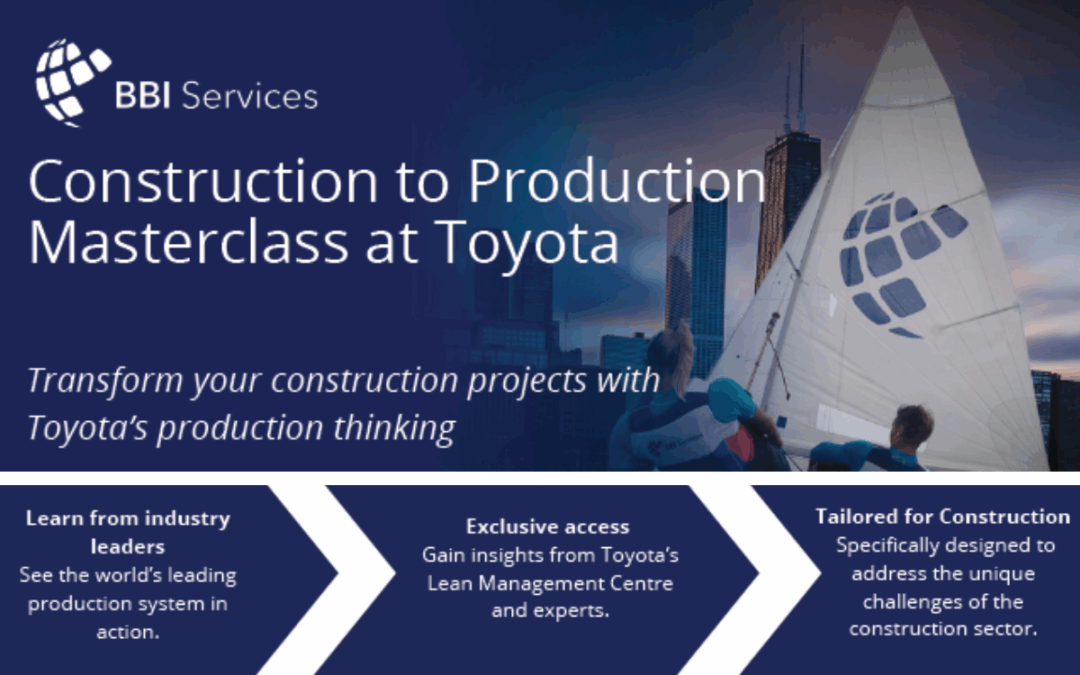
Construction to Production Masterclass

Construction to Production Masterclass

Transform your construction projects with Toyota’s production thinking.

The Construction to Production Toyota Masterclass is a one-day, high-impact programme designed specifically for Directors, Business Owners, and Operational Leaders in the construction industry. Hosted in collaboration with Toyota at the Deeside Engine Plant, the masterclass provides a rare opportunity to see Toyota’s Production System (TPS) in action and learn how to apply these principles to overcome common construction challenges.

Why attend?

  • Learn from industry leaders – see the world’s leading production system in action
  • Exclusive access – Gain insights from Toyota’s Lean Management Centre and experts
  • Tailored for Construction – specifically designed to address the unique challenges of the construction sector.

Full details are available here. There are just two spaces remaining on the one-day course on 29 May.

The cost to attend is £495 and funding is available through the Employer Network funding of up to 70%. If you are interested in signing up, call: 07973 705018, email: contact@bbiservices.com or visit: www.bbiservices.com for details.

Further courses are planned for later in the year.

FIS Members vote “No” to CITB Levy proposals

FIS Members vote “No” to CITB Levy proposals

1Following a vote of the FIS membership on the level of money proposed to be collected for the construction industry levy by the Construction Industry Training Board (CITB), FIS has voted against the CITB proposal.  A full report has been provided to CITB documenting the result and delivering direct feedback from the community.

The Construction Industry Levy is collected and distributed by CITB in a process governed by the Industrial Training Act.  FIS, as a CITB Prescribed Organisation according to the Act, are required to consult with Levy paying members of FIS through the defined process and respond collectively on their behalf.

The proposals for raising and collecting the Levy for the next 3 years (2026 – 2029) were

  • 0.35% on PAYE staff
  • 1.25% on Net paid (taxable) CIS sub-contractors

Employers with an annual wage bill of less than £150k will be exempt and employers with an annual wage bill of between £150k and £500k will receive a 50% deduction on the Levy assessment, meaning employers will only pay the full assessment if their annual wage bill is £500k or above.

FIS Chief Executive Iain McIlwee stated: “This vote is a clear indication that the levy is not working for the majority of our members, that they have not seen enough improvement since the last consensus vote and do not have confidence that the proposed CITB Strategic Plan will do enough to shift the dial.

The skills issue is perhaps the biggest challenge facing construction and any levy designed to alleviate this can only be judged by results.  Members are simply not seeing the flow of people, the availability and quality of qualification provision and access to the wider training they need, particularly to support the high levels of contingent workforce necessitated by procurement practices in the sector.”

FIS is one of 14 consensus organisations and the vote will be considered in line with others.  The overall outcome of the consensus process is expected to be communicated by CITB to the industry after consultation with government over the summer.

Whatever the final outcome, FIS will continue to help members to utilise levy paid where appropriate through the one-to-one FIS Skills Clinics. If any member would like help in understanding what grant claims they are eligible for, Marie Flinter, FIS Skills and Training Advisor will be able to provide support.

For further information or for any questions please contact FIS at info@thefis.org or call 0121 707 0077.

Modern methods of construction in new-build residential properties

Modern methods of construction in new-build residential properties

The BSI has published PAS 8700, sponsored by MHCLG, to standardise and streamline the use of modern methods of construction (MMC) in new-build residential properties. It covers project set up, design, information management, delivery and assembly, and maintenance and repair.

This PAS sets out the process for the effective deployment of modern methods of construction (MMC) in residential development to improve stakeholder understanding and realise the benefits of MMC. As the sector has significantly evolved and matured, there is a need for greater consistency and comparability to increase the use of MMC.